
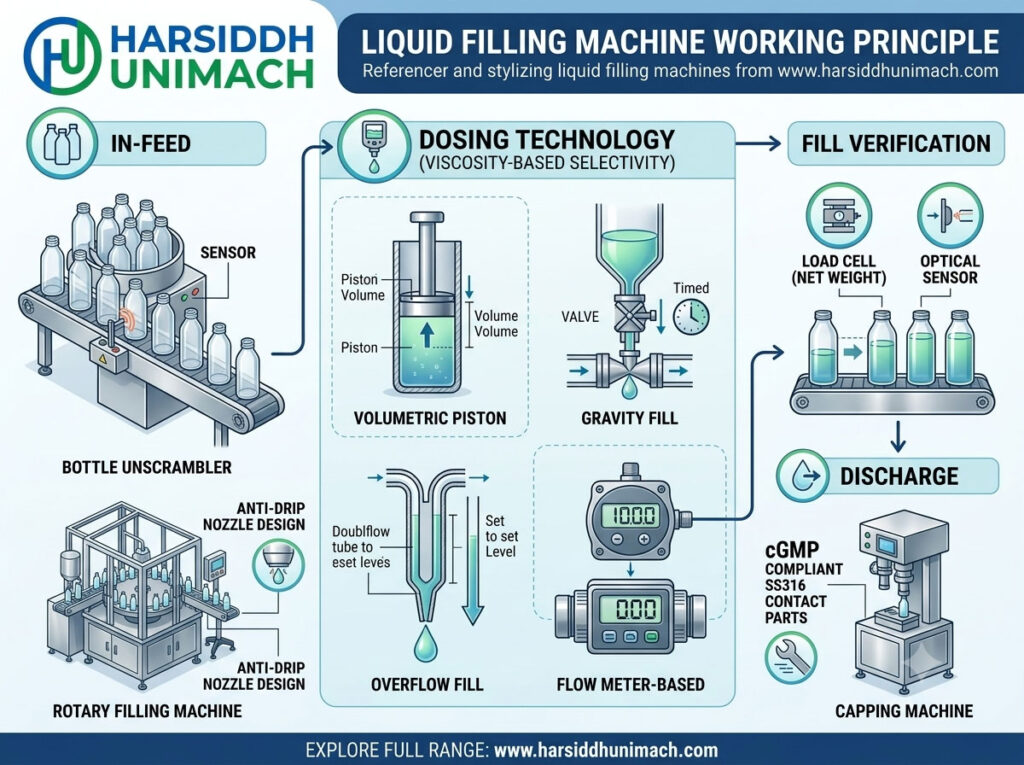
At its heart, every liquid filling machine does the same thing: it measures a dose of liquid and delivers it into a container, cleanly and accurately, then passes the container on to be closed. Yet a filler for 1 ml ampoules looks nothing like a filler for 5-litre cans, and a vial filler in a sterile suite works very differently from a pouch filler in a food plant.
The reason is the container. Its size, shape, material, opening and closure all shape how the basic working principle is applied in practice. This article explains the core principle briefly, then shows how it adapts to the main container types used in pharmaceutical, cosmetic, food and chemical production.
If you want a detailed explanation of the core mechanisms first, read liquid filling machine working principle explained. For a step-by-step look at a filling cycle, see how does a liquid filling machine work: step-by-step process.
The Core Principle in Brief
Every liquid filler has four functions:
- Supply – liquid is held in a tank or hopper and supplied to the dosing system.
- Measure – the dose is controlled by volume (piston, pump, time-pressure), by level (overflow), by flow (flow meter) or by weight (load cell).
- Deliver – the liquid passes through a nozzle or needle into the container, with a clean cut-off.
- Handle – the container is positioned, filled and moved on to closing.
What changes from container to container is how each function is carried out.
How the Container Shapes the Filling Machine
| Container Factor | Effect on the Filler |
|---|---|
| Fill volume | Determines pump size, number of heads and filling time |
| Opening size | Determines nozzle or needle size and whether diving is possible |
| Material | Glass needs gentle handling; plastic may flex or tip |
| Stability | Unstable containers need pucks, pockets or holders |
| Sterility requirements | Sterile containers need aseptic design and contamination control |
| Closure type | Determines what machine follows the filler |
1. Bottles
Bottles are the most common liquid container, used for syrups, oral liquids, lotions, shampoos, oils and many other products.
How the principle applies
- Handling – bottles travel upright on conveyors. Linear machines hold a group of bottles under several nozzles; rotary machines carry bottles continuously in star wheels.
- Dosing – piston pumps are most common for pharmaceutical liquids; servo pistons add digital control. Gravity, overflow, pump and flow meter fillers are used for specific products.
- Delivery – diving nozzles enter the bottle and rise as it fills, reducing foam. Drip control keeps necks clean.
- Closing – screw caps, ROPP caps, pumps, triggers or flip-tops, often followed by induction sealing.
See the volumetric liquid bottle filling machine, the liquid bottle filling and capping machine (monoblock) and the bottle filling machines for oral liquids.
2. Vials
Vials hold injectable liquids and must be filled under strict aseptic conditions.
How the principle applies
- Handling – sterile vials come from the depyrogenation tunnel onto a turntable, then into star wheels or indexing systems that hold them precisely under filling needles.
- Dosing – piston pumps, servo-driven pistons or peristaltic pumps, with high accuracy for small volumes. Peristaltic systems keep the product inside tubing for easy cleaning and low cross-contamination risk.
- Delivery – fine needles enter the vial neck, often rising during filling to avoid foaming. Nitrogen purging may protect oxygen-sensitive products.
- Closing – rubber stoppers inserted immediately after filling, followed by aluminium cap sealing.
- Environment – unidirectional airflow and, increasingly, barrier systems around filling and stoppering.
See the Automatic Injectable Liquid Vial Filling and Stoppering Machine and the liquid vial filling machine with rubber stoppering.
3. Ampoules
Ampoules are glass containers sealed by flame after filling.
How the principle applies
- Handling – ampoules from the tunnel are fed into a tray or infeed and indexed under filling needles in groups (single to eight heads).
- Dosing – piston or peristaltic pumps deliver small, precise volumes.
- Delivery – needles enter the narrow neck; nitrogen may be purged before and after filling. Drip control is critical, because liquid on the neck spoils the seal.
- Closing – the neck is heated by gas-oxygen burners and sealed, by pulling for open ampoules or by tip sealing for closed ampoules.
See the eight head ampoule filling and sealing machine.
4. Pre-Filled Syringes and Cartridges
Pre-filled syringes (PFS) are a growing format for injectables, offering convenience and accurate dosing for patients.
How the principle applies
- Handling – syringes are often supplied nested in tubs; the machine removes them from the nest or fills them in place.
- Dosing – precise pumps deliver small volumes with very tight accuracy requirements.
- Delivery – fine needles fill the barrel without wetting areas where the plunger stopper will seal.
- Closing – a plunger stopper is placed, often using vacuum or vent-tube methods to minimise the air bubble.
- Environment – aseptic, frequently inside barrier systems.
See the Automatic Pre-Filled Syringe (PFS) Filling and Stoppering Machine and the pre-filled syringe filling and stoppering machine.
5. Jars and Wide-Mouth Containers
Jars hold thicker liquids, gels and semi-liquids such as honey, sauces, creams and balms.
How the principle applies
- Handling – jars are stable and travel upright on conveyors.
- Dosing – piston or gear pumps handle thick products; heated hoppers may be used for products filled warm.
- Delivery – larger nozzles; filling may start low and rise for a smooth, level surface.
- Closing – screw lids or lug caps, sometimes with an inner seal.
For thick products, read our high viscous liquid filling machine working principle and see the lotion and gel filling machine.
6. Spout Pouches
Spout pouches are flexible packages with a rigid spout and cap, used for juices, baby food, detergents, sauces and some personal care products.
How the principle applies
- Handling – pouches are held by their spouts on a rail or in clamps, since the flexible body cannot support itself.
- Dosing – piston or pump fillers deliver the dose through the spout.
- Delivery – the nozzle seals onto or enters the spout; flow must be controlled to avoid foaming and spills in a flexible container.
- Closing – a cap is screwed onto the spout.
See the Automatic Spout Pouch Filling Machine and the spout pouch filling machine.
7. Larger Containers: Cans, Jerrycans and Big Bottles
Edible oils, lubricants, chemicals and disinfectants are often filled into larger containers.
How the principle applies
- Handling – heavy containers need robust conveyors and stable positioning.
- Dosing – servo piston, gear pump, flow meter or net-weight filling; weight-based filling is common for large volumes.
- Delivery – larger nozzles, sometimes diving, with drip trays to keep containers clean.
- Closing – screw caps, often with induction seals or tamper bands.
See the Automatic Edible Oil Filling Machine and the servo based oil and viscous filling machine.
8. Dropper Bottles for Eye, Ear and Nasal Drops
Small dropper bottles, often made of LDPE, hold eye drops, ear drops and nasal solutions. Ophthalmic products in particular must be sterile.
How the principle applies
- Handling – small, light plastic bottles are unstable, so they are often carried in pucks or star wheel pockets.
- Dosing – peristaltic or precision piston pumps deliver small volumes accurately.
- Delivery – fine nozzles fill through the narrow neck without wetting the area where the dropper plug will sit.
- Closing – a nozzle insert (dropper plug) is pressed in, then a cap is screwed on. Some machines combine filling, plugging and capping in one unit.
- Environment – aseptic conditions for sterile eye drops.
Container-Specific Challenges and Solutions
| Challenge | Container Examples | Typical Solution |
|---|---|---|
| Containers tipping over | Small plastic bottles, dropper bottles | Pucks, pockets, side belts |
| Foaming during filling | Bottles, pouches with surfactant products | Diving nozzles, slow fill start |
| Narrow openings | Ampoules, vials, dropper bottles | Fine needles, accurate centring |
| Glass breakage | Ampoules, vials, glass bottles | Gentle transfers, correct change parts |
| Flexible containers | Pouches | Holding by spout, controlled flow |
| Heavy containers | Cans, jerrycans | Robust conveyors, weight-based filling |
| Sterility | Vials, ampoules, PFS, eye drops | Aseptic design, barriers, sterilisable parts |
| Thick products | Jars, tubes, large containers | Piston or gear pumps, heated hoppers |
Changeover Between Container Sizes
Many plants fill several container sizes on the same machine. Changeovers typically involve:
- Changing guides, star wheels, pucks or holders for the new container
- Changing nozzles or needles to suit the opening
- Setting the new fill volume, by stroke adjustment or recipe
- Adjusting nozzle height and diving depth
- Adjusting downstream closing equipment
- Running test containers and checking fill accuracy
Servo-driven machines with stored recipes and quick-release change parts make changeovers faster and more repeatable. Our article on liquid filling machine changeover time explains engineering methods to shorten them.
Summary: Container vs Filling Approach
| Container | Typical Dosing | Delivery | Closing | Environment |
|---|---|---|---|---|
| Bottles | Piston, servo piston, gravity, pump | Diving nozzles | Caps, pumps, ROPP | Clean production area |
| Vials | Piston, servo piston, peristaltic | Needles | Stopper + aluminium seal | Aseptic |
| Ampoules | Piston, peristaltic | Needles | Flame sealing | Aseptic or controlled |
| Pre-filled syringes | Precise pumps | Fine needles | Plunger stopper | Aseptic, often barrier |
| Jars | Piston, gear pump | Large nozzles | Screw or lug lids | Clean production area |
| Spout pouches | Piston, pump | Through spout | Spout cap | Clean production area |
| Large containers | Servo piston, pump, weight | Large nozzles | Caps | Industrial |
Browse all our liquid filling machines to find the right solution for your container.
Filling Accuracy Expectations by Container
Accuracy expectations differ with the container and product. Small-volume injectables in vials, ampoules and syringes usually demand very tight control, because each container holds a single dose and the allowable variation is small relative to the fill. Larger bottles and containers for oral liquids, cosmetics and foods also require accuracy, mainly to meet declared quantity rules without wasteful overfilling. In every case, the fill target and limits should be defined in your product specification and checked regularly during production, and the filling technology should be chosen and validated to meet them reliably.
Common Principles Across All Containers
Whatever the container, the same good practices apply:
- Stable supply – constant level, temperature and pressure in the supply tank
- Accurate dosing – the right technology for the product and volume
- Clean delivery – no drips, splashes or foam on necks and sealing areas
- Gentle handling – especially for glass and unstable containers
- Safeguards – no container, no fill
- Regular checks – fill weight or volume checks with trending
- Easy cleaning and changeover – smooth surfaces, quick-release parts, recipes
How to Choose a Liquid Filling Machine for Your Container
- Container type and size range
- Product properties – viscosity, foaming, solids, sterility needs
- Fill volume range and required accuracy
- Output and number of heads
- Dosing technology suited to product and container
- Closing method and downstream machines
- Environment – aseptic, clean or industrial
- Changeover frequency and cleaning requirements
Frequently Asked Questions
What is the basic working principle of a liquid filling machine? It supplies liquid from a tank, measures a dose by volume, level, flow or weight, delivers it through a nozzle or needle into the container, and passes the container on to be closed.
Why do filling machines differ so much between containers? Because container size, opening, material, stability, closure and sterility requirements all change how liquid must be handled and delivered.
Which dosing method is used for vials and ampoules? Usually piston, servo piston or peristaltic pumps, chosen for accuracy at small volumes and ease of cleaning.
How are pouches filled? Spout pouches are held by the spout and filled through it with a piston or pump filler, then capped.
Which method suits large containers? Servo pistons, pumps, flow meters or weight-based filling, depending on product and accuracy needs.
Need a liquid filling machine for your container? Contact our team or send an inquiry with your container, product and output details.