
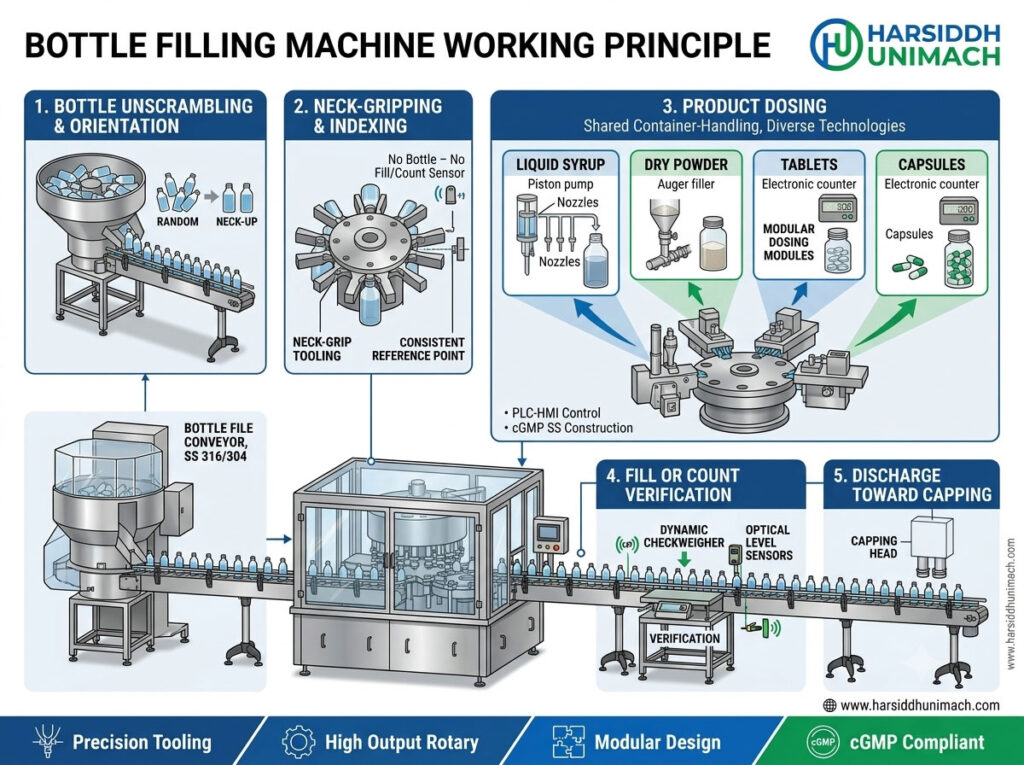
Walk into any pharmaceutical, cosmetic, food or chemical plant that makes liquids, and you will almost certainly find a bottle filling machine at the heart of the line. Syrups, oral suspensions, tonics, lotions, shampoos, oils, sanitisers, disinfectants and many more products are filled into bottles of glass, PET, HDPE and other plastics, in sizes ranging from small sample bottles to large family packs.
A bottle filling machine takes empty bottles and fills each one with an accurate dose of liquid, quickly and cleanly, ready for capping. Although the core idea is simple, the details, from how bottles are handled to which dosing technology is used, make a big difference to accuracy, speed and product quality.
In this article, we explain how bottle filling machines work: how bottles are prepared and positioned, how the dose is measured and delivered, how linear and rotary machines differ, how the filler fits into a complete bottle line, and how to set up and troubleshoot the process. For an overview of how filling adapts to other containers such as vials, ampoules and pouches, see our liquid filling machine working principle.
The Bottle Filling Process at a Glance
- Bottle feeding – empty bottles are oriented and placed on a conveyor.
- Bottle cleaning – bottles are washed or air-cleaned.
- Positioning – bottles are stopped or indexed under the filling nozzles.
- Filling – a measured dose is delivered into each bottle.
- Drip control – the nozzle stops cleanly with no drips on the neck.
- Release – filled bottles move on to capping.
Step 1: Bottle Feeding
Empty bottles arrive in bulk, usually in bags or cartons. A bottle unscrambler orients them upright and places them on the conveyor in a single line. This saves labour and gives the filler a steady supply. See the Automatic Bottle Unscramblers and the bottle unscrambler.
Step 2: Bottle Cleaning
Before filling, bottles must be clean:
- Washing – water and air jets clean the inside and outside of bottles; common for glass bottles and some pharmaceutical liquids. See the Automatic Linear Bottle Washing Machine and the linear bottle washing machine.
- Air-jet and vacuum cleaning – inverted bottles are blown with filtered or ionised air while loose particles are extracted; suitable for new plastic bottles and dry products. See the automatic bottle air-jet and vacuum cleaning machine.
Step 3: Positioning Bottles Under the Nozzles
How bottles are positioned depends on the machine design.
Linear (inline) fillers
Bottles travel on a straight conveyor. Entry and exit gates (pneumatic stoppers) hold a group of bottles, for example four, six, eight or more, directly under a row of nozzles. Sensors confirm every position is occupied before filling begins. After filling, the exit gate opens, the filled group moves on and the next group enters.
Rotary fillers
Bottles are fed by an infeed worm and star wheel onto a rotating carousel. Each bottle travels under its own nozzle, which fills it as the carousel turns. Filling is continuous, without stopping and starting.
Step 4: Measuring and Delivering the Dose
The dosing technology is the core of the working principle. The main options for bottles are:
Piston (volumetric) filling
A piston draws liquid into a cylinder, then pushes the same volume out through the nozzle. Fill volume is set by the piston stroke. Piston filling handles a wide viscosity range, from thin liquids to thick syrups and lotions, and is the most common method for pharmaceutical oral liquids. See the volumetric liquid bottle filling machine.
Servo piston filling
Each piston is driven by a servo motor, so fill volume is set digitally, individual heads can be trimmed, speed profiles reduce foaming and recipes speed up changeovers. See the Automatic Servo Based Liquid Filling Machine.
Gravity filling
Liquid flows from an elevated tank through timed valves. Simple and economical for thin, free-flowing liquids, but sensitive to changes in viscosity and tank level.
Overflow (level) filling
The nozzle seals on the bottle neck and fills to a set level, with excess liquid returning to the tank. Every bottle shows the same visible fill level, which suits clear bottles of thin liquids, even if bottle volumes vary slightly.
Pump filling
Gear, lobe or peristaltic pumps deliver liquid continuously, with the dose set by revolutions or time. Useful for viscous products or large volumes.
Flow meter and weight filling
Flow meters measure the liquid as it passes; weight fillers stop when the bottle reaches the target weight. These suit high-value products or large containers.
| Technology | Dose Controlled By | Best For |
|---|---|---|
| Piston | Stroke volume | Most pharmaceutical liquids, syrups, lotions |
| Servo piston | Programmed stroke | Multi-product lines needing precision and flexibility |
| Gravity | Time | Thin, free-flowing liquids |
| Overflow | Fill level | Clear bottles, thin liquids, cosmetic appearance |
| Pump | Revolutions or time | Viscous products, larger volumes |
| Flow meter / weight | Measured volume or mass | High-value products, large containers |
Step 5: Nozzles and Drip Control
How the liquid enters the bottle matters as much as how it is measured.
Diving nozzles
Nozzles descend into the bottle, often close to the bottom, and rise as the bottle fills, keeping the tip just below the liquid surface. This bottom-up filling reduces foaming and splashing.
Drip control
When the dose is complete, the nozzle must stop cleanly. Machines use:
- Suck-back – a small reverse movement of the piston pulls liquid back into the nozzle
- Shut-off nozzles – a valve closes at the nozzle tip
- Drip trays – swing under the nozzles between fills
Clean necks are essential for good capping, induction sealing and label adhesion.
Step 6: Release to Capping
Filled bottles leave the filler and move to the capper. On monoblock machines, filling and capping take place on the same frame, reducing transfers and floor space. See the Automatic Liquid Bottle Filling and Capping Machine (Monoblock) and the liquid bottle filling and capping machine (monoblock).
Linear vs Rotary Bottle Fillers
| Feature | Linear Filler | Rotary Filler |
|---|---|---|
| Bottle motion | Intermittent (stop-fill-go) | Continuous |
| Output | Low to medium-high | Medium to high |
| Flexibility | High; easy to change bottle sizes | Lower; more change parts |
| Footprint | Compact | Larger |
| Investment | Lower | Higher |
| Best for | Multi-product plants, varied bottles | Dedicated high-volume products |
The Complete Bottle Filling Line
A typical automatic line for pharmaceutical oral liquids includes:
- Bottle unscrambler
- Bottle washing or air-jet cleaning
- Bottle filling
- Capping – ROPP or screw caps, for example on a bottle screw and ROPP capping machine. For the capping process, read our bottle capping machine working principle.
- Measuring cup placement (for many syrups)
- Induction sealing – on an induction sealing machine
- Labelling – read our bottle labeling machine working principle
- Inspection, cartoning and packing
Browse the bottle filling machines for oral liquids.
Bottle Filling for Different Products
- Syrups and suspensions – piston fillers with stirred supply tanks; see our liquid syrup filling machine working principle
- Lotions, shampoos and gels – piston or servo piston fillers with diving nozzles to control foam; see our lotion filling machine working principle and the cosmetic bottle filling machine
- Oils – piston, pump or weight fillers, depending on viscosity and bottle size
- Thin liquids and sanitisers – piston, gravity or overflow fillers
- Chemicals – fillers with suitable materials of construction and safety features
Glass vs Plastic Bottles in Filling
| Aspect | Glass Bottles | Plastic Bottles (PET, HDPE) |
|---|---|---|
| Stability on conveyor | Heavy and stable | Light, can tip at speed |
| Handling | Avoid impacts and glass-to-glass contact | Avoid squeezing, which changes volume |
| Cleaning | Often washed with water | Often air-jet cleaned when new |
| Neck tolerances | Usually tight | Can vary with moulding |
| Typical products | Pharmaceutical syrups, some oils | Oral liquids, cosmetics, household products |
Plastic bottles may need side belts or guides to keep them upright, especially when nozzles dive into them. Glass bottles need smooth transfers and correct change parts to avoid breakage.
Changeover Between Bottle Sizes and Products
On multi-product lines, quick and controlled changeovers keep output high. A typical changeover involves:
- Line clearance of bottles and materials from the previous batch
- Cleaning the supply tank, pumps, valves and nozzles
- Changing nozzles and bottle guides for the new bottle
- Adjusting gate positions and nozzle height
- Setting the new fill volume by stroke adjustment or recipe
- Running test bottles and confirming fill accuracy from every head
Servo machines with stored recipes and quick-release parts make changeovers faster and more repeatable.
Key Settings and Their Effects
| Setting | What It Controls | Effect If Wrong |
|---|---|---|
| Fill volume (stroke or recipe) | Dose per bottle | Under- or overfilled bottles |
| Number of heads in use | Output | Mismatch with capper and labeller |
| Gate timing | Bottle positioning | Bottles misaligned under nozzles |
| Nozzle diving depth | Where filling starts | Foam if too shallow; contact with bottom if too deep |
| Nozzle rise speed | Bottom-up filling | Foam or air entrapment |
| Filling speed profile | Flow rate | Splashing, foaming, slow output |
| Suck-back or shut-off | Drip control | Wet necks, poor capping and labelling |
| Supply tank level | Stable dosing | Air drawn into pumps |
Troubleshooting Common Bottle Filling Problems
| Problem | Likely Cause | Corrective Action |
|---|---|---|
| Foaming and overflow | Filling from the top, high speed | Use diving nozzles, slow the start of fill |
| Fill variation between heads | Worn seals, air in pump | Service pumps, bleed air, trim heads |
| Fill drifting over the shift | Supply level or temperature changes | Stabilise supply tank |
| Wet bottle necks | Weak drip control | Increase suck-back, use shut-off nozzles |
| Bottles not positioned correctly | Gate timing, wrong guides | Adjust gates, fit correct change parts |
| Bottles tipping over | Light bottles, conveyor speed | Adjust guides, reduce conveyor speed |
| Nozzles missing bottle necks | Misalignment | Realign nozzles with bottle positions |
Maintenance Tips
- Inspect piston seals, valves and O-rings regularly.
- Clean the supply tank, pumps, valves and nozzles thoroughly between batches.
- Check gate cylinders and sensors.
- Keep nozzle sets and change parts labelled for each bottle size.
- Verify fill accuracy at start-up and at regular intervals.
How to Choose a Bottle Filling Machine
- Product – viscosity, foaming, suspended solids
- Bottle types and sizes
- Fill volume range and accuracy needs
- Output – number of heads, linear or rotary
- Dosing technology – piston, servo piston, gravity, overflow or pump
- Changeover frequency
- Integration with unscrambler, washer, capper, sealer and labeller
- GMP and documentation
Frequently Asked Questions
What is the working principle of a bottle filling machine? Bottles are positioned under nozzles, a measured dose of liquid is delivered into each bottle, usually by piston pumps, and the nozzles stop cleanly before the filled bottles move on to capping.
Which filling technology is most common for bottles? Piston filling is widely used, especially for pharmaceutical liquids, because it handles a range of viscosities and gives consistent volumes.
What is the difference between linear and rotary bottle fillers? Linear fillers fill groups of stationary bottles on a straight conveyor; rotary fillers fill bottles continuously as they travel around a carousel.
How do bottle fillers prevent foaming? With diving nozzles that fill from the bottom up and gentle speed profiles at the start and end of each fill.
What is a monoblock bottle filling machine? A machine that combines filling and capping on one frame to save space and reduce bottle transfers.
Planning a bottle filling line? Contact our team or send an inquiry with your product, bottle sizes and output targets.