
Hand sanitizers became an everyday essential and remain a staple in hospitals, clinics, offices, schools, homes and travel bags. They are sold as liquid sanitizers in spray and flip-top bottles, as gel sanitizers in pump bottles and squeeze tubes, and in large refill containers for dispensers. Most are alcohol-based, while some use non-alcohol actives.
Sanitizers look simple, but they bring specific filling challenges. Alcohol evaporates quickly and is flammable. Gels are viscous and trap air bubbles that show clearly in transparent bottles. Some formulations foam. And sanitizers are often filled in large volumes with frequent changes between bottle sizes.
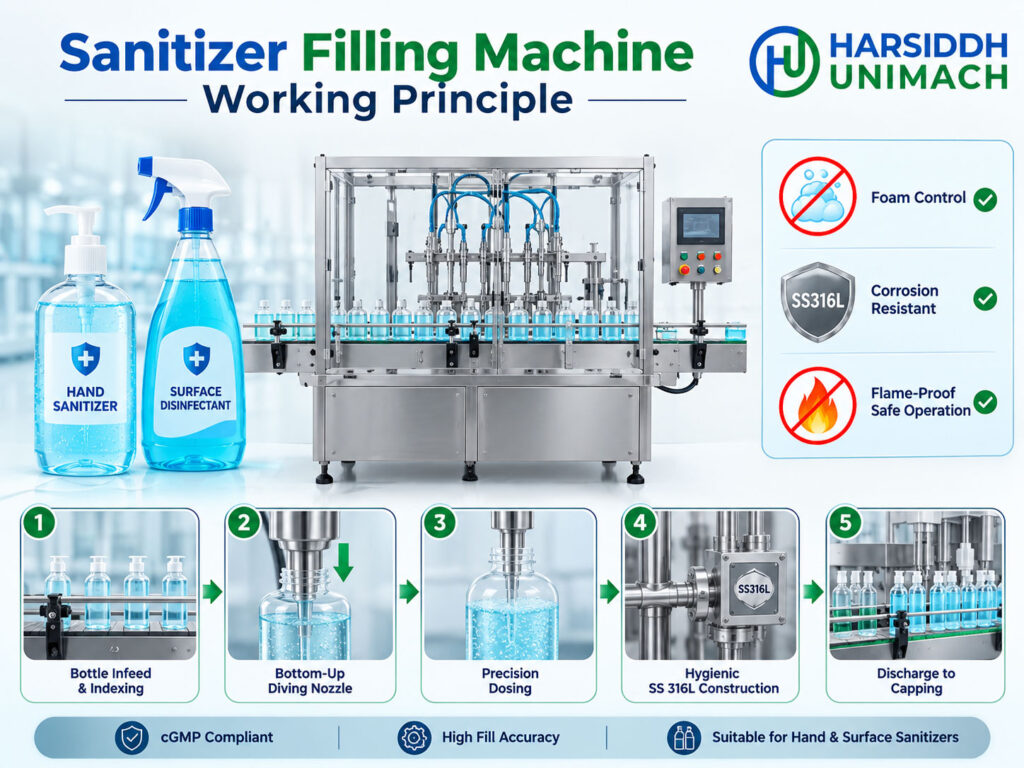
A sanitizer filling machine is designed to handle these challenges. In this article, we explain how sanitizer fillers work, which dosing methods suit liquids and gels, how to control foam, evaporation and air bubbles, what safety and material considerations apply, and how the filler fits into a complete line.
Types of Sanitizer Products
| Product | Typical Characteristics | Filling Considerations |
|---|---|---|
| Alcohol liquid sanitizer | Thin, volatile, flammable | Evaporation, flammability, splashing |
| Alcohol gel sanitizer | Viscous, clear, flammable | Air bubbles, stringing, flammability |
| Non-alcohol sanitizer | Water-based, may foam | Foaming, drip control |
| Surface disinfectant | Thin liquid, may contain chemicals | Material compatibility, splashing |
| Refill packs | Large volumes | Fill speed, weight or volume control |
The Core Working Principle
Most sanitizer fillers work on the volumetric principle:
- Sanitizer is held in a supply tank and fed to the dosing system.
- A piston pump (or other positive displacement pump) draws a fixed volume.
- The pump pushes that volume through a nozzle into the bottle.
- A cut-off system stops the flow cleanly.
- The filled bottle moves on to capping.
Fill volume is set by the piston stroke, or digitally on servo machines. Because volumetric dosing measures volume directly, it handles both thin liquids and viscous gels with consistent results.
Other dosing methods
- Gravity filling – for thin liquid sanitizers in simple applications
- Overflow filling – fills clear bottles to a uniform visible level
- Gear or lobe pump filling – for gels and larger volumes
- Flow meter or weight filling – for large refill containers
For a broader comparison, read liquid filling machine technologies compared.
Main Components of a Sanitizer Filling Machine
- Supply tank – stores sanitizer, ideally closed to limit evaporation, with a level sensor.
- Piston pumps or other dosing pumps – one per filling head.
- Valves – switch pumps between suction and delivery.
- Filling nozzles – often diving nozzles with shut-off tips.
- Bottle conveyor – carries bottles through the machine.
- Entry and exit gates – hold groups of bottles under the nozzles.
- Bottle sensors – “no bottle, no fill” and counting.
- Drip tray – catches residual drops between fills.
- Control panel – sets volume, speed and number of heads.
- Frame and enclosure – with materials and electrical design suited to the product and environment.
Step-by-Step Filling Process
Step 1: Bottle feeding
Empty bottles are fed onto the conveyor, usually by a bottle unscrambler, and travel upright to the filler.
Step 2: Positioning
On a linear filler, gates hold a group of bottles under the nozzles. Sensors confirm every position is occupied.
Step 3: Nozzle diving
Nozzles descend into the bottles, often near the bottom. This is especially important for gels and foaming liquids, because filling below the surface prevents air entrapment and foam.
Step 4: Dosing
The pistons push sanitizer into the bottles while the nozzles rise with the liquid level. Speed profiles, slower at the start and end, help reduce splashing for liquids and air bubbles for gels.
Step 5: Cut-off
Shut-off nozzles or suck-back stop the flow cleanly. Gels tend to string, so positive shut-off is particularly valuable. Clean necks are essential for good capping and labelling.
Step 6: Release
The exit gate opens, filled bottles move to capping and the next group enters.
Liquid vs Gel Sanitizer Filling
| Aspect | Liquid Sanitizer | Gel Sanitizer |
|---|---|---|
| Viscosity | Thin | Medium to high |
| Main challenge | Evaporation, splashing | Air bubbles, stringing |
| Nozzle type | Standard or diving | Diving, with positive shut-off |
| Fill speed | Fast | Controlled, to avoid bubbles |
| Common containers | Spray bottles, flip-top bottles | Pump bottles, squeeze bottles, tubes |
| Appearance check | Fill level | Clarity, no visible bubbles |
For more on handling gels and lotions, read our lotion filling machine working principle.
Special Considerations for Alcohol-Based Sanitizers
Evaporation
Alcohol evaporates quickly. Open tanks and long exposure times can reduce alcohol content and create vapours in the filling room. Good practice includes:
- Closed or covered supply tanks
- Short product paths and minimal open surfaces
- Capping bottles promptly after filling
- Good room ventilation
Flammability and safety
Alcohol-based sanitizers are flammable liquids. Filling them safely requires attention to:
- Electrical design suited to the area classification where flammable vapours may be present
- Earthing and bonding of tanks, machines and containers to prevent static discharge
- Ventilation to keep vapour concentrations low
- Avoiding ignition sources near the filling area
- Storage limits for bulk alcohol and finished product
Requirements depend on local regulations, the product’s alcohol content and the plant layout. Manufacturers should assess the risks with qualified safety professionals and specify machinery accordingly.
Material compatibility
Alcohol and some sanitizer ingredients can attack certain plastics, rubbers and seals. Contact parts, hoses and seals must be compatible with the specific formulation to avoid swelling, leaks or contamination.
Sanitizer Filling Machines from Harsiddh
- Automatic Sanitizer Filling Machine
- Automatic Gel Filling Machine
- Automatic Disinfectant Filling Machine
- Automatic Dishwash Liquid Filling Machine for related household liquids
- Lotion and gel filling machine
- Cosmetic bottle filling machine
- Volumetric liquid bottle filling machine
- Liquid bottle filling and capping machine (monoblock)
Browse all our liquid filling machines.
The Complete Sanitizer Filling Line
- Bottle unscrambler – orients and feeds bottles
- Bottle air cleaning (optional)
- Sanitizer filling
- Capping – pumps, triggers, flip-top caps or screw caps
- Induction sealing (optional) – for leak protection during transport, using an induction sealing machine
- Labelling – front and back labels on flat or oval bottles, for example on a double side flat bottle sticker labeling machine
- Coding, inspection and packing
Capping sanitizer bottles
Sanitizer bottles use a variety of closures:
- Lotion pumps and trigger sprayers – tall, irregular closures best applied by pick-and-place capping. Read our pick and place capping machine working principle.
- Flip-top and screw caps – applied by inline cappers, such as the linear capping machine, or rotary cappers.
- ROPP or screw caps on refill bottles – see the bottle screw and ROPP capping machine.
For a broader look at bottle lines, read our bottle filling machine working principle.
Sanitizer Container Formats
| Container | Typical Product | Filling Notes |
|---|---|---|
| Small travel bottles | Liquid or gel | Narrow necks need accurate nozzle alignment and low fill speeds |
| Flip-top squeeze bottles | Gel | Diving nozzles and shut-off tips control bubbles and stringing |
| Pump bottles | Gel or liquid | Fill below the pump dip-tube height; tall closures need pick-and-place capping |
| Spray bottles | Liquid | Fast filling possible; control splashing |
| Squeeze tubes | Gel | Filled on tube filling machines and sealed |
| Refill cans and jerrycans | Liquid or gel | Larger pumps, weight or flow meter control |
Quality Checks During Production
- Fill volume or weight checked from each head at start-up and at regular intervals
- Visual appearance – no bubbles in clear gels, uniform fill level in transparent bottles
- Closure integrity – pumps and caps correctly fitted, no leaks when inverted
- Label and code – correct label, batch number and expiry date
- Alcohol content – where required by the product specification, checked on samples according to your quality procedures
Recording these checks supports traceability and helps detect drift early.
Changeover Between Products and Bottle Sizes
Sanitizer plants often run many bottle sizes and private-label variants on the same line. A typical changeover involves:
- Line clearance of bottles, closures and labels from the previous run
- Flushing and cleaning the supply tank, pumps and nozzles, especially when changing between fragranced or coloured products
- Changing nozzles, guides and gate positions for the new bottle
- Setting the new fill volume by stroke adjustment or recipe
- Adjusting nozzle diving depth and fill speed for liquid or gel
- Running test bottles and checking fill and appearance before production
Servo-driven machines with stored recipes and quick-release parts shorten changeovers and make results more consistent.
Key Settings and Their Effects
| Setting | What It Controls | Effect If Wrong |
|---|---|---|
| Fill volume | Dose per bottle | Under- or overfilled bottles |
| Nozzle diving depth | Where filling starts | Foam or bubbles if too shallow |
| Fill speed profile | Flow into bottle | Splashing, foam, bubbles |
| Shut-off or suck-back | Clean end of fill | Drips, stringing, wet necks |
| Gate timing | Bottle positioning | Misaligned bottles |
| Supply tank level | Stable dosing | Air drawn into pumps |
| Number of heads | Output | Mismatch with capper |
Troubleshooting Common Problems
| Problem | Likely Cause | Corrective Action |
|---|---|---|
| Bubbles in gel sanitizer | Top filling, high speed, air in product | Use diving nozzles, slow fill, de-aerate product |
| Foam overflowing | Fast filling of foaming liquid | Dive nozzles, slow start |
| Gel stringing from nozzles | Viscous product, weak cut-off | Use positive shut-off nozzles |
| Fill variation | Worn seals, air in pump, evaporation | Service pumps, bleed air, cover tanks |
| Swollen or leaking seals | Incompatible materials | Replace with compatible seals |
| Strong alcohol smell in room | Open tanks, poor ventilation | Cover tanks, improve ventilation |
| Labels not sticking | Sanitizer on bottle surface | Improve drip control, clean bottles |
Hygiene and Cleaning
Although sanitizers are designed to kill germs, the filling equipment still needs good hygiene. Residues can dry and harden in nozzles, alter fill volumes and contaminate the next product, especially when switching between alcohol-based and non-alcohol formulations or between fragrances. Smooth, easily removable contact parts, clear cleaning procedures and thorough drying before restarting keep the machine accurate and prevent cross-contamination. Cleaning agents should also be checked for compatibility with both the product and the machine’s seals and hoses.
Maintenance Tips
- Inspect piston seals, O-rings and hoses for swelling or wear, which alcohol can accelerate.
- Clean pumps, valves and nozzles thoroughly between products.
- Check earthing and bonding connections regularly.
- Verify sensors and gates.
- Keep change parts and nozzles organised for each bottle size.
How to Choose a Sanitizer Filling Machine
- Product type – liquid, gel or both
- Alcohol content and related safety requirements
- Bottle types and sizes, including refill packs
- Fill volume range and accuracy
- Output – number of heads, linear or rotary
- Material compatibility of contact parts and seals
- Closure types and downstream capping
- Changeover needs
Frequently Asked Questions
What is the working principle of a sanitizer filling machine? A piston or other positive displacement pump draws a fixed volume of sanitizer from a supply tank and pushes it through a nozzle into each bottle. A cut-off prevents drips, and filled bottles move on to capping.
Can the same machine fill liquid and gel sanitizers? Often yes, with suitable nozzles, speed settings and pump sizes.
Why do gel sanitizers get air bubbles? Air is trapped when filling from the top or too fast. Diving nozzles and slower fill speeds reduce bubbles.
Are there safety concerns with alcohol sanitizers? Yes. Alcohol is flammable, so electrical design, earthing, ventilation and ignition control must be considered according to local regulations.
Which capping machine suits sanitizer pumps? Pick-and-place cappers suit lotion pumps and trigger sprayers; inline or rotary cappers suit flip-top and screw caps.
Planning a sanitizer filling line? Contact our team or send an inquiry with your product, bottle sizes and output requirements.