
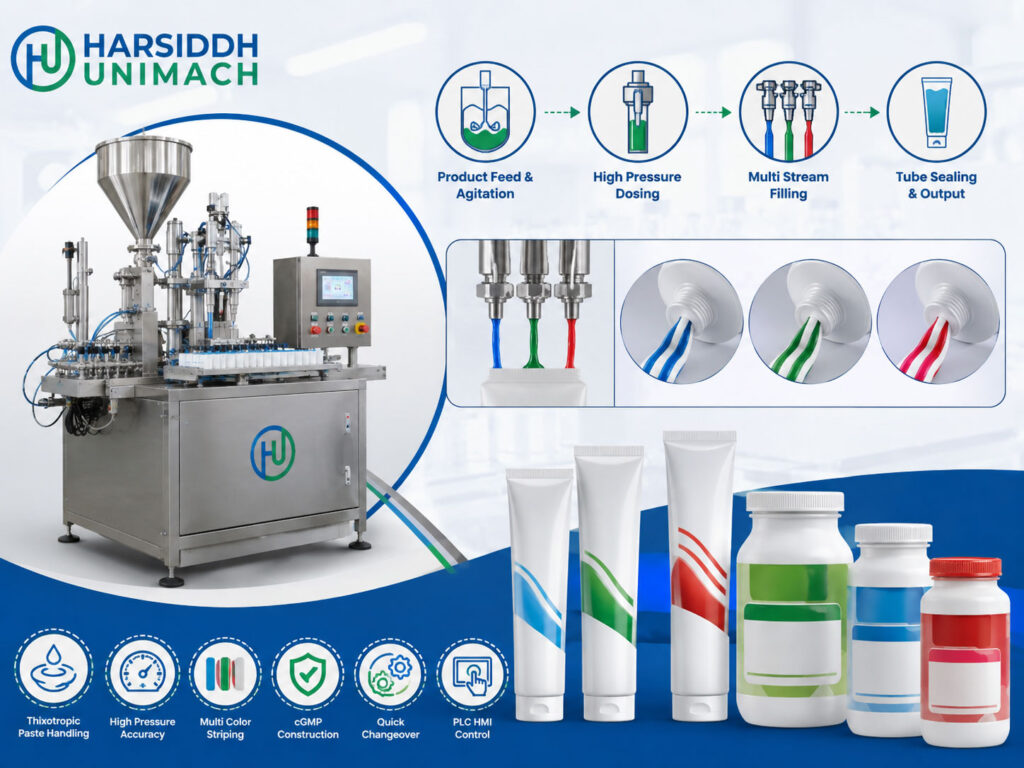
Toothpaste, medicated pastes, Ayurvedic pastes, dental pastes, tomato and ginger-garlic pastes, nut butters, adhesives, sealants and colour pastes have one thing in common: they are thick. Many contain a high proportion of solids, hold their shape when left alone and refuse to flow on their own. Pouring them is not an option; they must be pushed.
A paste filling machine is built to do exactly that, delivering accurate doses of stiff, sticky products into tubes, jars and other containers without air pockets, smears or product damage. In this article, we explain how paste fillers work, why pastes need special handling, which dosing and feeding systems are used, how pastes are filled into different containers and how to set up and troubleshoot the process.
What Makes Pastes Different?
Pastes sit at the thick end of the semi-solid range:
| Product | Typical Texture | Main Filling Challenge |
|---|---|---|
| Lotion | Pourable | Foaming, drips |
| Cream | Soft, smooth emulsion | Air entrapment, surface finish |
| Ointment | Greasy, often temperature-sensitive | Temperature control, stringing |
| Paste | Stiff, often high in solids | Feeding the pump, pushing through valves and nozzles, air pockets |
If your products are softer, see our cream filling machine working principle and our ointment filling machine working principle.
Key paste properties
- High viscosity – pastes resist flow and need force to move.
- Yield stress – many pastes do not flow at all until a certain force is applied, then flow more easily.
- Solids content – particles such as abrasives in toothpaste, spices in food pastes or fillers in sealants can wear seals and block narrow passages.
- Stickiness – pastes cling to surfaces, forming tails at the nozzle.
- Air entrapment – air pockets trapped during filling cause light fills and voids.
- Separation – some pastes can separate under high pressure or shear, with liquid squeezed out of the solids.
The Core Working Principle
Paste fillers almost always use positive displacement: a fixed volume of product is mechanically pushed out on each cycle.
The most common design is the heavy-duty piston filler:
- Suction stroke – the piston retracts, drawing paste from the hopper into the cylinder through a valve.
- Valve switch – a rotary or slide valve closes the hopper side and opens the nozzle side.
- Delivery stroke – the piston advances, pushing the measured volume through the nozzle into the container.
- Cut-off – the flow is stopped cleanly at the nozzle.
Fill volume is set by the piston stroke length, or digitally on servo machines.
The Biggest Challenge: Getting Paste into the Pump
With thin liquids, gravity fills the pump cylinder easily. With stiff pastes, the cylinder may not fill completely on its own. Air pockets form, and fill weight becomes inconsistent. Paste fillers use one or more of these solutions:
Large hopper outlets and valve passages
Wide, smooth passages reduce resistance so paste can flow into the cylinder more easily.
Hopper agitator or feed screw
A slow agitator or a feed screw at the hopper bottom pushes paste down towards the valve and keeps it moving.
Pressurised hoppers
Some machines apply air pressure on top of the paste in a closed hopper, pushing product into the pump.
Feed pumps
For larger systems, a separate pump transfers paste from a bulk container directly into the filler’s hopper or valve.
Controlled suction speed
Slowing the piston’s suction stroke gives the paste time to fill the cylinder fully.
Dosing Options for Pastes
| Dosing Method | How It Works | Best For |
|---|---|---|
| Mechanical piston | Fixed stroke, cam or crank driven | Single-product lines, robust operation |
| Servo piston | Programmable stroke and speed | Multi-product lines, precise speed profiles |
| Gear pump (servo) | Continuous delivery, dose by revolutions | Smooth pastes, larger volumes |
| Lobe or progressive cavity pump | Gentle continuous delivery | Shear-sensitive or particulate pastes |
| Auger (for very stiff products) | Screw pushes product forward | Some very thick food or industrial pastes |
See the Automatic Servo Based Piston Filling Machine, the servo based piston filling machine, the servo based gear pump filling machine, the Automatic Viscous Liquid Filling Machine and the servo based oil and viscous filling machine. For more on thick products in general, read our high viscous liquid filling machine working principle.
Valves and Nozzles for Pastes
Rotary valves
A rotating valve body with large internal passages switches between hopper and nozzle. Rotary valves handle thick and particulate pastes well because they offer a smooth, unrestricted path.
Nozzles
- Large-bore nozzles reduce pressure and shear.
- Shut-off nozzles with a positive valve at the tip give a clean cut-off, preventing tails.
- Diving nozzles start filling near the bottom of the container and rise, avoiding trapped air.
Cut-off methods
- Positive shut-off valves at the nozzle tip
- Piston suck-back at the end of the stroke
- Cutting wires or blades for very stiff products
- Air blow for some applications
Filling Pastes into Different Containers
Tubes
Toothpaste, medicated pastes and many cosmetic pastes are filled into tubes. Tube fillers combine a heavy-duty piston pump with tube loading, orientation, bottom-up filling and sealing (heat sealing for plastic and lami tubes, folding and crimping for aluminium tubes).
See the Automatic Lami Tube Filling Machine, the automatic lami tube filling machine, the automatic single head tube filling machine (HTF-40A) and the semi-automatic aluminium tube filling and sealing machine. For the complete tube process, read our tube filling machine working principle.
Jars and tubs
Food pastes, Ayurvedic pastes, balms and some industrial products go into jars. The filler places paste from near the bottom of the jar and rises, sometimes with a slight rotation of the jar for a smooth surface. Jars are then capped, for example on an Automatic Jar Capping Machine or using the capping machines for glass and PET bottles.
Bottles and squeeze containers
Softer pastes and gels may be filled into squeeze bottles using piston fillers with diving nozzles. See the lotion and gel filling machine.
Related thick products such as honey use similar principles; see the Automatic Honey Filling Machine. Browse the cream and ointment filling machines range for more semi-solid solutions.
Step-by-Step: A Paste Filling Cycle
- Paste is loaded into the hopper, by hand or by a transfer pump.
- The agitator or feed screw pushes paste towards the valve.
- The container is positioned under the nozzle and its presence confirmed.
- The piston retracts slowly, filling the cylinder completely.
- The valve switches to the nozzle side.
- The nozzle dives into the container (where used).
- The piston advances, pushing paste into the container as the nozzle rises.
- The cut-off stops the flow cleanly.
- The container moves on to sealing or capping.
Common Paste Types and Their Filling Needs
| Paste Type | Typical Characteristics | Filling Considerations |
|---|---|---|
| Toothpaste | Smooth, abrasive particles | Wear-resistant seals, tube filling with clean cut-off |
| Medicated and dental pastes | Thick, may contain actives | Accurate dosing, GMP cleaning, tubes |
| Ayurvedic and herbal pastes | Variable texture, natural particles | Large passages, jars or tubes, careful cleaning |
| Food pastes (tomato, ginger-garlic, spice) | Particulate, sometimes acidic | Hygienic design, compatible materials, jars or pouches |
| Nut butters | Very thick, oily | Feed assistance, sometimes warm filling |
| Adhesives and sealants | Very stiff, may cure in air | Closed systems, prompt cleaning, cartridges or tubes |
| Colour and industrial pastes | Pigmented, dense | Robust pumps, easy cleaning between colours |
Hygiene and Cleaning
Pastes are harder to clean out of a machine than liquids. Residues cling to hoppers, valves and nozzles and may dry or harden if left. For pharmaceutical, food and cosmetic pastes, residues can also support microbial growth. Good practice includes:
- Quick-release clamps and easily removable hoppers, valves and nozzles
- Smooth, polished contact surfaces with no dead zones
- Cleaning promptly after each batch, before paste dries
- Scraping out bulk product before washing to reduce waste and cleaning time
- Written cleaning procedures with verification for GMP products
Changeover Between Products
- Empty and scrape out the hopper and product path
- Dismantle and clean the valve, cylinder and nozzles
- Fit nozzles and container guides for the next product
- Set the new fill volume, suction and delivery speeds (or recall a servo recipe)
- Prime the system and run test containers
- Check fill weights before releasing production
Key Settings and Their Effects
| Setting | What It Controls | Effect If Wrong |
|---|---|---|
| Piston stroke | Fill volume | Under- or overfilled containers |
| Suction speed | Complete cylinder filling | Air pockets, light fills |
| Delivery speed | Flow into the container | Air entrapment, splashing, separation |
| Hopper agitation or pressure | Feeding the pump | Inconsistent filling |
| Hopper temperature (where used) | Viscosity | Stiffness changes affecting fills |
| Nozzle size | Pressure and shear | Separation, slow filling, poor cut-off |
| Cut-off method and timing | Clean end of fill | Tails, smears on containers |
Troubleshooting Common Paste Filling Problems
| Problem | Likely Cause | Corrective Action |
|---|---|---|
| Light or variable fills | Cylinder not filling completely | Slow suction, add hopper pressure or agitation |
| Air pockets in containers | Filling from the top, air in product | Use diving nozzles, de-aerate product |
| Tails and smears | Poor cut-off | Use shut-off nozzles, adjust suck-back |
| Liquid separating from paste | Excessive pressure or narrow passages | Larger valves and nozzles, slower delivery |
| Rapid seal wear | Abrasive solids | Use wear-resistant seals and materials |
| Paste too stiff to pump | Low temperature, product variation | Adjust temperature within product limits, review formulation |
| Nozzle blocking | Large particles, drying at tip | Larger nozzle, clean regularly |
Checking Fill Accuracy
Pastes are usually checked by weight. Because air pockets and density changes directly affect weight, regular checks are essential:
- Weigh sample containers from every head at start-up
- Repeat checks at defined intervals and after any stoppage
- Watch for gradual drift, which often signals seal wear or changing paste temperature
- Investigate sudden variation, which usually points to air in the cylinder or feeding problems
- Record results in the batch documentation
Consistent fill weights are the best sign that the feeding system, pump and cut-off are all working correctly.
Maintenance Tips
- Inspect piston seals and valve parts frequently, especially with abrasive pastes.
- Clean the hopper, pump, valve and nozzles thoroughly before paste dries.
- Check agitator and feed screw drives.
- Verify fill weights at start-up and at regular intervals.
- Keep nozzles and change parts organised for each container.
How to Choose a Paste Filling Machine
- Paste properties – viscosity, yield stress, solids, abrasiveness
- Containers – tubes, jars, bottles or tubs
- Fill volume range
- Output – semi-automatic, single head or multi-head
- Feeding system – agitator, feed screw, pressurised hopper or feed pump
- Dosing technology – piston, servo piston or pump
- Cut-off and nozzle design
- Cleaning and hygiene requirements
Frequently Asked Questions
What is the working principle of a paste filling machine? A heavy-duty piston or pump draws a fixed volume of paste from a hopper through a valve and pushes it through a nozzle into the container, with a cut-off to stop the flow cleanly.
Why are pastes harder to fill than liquids? Pastes are thick, sticky and often high in solids. They do not flow on their own, can trap air and can separate under pressure.
How do paste fillers make sure the pump fills completely? Using large passages, hopper agitators or feed screws, pressurised hoppers, feed pumps and slow suction strokes.
Which nozzle is best for paste? Large-bore nozzles with positive shut-off, often diving into the container, give clean, air-free fills.
Can a paste filler also fill creams and gels? Usually yes, with adjusted settings and suitable nozzles.
Need a paste filling machine for your product? Contact our team or send an inquiry with your paste details, containers and output targets.