
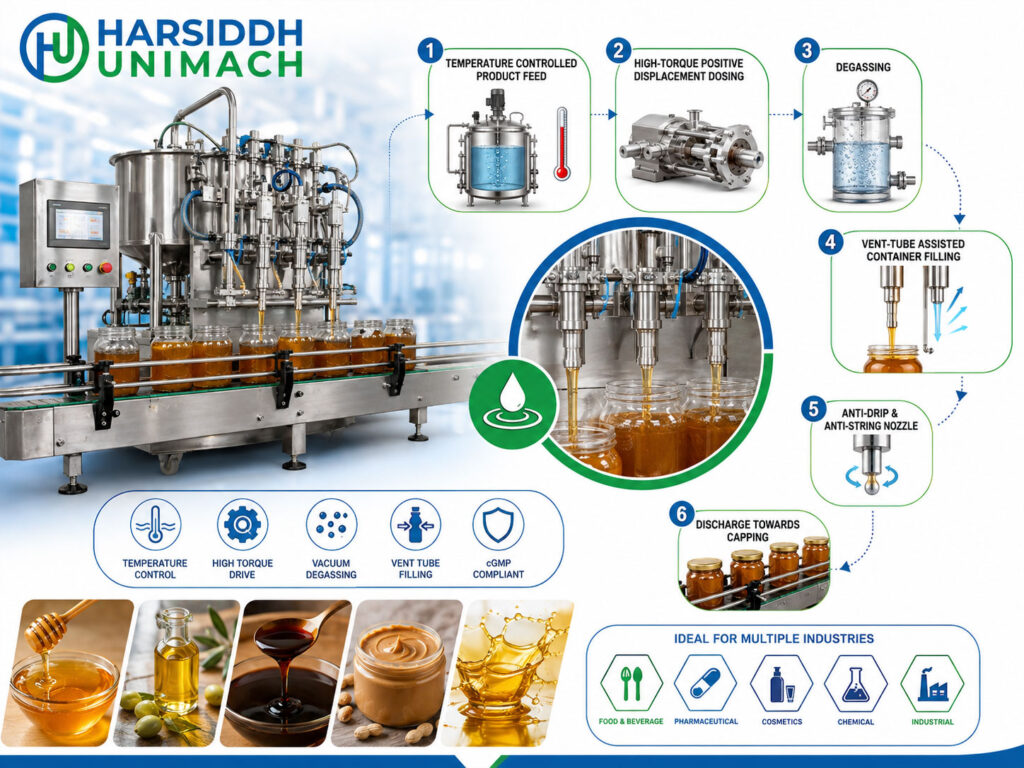
Some liquids pour like water. Others move slowly, cling to everything they touch and take a long time to settle in a bottle. Honey, glycerine, gear oil, engine oil, edible oils, thick syrups, shampoos, liquid soaps, conditioners and some pharmaceutical suspensions are all examples of viscous liquids. They still flow, unlike stiff pastes, but they do so reluctantly.
Filling these products accurately and cleanly requires a machine designed for their behaviour. A high viscous liquid filling machine uses positive displacement pumps, suitable valves and nozzles, and sometimes temperature control, to deliver consistent doses of thick liquids without long fill times, drips or air bubbles.
In this article, we explain what viscosity means for filling, how viscous liquid fillers work, which dosing technologies suit different products, how temperature affects the process, and how to set up and troubleshoot a viscous filling line.
Understanding Viscosity
Viscosity is a liquid’s resistance to flow. Water has low viscosity; honey has high viscosity. For filling, viscosity affects:
- Flow rate – thick liquids flow slowly through pipes, valves and nozzles.
- Pump filling – the pump cylinder or chamber may not fill completely if the liquid cannot flow in quickly enough.
- Cut-off – thick liquids form long “strings” or tails when the nozzle stops.
- Air entrapment – air bubbles rise slowly through thick liquids and can remain trapped.
- Temperature sensitivity – the viscosity of many products changes significantly with temperature.
Where viscous liquids sit
| Product Category | Typical Behaviour | Example Products |
|---|---|---|
| Thin liquids | Flow freely | Water-based solutions, sanitizer liquids |
| Medium viscosity | Flow steadily | Syrups, lotions, liquid soaps |
| High viscosity liquids | Flow slowly, string at cut-off | Honey, glycerine, gear oil, thick shampoos |
| Semi-solids and pastes | Hold shape, must be pushed | Creams, ointments, toothpaste |
For the stiffest products, see our paste filling machine working principle. For lighter viscous cosmetics, read our lotion filling machine working principle.
Why Gravity Filling Does Not Work Well
Gravity fillers rely on liquid flowing under its own weight. With thick liquids:
- Flow is very slow, making fill times long
- Small temperature changes alter flow rate and therefore fill volume
- Tails form at the valve, causing drips and inaccurate fills
That is why viscous liquids are almost always filled with positive displacement systems, which push a fixed volume regardless of how easily the liquid flows.
The Core Working Principle: Positive Displacement
A positive displacement filler traps a fixed volume of liquid and mechanically pushes it out. The two most common types for viscous liquids are piston fillers and gear pump fillers.
Piston filling
- The piston retracts, drawing liquid from the hopper through a valve into the cylinder.
- The valve switches from the hopper side to the nozzle side.
- The piston advances, pushing the measured volume through the nozzle into the container.
- A cut-off stops the flow.
Fill volume is set by the piston stroke. Piston fillers handle a very wide range of viscosities and give consistent volumes.
See the Automatic Servo Based Piston Filling Machine on Harsiddh Engineering.
Gear pump filling
A pair of meshing gears rotates inside a close-fitting housing. Liquid is carried around the outside of the gears from the inlet to the outlet. With a servo motor driving the pump, fill volume is controlled by the number of revolutions.
Gear pumps:
- Deliver smooth, continuous flow
- Handle oils and other lubricating liquids very well
- Allow quick volume changes through the control panel
- Suit larger fill volumes efficiently
See the Automatic Servo Based Gear Pump Filling Machine and the servo based gear pump filling machine.
Other options
- Lobe pumps – gentle handling of shear-sensitive or particulate liquids
- Progressive cavity pumps – smooth, low-shear delivery for thick products
- Weight-based filling – for large containers, where weight is measured directly
Comparing Dosing Technologies for Viscous Liquids
| Technology | Dose Controlled By | Strengths | Typical Products |
|---|---|---|---|
| Piston | Stroke volume | Wide viscosity range, accurate | Honey, syrups, shampoos, glycerine |
| Servo piston | Programmed stroke | Recipes, speed profiles, head trimming | Multi-product viscous lines |
| Servo gear pump | Revolutions | Smooth flow, quick changes, good for oils | Edible oils, engine and gear oils |
| Lobe / progressive cavity | Revolutions or time | Gentle, low shear | Shear-sensitive or particulate liquids |
| Weight filling | Measured weight | Direct, density-independent | Large containers |
Temperature Control
The viscosity of many liquids falls as temperature rises. Honey, for example, flows much more easily when warm. Temperature control can:
- Reduce viscosity so the product flows more easily into the pump and container
- Speed up filling and reduce fill times
- Improve accuracy by keeping viscosity consistent throughout the batch
- Reduce stringing at the nozzle
Methods include jacketed hoppers, heated product lines and controlled room temperatures. The right temperature depends on the product, because overheating can damage some products. For products that are filled hot and set as they cool, such as petroleum jelly, see the petroleum jelly filling machine.
Valves and Nozzles
Valves
Viscous liquids need valves with large, smooth passages to reduce resistance. Rotary valves and large check valves are common.
Nozzles
- Large-bore nozzles keep filling times reasonable.
- Diving nozzles start filling near the bottom and rise with the liquid, preventing air entrapment.
- Positive shut-off nozzles close at the tip to cut off the flow cleanly.
Drip and string control
Strings and drips are the most common problem with viscous liquids. Solutions include:
- Positive shut-off nozzles
- Suck-back at the end of the stroke
- Controlled nozzle withdrawal speed
- Drip trays between fills
- Warming the product slightly to reduce stringing
Step-by-Step: A Viscous Liquid Filling Cycle
- Product is supplied to the hopper, often by a transfer pump, with level control.
- Temperature is maintained where required.
- Containers are positioned under the nozzles; sensors confirm presence.
- Nozzles dive into the containers.
- The pump delivers the dose, slowly at first, faster once the nozzle tip is submerged, then slowly again near the end.
- Nozzles rise with the liquid level.
- Shut-off or suck-back cuts the flow cleanly.
- Containers move on to capping.
Products and Machines
High viscous liquid fillers are used across many industries:
- Food – honey, edible oils, syrups, sauces. See the Automatic Honey Filling Machine and read our edible oil filling machine working principle.
- Automotive and industrial – engine oil, gear oil, lubricants. See the Automatic Engine Oil Filling Machine and read our gear oil filling machine working principle.
- Pharmaceutical – thick syrups, suspensions, glycerine-based products.
- Cosmetics and personal care – shampoos, conditioners, liquid soaps, body washes. See the cosmetic bottle filling machine and the lotion and gel filling machine.
Dedicated viscous fillers include the Automatic Viscous Liquid Filling Machine and the servo based oil and viscous filling machine. For bottled viscous pharmaceutical liquids, see also the volumetric liquid bottle filling machine and the liquid bottle filling and capping machine (monoblock).
Browse all our liquid filling machines.
After Filling: Capping and Sealing
Viscous products are capped with screw caps, flip-top caps, pumps or lug caps depending on the product and container. Clean necks are essential, because sticky residues prevent caps from seating properly and labels from sticking. Browse the capping machines for glass and PET bottles.
Container Considerations
Viscous liquids are filled into many container types, each with its own needs:
- Glass jars (honey, sauces) – wide mouths allow large nozzles; fill from low down for a clean, bubble-free appearance.
- PET and HDPE bottles (oils, shampoos) – narrow necks require accurate nozzle alignment and diving nozzles sized to fit.
- Squeeze bottles (sauces, condiments) – flexible walls; avoid squeezing during handling.
- Cans and jerrycans (lubricants, bulk oils) – larger volumes favour gear pumps or weight filling.
- Pouches – flexible containers held by the spout, filled through it with controlled flow.
Choosing nozzles and handling parts to suit each container is as important as choosing the pump.
Changeover and Cleaning
Viscous products leave thick residues that take longer to remove than thin liquids. To keep changeovers efficient:
- Drain and recover as much product as possible from the hopper and lines
- Flush the system, using warm water or suitable cleaning solutions for the product
- Dismantle and clean valves, pump parts and nozzles where required
- Fit nozzles and guides for the next container
- Set the new fill volume and speed profile, or recall a recipe on servo machines
- Prime the system and confirm fill accuracy before production
Quick-release parts, smooth surfaces and stored recipes reduce changeover time considerably.
Key Settings and Their Effects
| Setting | What It Controls | Effect If Wrong |
|---|---|---|
| Fill volume (stroke or revolutions) | Dose per container | Under- or overfilling |
| Suction speed (piston) | Complete cylinder filling | Air in dose, light fills |
| Delivery speed profile | Flow into the container | Air bubbles, splashing, long fill times |
| Product temperature | Viscosity | Fill variation, stringing |
| Nozzle diving depth and rise speed | Bottom-up filling | Air entrapment |
| Shut-off or suck-back timing | Clean cut-off | Strings, drips, sticky necks |
| Hopper level | Stable supply | Air drawn into pump |
Troubleshooting Common Problems
| Problem | Likely Cause | Corrective Action |
|---|---|---|
| Light or inconsistent fills | Cylinder not filling, air in product | Slow suction, keep hopper level up, de-aerate |
| Long filling times | Small nozzles, cold product | Larger nozzles, controlled warming |
| Strings and drips | Viscous product, weak cut-off | Positive shut-off nozzles, adjust suck-back |
| Air bubbles in containers | Filling from the top, too fast | Diving nozzles, slower start |
| Fill drifts during batch | Temperature changing | Stabilise product temperature |
| Sticky bottle necks | Drips, poor nozzle alignment | Improve cut-off, align nozzles |
| Gear pump volume drift | Wear, temperature change | Inspect pump, stabilise temperature |
Checking Fill Accuracy
Viscous liquids are usually checked by weight, which is fast and precise. Because density can change with temperature and trapped air, good practice is to:
- Weigh containers from every head at start-up
- Repeat checks at regular intervals, especially as product or room temperature changes
- Convert weight to volume using the product’s density at the filling temperature when the label declares volume
- Trend results so gradual drift from pump wear is spotted early
Stable temperature and a full, air-free pump are the keys to consistent viscous fills.
Maintenance Tips
- Inspect piston seals, valve seals and O-rings regularly.
- Check gear pumps for wear, which reduces delivered volume.
- Clean hoppers, pumps, valves and nozzles thoroughly, ideally while product is still warm and fluid.
- Check heating systems and temperature controllers.
- Verify fill accuracy at start-up and at regular intervals.
How to Choose a High Viscous Liquid Filling Machine
- Product viscosity and how it changes with temperature
- Product type – food, oil, pharmaceutical, cosmetic, chemical
- Fill volume range and container sizes
- Dosing technology – piston, servo piston or gear pump
- Temperature control needs
- Nozzle and cut-off design
- Output and number of heads
- Cleaning and changeover requirements
Frequently Asked Questions
What is the working principle of a high viscous liquid filling machine? It uses a positive displacement pump, usually a piston or gear pump, to push a fixed volume of thick liquid through a valve and nozzle into each container, with a cut-off to prevent strings and drips.
Why are piston fillers used for viscous liquids? They deliver consistent volumes across a wide range of viscosities, unlike gravity fillers whose output depends on how easily the liquid flows.
When is a gear pump better than a piston? Gear pumps suit oils and smooth viscous liquids, larger volumes and lines needing frequent volume changes.
Does temperature affect viscous filling? Yes. Warmer liquids are usually less viscous, so controlling temperature improves flow, speed and accuracy.
How do you stop strings and drips? Use positive shut-off nozzles, suck-back, controlled nozzle withdrawal and, where appropriate, gentle warming.
Need a filling machine for thick liquids? Contact our team or send an inquiry with your product, viscosity information and container details.