
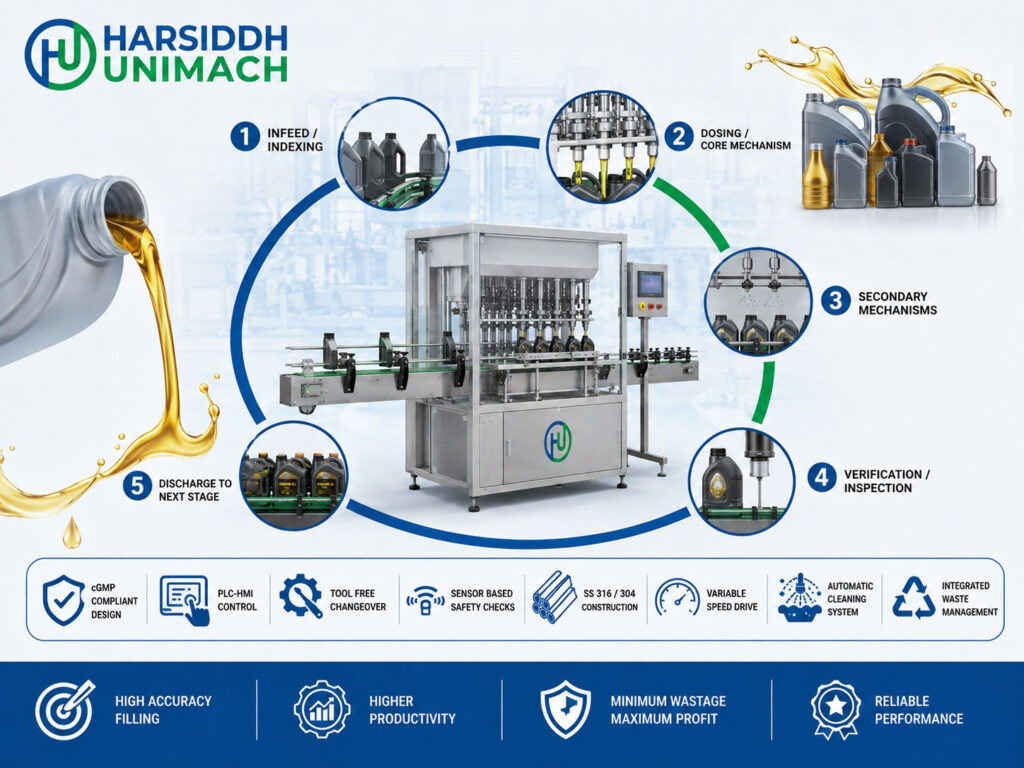
Almost every manufactured product that comes in a container passes through a filling machine at some point. Medicines, cosmetics, foods, chemicals and household products all depend on machines that put the right amount of product into each bottle, vial, ampoule, tube, jar, pouch or can, quickly, accurately and cleanly.
But the way a filling machine works depends heavily on what it is filling. A liquid flows; a powder pours unevenly; a cream must be pushed; tablets must be counted; an aerosol product must be filled under pressure. Each needs a different working principle.
This guide explains the universal principle behind all filling machines, then shows how it is applied to each major product type. It is designed as a starting point; for deeper detail on each category, follow the links to our dedicated articles.
The Universal Principle: Measure, Deliver, Handle
Every filling machine, whatever it fills, performs three core functions:
- Measure the dose – by volume, weight, level or count
- Deliver the dose into the container – cleanly, without spills or contamination
- Handle the container – positioning it for filling and passing it on for closing
In addition, most machines include:
- A product supply system – tank, hopper or bowl
- Safeguards – such as “no container, no fill”
- Controls – to set dose, speed and other parameters
The differences between machines lie in how each function is achieved for a given product.
The Four Ways to Measure a Dose
| Measurement Method | What It Measures | Typical Technologies |
|---|---|---|
| Volumetric | A fixed volume | Piston pumps, gear pumps, peristaltic pumps, augers, measuring cups, vacuum powder wheels |
| Gravimetric | Weight | Load cells under the container or a weigh bucket |
| Level | Fill height in the container | Overflow fillers |
| Count | Number of units | Electronic sensor counters, slat counters |
Most pharmaceutical filling uses volumetric or count-based methods, with weight checks to verify accuracy.
1. Liquid Filling Machines
How they work
Liquids are measured by volume, weight or level and delivered through nozzles or needles.
Main dosing technologies
- Piston pumps – a piston draws in and pushes out a fixed volume; the most common method for pharmaceutical liquids
- Servo piston pumps – digitally controlled strokes for precision and quick changeovers
- Peristaltic pumps – rollers squeeze tubing; product only touches the tube, ideal for sterile and multi-product lines
- Gear pumps – continuous flow, dose set by revolutions; good for oils and viscous liquids
- Gravity and overflow fillers – for thin, free-flowing liquids
- Flow meter and weight fillers – for high-value products or large containers
Typical containers
Bottles, vials, ampoules, pre-filled syringes, jars, pouches and cans.
Learn more
Read our liquid filling machine working principle and bottle filling machine working principle. See the Automatic Servo Based Liquid Filling Machine, the volumetric liquid bottle filling machine, the liquid vial filling machine with rubber stoppering and the eight head ampoule filling and sealing machine. Browse all our liquid filling machines.
2. Powder Filling Machines
How they work
Powders do not flow like liquids. Their density changes with compaction, humidity and aeration, so powder fillers are designed to present powder consistently and measure it precisely.
Main dosing technologies
- Auger fillers – a rotating screw delivers a fixed volume per revolution; widely used for dry syrups and bulk powders
- Vacuum powder wheels – vacuum draws powder into precision ports, then air or nitrogen blows it into vials; the classic method for sterile dry powder injections
- Measuring cup fillers – fixed cups filled by gravity; suited to free-flowing granules
- Net weight fillers – fill directly to a target weight
Typical containers
Vials, bottles, jars, pouches.
Learn more
Read our powder filling machine working principle. See the auger type powder filling machine and the single wheel injectable dry powder vial filling with rubber stoppering machine.
3. Semi-Solid Filling Machines (Creams, Ointments, Gels and Pastes)
How they work
Semi-solids are thick and must be pushed. Fillers use heavy-duty positive displacement pumps, often with heated or agitated hoppers, large valves and nozzles, and positive cut-off.
Main dosing technologies
- Piston pumps with rotary valves – the standard for creams, ointments and pastes
- Servo pistons – for precise control and speed profiles
- Gear, lobe or progressive cavity pumps – for continuous delivery
Typical containers
Tubes (plastic, laminated, aluminium), jars, bottles.
Tube filling
Tube fillers combine dosing with tube loading, orientation, bottom-up filling and sealing: heat sealing for plastic and lami tubes, folding and crimping for aluminium tubes.
Learn more
Read our cream filling machine working principle and tube filling machine working principle. See the automatic single head tube filling machine (HTF-40A). For small onion skin tubes and specialised formats, see the other filling machines for onion skin tubes, crushable ampoules and biological indicators.
4. Solid Dosage Filling Machines (Tablets and Capsules)
How they work
Solid dosage forms are filled by count rather than volume or weight. Vibratory trays separate tablets or capsules into single file, and optical sensors count each one as it falls. When the target count is reached, a gate releases the counted units into the bottle.
Main technologies
- Electronic sensor counting – the most common for pharmaceutical bottles
- Slat counters – pockets on a moving belt, one unit per pocket
- Disc counters – plates with holes sized for single units
Typical containers
Bottles and jars.
Learn more
Read our tablet filling machine working principle. See the tablet and capsule counting and filling machine.
5. Aerosol Filling Machines
How they work
Aerosol products, such as sprays for personal care, household and some medical uses, are filled in stages: the product concentrate is dosed into the can, a valve is placed and crimped onto the can, and propellant is then filled under pressure, usually through the valve.
Key considerations
- Pressure handling and safety
- Accurate dosing of both concentrate and propellant
- Valve crimping quality
- Leak testing
See the Automatic Aerosol Filling Machine and the aerosol filling machines range.
A Typical Filling Cycle, Step by Step
Although details vary, most automatic filling machines follow a similar cycle:
- Container infeed – containers arrive on a conveyor, turntable or tray, often after cleaning or sterilisation.
- Spacing and positioning – gates, star wheels, worms or pockets place each container precisely under the filling station.
- Presence check – sensors confirm a container is in place before any product is dispensed.
- Dose preparation – the dosing system draws or measures the next dose from the supply.
- Delivery – the dose is transferred into the container, often through a nozzle or needle that enters the container.
- Cut-off – the flow stops cleanly, with suck-back, shut-off valves, gates or blow-off.
- Release – the filled container moves on to stoppering, capping, sealing or another closing step.
- Verification – samples are checked by weight or count, and some lines check every container automatically.
Volumetric vs Gravimetric Filling
The choice between measuring by volume and measuring by weight is one of the most fundamental decisions:
| Aspect | Volumetric | Gravimetric (Weight) |
|---|---|---|
| What is measured | Volume dispensed | Weight in the container |
| Effect of density changes | Fill weight changes with density | Compensated automatically |
| Speed | Generally fast | Often slower per station |
| Typical use | Most liquids, semi-solids, many powders | Large containers, high-value products, some powders |
| Equipment | Pistons, pumps, augers, cups, powder wheels | Load cells, weigh buckets |
Many lines combine both: volumetric dosing for speed, with checkweighing to verify accuracy.
Comparing Filling Principles by Product Type
| Product Type | Main Measurement | Typical Dosing | Key Challenge |
|---|---|---|---|
| Thin liquids | Volume or level | Piston, peristaltic, gravity, overflow | Splashing, foaming |
| Viscous liquids | Volume or weight | Piston, gear pump | Stringing, slow flow |
| Sterile liquids | Volume | Piston, servo piston, peristaltic | Aseptic handling |
| Powders | Volume or weight | Auger, vacuum wheel, cup | Density variation, dust |
| Semi-solids | Volume | Heavy-duty piston, pumps | Pushing thick product, air pockets |
| Tablets and capsules | Count | Electronic counting | Separation, dust, breakage |
| Aerosols | Volume (concentrate + propellant) | Metering under pressure | Pressure and leak safety |
Closing the Container After Filling
Filling is only half of the job; the container must then be closed securely. The closing method depends on the container: rubber stoppers and aluminium seals for vials, flame sealing for ampoules, screw, ROPP or lug caps for bottles and jars, heat sealing or crimping for tubes, plunger stoppers for syringes and valve crimping for aerosol cans. Many machines combine filling and closing on one frame, while others pass containers to a separate closing machine. Either way, a clean fill with no product on the neck, rim or sealing area is essential for a reliable closure.
Machine Configurations
Across all product types, machines come in similar configurations:
| Configuration | Description | Best For |
|---|---|---|
| Manual / tabletop | Operator performs most tasks | R&D, very small batches |
| Semi-automatic | Machine doses, operator handles containers | Small batches, start-ups |
| Automatic linear | Containers indexed in groups on a straight conveyor | Flexible, multi-product production |
| Automatic rotary | Continuous motion on a carousel | High output, dedicated products |
| Monoblock | Filling plus closing on one frame | Space saving, fewer transfers |
| Integrated line | Container preparation to packing, synchronised | High-volume production |
Features Found on Modern Filling Machines
- Servo drives for digital dose setting and smooth motion
- Recipe management for fast changeovers
- No container, no fill safeguards
- Drip and cut-off control for clean containers
- Nitrogen purging for oxygen-sensitive products
- Quick-release change parts for cleaning and changeover
- Data recording and user access control for GMP compliance
Industries That Use Filling Machines
- Pharmaceuticals – injectables, oral liquids, dry syrups, creams, ointments, tablets and capsules
- Nutraceuticals – syrups, powders, capsules and tablets
- Cosmetics and personal care – lotions, creams, shampoos, gels, sprays
- Food and beverages – oils, honey, sauces, syrups, powders
- Household and chemicals – detergents, disinfectants, sanitizers, lubricants
- Veterinary and agrochemical – liquids and powders in bottles and cans
Each industry has its own priorities, such as sterility and documentation in pharmaceuticals, appearance in cosmetics, hygiene in food and safety with chemicals, but the underlying filling principles are the same.
How to Choose the Right Filling Machine
- Identify the product type – liquid, powder, semi-solid, solid or aerosol
- Define product properties – viscosity, flow, density, sensitivity, sterility
- Choose containers and closures
- Select the measurement and dosing method
- Determine output and machine configuration
- Plan changeover and cleaning requirements
- Confirm GMP and documentation needs
- Plan line integration with upstream and downstream machines
- Compare total cost of ownership, not just price
Common Principles for Accurate Filling
Whatever the product, accurate filling depends on:
- Stable product supply – constant level, temperature and condition
- The right dosing technology for the product
- Clean delivery – no drips, splashes, dust or product on sealing areas
- Precise container handling – correct positioning every cycle
- Regular checks – weight or count verification with trend monitoring
- Good maintenance – seals, sensors and wear parts kept in good condition
Frequently Asked Questions
What is the basic working principle of a filling machine? It measures a dose of product by volume, weight, level or count, delivers it into a container and handles the container through the process.
What are the main types of filling machines? Liquid fillers, powder fillers, semi-solid (cream, ointment and paste) fillers, tablet and capsule counters, and aerosol fillers.
Which dosing method is most common in pharmaceuticals? Volumetric piston dosing for liquids and semi-solids, vacuum wheels and augers for powders, and electronic counting for tablets and capsules.
What is the difference between linear and rotary filling machines? Linear machines fill groups of stationary containers on a straight conveyor; rotary machines fill containers continuously on a rotating carousel.
How do I choose the right filling machine? Start with your product type and properties, then choose the container, dosing method, output, configuration and features that suit your production.
Looking for the right filling machine for your product? Contact our team or send an inquiry with your product, container and output details.