
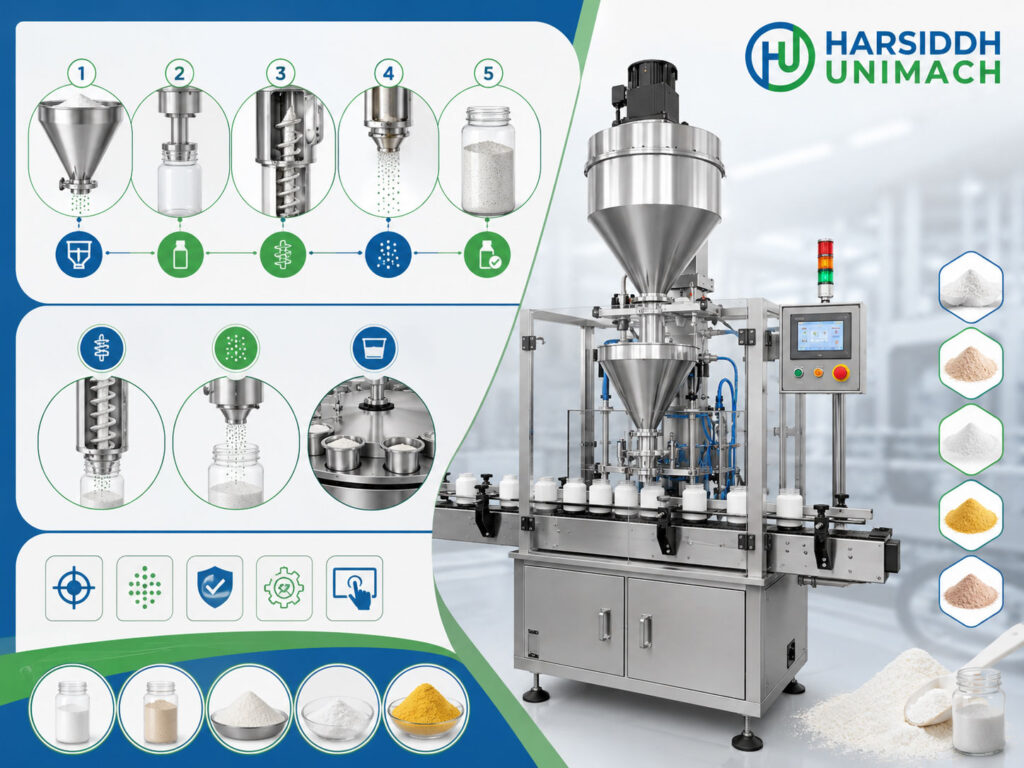
Every powder filling machine, whatever its design, has to solve the same problem: deliver the same quantity of a material that refuses to behave the same way twice. A powder can be loose and aerated one minute and compacted the next. Its density shifts with humidity, particle size, hopper level and even vibration from the floor. Yet a sterile vial, a dry syrup bottle or a nutritional jar still needs the correct amount, every time.
This article looks closely at the working principle of powder filling machines, in other words the mechanics of how each type actually measures a dose, and the engineering controls that keep that dose consistent. If you want a general introduction first, read what is a powder filling machine and how does it work. For a side-by-side comparison of the main machine families, see types of powder filling machines: auger, gravity and vacuum explained.
The Core Principle: Volume, Density and Mass
Most powder fillers do not weigh each dose directly. They measure a volume and rely on the powder’s density to turn that volume into the right mass:
Fill mass = dosed volume × bulk density of the powder at the moment of dosing
This simple relationship explains almost everything about powder filling:
- If the dosed volume is repeatable but the bulk density changes, the fill mass changes in the same proportion.
- If the density is stable but the volume varies, for example because a cavity does not fill completely, the fill mass varies.
- Good machine design therefore tries to do two things: deliver a precise volume and present the powder at a consistent density every time.
The alternative is to measure mass directly with a load cell, which is the principle behind net weight filling. We cover both approaches below. For a deeper discussion of the trade-offs between the two philosophies, our article on weight-based vs volumetric filling explains the logic in detail; the same reasoning applies to powders.
Why Powders Are Hard to Dose
Before looking at each mechanism, it helps to understand what the machine is fighting against.
| Powder Property | What It Does During Filling |
|---|---|
| Flowability | Free-flowing powders pour easily; cohesive powders bridge, rat-hole and stick |
| Bulk density | Determines how much mass fits in a given volume |
| Compressibility | Powder packs tighter under pressure, from hopper weight, augers or vacuum |
| Aeration | Agitation or transfer can fluff powder up, lowering density temporarily |
| Particle size and shape | Fine particles create dust and can flood; coarse particles flow but segregate |
| Moisture sensitivity | Humidity causes caking and density drift |
| Electrostatic charge | Powder clings to surfaces and containers |
Every powder filling mechanism is, in effect, a way of managing these properties well enough to produce a repeatable dose.
Principle 1: Auger Filling
How the dose is measured
An auger filler uses a precision-machined screw (the auger) rotating inside a closely fitting tube. Each turn of the auger moves a nearly fixed volume of powder forward and out of the tube. The dose is therefore set by the number of auger revolutions, or a fraction of a revolution.
Step by step
- Powder is held in a hopper above the auger.
- An agitator inside the hopper turns slowly to keep the powder moving, prevent bridging and feed the auger flights evenly.
- When a container is in position, the auger rotates a set number of turns.
- Powder is pushed down the tube and discharged into the container.
- The auger stops precisely; a disc, spinner or screen at the tube outlet may be fitted to stop free-flowing powders from dribbling after the auger stops.
- The container moves on and the cycle repeats.
What controls accuracy
- Auger and tube tooling – the auger diameter and flight pitch are chosen to suit the fill size and powder. Too large an auger for a small fill means very few turns, which reduces resolution; too small an auger for a large fill slows the cycle.
- Drive precision – modern auger fillers use servo or stepper motors so the number of revolutions, acceleration and stop position are repeatable.
- Agitator speed – keeps the density in the auger flights consistent. Too fast can aerate the powder; too slow allows bridging.
- Hopper level – a higher powder column compresses the powder at the auger inlet. Level sensors and automatic top-up keep it within a band.
Best suited to
Fine and moderately cohesive powders, nutritional powders, food powders, chemicals, and many pharmaceutical bulk powders filled into bottles, jars and pouches. See the Automatic Auger Type Powder Filling Machine and the auger type powder filling machine (single and double head).
Principle 2: Vacuum (Powder Wheel) Filling
How the dose is measured
Vacuum powder filling is the classic principle for sterile dry powder injections in vials. A rotating powder wheel has a number of precisely machined dosing ports around its circumference. Behind each port is a filter. The volume of each port, which is adjustable with a piston or plug, defines the dose.
Step by step
- Powder sits in a hopper above the wheel, kept moving by an agitator or stirrer.
- As a port rotates under the hopper, vacuum is applied behind the filter. The vacuum draws powder into the port and packs it to a consistent density.
- A scraper or doctor blade levels the powder flush with the wheel surface as the port leaves the hopper, removing excess.
- The vacuum holds the dose in place as the wheel rotates to the bottom position.
- Above the vial, the vacuum is switched off and a short pulse of sterile compressed air or nitrogen blows the powder plug out of the port and into the vial.
- The port continues round, is cleaned by the next cycle and refills.
What controls accuracy
- Port volume setting – the main adjustment for fill weight.
- Vacuum level – controls how firmly powder is packed into the port; a stable vacuum gives a stable density.
- Blow-off pressure and timing – must discharge the full plug without scattering powder.
- Hopper agitation and level – keep powder presenting to the ports evenly.
- Filter condition – blocked filters reduce effective vacuum and fill.
Single wheel, double wheel and servo designs
- Single wheel machines dose one vial at a time and suit small to medium batches.
- Double wheel machines use two powder wheels for higher output or for filling two components.
- Servo-driven machines position the wheel and vial transport precisely and allow settings to be stored as recipes.
See the Automatic Injectable Vial Dry Powder Filling and Stoppering Machine (Servo Based), the single wheel injectable dry powder vial filling with rubber stoppering machine and the double wheel injectable dry powder filling machine with vial rubber stoppering. For the complete vial process, read our vial powder filling machine working principle.
Principle 3: Volumetric Cup (Measuring Cup) Filling
How the dose is measured
A rotating disc carries a set of measuring cups. Each cup is filled by gravity as it passes under the hopper, the surplus is scraped off level, and the cup then empties into the container below.
Step by step
- Powder flows from the hopper onto the rotating cup plate.
- Each cup fills by gravity as it passes beneath the powder.
- A scraper levels the top of each cup.
- The cup reaches the discharge point, a flap or slide opens, and powder falls into the container.
What controls accuracy
- Cup volume – often adjustable with telescopic cups that change height to change volume.
- Flowability – the powder must flow freely enough to fill each cup completely.
- Plate speed – too fast and cups do not fill fully.
Best suited to
Free-flowing, granular powders and granules where density is reasonably stable. Cup fillers are simple and fast but less suited to cohesive or very fine powders.
Principle 4: Gravity and Rotary Dry Syrup Filling
Dry syrup powders, which are reconstituted with water before use, are usually filled into bottles on rotary machines. Depending on the design, the dose is measured by an auger, by measuring cups or by a rotary dosing device synchronised with a star wheel that indexes the bottles beneath the filling station.
Because dry syrup powders and granules are often relatively free-flowing, these machines can combine volumetric dosing with simple, robust bottle handling. See the Automatic Rotary Dry Syrup Powder Filling Machine, the rotary dry syrup powder filling machine and the automatic dry syrup powder filling line. For the full process, read our dry syrup filling machine working principle.
Principle 5: Net Weight Filling
How the dose is measured
Instead of measuring volume, a net weight filler places the container (or a weigh bucket) on a load cell and fills until the target mass is reached.
Step by step
- The container is placed on the load cell and the scale is tared.
- A feeder, usually an auger or vibratory tray, delivers powder at a fast bulk rate.
- As the weight approaches the target, the feeder slows to a dribble rate for fine control.
- The feeder stops at the target, allowing for powder still in the air (“in-flight” material).
- The container is released.
Strengths and limitations
Net weight filling compensates for density changes automatically, which makes it attractive for larger fills and high-value products. It is generally slower per station than volumetric dosing and needs vibration-free mounting and careful dust control around the load cell.
Closing the Loop: Checkweighing and Feedback
Many modern lines combine volumetric dosing with weighing:
- Statistical checks – an operator weighs a sample of containers at set intervals and adjusts the dose.
- In-line checkweighing – a checkweigher after the filler weighs every container or a sample and rejects those outside limits.
- Automatic feedback – the checkweigher’s trend data is fed back to the filler, which makes small corrections to auger revolutions or port volume to compensate for density drift.
This approach keeps the speed of volumetric filling while gaining much of the accuracy benefit of weighing.
Comparing the Working Principles
| Principle | What Sets the Dose | Density Compensation | Typical Containers | Typical Powders |
|---|---|---|---|---|
| Auger | Number of revolutions | Indirect (agitation, level control, feedback) | Bottles, jars, pouches | Fine to moderately cohesive |
| Vacuum wheel | Port volume plus vacuum packing | Vacuum gives consistent packing | Vials | Sterile injectable powders |
| Measuring cup | Cup volume | None inherent | Bottles, pouches | Free-flowing granules |
| Rotary dry syrup | Auger, cup or rotary dosing device | Depends on dosing device | Bottles | Dry syrup powders and granules |
| Net weight | Target mass on load cell | Direct | Larger containers, bags | Wide range |
The Factors That Decide Fill Accuracy
Whichever principle you use, accuracy depends on the same group of factors:
- Powder consistency – particle size distribution, moisture and density from batch to batch.
- Powder presentation – constant hopper level, correct agitation and no bridging.
- Mechanical precision – tooling fit, drive accuracy and wear.
- Environment – controlled temperature and humidity, especially for hygroscopic powders.
- Correct tooling selection – auger size, port size or cup volume matched to the fill.
- Monitoring – regular weight checks and trend analysis.
- Operator practice – consistent set-up, cleaning and adjustment.
Dust, Containment and Cleanliness
Powder filling always creates some dust. Good machines limit it by:
- Enclosing the dosing area and fitting dust extraction points
- Using close-fitting nozzles and funnels that sit near or inside the container mouth
- Controlling discharge speed and blow-off pressure
- Using smooth, polished contact surfaces that release powder easily
- Designing parts for quick removal and thorough cleaning
For sterile injectable powders, filling takes place under unidirectional airflow, with contact parts sterilised and the process designed to protect the open vials. Always confirm requirements against your own quality procedures and the current applicable guidelines.
Troubleshooting From the Working Principle
| Symptom | Likely Root Cause | Corrective Action |
|---|---|---|
| Fill weight drifting slowly | Changing hopper level or bulk density | Control hopper level, check environment, use feedback |
| Random light fills (auger) | Bridging or rat-holing | Adjust agitator, check powder condition |
| Dribbling after the auger stops | Free-flowing powder | Fit a disc, spinner or screen at the outlet |
| Light fills (vacuum wheel) | Low vacuum, blocked filters | Check vacuum supply, clean or replace filters |
| Powder scatter at the vial | Blow-off pressure too high or timing wrong | Adjust pressure and timing |
| Inconsistent cup fills | Plate speed too high, poor flowability | Slow plate, check powder |
| Excess dust | Discharge too fast or too high above container | Lower nozzle, adjust speed, improve extraction |
| Variation between heads | Worn or mismatched tooling | Inspect and match tooling head by head |
Completing the Line
After filling, containers are closed and checked. Vials are stoppered and then sealed, inspected and labelled; bottles are capped and often induction sealed. Visual inspection of filled vials can be carried out on a visual vial dry powder inspection machine.
Explore our full range of powder filling machines, and on Harsiddh Engineering browse dry powder filling machines, dry syrup powder filling machines and injectable powder filling machines.
Frequently Asked Questions
What is the working principle of a powder filling machine? Most powder fillers measure a fixed volume of powder, using auger revolutions, a vacuum port or a measuring cup, and rely on the powder’s bulk density to deliver the correct mass. Net weight fillers instead weigh the powder directly.
Why does fill weight change when the machine settings stay the same? Because bulk density changes with hopper level, humidity, agitation and batch-to-batch variation. A constant volume of less dense powder weighs less.
Which principle is used for sterile dry powder injections? Vacuum powder wheel filling is the most common. Vacuum packs powder into precision ports, and sterile air or nitrogen blows each dose into the vial.
How does an auger filler control the dose? By rotating a precision auger a set number of revolutions. Each revolution moves a nearly fixed volume of powder.
Can volumetric fillers compensate for density changes? Not on their own, but checkweigher feedback can automatically adjust auger revolutions or port volume to compensate.
Want help choosing the right powder filling principle for your product? Contact our team or send an inquiry with your powder details, fill weight and container type, and we can recommend a solution and arrange trials.