
/ Pharma Machinery / By Harsiddh Unimach
In pharmaceutical manufacturing, a product’s label is more than just branding—it is a critical legal document containing vital dosage information, batch numbers, expiry dates, and serialized barcodes. A single skewed, wrinkled, or missing label can lead to immediate batch rejections, costly market recalls, and severe regulatory penalties from bodies like the US FDA, MHRA, and WHO.
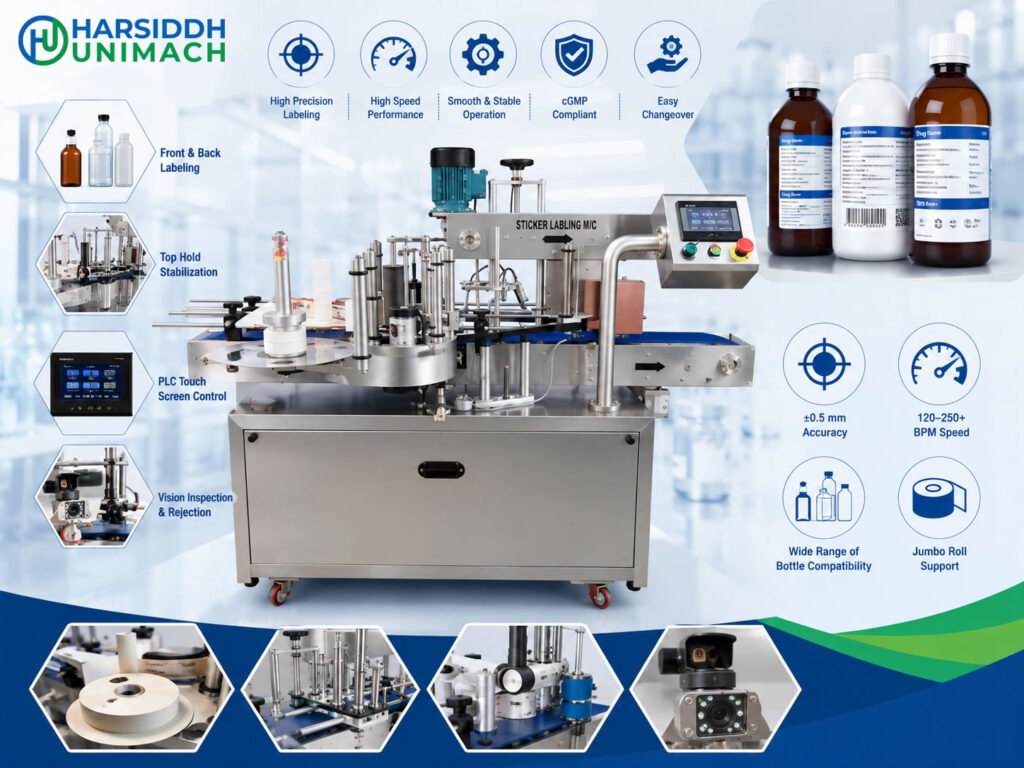
When it comes to flat, oval, square, or uniquely shaped containers (such as syrup bottles, suspensions, oral drops, and topical lotions), an Automatic Front and Back Sticker Labeling Machine is the definitive industry standard for ensuring dual-sided application compliance.
However, with numerous variants, speed capacities, and technical configurations flooding the market, selecting the right machinery is a high-stakes decision for procurement and engineering teams. This comprehensive buying guide by Harsiddh Unimach Pvt. Ltd. breaks down the vital technical parameters, compliance checkpoints, and mechanical features you must evaluate before making a capital investment.
1. Container Geometry & Material Compatibility
Before looking at machine speed or automation features, you must evaluate the physical characteristics of your product containers. A machine that handles a rigid square bottle flawlessly may struggle with a flexible, contoured oval PET container.
Shape Variations: Flat, Square, and Oval
- Square/Rectangular Bottles: These require precise parallel alignment. The machine must feature an initial alignment system (such as twin twin-gripper belts or side-shaping rollers) to ensure the container enters the labeling zone perfectly perpendicular to the dispensing heads.
- Oval/Elliptical Bottles: Oval shapes present a unique challenge because their surfaces curve in multiple planes. To prevent crooked application, look for machinery fitted with a top-holding stabilization belt that applies downward pressure, locking the bottle’s orientation during the exact millisecond of label release.
Material Dynamics: Glass vs. HDPE/PET
- Glass Containers: Glass surfaces are highly rigid but suffer from dimensional variations during molding. Your labeling machine should feature flexible, spring-loaded application rollers or brush assemblies that absorb minor bottle size variations without crushing the container.
- PET/HDPE Bottles: Plastic bottles are lightweight and prone to minor flexing when empty. If you are labeling containers online right after blow-molding or prior to liquid filling, the machine must use gentle, non-destructive indexing mechanisms to prevent bottle structural deformation.
2. Technical Evaluation of Labeling Heads and Drive Motors
The core accuracy of any front and back labeling machine rests within its twin labeling heads. The mechanical drive system directly dictates how cleanly the self-adhesive sticker detaches from the backing paper and adheres to the container.
[Label Roll Dispenser] ➔ [Tensioning Arm] ➔ [Stepper/Servo Drive] ➔ [Peeling Blade] ➔ [Container Adhesion]Stepper Motors vs. Servo Motors
When reviewing technical specifications, pay close attention to the drive motor type:
- Stepper Motor Systems: Best suited for low-to-medium speed production lines (up to 80–120 bottles per minute). While highly reliable and cost-effective, stepper motors operate on a fixed-step loop, meaning they can drift slightly in accuracy if subjected to sudden speed fluctuations.
- Servo Motor Systems (Recommended for Pharma): High-speed lines (150+ bottles per minute) require closed-loop servo drives. Servo systems constantly communicate with the primary PLC, automatically adjusting the label dispensing speed to match the conveyor’s exact velocity down to the micrometer. This eliminates label slippage and guarantees application tolerances within ±0.5 mm.
3. Critical Label Application Mechanisms
How the label physically transitions from the dispensing roll to the container surface determines whether your finished product will look flawless or contain air bubbles and creases.
Wipe-On (Direct Dispensing) vs. Tamp-Blow Assemblies
- Wipe-On Method: This is the most efficient configuration for high-speed pharmaceutical bottle lines. The label is peeled off its backing sheet and dispensed directly onto the moving container. A series of specialized rubber rollers and soft-bristle brushes then “wipe” the label down seamlessly.
- Tamp-Blow/Air-Assist: Used primarily for delicate vials or recessed panels on specialized containers where direct mechanical contact could tip the bottle over.
Dual-Sided Synchronization
Because front and back labels are frequently different sizes or printed on independent rolls, the machine must feature a Dual-Axis Synchronization Controller. If the front label roll runs slightly faster, the PLC must dynamically re-calibrate the trailing back label head to prevent asymmetric alignment.
4. Key Engineering Specifications for Procurement Teams
When drafting your User Requirement Specification (URS) document for manufacturers like Harsiddh Unimach Pvt. Ltd., utilize this technical baseline matrix to define your operational targets:
| Technical Feature | Medium-Scale Linear Labeler | High-Speed Advanced Line |
|---|---|---|
| Output Speed Capacity | 40 to 120 Containers / Minute | 120 to 250+ Containers / Minute |
| Label Placement Accuracy | ±1.0 mm | ±0.5 mm |
| Container Width Range | 20–100 mm | 15–150 mm |
| Label Height Capability | 10–120 mm | 10–180 mm |
| Reel Core Diameter | Standard 76 mm (3 inches) | Standard 76 mm with Jumbo Roll Adaptor |
| Construction Standard | AISI SS 304 Frame, Anodized Al | AISI SS 316 Contact, Full cGMP Frame |
| Control Interface | Standard Digital Microprocessor | Multi-Color Touchscreen HMI with PLC |
5. Pharmaceutical Regulatory & Quality Compliance Checkpoints
Pharmaceutical labeling hardware must adhere to rigid compliance standards that go far beyond standard beverage or cosmetic packaging requirements.
21 CFR Part 11 Integration
If your facility exports formulations to regulated markets like the United States, your labeling line’s software must comply with FDA 21 CFR Part 11 guidelines:
- User Access Controls: Multi-level security login profiles (Operator, Maintenance, Supervisor, Quality Assurance) to restrict parameter alterations.
- Audit Trails: An unalterable internal log that records exactly who changed a machine setting, at what millisecond, and what the previous value was.
Online Batch Coding Integration
A premium front and back labeler must accommodate modern industrial coding units directly on the machine bridge prior to label peeling. Look for plug-and-play compatibility with:
- Thermal Inkjet (TIJ) Coppers: For high-resolution, smudge-free variable text printing.
- Continuous Inkjet (CIJ): Ideal for rapid, ultra-fast batch data entry.
- Laser Coders: Perfect for indelible, tamper-proof security marking.
Vision Inspection and Defect Rejection Systems
Human inspection is insufficient at modern line speeds. To eliminate human error, your buying checklist must include an integrated Vision Inspection System featuring smart OCR/OCV (Optical Character Recognition/Verification) cameras:
[Vision Camera Scan] ➔ [PLC Validation Check] ➔ [Pneumatic Pusher/Flipper] ➔ [Defect Reject Bin]- Missing Label Detection: Photodetectors scan both sides of the bottle; if either label is absent, a reject signal triggers.
- Barcode/Datamatrix Readability: The camera verifies that the 2D serialized data matrix code is fully legible and accurate.
- Pneumatic Rejection System: Faulty containers are instantly deflected into a locked collection bin via a heavy-duty pneumatic pusher or air-blast flipper without pausing the entire production line.
6. Operational Ergonomics and Maintenance Considerations
A labeling machine that is difficult to maintain will inevitably drive down your Overall Equipment Effectiveness (OEE). Evaluate these mechanical design points before final selection:
- Tool-Less Changeover: Pharmaceutical facilities handle multiple bottle sizes in a single week. Advanced machinery from Harsiddh Unimach Pvt. Ltd. utilizes quick-release hand wheels and calibrated ruler scales, allowing operators to transition from a 100ml syrup bottle to a 500ml bottle in under 15 minutes without needing tools.
- Low Maintenance Components: Opt for self-lubricating polymer bearings and brushless AC motors. Labeling zones are prone to paper dust accumulation; therefore, electrical enclosures must carry an IP54 or IP65 protection rating to shield sensitive electronics during cleanroom washdowns.
- Label Tensioning & Breakage Alarms: High-speed pulling can snap thin glassine label backing paper. The system should feature automated web tension sensors that stop the machine instantly if a roll breaks, preventing costly adhesive wrap-arounds on the internal drive rollers.
Why Choose Harsiddh Unimach Pvt. Ltd. for Your Labeling Automation?
Sourcing your packaging line components from an experienced engineering partner simplifies your route to regulatory validation. At Harsiddh Unimach Pvt. Ltd., we design, engineer, and commission state-of-the-art automatic sticker labeling machines built specifically to satisfy the strict quality metrics of modern pharmaceutical cleanrooms.
Our Structural Advantages:
- True cGMP-Compliant Frameworks: Open-frame designs utilizing premium-grade stainless steel with zero exposed threads or crevices, ensuring rapid line clearance and sanitization.
- Micro-Precision Placement: Advanced servo-driven dispensing paired with synchronized top-hold stabilization ensures pristine label geometry on every bottle profile.
- Seamless Turnkey Integration: Our labeling units effortlessly interface with upstream filling/capping systems and downstream cartoning machinery to create a synchronized, high-performance production line.
- Comprehensive Validation Dossier: We provide detailed Design, Installation, and Operational Qualification (DQ/IQ/OQ) protocol validation packages to significantly reduce your facility’s internal auditing timelines.
Upgrade Your Packaging Accuracy Today
Ensure your pharmaceutical packaging workflow operates with flawless precision and zero compliance risk. For detailed product blueprints, operational consumption data, or a custom project pricing quote tailored to your plant layout, contact our engineering sales department directly:
- Official Website: www.harsiddhunimach.com
- Technical Inquiry Email: info@harsiddhunimach.com
- Manufacturing Headquarters: Harsiddh Unimach Pvt. Ltd., Gujarat, India.
Related Reading
- Sticker Labeling Machine Working Principle
- Top 10 Labeling Mistakes Manufacturers Should Avoid
- The Importance of GMP Compliance in Pharmaceutical Machinery
- Liquid Filling Machine Utility Requirements for Pharmaceutical Plants
- Ampoule Washing Machine Working Principle