
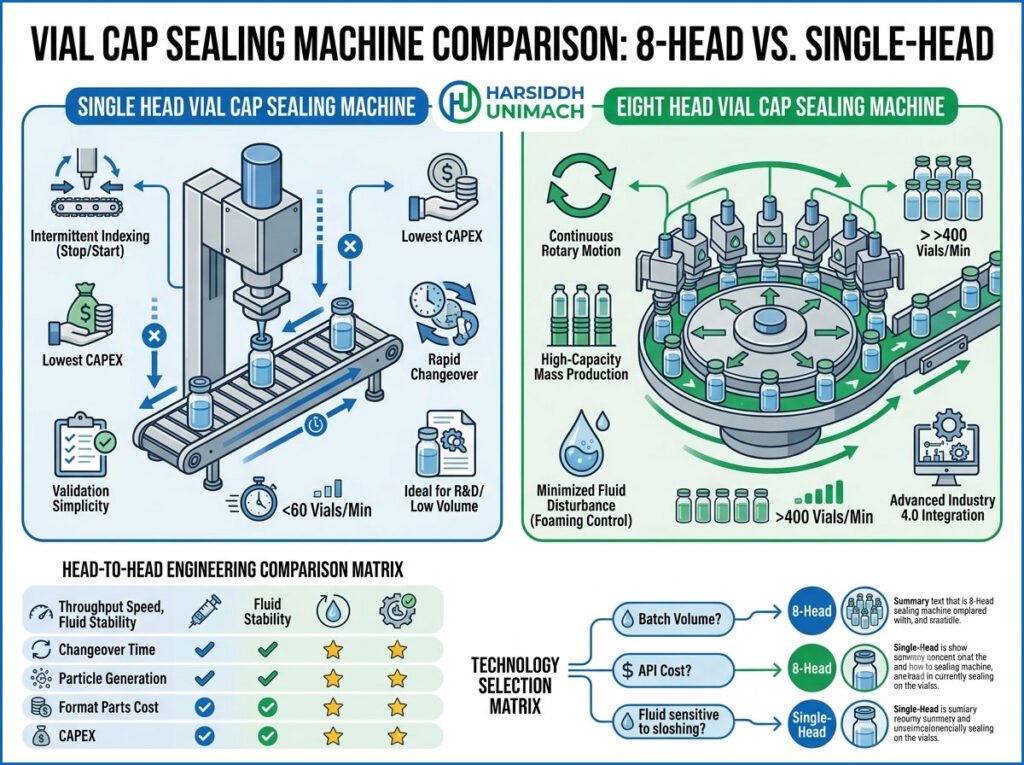
Every injectable vial must be sealed with an aluminium crimp cap to hold the rubber stopper securely and provide tamper evidence. The machine that does this job ranges from compact single head cappers to high-speed eight head rotary machines. Both crimp the same seals onto the same vials — but they are built for very different production realities.
Choosing between them affects your line speed, crimp consistency, floor space, investment and running costs. Pick a machine that is too small and it becomes the bottleneck on your line. Pick one that is too large and you tie up capital and cleanroom space in capacity you don’t use.
This guide compares eight head and single head vial cap sealing machines across the factors that matter most, explains where each one fits and shows how to decide — including when a four or six head machine might be the better middle ground.
Quick Answer
- Choose a single head machine for R&D, pilot plants, clinical batches and small-scale production where output needs are modest and flexibility matters most.
- Choose an eight head machine for high-speed commercial lines producing large volumes of vials continuously.
- Consider four or six heads if your output sits between these two extremes.
How Each Machine Works
Single head vial cap sealing machine
A single head machine has one sealing head. Depending on the design, vials are positioned under the head one at a time, either manually (semi-automatic) or automatically by a star wheel. The head presses the seal onto the stopper and rollers crimp the skirt under the vial neck. The vial is then released and the next vial moves into position.
Single head machines include:
- Semi-automatic models, where the operator places each vial — see the Semi-Automatic Vial Cap Sealing Machine
- Automatic models, with conveyor infeed and automatic cap feeding — see the Automatic Single Head Vial Cap Sealing Machine
Eight head vial cap sealing machine
An eight head machine uses a continuously rotating turret carrying eight sealing heads. Vials are spaced by an infeed worm, transferred into the turret by a star wheel and pick up seals from a chute. As the turret turns, each head descends, presses the seal down with a spring-loaded plunger and crimps it with rollers, then lifts and releases the vial. Eight vials are being crimped at different stages at any moment.
See the Automatic Eight Head Vial Cap Sealing Machine and read the full eight head vial cap sealing machine working principle. For the basics that apply to all models, see the vial cap sealing machine working principle.
Side-by-Side Comparison
| Factor | Single Head | Eight Head |
|---|---|---|
| Sealing heads | 1 | 8 |
| Motion | Intermittent (one vial at a time) | Continuous rotary |
| Relative output | Low | High |
| Typical use | R&D, pilot, small batches | High-speed commercial lines |
| Vial feeding | Manual or simple automatic | Infeed worm and star wheels |
| Time available per crimp at high line speed | Limited | Ample, as work is shared |
| Footprint | Compact | Larger |
| Investment | Low | Higher |
| Changeover parts | Few | More (worm, star wheels, 8 heads) |
| Changeover time | Short | Longer |
| Maintenance points | One head | Eight heads |
| Line integration | Standalone or small lines | Integrated high-speed lines |
| Best for | Flexibility, low volume | Throughput, consistency at speed |
Single Head vs Eight Head Vial Cap Sealing
Comparing the Key Factors
1. Output
This is the biggest difference. A single head machine processes one vial per sealing cycle, so output is limited. An eight head machine crimps eight vials in sequence during each turret rotation, in continuous motion, delivering far higher throughput. If your filling machine is fast, only a multi-head capper will keep pace.
2. Crimp quality and consistency
Both machine types can produce excellent crimps when correctly set up. The difference appears at speed:
- On a single head machine, pushing output higher means each crimp must be completed faster, which can reduce consistency.
- On an eight head machine, the crimping work is shared among eight heads, so each head has enough time to form a smooth, tight crimp even at high line speeds.
However, eight heads also means eight sets of springs and rollers that must be kept identical. A single worn roller produces a defect on every eighth vial, so head-by-head checks are essential. On both machine types, the balance between plunger pressure from above and roller pressure from the side determines whether the seal is tight enough to protect container closure integrity without cracking the glass or tearing the aluminium. ### 3. Vial handling
Single head machines handle vials gently at low speeds, and semi-automatic versions give the operator full control. Eight head machines use an infeed worm and star wheels designed to handle vials smoothly at high speed, with continuous motion that avoids repeated start-stop shocks.
4. Footprint
Single head machines are compact and fit easily into laboratories, pilot plants or small cleanrooms. Eight head machines need more floor space but deliver far more output per square metre at high volumes.
5. Investment and running costs
Single head machines have a lower purchase price and fewer parts. Eight head machines cost more but reduce labour cost per vial and avoid the need for multiple smaller cappers on a high-output line. The right choice depends on how many vials you need to seal.
6. Changeover
Single head machines change over quickly — often just a few parts and a height adjustment. Eight head machines have more change parts (infeed worm, star wheels, guides, chute) and eight heads to adjust, so changeovers take longer. For plants with frequent product changes and small batches, this matters.
7. Maintenance
A single head has fewer components to inspect and maintain. An eight head machine requires regular inspection of all eight heads — springs, plungers and rollers — plus the turret, cam tracks and drive. Well-maintained, both are reliable; but maintenance effort scales with the number of heads.
8. Line integration
Single head machines are often used standalone or on small lines. Eight head machines are designed for integration with high-speed filling and stoppering machines, external washers, inspection and labelling equipment.
Where Each Machine Fits
Single head is ideal for:
- Pharmaceutical R&D and formulation laboratories
- Clinical trial and stability batch production
- Pilot plants and technology transfer
- Small-scale or niche injectable manufacturers
- Hospital or institutional units
- Backup capacity alongside a larger line
Typical upstream equipment includes a small filling and stoppering machine or a compact line such as the automatic liquid vial filling line (compact line).
Eight head is ideal for:
- High-volume generic injectable production
- Plants supplying tenders, institutional markets or exports
- Integrated high-speed vial lines
- Long production runs of the same product
Typical upstream equipment includes high-output fillers such as our liquid vial filling machine with rubber stoppering or, for powders, the injectable dry powder vial filling with rubber stoppering machine (single wheel).
The Middle Ground: Four and Six Head Machines
Many plants fall between “small batch” and “very high volume”. Four and six head machines offer:
- Higher output than single head machines
- Lower investment and simpler changeovers than eight head machines
- A good balance for medium-scale commercial production
See our range of 1, 4, 6 and 8 head vial cap sealing machines, and read our practical guide to the step-by-step operation of a four head vial cap sealing machine.
How to Decide: A Practical Framework
Step 1: Know your filler speed
The capper must run slightly faster than the filling and stoppering machine. Start with the filler’s actual output.
Step 2: Calculate future demand
Consider growth over the next several years. A capper that is already at full capacity on day one will soon become a bottleneck.
Step 3: Consider batch sizes and product variety
Many small batches with frequent changeovers favour simpler machines. Long runs favour multi-head machines.
Step 4: Check space and layout
Make sure the chosen machine fits the cleanroom and connects smoothly to upstream and downstream equipment.
Step 5: Compare total cost of ownership
Include purchase price, labour per vial, changeover time, maintenance and spare parts.
For a broader approach to capping selection, read choosing the right capping machine for your pharmaceutical production line, and for line capacity planning, see small vial machine vs high-speed vial lines.
Example Scenarios
R&D laboratory: fills a few hundred vials per formulation trial. A semi-automatic or automatic single head capper offers flexibility, minimal product loss and quick changeovers.
Start-up injectable unit: fills moderate volumes of several products. A single head automatic capper may work initially, but a four head machine offers room to grow.
Established generic manufacturer: runs a high-speed vial line for large tenders. An eight head capper keeps pace with the filler and delivers consistent crimps at high output.
Plant with both small and large batches: may run an eight head machine on the main line and keep a single head machine for development, clinical or small special batches.
What to Check During Factory Acceptance Testing
Whichever machine you choose, a factory acceptance test with your own vials, stoppers and seals is the best way to confirm performance. During the test:
- Run every vial and seal size you plan to use, including the smallest and largest
- Check crimp quality visually for smoothness, wrinkles and tilted seals
- Test seal tightness using your approved method
- Inspect vial necks for cracks or chips after crimping
- Sample head by head on multi-head machines to confirm all heads perform identically
- Measure actual output at your target speed, not just rated speed
- Time a full changeover between two sizes
- Review documentation — drawings, material certificates and qualification protocols
Recording these results in a short test report gives you a clear, objective baseline for installation, qualification and future troubleshooting.
After Capping: Quality and Downstream Steps
Regardless of machine type, sealed vials should be inspected for crimp quality, cracks and missing seals — for example, on a visual ampoule and vial inspection machine — and then labelled, for instance with a vertical vial sticker labeller.
Common Mistakes When Choosing
- Choosing a single head machine for a fast line, creating a bottleneck
- Buying an eight head machine for small batches, leading to long changeovers and unused capacity
- Ignoring future growth
- Overlooking maintenance requirements of multi-head machines
- Not checking head-by-head consistency during factory acceptance testing
Frequently Asked Questions
What is the main difference between single head and eight head vial cap sealing machines? A single head machine seals one vial at a time with intermittent motion, while an eight head machine uses a continuously rotating turret with eight heads for much higher output.
Is crimp quality better on an eight head machine? At high line speeds, eight head machines can maintain consistent quality because the work is shared among heads. At low speeds, a well-set single head machine also produces excellent crimps.
Which machine is better for R&D? Single head machines — semi-automatic or automatic — are ideal for R&D, pilot and small batches.
Are eight head machines harder to maintain? They have more components to inspect and keep identical, but with a proper maintenance plan they are reliable.
Should I consider a four or six head machine? Yes, if your output sits between small-batch and high-volume production. They balance capacity, cost and flexibility.
Need help choosing the right vial cap sealing machine? Explore our capping machines, the full range of glass vial capping machines, all capping machines on Harsiddh Engineering and our vial filling machines for liquid vials, contact our team or send an inquiry.