
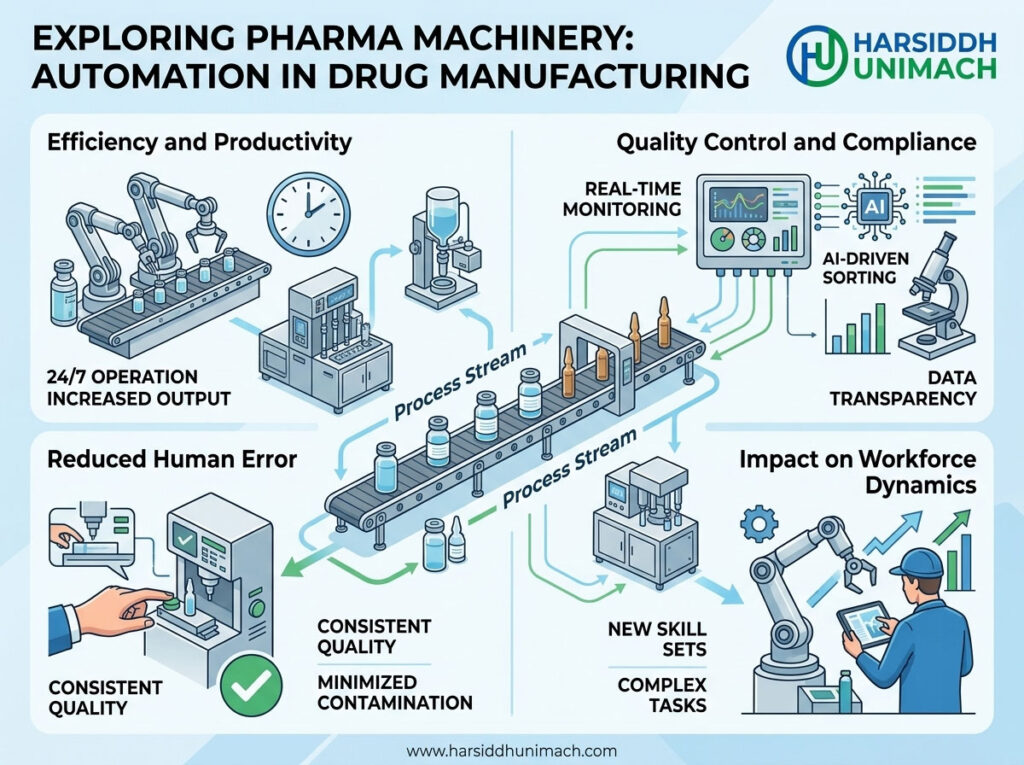
Pharmaceutical machinery has always evolved with the medicines it produces. Mechanical fillers gave way to cam-driven automatic lines; manual inspection gave way to machine-assisted inspection; paper batch records began giving way to electronic data. Today, the pace of change is faster than ever.
Several forces are driving it at once: regulators expect stronger data integrity and contamination control; product portfolios are becoming more varied, with smaller batches and more specialised medicines; supply chains demand traceability down to the individual pack; energy and material costs push manufacturers towards leaner, greener operations; and skilled labour is scarce in many regions.
In this article, we look at ten trends shaping the future of pharma machinery, what they mean in practice for filling, sealing, inspection and packaging equipment, and how manufacturers can prepare when planning their next investment.
1. Servo Technology Replaces Fixed Mechanics
For decades, many pharmaceutical machines relied on cams, gears and mechanical linkages. They were robust, but every change in fill volume, speed or container size meant mechanical adjustment or change parts.
Servo motors are steadily replacing these fixed mechanisms. A servo axis can be programmed for exact position, speed and motion profile, so:
- Fill volumes are set digitally rather than by turning a screw
- Motion profiles can be tuned to reduce splashing, foaming or glass breakage
- Recipes for each product and container are stored and recalled at changeover
- Individual heads can be fine-tuned independently
Servo control is already standard in many new filling, capping and labelling machines, and its use will keep expanding. For an engineering view, read how servo-driven vial filling systems outperform mechanical lines. Examples include the Automatic Servo Based Vial Filling Machine, the Automatic Servo Based Ampoule Filling and Sealing Machine, the servo based piston filling machine and the servo based gear pump filling machine.
2. Connected Machines and Industry 4.0
The next generation of machines does not just run; it communicates. Machines are increasingly connected to plant networks, sharing data on output, stoppages, alarms, settings and quality checks.
This connectivity enables:
- Real-time dashboards showing line performance and bottlenecks
- Overall equipment effectiveness (OEE) tracking to target improvements
- Integration with manufacturing execution systems (MES) for electronic batch records
- Remote diagnostics, allowing the machine supplier to help troubleshoot without travelling to site
For many plants, the first step is simply making sure new machines have standard communication interfaces, so they can be connected later even if the plant is not ready today.
3. Data Integrity Built into the Machine
Regulators worldwide emphasise data integrity: data must be attributable, legible, contemporaneous, original and accurate, among other principles. For machinery, this translates into features such as:
- User log-in with defined access levels
- Audit trails recording who changed which setting and when
- Secure, tamper-resistant storage of batch data
- Electronic records and, where applicable, electronic signatures
These features are moving from optional extras to baseline expectations on new pharmaceutical machines. When specifying equipment, manufacturers should check the control system’s data integrity capabilities against their own procedures and current regulatory guidance.
4. Serialization and End-to-End Traceability
Serialization, which gives each saleable pack a unique identifier, is now required or being introduced in many markets. It has reshaped packaging lines by adding printers, vision systems, aggregation stations and data management software.
In future, traceability will extend further: linking individual packs to batch data, process parameters and distribution records. Machines that print, verify and record codes reliably, and that integrate cleanly with serialization systems, will be essential. Read our guide to how serialization is transforming pharmaceutical packaging.
5. Flexible Lines for Smaller Batches
Many manufacturers now produce more products in smaller batches than in the past: specialised injectables, niche generics, contract manufacturing and market-specific packs. This shifts priorities from maximum speed towards flexibility:
- Quick, tool-less changeovers
- Recipe-driven settings
- Machines that handle a wide range of container sizes
- Compact monoblock designs that combine several steps on one frame
Monoblock machines, such as vial filling, stoppering and capping systems or the liquid bottle filling and capping machine (monoblock), reduce transfers, floor space and set-up time. Read monoblock vial filling, stoppering and capping explained. Complete compact solutions such as the automatic liquid vial filling line bring washing, depyrogenation, filling and sealing together in a smaller footprint.
6. Barrier Technology and Contamination Control
For sterile products, contamination control continues to tighten. Regulatory guidance places strong emphasis on reducing direct human intervention in critical zones. This is accelerating the adoption of:
- Restricted Access Barrier Systems (RABS) around filling and stoppering
- Isolators that fully separate the process from the operator
- Machines designed for cleanability and decontamination, with smooth surfaces and minimal hidden areas
- Automation of manual interventions, such as stopper loading or weight checks
Machine design is evolving to fit inside barriers: fewer parts within the critical zone, drives mounted outside, and easy access through glove ports. Read the rise of RABS and isolators in modern pharmaceutical vial filling machines and our article on the future of sterile filling: moving toward fully automated lines.
Upstream equipment is evolving too, with washers such as the linear vial washer and depyrogenation in a sterilizing tunnel for ampoules and vials designed for better integration with barrier filling systems.
7. Smarter Inspection
Inspection is moving from manual and semi-automatic methods towards more automated and data-rich systems:
- Camera-based inspection for particles, cracks, fill level, closure and labels
- Automatic rejection with recorded reasons
- Trend analysis that shows when defect rates begin to rise, allowing earlier corrective action
- Combination of inspection and serialization checks on packaging lines
Even where manual inspection remains, machines such as the visual ampoule and vial inspection machine improve consistency by presenting containers in a controlled way. Future systems will increasingly combine automated detection with human review of borderline cases.
8. Sustainability and Resource Efficiency
Energy, water and material use are under growing scrutiny, from both cost and environmental perspectives. Future machinery will focus on:
- Energy-efficient drives and standby modes
- Water-saving washers with recirculation and optimised spray patterns
- Reduced product loss through accurate dosing and clean cut-off
- Less packaging waste, including lighter materials and fewer rejects
- Longer machine life through robust design and support
Read our article on green manufacturing: reducing waste in liquid filling processes for practical steps.
9. Predictive Maintenance
Traditional maintenance is either reactive (fixing things when they break) or time-based (servicing on a schedule). Future machines will increasingly support predictive maintenance:
- Monitoring motor current, vibration, temperatures and cycle counts
- Alerting when a component is wearing faster than expected
- Planning maintenance during scheduled downtime rather than during production
This reduces unplanned stoppages and extends component life. Even without advanced sensors, recording stoppages and wear patterns gives valuable data for planning.
10. Easier Operation and Remote Support
As machines become more capable, they must also become easier to operate. Trends include:
- Intuitive touchscreen interfaces with graphical guidance
- Built-in changeover instructions and checklists
- Alarm messages that explain causes and solutions
- Multi-language interfaces for global operations
- Remote access (with appropriate security) so suppliers can support operators and engineers
This matters in a world where skilled operators are scarce and training time is limited.
Looking Further Ahead: New Products, New Containers
Beyond these ten trends, the medicines themselves are changing. Biologics, specialised injectables and combination products often need gentler handling, tighter contamination control and smaller batch sizes. Container formats are diversifying too, with more pre-filled syringes, cartridges, ready-to-use vials and nested containers. Machinery suppliers will need to offer equipment that adapts to these formats, handles sensitive products gently and keeps documentation and validation manageable. Manufacturers planning new facilities should consider which product types they may need to handle in the future, not just what they make today.
What This Means for Different Machine Types
| Machine Type | Likely Future Developments |
|---|---|
| Vial and ampoule fillers | Servo dosing, barrier integration, automated weight checks |
| Washers and tunnels | Water and energy efficiency, better integration with filling lines |
| Cap sealers | Servo control, data recording, closure integrity focus |
| Liquid and viscous fillers | Recipe-based changeovers, servo pumps, reduced product loss |
| Powder fillers | Better weight control, containment, feedback from checkweighers |
| Tablet and capsule counters | Smarter sensors, data recording, faster changeovers |
| Labellers | Integrated coding, inspection and serialization |
| Inspection systems | Camera-based detection, trend analysis |
For solid dose packaging, complete systems such as the tablet and capsule counting and filling line show how counting, capping, sealing and labelling are being combined into integrated lines.
How to Prepare for the Future When Buying Machinery
- Think in lifecycles – machines often run for many years, so consider how needs may change over that time.
- Prefer flexible designs – servo control, recipe management and wide format ranges protect your investment.
- Check connectivity – standard communication interfaces make future integration possible.
- Review data integrity features – access control, audit trails and secure records.
- Plan for contamination control – especially for sterile lines, consider compatibility with RABS or isolators.
- Look at total cost of ownership – energy, water, product loss, change parts and maintenance, not just purchase price.
- Value support – documentation, training, spare parts and remote support matter as much as the machine itself.
- Start small if needed – a modular or upgradeable machine lets you add features as your plant matures.
Browse our liquid filling machines and the vial filling machines for liquid vials to see current equipment options.
Challenges on the Road Ahead
The future of pharma machinery is exciting, but adopting new technology is not without challenges:
- Validation effort – every new machine, software update or process change must be qualified and documented. More software means more validation work.
- Cybersecurity – connected machines must be protected against unauthorised access. Network design, user management and secure remote access become part of machine selection.
- Legacy equipment – many plants run a mix of old and new machines. Connecting older machines may require retrofits or additional hardware.
- Skills gap – servo systems, networks and data tools require new skills in maintenance and engineering teams.
- Investment decisions – advanced features add cost, so manufacturers must decide which capabilities deliver real value for their products and markets.
- Standardisation – different suppliers may use different control platforms and data formats, complicating integration.
None of these is a reason to stand still, but each should be considered openly during planning.
A Practical Roadmap for Existing Plants
Not every plant can replace its lines at once. A step-by-step approach often works best:
- Measure first – record output, stoppages and rejects on existing lines to find the biggest losses.
- Target bottlenecks – upgrade or replace the machine that limits the line, rather than the whole line.
- Standardise new purchases – choose control platforms, interfaces and data features that will work together as the plant grows.
- Upgrade where it pays – retrofitting servo drives, sensors or better changeover parts can extend the life of sound older machines.
- Build skills alongside equipment – train operators and engineers as new technology arrives.
- Review regularly – revisit the plan as products, regulations and technology evolve.
This approach spreads investment over time while moving steadily towards a more flexible, connected and efficient operation.
The Human Side of Future Machinery
Advanced machines do not remove the need for skilled people; they change the skills needed. Operators will spend less time making mechanical adjustments and more time monitoring data, handling exceptions and ensuring quality. Engineers will need to understand servo systems, networks and software as well as mechanics. Training, clear procedures and good supplier support will be just as important as the technology itself.
Frequently Asked Questions
What is the future of pharma machinery? More servo control, connectivity, built-in data integrity, flexible small-batch capability, barrier technology for sterile products, smarter inspection, sustainability and predictive maintenance.
Why is servo technology important for the future? It allows digital settings, stored recipes, precise motion and faster changeovers, all of which support flexibility and quality.
How will data integrity affect machinery? New machines are expected to provide user access control, audit trails and secure data storage.
Are high-speed lines still important? Yes, for high-volume products, but many manufacturers increasingly need flexible lines that handle smaller batches and frequent changeovers.
How can manufacturers prepare? By choosing flexible, connectable machines with strong data integrity features and good supplier support, and by evaluating total cost of ownership.
Planning your next production line? Contact our team or send an inquiry to discuss machinery that is ready for the future of pharmaceutical manufacturing.