
In today’s manufacturing landscape, product diversity is no longer optional — it’s the norm. A single production line may be expected to run a water-thin syrup one shift and a viscous cream-based liquid the next, switching between bottle sizes, cap types, and fill volumes multiple times a week. Every minute the liquid filling machine sits idle during this transition is a minute of lost throughput, lost revenue, and — in regulated industries — a compliance risk if cleaning and verification steps aren’t handled correctly.
Changeover time is quietly one of the biggest hidden costs in liquid packaging operations. Yet it’s also one of the most controllable, once you understand the mechanical and engineering principles behind it. This guide, from Harsiddh Unimach Pvt. Ltd., breaks down exactly what drives changeover time on a liquid filling line and the engineering methods that reduce it — without compromising fill accuracy, hygiene, or compliance.
What Is Changeover Time, and Why Does It Matter So Much?
Changeover time is the total duration a filling machine remains non-productive while transitioning from one product, container size, or batch to another. It typically includes:
- Physically removing and replacing format parts (guide rails, star wheels, nozzles, neck holders)
- Adjusting fill volume, timing, and pump settings
- Cleaning or sanitizing product-contact parts (CIP/SIP where applicable)
- Running trial fills and verifying weight/volume accuracy
- Documentation and sign-off for regulated environments
On paper, this sounds like a routine maintenance task. In practice, it’s often the single largest source of Overall Equipment Effectiveness (OEE) loss on a filling line. A line that changes over four times a week and loses 90 minutes per changeover is losing roughly 6 hours of production time weekly — nearly a full extra shift’s worth of output, every single week, without a single mechanical fault occurring.
For contract manufacturers and multi-SKU plants, this number multiplies quickly. Reducing changeover time isn’t a “nice to have” efficiency tweak — it directly determines how many batches a facility can realistically run in a month.
The Engineering Root Causes of Long Changeovers
Before applying a fix, it helps to understand where changeover time is actually lost. In our experience engineering filling systems for pharmaceutical, food, and chemical manufacturers, the delay almost always comes from one of four sources:
1. Non-Modular Format Parts
Older or poorly designed machines use format parts that require full disassembly — multiple bolts, custom tools, and manual alignment — to swap between container sizes. Every extra fastener is extra time and an extra chance for misalignment.
2. Manual Fill-Volume Calibration
On machines without servo-controlled dosing, operators must manually adjust stroke length or pump timing and then run trial fills repeatedly until the volume is correct. This iterative “fill, weigh, adjust, repeat” cycle can consume the majority of total changeover time.
3. Poor Sequencing of Tasks
Many facilities perform changeover steps sequentially when several could be done in parallel — for example, staging the next batch’s format parts and cleaning solutions while the current batch is still running, rather than starting the search for tools only after the line has already stopped.
4. Inadequate Recipe Management
Without a digital recipe system, every changeover starts from scratch, relying on an operator’s memory or a paper log rather than a machine that can recall exact prior settings instantly.
Engineering Methods That Actually Reduce Changeover Time
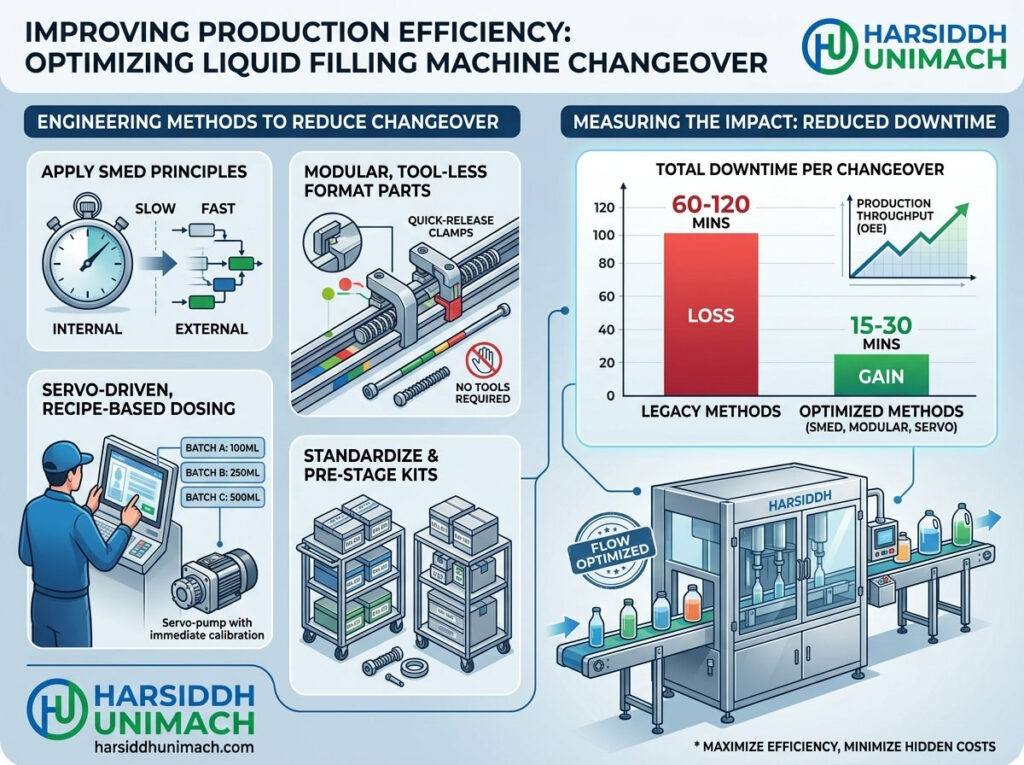
Method 1: Apply SMED Principles to Filling Line Changeovers
SMED (Single-Minute Exchange of Die) is a lean manufacturing methodology originally developed for stamping presses, but it applies directly to filling machines. Its core idea is separating changeover tasks into two categories:
- Internal tasks: Steps that can only be performed while the machine is stopped (e.g., physically swapping a nozzle head)
- External tasks: Steps that can be performed while the machine is still running the previous batch (e.g., pre-staging the next batch’s format parts, pre-mixing cleaning solution, pre-verifying documentation)
By converting as many internal tasks into external ones as possible, plants routinely cut changeover time by 40–60% without touching the machine’s core mechanics at all — it’s purely a workflow and preparation discipline.
Method 2: Modular, Tool-Less Format Parts
Mechanically, the single biggest lever for faster changeovers is designing format parts that don’t require tools. Quick-release clamps, spring-loaded guide rails, and color-coded, size-specific change parts let an operator swap a container-size configuration in minutes rather than hours.
Machines like the Automatic Peristaltic Based Liquid Filling Machine are a good example of this principle taken to its logical extreme — because the product only contacts a length of silicone tubing rather than valves, seals, or pistons, a full product changeover is often a matter of swapping the tube itself, with no disassembly of the fluid path at all.
Method 3: Servo-Driven, Recipe-Based Dosing
Replacing mechanical, manually-adjusted dosing systems with servo-driven pumps tied to a PLC-HMI recipe system removes almost all of the manual trial-and-error from fill-volume calibration. Once a product’s exact fill parameters — stroke length, speed, nozzle height, dwell time — have been programmed and validated once, the operator can recall that exact recipe with a single touchscreen selection on every future changeover, eliminating repeated “fill, weigh, adjust” cycles.
This is precisely the approach used in the Automatic Load Cell Based Liquid Filling Machine, where real-time weight feedback and micro-adjustments allow the system to hit target fill weights immediately after recipe recall, rather than requiring several manual verification cycles.
Method 4: Standardize and Pre-Stage Format Part Kits
Rather than storing format parts loosely and searching for the right size mid-changeover, leading plants organize format parts into labeled, complete kits — one kit per SKU or product family, containing every guide rail, star wheel segment, and nozzle needed for that configuration. This single organizational change, independent of any mechanical upgrade, frequently removes 10–15 minutes of pure searching and walking time from every changeover.
Method 5: Design for High-Viscosity and Multi-Product Flexibility from the Start
Facilities that run genuinely different product types — for instance, switching between a thin liquid and a viscous gel — benefit from selecting a filling platform engineered for that flexibility upfront, rather than retrofitting a single-purpose machine. The Automatic Gear Oil Filling Machine and the Automatic Liquid Detergent Filling Machine, for example, are both built with foam-suppression and viscosity-tolerant dosing systems specifically because their target industries run a wide product mix through the same line — reducing the engineering compromises that otherwise slow down a changeover between very different fluid types.
Method 6: Reduce Cleaning and Sanitation Time with Smarter Fluid Paths
For plants where cleaning is a major component of changeover time (particularly in food, dairy, and pharmaceutical applications), minimizing the number of product-contact surfaces has a direct, measurable effect. Machines with fewer valves, shorter fluid paths, and smooth, crevice-free stainless steel contact parts — such as the sanitary design used in the Automatic Milk Filling Machine — require significantly less manual scrubbing and rinse-verification time between batches.
Measuring the Impact: What “Good” Changeover Time Looks Like
While every product and container combination is different, well-engineered liquid filling lines with the methods above applied typically achieve:
| Changeover Type | Typical Legacy Time | Optimized Time (with SMED + Modular Parts + Recipe System) |
|---|---|---|
| Same product, different container size | 45–90 minutes | 10–20 minutes |
| Different product, same container | 60–120 minutes | 15–30 minutes |
| Different product and container (full changeover) | 90–180 minutes | 30–45 minutes |
The gap between the legacy and optimized columns is almost entirely attributable to engineering and process discipline — not to running the machine faster or cutting corners on quality checks.
A Practical Checklist for Reducing Changeover Time on Your Line
- Audit your current changeover — time each step with a stopwatch and categorize it as internal or external per SMED principles.
- Move preparation tasks earlier — stage format parts, cleaning solutions, and documentation before the current batch finishes.
- Invest in tool-less format parts wherever mechanically feasible, prioritizing the most frequently changed components first.
- Digitize your recipes — even a basic PLC recipe system removes the guesswork from fill-volume recalibration.
- Standardize format-part kits by SKU so operators are never searching for the right part mid-changeover.
- Review your fluid path design — fewer valves and smoother surfaces directly reduce cleaning-related downtime.
- Train operators specifically on changeover sequencing, not just machine operation — the biggest gains often come from workflow discipline rather than new hardware.
The Real Cost of Slow Changeovers: A Simple ROI Perspective
It’s easy to underestimate changeover losses because they don’t show up as a single dramatic failure — they accumulate quietly, shift after shift. Consider a mid-sized facility running two changeovers per day, five days a week, at 75 minutes per changeover. That’s 12.5 hours of lost production time every week, or roughly 650 hours annually — the equivalent of shutting the entire line down for more than 27 full days a year for no reason other than slow transitions.
Now compare that to the same facility after implementing SMED workflow changes and modular format parts, bringing average changeover time down to 25 minutes. The same schedule now loses only about 4.2 hours a week, or roughly 217 hours annually — recovering over 430 hours of production capacity every year without adding a single shift, hiring additional staff, or purchasing a second machine.
For most manufacturers, that recovered capacity is worth significantly more than the cost of the format-part upgrade or recipe-management retrofit that made it possible — which is why changeover optimization consistently ranks among the highest-ROI investments a filling line can make, ahead of many speed-focused upgrades.
Frequently Asked Questions
How much changeover time is considered “normal” for a liquid filling machine? It depends heavily on the complexity of the switch, but as a rough benchmark, a same-container product change should take well under 30 minutes on a well-engineered line, while a full changeover involving both container size and product type should be achievable within 45 minutes using modular parts and a digital recipe system.
Does reducing changeover time compromise fill accuracy or hygiene? No — when done correctly, faster changeovers come from removing wasted motion and manual guesswork, not from skipping validation or cleaning steps. Servo-driven recipe recall, for example, actually improves consistency because it eliminates operator-to-operator variation in manual calibration.
Can older filling machines be retrofitted for faster changeovers, or does it require a new machine? Many legacy machines can be retrofitted with modular format-part kits, quick-release fasteners, and in some cases servo-driven dosing upgrades. A full retrofit assessment is usually the fastest way to determine whether an existing machine can be improved or whether a purpose-built replacement offers a better long-term return.
What is the single most impactful first step for a plant looking to reduce changeover time? Start with a SMED audit — timing your current changeover process step by step and separating “internal” tasks (machine must be stopped) from “external” tasks (can be prepared in advance). This costs nothing beyond a stopwatch and a clipboard, and it routinely uncovers 20–40% of the time savings before any equipment is purchased.
Why Partner with Harsiddh Unimach Pvt. Ltd.
With over three decades of engineering experience and machinery exported to 50+ countries, Harsiddh Unimach Pvt. Ltd. designs liquid filling systems specifically to minimize changeover downtime without compromising accuracy or compliance. Our engineering approach includes:
- Servo-driven, recipe-based dosing for instant recall of validated fill parameters
- Modular, tool-less format parts across our Liquid Filling Machine range
- Sanitary, low-complexity fluid paths that reduce cleaning and changeover time in regulated environments
- Full validation documentation (DQ, IQ, OQ) to support fast, audit-ready changeovers in pharmaceutical settings
If your production line is losing hours every week to slow changeovers, our engineering team can help design or retrofit a system built around your specific SKU mix. For related reading, see our guide on Optimizing Your Pharmaceutical Packaging Line: The Essential Guide to Filling Machines.
Explore our full equipment range: www.harsiddhunimach.com Talk to our engineering team: info@harsiddhunimach.com