
Flat, oval, and square containers dominate the cosmetics, food, nutraceutical, and personal care shelves — think shampoo bottles, sanitizer sachets, ghee tins, and skincare tubs. These container shapes have one packaging challenge that round bottles never face: they need two labels applied to two different flat faces, at the exact same moment, with pixel-perfect alignment on both sides.
Get the front label a millimeter off-center and it’s a cosmetic flaw. Get the back label skewed, wrinkled, or misaligned with the front — and now the batch code, barcode, or MRP declaration on the back panel may not scan correctly at the retailer’s checkout counter, triggering compliance issues and returns.
This is exactly the problem a Front and Back Sticker Labeling Machine is engineered to solve. In this guide, we’ll break down how dual-side labeling systems actually achieve their precision, which components matter most, and what to check before you invest in one for your production line.
What Is a Front and Back Labeling Machine?
A front and back sticker labeling machine is an automated labeling system built specifically for containers with two opposing flat (or near-flat) surfaces. Instead of wrapping a single label around a cylindrical body — the way a round bottle labeler works — this machine uses two independent labeling heads positioned on opposite sides of the conveyor line. As each container passes through the labeling zone, both heads dispense and press their respective labels onto the container simultaneously.
The result: a front label (brand, product name, graphics) and a back label (ingredients, batch number, regulatory declarations) applied in one synchronized pass, at production speeds that can exceed 100–150 containers per minute depending on container size and label complexity.
This is different from a rotary sticker labeling machine, which wraps labels 360° around round containers, or a horizontal ampoule labeler, which is built for unstable, non-standing containers. Container geometry dictates machine architecture — and flat-faced packaging specifically needs the dual-head, linear-conveyor design a front and back labeler provides.
Why Precision Matters More Than It Looks
On paper, “apply two labels to a box-shaped bottle” sounds simple. In practice, precision on both sides simultaneously is one of the harder problems in packaging automation, for three reasons:
1. Two points of failure instead of one. A round-bottle wrap-around labeler only has to get one label right. A front and back machine has to get two labels right, on two different applicator heads, in the same fraction of a second — and both have to line up with the container’s edges and with each other.
2. Regulatory information usually lives on the back label. Batch numbers, expiry dates, and barcodes are typically printed on or near the back panel. If that label is skewed or misapplied, barcode scanners at the point of sale may reject it, and regulatory audits can flag it as a compliance gap.
3. Brand appeal lives on the front label. Retail shelf appeal is unforgiving — a crooked or bubbled front label undermines premium positioning instantly, regardless of how good the product inside is.
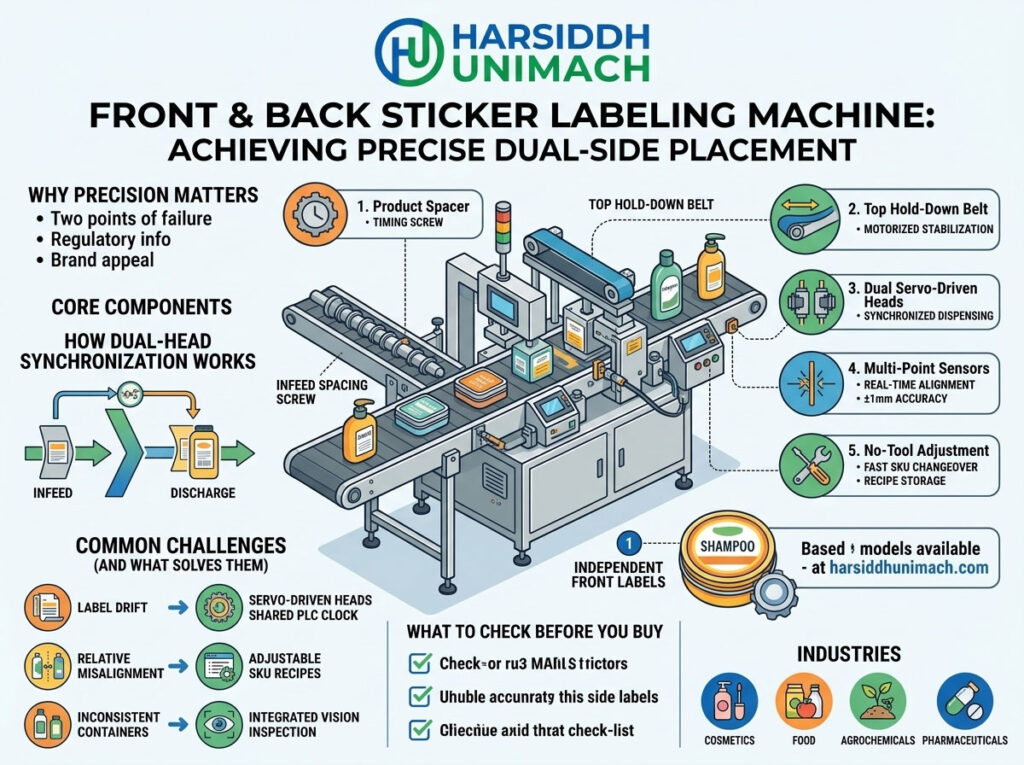
Core Components That Make Dual-Side Placement Possible
A well-engineered front and back labeling system depends on several components working in exact synchronization. Understanding these helps you evaluate machines properly instead of comparing them on speed specs alone.
1. Product Spacer / Infeed Screw
Before a container ever reaches the labeling zone, it needs to be spaced at a fixed, repeatable interval. An infeed spacer screw or timing screw ensures every container enters the labeling station at the exact same gap and orientation — because even a few millimeters of infeed inconsistency will throw off both applicator heads.
2. Top Hold-Down Belt
Flat and square containers, especially lightweight plastic ones, are prone to tilting or vibrating as two labeling heads press against them from opposite sides. A motorized overhead hold-down belt stabilizes the container from above during the entire labeling cycle, keeping it perfectly upright and centered between the two heads.
3. Dual, Independently Driven Labeling Heads
This is the heart of the machine. Each head has its own label dispensing mechanism, but both are electronically synchronized — typically via servo motors and a shared PLC clock — so that the front and back labels are dispensed and pressed onto the container within the same fraction of a second, at matched speed and pressure.
4. Multi-Point Alignment Sensors
High-precision systems use optical sensors at multiple points along the labeling zone to detect container position in real time, feeding continuous correction data to the servo controllers. This is what allows a well-built machine to hold tolerances around ±1mm even at full production speed.
5. No-Tool Adjustment System
Because product lines run multiple SKUs, the labeling heads need to be repositioned for height, width, and tilt whenever the container size changes. Machines with calibrated handwheels (rather than wrench-and-bolt manual resets) cut changeover time from hours to minutes, and PLC-based “recipe” storage lets operators recall saved settings for a given SKU instantly.
How Dual-Head Synchronization Actually Works
It helps to walk through the sequence a container goes through inside the machine:
- Infeed and spacing — the timing screw or spacer mechanism sets a fixed gap between containers entering the line.
- Stabilization — the top hold-down belt engages, locking the container’s orientation as it enters the labeling zone.
- Position detection — sensors confirm the exact position of the container relative to both labeling heads.
- Synchronized dispensing — both heads release their labels at a servo-calculated moment, matched to the container’s speed through the zone.
- Pressing — foam-lined or brush-style pressing units apply even pressure on both faces simultaneously, eliminating bubbles and ensuring full adhesive contact.
- Discharge — the labeled container exits toward the next process stage, whether that’s batch coding, vision inspection, or cartoning.
If any one of these steps drifts out of calibration — a worn hold-down belt, a slipping timing screw, a sensor that’s collecting dust — both labels suffer, because the entire system depends on precise coordination rather than any single component working in isolation. For a deeper look at how small maintenance gaps compound into placement errors over time, see our breakdown of the most common labeling mistakes manufacturers make.
Common Alignment Challenges (And What Solves Them)
Challenge: Labels drift out of alignment as production speed increases. This usually traces back to unsynchronized head timing or a hold-down belt that isn’t gripping firmly enough at higher line speeds. Servo-driven heads with closed-loop feedback correct for this automatically; belt-driven mechanical systems tend to degrade faster under speed increases.
Challenge: Front and back labels line up individually but not relative to each other. This is a calibration issue between the two heads’ reference points, not a single-head problem. Machines with a shared PLC clock and synchronized encoder feedback avoid this by treating both heads as one coordinated system rather than two independent ones.
Challenge: Inconsistent results across different container batches. Variation in container wall thickness, weight, or surface texture (common with recycled or thin-gauge plastic) can throw off hold-down pressure. Adjustable, calibrated pressure settings per SKU — saved as a recipe — solve this without requiring manual guesswork on every changeover.
Challenge: Labels apply correctly but batch codes underneath aren’t legible. This typically means the labeling and coding stations aren’t properly synchronized, or the printed code quality wasn’t verified before application. Integrating a vision inspection system immediately downstream catches this before non-compliant units reach cartoning.
What to Check Before You Buy
If you’re evaluating front and back labeling machines for your line, run through this checklist:
- Placement accuracy spec — look for ±1mm or better, verified under load, not just at idle speed.
- Changeover method — no-tool, handwheel-based adjustment with recipe storage saves hours per week on multi-SKU lines.
- Build material — SS 304/316 construction matters for washdown environments and cGMP-regulated facilities.
- Integration readiness — confirm the machine can host inline coding (TIJ, TTO, hot foil) and vision inspection without a separate retrofit.
- Container range — verify the machine’s adjustable width and height range actually covers your full SKU portfolio, including future product launches.
- Support and spares availability — foam pads, wrap belts, and rollers are wear items; confirm lead times for replacement parts before committing.
Industries That Rely on Front and Back Labeling
- Cosmetics and personal care — shampoo, lotion, and cream bottles with front branding and back ingredient panels
- Food and beverage — sauce bottles, ghee tins, and snack packaging requiring nutritional information on the reverse face
- Agrochemicals — pesticide and fertilizer containers where regulatory warning labels must appear clearly on the back panel
- Pharmaceutical and nutraceutical — supplement bottles and OTC packaging where batch and expiry data must be legible and scannable
The Harsiddh Unimach Advantage
At Harsiddh Unimach Pvt. Ltd., our Automatic Front and Back Sticker Labeling Machine is built around exactly the synchronization principles covered above:
- Synchronous multi-point alignment system holding accuracy of ±1mm at full production speed
- Motorized top hold-down belt to keep every container stable regardless of wall thickness or weight
- Independent, servo-synchronized dual labeling heads for true simultaneous front-and-back application
- No-tool, calibrated handwheel adjustments with PLC-based recipe storage for fast SKU changeovers
- Full integration readiness with inline coding and vision inspection systems for complete track-and-trace compliance
Our machines are part of a wider Labeling Machines range that also includes rotary wrap-around labelers, horizontal ampoule labelers, tube labelers, and shrink sleeve applicators — so whether your line runs round bottles, ampoules, tubes, or flat-faced containers, there’s a purpose-built solution rather than a compromise.
Conclusion
Precise dual-side label placement isn’t the result of one clever component — it’s the outcome of an entire system working in synchronization: spacing, stabilization, dual-head servo control, and real-time sensor correction, all calibrated to your specific container and SKU mix. Understanding these mechanics gives you a real basis for evaluating machines on more than just a speed spec sheet, and for catching alignment problems on your existing line before they turn into rejected batches or compliance flags.
If you’re planning a new labeling line or upgrading an existing one, our engineering team at Harsiddh Unimach Pvt. Ltd. can walk through your specific container geometry, SKU range, and line speed requirements to recommend the right configuration.
Get in touch: 🌐 www.harsiddhunimach.com 📧 info@harsiddhunimach.com