
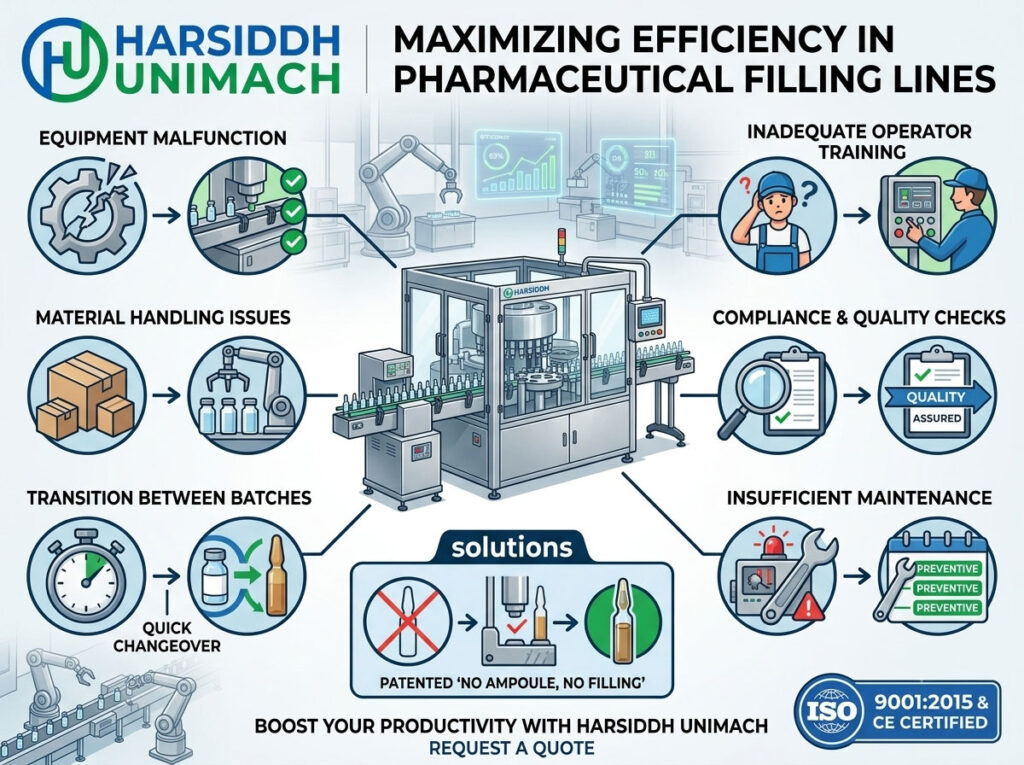
Every minute a pharmaceutical filling line is not producing good product is a minute of lost capacity. Downtime delays batches, increases costs, puts pressure on staff and, in sterile production, can even put product at risk when open containers wait at the wrong moment.
Yet many plants do not know exactly why their lines stop. Operators remember the big breakdowns, but the hundreds of short stops, slow changeovers and waiting times that quietly add up are often invisible.
This article explains the most common causes of downtime in pharmaceutical filling lines, whether vial, ampoule, syrup, powder or tube lines, how to identify them and what practical steps reduce them. The aim is simple: more good product from the same equipment, staff and floor space.
First, Make Downtime Visible
You cannot reduce what you cannot see. Before trying to fix anything, start recording:
- Every stoppage – start time, end time, machine and reason
- Changeovers – start and finish, including cleaning and line clearance
- Speed losses – periods when the line runs below its rated speed
- Rejects – quantity and reason
A simple paper log or spreadsheet is enough to begin. After a few weeks, patterns appear. Many plants use OEE (Overall Equipment Effectiveness), which combines availability, performance and quality, to track progress over time.
Cause 1: Changeovers
Why it happens
Changeovers between products, batch sizes or container formats are often the single largest source of planned downtime, especially in multi-product plants. They include line clearance, cleaning, changing format parts, adjusting settings, documentation and start-up checks.
Typical problems
- Parts and tools not prepared in advance
- Settings adjusted by trial and error
- Incomplete or unclear procedures
- Waiting for quality approval to restart
How to reduce it
- Prepare externally – stage change parts, tools and materials while the line is still running
- Standardise – illustrated procedures, checklists and labelled change parts
- Use recipes – servo machines store fill volumes and motion settings
- Quick-release parts – reduce tool use and adjustment time
- Coordinate with QA – plan approvals so they do not delay restart
For detailed methods, read liquid filling machine changeover time: engineering methods to improve production efficiency and vial filling machine changeover: best practices for faster product and format changes.
Cause 2: Equipment Breakdowns
Why it happens
Mechanical, electrical and pneumatic failures stop the line unexpectedly. Common examples include worn pump seals, failed sensors, broken belts, jammed star wheels, worn cams and pneumatic leaks.
How to reduce it
- Preventive maintenance – replace wear parts on schedule rather than waiting for failure
- Daily operator checks – listen, look and feel for early warning signs
- Critical spares – keep key parts on site to shorten repair time
- Root cause analysis – fix the underlying cause of repeat failures
- Supplier support – training for maintenance staff and access to technical help
Practical guidance is available in vial filling machine maintenance: 7 best practices to prevent unscheduled downtime and the ampoule filling machine maintenance checklist.
Cause 3: Micro-Stops and Jams
Why it happens
Short stoppages, often only seconds or a few minutes, caused by containers tipping, jamming at transfers, missing caps or stoppers, sensor faults or broken glass. Individually they seem trivial; together they can cost a large share of production time.
How to reduce it
- Record micro-stops – they are often not logged because they are cleared quickly
- Check change parts – worn or wrong-size star wheels, guides and scrolls cause jams
- Inspect incoming components – out-of-tolerance containers, caps and stoppers cause feeding problems
- Clean sensors – dust and product residues cause false signals
- Improve feeding – adjust unscramblers, hoppers and vibratory bowls
Cause 4: Line Imbalance
Why it happens
A filling line is only as fast as its slowest machine. If the washer, tunnel, filler, capper, inspection machine and labeller are not matched, some machines wait while others become bottlenecks. Stops at one machine ripple through the line.
How to reduce it
- Identify the bottleneck – the machine that limits overall output
- Balance speeds – set each machine slightly faster than the bottleneck so it never starves or blocks
- Add buffers – short accumulation conveyors absorb brief stoppages
- Plan integrated lines – where machines are designed and synchronised together
For example, a vial line might combine a linear vial washer, a sterilizing tunnel for ampoules and vials, a filling machine, a vial cap sealing machine, a visual ampoule and vial inspection machine and a vial sticker labeling machine. Each must keep pace with the others. Integrated solutions such as the automatic liquid vial filling line are designed with this balance in mind.
Cause 5: Material and Component Shortages
Why it happens
The line stops because containers, stoppers, caps, labels or product are not available at the right time, or the wrong components arrive.
How to reduce it
- Kitting – prepare all materials for a batch before it starts
- Clear material flow – defined staging areas near the line
- Supplier quality – consistent component dimensions reduce feeding problems
- Communication – production planning, warehouse and production working together
Cause 6: Utility Problems
Why it happens
Filling lines depend on utilities: electricity, compressed air, vacuum, nitrogen, purified water, steam, gas and HVAC. Low pressure, poor quality or interruptions stop machines or trigger alarms.
How to reduce it
- Size utilities correctly for all machines running together
- Monitor pressures and quality at the point of use
- Maintain compressors, vacuum pumps and filters
- Plan for redundancy where critical
Read liquid filling machine utility requirements for pharmaceutical plants for guidance.
Cause 7: Quality Holds and Rejects
Why it happens
The line stops when in-process checks show fill weights out of limits, sealing defects, particle contamination or label errors. High reject rates also reduce effective output even when the line keeps running.
How to reduce it
- Stable processes – accurate dosing, consistent sealing, clean product paths
- Trend monitoring – catch drift before it causes out-of-limit results
- Fix root causes – rather than simply rejecting more product
- Accurate machines – servo-driven dosing, such as the Automatic Servo Based Liquid Filling Machine or the servo based piston filling machine, reduces fill variation
Cause 8: Cleaning and Sanitisation
Why it happens
Cleaning between batches and products is essential but can take longer than necessary when machines are hard to dismantle, procedures are unclear or drying times are long.
How to reduce it
- Hygienic design – smooth surfaces, quick-release parts, minimal hidden areas
- Clear, validated procedures
- Prepared cleaning kits and dedicated tools
- Parallel work – cleaning one area while preparing another
Cause 9: Human Factors
Why it happens
Inexperienced operators, unclear instructions, poor communication between shifts and fatigue all contribute to stoppages, errors and slow recovery from problems.
How to reduce it
- Training – especially for changeovers, troubleshooting and quality checks
- Standard work – clear, visual instructions at the machine
- Shift handovers – structured communication of problems and status
- Operator involvement – operators often know the causes of losses best
- User-friendly machines – clear HMI screens and alarm messages
Cause 10: Documentation and Administrative Delays
Why it happens
Waiting for batch records, approvals, line clearance sign-offs or test results can keep a ready line idle.
How to reduce it
- Plan documentation ahead of the batch
- Electronic records where appropriate
- Clear responsibilities for approvals
- Schedule QA support for critical points
Planned vs Unplanned Downtime
It helps to separate downtime into two groups, because they need different solutions:
| Type | Examples | Main Lever |
|---|---|---|
| Planned | Changeovers, cleaning, scheduled maintenance, planned breaks | Make planned stops shorter and better organised |
| Unplanned | Breakdowns, jams, material shortages, utility failures, quality holds | Prevent them through maintenance, process control and planning |
Planned downtime is often accepted as “normal”, yet it can usually be shortened significantly. Unplanned downtime is more disruptive because it is unpredictable, causes stress and can leave product exposed. A good programme tackles both.
Early Warning Signs to Watch For
Many breakdowns and quality holds give warning before they happen. Train operators and engineers to notice:
- Fill weights slowly drifting – often a sign of seal wear or supply changes
- More frequent minor jams at one transfer point – worn or misaligned parts
- Unusual noises or vibration from drives, pumps or conveyors
- Longer cycle times or machines struggling to reach set speed
- Rising reject counts for a particular defect
- Utility pressures fluctuating during peak demand
- Alarms repeating more often than usual
Acting on these signs during planned downtime is far cheaper than repairing a failure in the middle of a batch.
Summary: Downtime Causes and Fixes
| Cause | Typical Fix |
|---|---|
| Changeovers | External preparation, standard procedures, recipes, quick-release parts |
| Breakdowns | Preventive maintenance, spares, root cause analysis |
| Micro-stops | Logging, correct change parts, component quality, sensor cleaning |
| Line imbalance | Bottleneck focus, speed balancing, buffers, integrated lines |
| Material shortages | Kitting, staging, supplier quality |
| Utility issues | Correct sizing, monitoring, maintenance |
| Quality holds | Stable processes, trend monitoring, accurate machines |
| Cleaning | Hygienic design, clear procedures |
| Human factors | Training, standard work, handovers |
| Documentation | Advance planning, clear responsibilities |
Calculating the Cost of Downtime
Putting a value on downtime helps justify improvement work. A simple approach is to multiply the hours lost by the value of the output the line would have produced in that time, then add extra costs such as overtime, wasted product, scrapped components and additional cleaning. Even a rough estimate often shows that small, regular losses, such as a few minutes per changeover or frequent short jams, add up to more than the occasional major breakdown. Use your own production data for this calculation, and repeat it as improvements take effect to show progress.
Building a Downtime Reduction Programme
- Measure – record all stoppages, changeovers, speed losses and rejects for several weeks.
- Analyse – rank causes by total time lost.
- Prioritise – focus on the top two or three causes.
- Act – find root causes and implement practical fixes.
- Verify – confirm that the loss has actually reduced.
- Standardise – update procedures and training.
- Repeat – move on to the next biggest loss.
Short daily reviews at the line, visual performance boards and regular cross-functional meetings keep the programme alive.
The Role of Machine Design
Well-designed machines make downtime reduction easier:
- Servo drives and recipes for fast changeovers
- Quick-release, colour-coded change parts
- Accessible layouts for cleaning and maintenance
- Clear HMI alarms that speed up troubleshooting
- Robust safeguards such as no container, no fill
- Integrated designs such as the liquid bottle filling and capping machine (monoblock) or the Automatic Liquid Bottle Filling and Capping Machine (Monoblock), which reduce transfers between machines
Reliable infeed equipment, such as a bottle unscrambler, also prevents many feeding-related micro-stops on bottle lines.
Compliance Considerations
In pharmaceutical production, efficiency improvements must never compromise product quality or GMP. Changes to validated processes, settings or procedures should go through change control and, where necessary, revalidation. Involve quality assurance early so improvements can be implemented smoothly. For ampoule-specific guidance, read how to optimize your ampoule filling line, and for labeller upkeep see high-speed labeling machine maintenance.
Frequently Asked Questions
What are the most common causes of downtime in pharmaceutical filling lines? Changeovers, equipment breakdowns, micro-stops, line imbalance, material shortages, utility problems, quality holds, cleaning, human factors and documentation delays.
How can I measure downtime? Record every stoppage with its duration and reason, along with changeovers, speed losses and rejects. OEE is a useful overall measure.
What is the quickest way to reduce downtime? Usually, preparing changeovers externally, fixing frequent micro-stops and balancing line speeds deliver quick results.
How does machine design affect downtime? Servo drives, recipes, quick-release parts, accessible layouts and clear alarms all reduce changeover and troubleshooting time.
Do downtime improvements need revalidation? Changes to validated processes or settings must go through change control and may need revalidation.
Want to reduce downtime on your filling line? Contact our team or send an inquiry to discuss your line, current losses and improvement goals.