
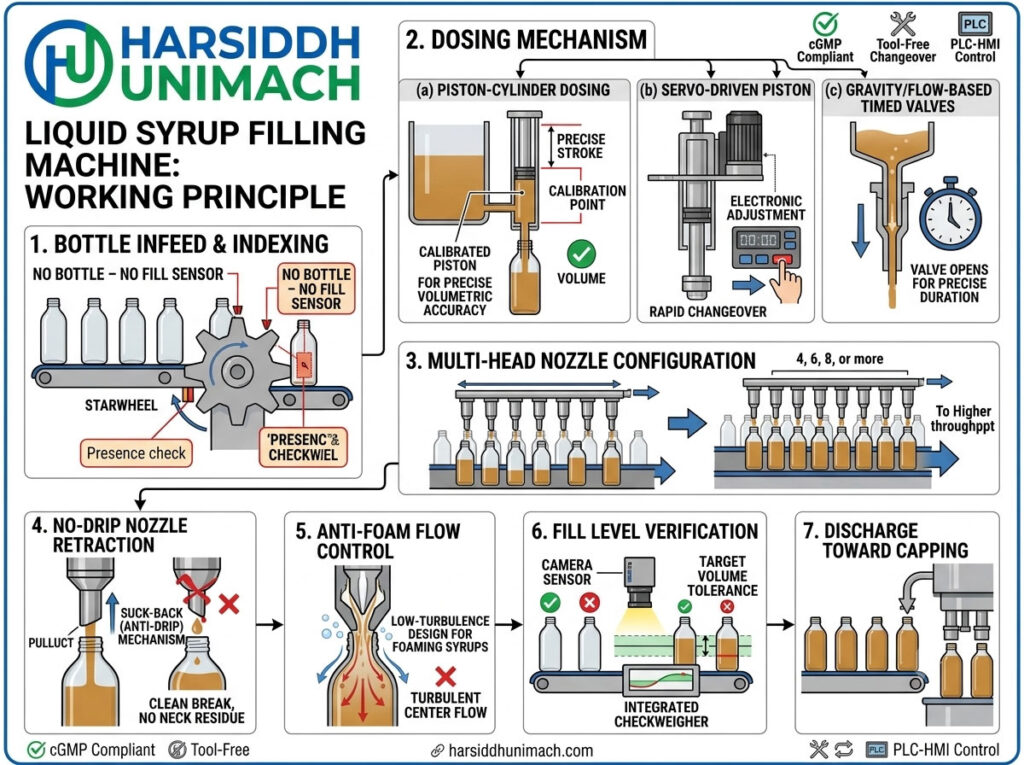
Cough syrups, paediatric suspensions, antacids, multivitamin tonics, iron syrups, herbal and Ayurvedic syrups: liquid syrups are among the most widely produced pharmaceutical dosage forms. They are filled into amber glass or PET bottles in sizes from small paediatric packs to large family bottles, and every bottle must contain at least the volume stated on the label without wasteful overfilling.
There is no single “syrup filling machine”. Manufacturers can choose from several filling technologies, each with its own working principle, and from several machine levels, from simple semi-automatic fillers to fully automatic monoblock lines. The right combination depends on the syrup, the output and the budget.
This article explains the working principle of each main filling technology, how the syrup travels from the mixing tank to the bottle, the different machine levels available, and how to check and control fill accuracy. For a detailed walk-through of an automatic line, including capping, cup placement and induction sealing, see our automatic liquid syrup filling machine working principle.
Understanding Syrup as a Product
Before choosing a technology, understand how your syrup behaves:
| Syrup Property | What It Means for Filling |
|---|---|
| Viscosity | Sugar-based syrups are thicker than water; thickness varies with sugar content and temperature |
| Temperature dependence | Viscosity falls as temperature rises, which can affect flow-based filling |
| Suspended solids | Suspensions must be kept uniform so every bottle gets the same dose |
| Foaming | Some formulations foam when splashed or agitated |
| Stickiness | Sugar residues on necks interfere with capping and labelling |
| Density | Matters when converting fill volume to weight for checks |
Dry syrups, which are powders reconstituted before use, need completely different equipment. See our dry syrup filling machine working principle.
From Mixing Tank to Filler
The filling machine is the final step of a product path that starts in the manufacturing area:
- Manufacturing vessel – the syrup is prepared, mixed and, for suspensions, homogenised.
- Transfer – the syrup is pumped or pressure-transferred to a holding tank near the filler, often through a filter.
- Holding (buffer) tank – stores syrup during filling. For suspensions, a slow stirrer keeps solids evenly distributed.
- Filler supply – syrup flows from the holding tank to the filler’s hopper or manifold, with a level control to keep supply steady.
A stable supply is important. Changes in hopper level, temperature or air content can all affect fill accuracy, whichever technology is used.
Filling Technology 1: Gravity Filling
Working principle
Syrup flows from an elevated tank through a valve into the bottle under its own weight. The fill volume is controlled by timing: the valve opens for a set time.
Suitability for syrups
- Works best for thin, free-flowing liquids with stable viscosity.
- Because flow rate depends on viscosity and head height, changes in temperature or tank level affect the fill.
- Generally less suited to thick syrups and suspensions.
Filling Technology 2: Piston (Volumetric) Filling
Working principle
A piston moves inside a precision cylinder. On the suction stroke, syrup is drawn in through a valve; on the delivery stroke, the same volume is pushed out through the nozzle into the bottle. Fill volume is set by the piston stroke length.
Suitability for syrups
- Handles a wide range of viscosities, from thin syrups to thick tonics.
- Delivers a consistent volume largely independent of small viscosity changes.
- Suitable for suspensions when combined with stirred supply tanks.
- The most widely used technology for pharmaceutical syrups.
See the volumetric liquid bottle filling machine.
Filling Technology 3: Servo-Driven Piston Filling
Working principle
The same piston principle, but each piston is driven by a servo motor instead of a mechanical cam or crank.
Advantages
- Digital fill setting from the touchscreen
- Individual head adjustment to balance multi-head machines
- Programmable speed profiles – slow start and finish to reduce foaming and splashing
- Recipe storage for quick changeovers between products and bottle sizes
For more detail, read servo based liquid filling machines explained.
Filling Technology 4: Pump Filling (Gear, Lobe or Peristaltic)
Working principle
A positive displacement pump delivers syrup continuously. The fill volume is controlled by pump revolutions or running time.
Suitability for syrups
- Gear and lobe pumps handle viscous syrups and larger volumes well.
- Peristaltic pumps keep the syrup inside tubing only, simplifying cleaning; they suit smaller volumes and products where cross-contamination must be minimised.
Filling Technology 5: Flow Meter Filling
Working principle
A flow meter measures the volume or mass passing through it, and the valve closes when the target is reached.
Suitability for syrups
- Can be very accurate, especially mass flow meters that are unaffected by density changes.
- Higher cost and more complex; often used for high-value products or where frequent volume changes are needed.
Comparing Filling Technologies for Syrups
| Technology | Fill Controlled By | Viscosity Range | Suspensions | Typical Use |
|---|---|---|---|---|
| Gravity | Valve opening time | Thin liquids | Not ideal | Simple, thin products |
| Piston | Piston stroke | Thin to thick | Yes, with stirring | Most pharmaceutical syrups |
| Servo piston | Programmed stroke | Thin to thick | Yes, with stirring | Multi-product, high accuracy |
| Pump | Revolutions or time | Medium to thick | Depends on pump | Viscous syrups, larger volumes |
| Flow meter | Measured volume or mass | Wide | Depends on meter | High-value or flexible lines |
For a broader comparison, read liquid filling machine technologies compared.
Machine Levels: From Semi-Automatic to Monoblock
Semi-automatic fillers
The operator places each bottle under the nozzle and starts the fill, usually with a foot pedal or button. Ideal for small batches, R&D, start-ups and small Ayurvedic or herbal producers.
Automatic linear fillers
Bottles travel on a conveyor; gates hold a group of bottles under multiple nozzles, which fill them simultaneously. Output depends on the number of heads. See the Automatic Liquid Syrup Filling Machine.
Automatic rotary fillers
Bottles are carried continuously in star wheel pockets while moving nozzles fill them. Rotary designs suit higher outputs and continuous motion.
Monoblock filling and capping
Filling and capping are combined on one frame with one drive. This saves floor space, reduces bottle transfers and simplifies line control. See the Automatic Liquid Bottle Filling and Capping Machine (Monoblock) and the liquid bottle filling and capping machine (monoblock).
| Machine Level | Output | Labour | Investment | Best For |
|---|---|---|---|---|
| Semi-automatic | Low | High | Low | Small batches, start-ups |
| Automatic linear | Medium | Low | Medium | Growing production, flexibility |
| Automatic rotary | High | Low | Higher | Dedicated high-volume lines |
| Monoblock | Medium to high | Low | Medium to higher | Space-saving integrated lines |
Browse our liquid filling machines and the bottle filling machines for oral liquids.
The Filling Cycle in Brief
Whatever the technology, an automatic syrup filler follows this cycle:
- Bottles arrive from the unscrambler, such as a bottle unscrambler, and cleaning machine.
- Bottles are positioned under the nozzles and their presence confirmed.
- Nozzles descend into the bottles, often diving close to the bottom to reduce foaming.
- The dose is delivered, with nozzles rising as the bottle fills.
- Drip control (suck-back, shut-off or drip tray) prevents syrup on necks.
- Filled bottles are released to the capper.
After Filling
Syrup bottles are typically:
- Capped with ROPP or screw caps on a bottle screw and ROPP capping machine or, for small batches, a semi-automatic ROPP capping machine. Browse all capping machines.
- Fitted with a measuring cup, using the Automatic Measuring Cup Placement Machine or the automatic measuring cup placement machine
- Induction sealed on an induction sealing machine
- Labelled on a bottle sticker labeling machine
Matching Technology to Common Syrup Types
| Syrup Type | Typical Characteristics | Common Filling Approach |
|---|---|---|
| Clear cough and cold syrups | Moderate viscosity, clear | Piston or servo piston filling |
| Paediatric suspensions | Contain suspended solids | Piston filling with stirred supply tank |
| Antacid suspensions | Thick, opaque, solids present | Piston or pump filling with good agitation |
| Multivitamin and iron tonics | Sugar-rich, can be sticky | Piston filling with strong drip control |
| Herbal and Ayurvedic syrups | Variable viscosity, may contain extracts | Piston filling, sometimes semi-automatic for small batches |
| Sugar-free syrups | Often thinner | Piston, pump or flow meter filling |
These are general patterns. The right choice for any product should be confirmed with trials on the actual syrup.
Hygiene, Cleaning and Changeover
Syrups contain sugars and other ingredients that can support microbial growth if residues are left in the machine. Good practice includes:
- Smooth, polished contact parts that are easy to remove and clean
- Cleaning immediately after each batch, before residues dry and harden
- Flushing product paths with suitable cleaning solutions and rinsing thoroughly
- Drying parts before reassembly to prevent microbial growth
- Clear cleaning procedures with records for each batch
A typical changeover between products or bottle sizes includes line clearance, cleaning, changing nozzles and bottle guides, setting the new fill volume (by stroke or recipe), and running test bottles to confirm fill accuracy before production. Servo machines with stored recipes and quick-release parts make this faster and more consistent.
Checking Fill Accuracy
Syrups are usually sold by volume, but fill checks are often done by weight because weighing is fast and precise. To convert, divide the net weight by the syrup’s density at the filling temperature. Since density varies between products and with temperature, each product needs its own established density value.
Good practice includes:
- Checking fill weights from every head at start-up
- Sampling at defined intervals during production
- Trending results to spot drift early
- Adjusting individual heads when needed
- Recording results in the batch documentation
Troubleshooting Common Syrup Filling Problems
| Problem | Likely Cause | Corrective Action |
|---|---|---|
| Fill variation over the shift | Temperature or level changes in supply | Stabilise supply temperature and level |
| Variation between heads | Worn seals, air in one pump | Service pumps, bleed air, trim heads |
| Foaming and overflow | Top filling, high speed | Use diving nozzles, slow fill start |
| Sticky necks | Dripping nozzles | Improve suck-back or shut-off |
| Uneven suspension doses | Poor stirring in supply tank | Check stirrer speed and tank design |
| Gravity filler inconsistent | Viscosity changes | Control temperature or switch to piston filling |
How to Choose a Liquid Syrup Filling Machine
- Syrup properties – viscosity, suspensions, foaming
- Fill volume range and bottle sizes
- Output – semi-automatic, linear, rotary or monoblock
- Filling technology – piston, servo piston, pump or flow meter
- Changeover needs and number of products
- Downstream integration – capping, cup placement, sealing, labelling
- GMP and documentation requirements
Frequently Asked Questions
What is the working principle of a liquid syrup filling machine? It measures a set volume of syrup, most commonly with a piston pump, and delivers it through a nozzle into each bottle. Other technologies include gravity, pump and flow meter filling.
Which filling technology is best for syrups? Piston filling is the most widely used for pharmaceutical syrups because it handles a range of viscosities and gives consistent volumes. Servo pistons add flexibility and digital control.
Why are fills checked by weight? Weighing is fast and precise. The weight is converted to volume using the syrup’s density.
Is gravity filling suitable for syrup? Mainly for thin, free-flowing syrups with stable viscosity. Thick syrups and suspensions are better filled with piston or pump fillers.
What is a monoblock syrup filling machine? A machine that combines filling and capping on one frame, saving space and reducing bottle transfers.
Planning a liquid syrup filling line? Contact our team or send an inquiry with your syrup details, bottle sizes and output targets.