
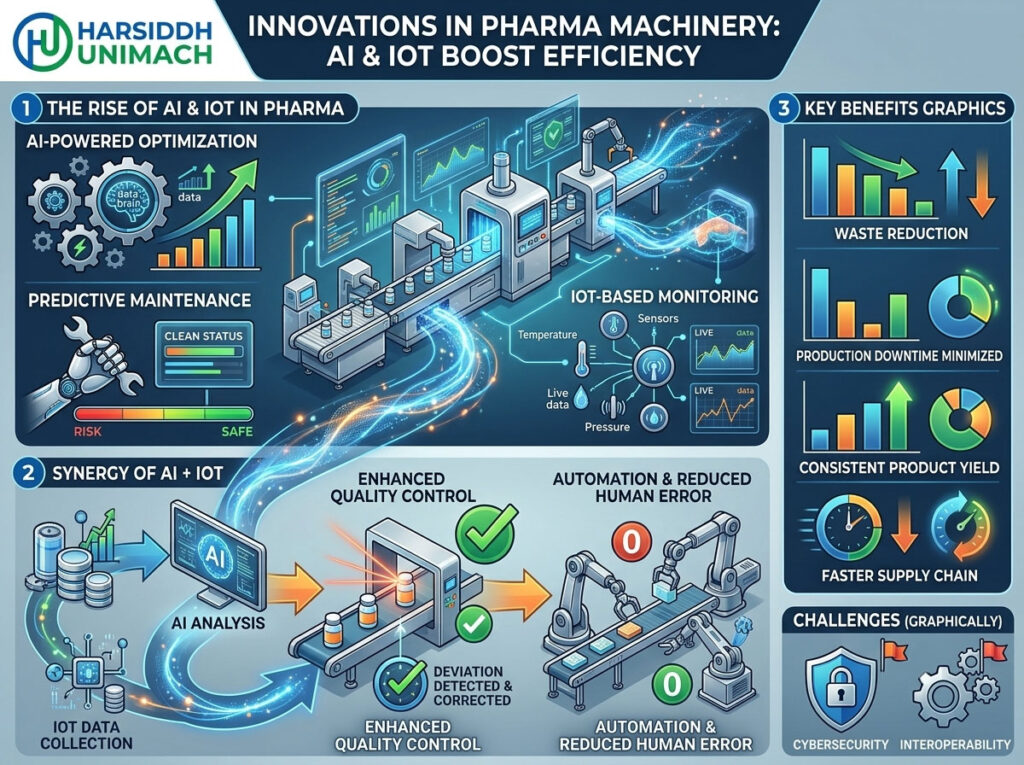
Artificial intelligence has moved from science fiction into everyday life: it recommends what we watch, translates languages and helps doctors read scans. In pharmaceutical manufacturing, AI is beginning to change how machines inspect products, how they are maintained and how processes are controlled.
But pharmaceutical production is not like other industries. Every process must be validated, every decision must be traceable and patient safety always comes first. That makes the adoption of AI both promising and challenging.
In this article, we explore how AI is being applied to pharmaceutical machinery today, where it is likely to go next, what challenges manufacturers face in validating and trusting it, and what practical steps you can take now to prepare your production lines. We focus on filling, sealing, inspection and packaging, the areas where machines meet the product most directly.
What Do We Mean by AI in Machinery?
“AI” is a broad term. In the context of production machinery, it usually refers to:
- Machine learning (ML) – algorithms that learn patterns from data rather than following only fixed, hand-written rules. For example, a system trained on thousands of images of good and defective vials can learn to tell them apart.
- Deep learning – a type of machine learning using neural networks, particularly effective for image recognition.
- Anomaly detection – systems that learn what “normal” looks like and flag anything unusual.
- Optimisation algorithms – tools that search for the best settings to achieve a goal, such as minimum fill variation or maximum output.
AI does not replace the machine’s mechanics. A filler still needs a pump, a capper still needs heads and a labeller still needs a label web. AI adds a layer of intelligence on top, using data from sensors, cameras and controls to make better decisions.
Application 1: AI-Powered Visual Inspection
Visual inspection is one of the most promising areas for AI in pharma.
The challenge
Injectable products in vials and ampoules must be inspected for visible particles, glass defects, cracks, fill level, closure defects and cosmetic flaws. Traditional automated systems use rule-based image processing: engineers define thresholds for brightness, size and shape. These systems work well but can struggle with:
- Natural variation in glass, such as bubbles, scratches or embossing, that looks like a defect
- Products that foam, contain bubbles or are slightly opaque
- Distinguishing real particles from harmless features
- Balancing false rejects (good product rejected) against missed defects
How AI helps
Deep-learning systems are trained on large libraries of images of good and defective containers. They learn subtle patterns that are difficult to express as simple rules. Potential benefits include:
- Better discrimination between real defects and acceptable variation
- Fewer false rejects, which saves good product
- Consistent decisions across shifts
- Continuous improvement as more images are collected and reviewed
Where humans still matter
Manual and semi-automatic inspection remain widely used and are an important part of many inspection strategies. Machines such as the visual ampoule and vial inspection machine, the visual vial dry powder inspection machine, the Automatic Visual Vial Dry Powder Inspection Machine and the Visual Vial Bottle Inspection Machine present containers to trained inspectors under controlled lighting and motion. In future, AI systems are likely to work alongside human inspectors, with people reviewing borderline cases and helping to train and verify the AI.
Browse our inspection machines, and read the best practices for ampoule and vial inspection and vial filling machine inspection points.
Application 2: Predictive Maintenance
The challenge
Unplanned breakdowns stop production, risk batch losses and create stress for maintenance teams. Time-based maintenance helps, but it can replace parts too early or miss failures that develop between services.
How AI helps
Machines generate data constantly: motor currents, temperatures, vibration, cycle counts, alarm histories and timing. AI models can learn the normal patterns and detect early signs of wear, such as:
- A pump drawing slightly more current as seals wear
- A capping head’s torque profile changing as a clutch wears
- A vacuum pump taking longer to reach its set level
- A conveyor motor vibrating more than usual
The system can then alert engineers to plan maintenance before a failure occurs.
What it needs
Predictive maintenance depends on good data: sensors in the right places, reliable data collection and enough history to learn from. Servo-driven machines are well suited, because servo drives already monitor current, position and speed. Examples include the servo based piston filling machine and the servo based gear pump filling machine. For more on servo technology, read the working principle of servo based liquid filling machines.
Application 3: Process Optimisation and Anomaly Detection
Filling accuracy
AI can analyse fill weight data alongside machine parameters, product temperature, hopper levels and environmental conditions to find what drives variation. It can then recommend, or in future automatically make, small adjustments to keep fills on target.
Sealing and capping quality
Data from cap sealers and cappers, such as torque, force and position, can be analysed to detect subtle changes that may indicate a closure problem before it becomes a defect. Vial lines, from the automatic liquid vial filling line to the vial cap sealing machine (1, 4, 6, 8 head), generate the kind of data that such analysis can use.
Anomaly detection
Rather than looking for a specific known fault, anomaly detection flags anything that does not match normal patterns. This can catch unexpected problems early, such as an unusual vibration, a change in cycle time or a drift in a sensor reading.
Application 4: Smarter Counting and Packaging
In solid dose packaging, AI-enhanced sensors and cameras can help distinguish whole tablets and capsules from fragments, identify the wrong product in a bottle or recognise damaged units. Electronic counters such as the tablet and capsule counting and filling machine already use optical sensors; more advanced analysis of sensor signals is a natural next step.
Application 5: Code, Label and Serialization Verification
Every pharmaceutical pack must carry the correct label, batch number, expiry date and, in many markets, a unique serial code. Vision systems verify these elements. AI-based optical character recognition (OCR) can read printed codes more reliably under varying print quality, lighting and surface conditions.
This supports labelling machines such as the vial sticker labeling machine and the wider range of labeling machines. For more on traceability, read our guide to how serialization is transforming pharmaceutical packaging.
Application 6: Operator Assistance
AI can also help people work more effectively:
- Guided troubleshooting – suggesting likely causes and fixes based on alarm patterns and past events
- Changeover support – checking that the right parts and settings are in place
- Training – interactive guidance for new operators
- Natural-language interfaces – allowing engineers to ask questions about machine performance in plain language
These tools support, rather than replace, skilled operators and engineers.
Application 7: Digital Twins and Simulation
A digital twin is a virtual model of a machine or production line that mirrors its behaviour using real data. Combined with AI, digital twins can be used to:
- Test new settings or products virtually before trying them on the real line
- Simulate the effect of a faster speed or a new container on output and quality
- Train operators on a virtual machine without risking product
- Plan line layouts and identify bottlenecks before installing equipment
Digital twins are still emerging in pharmaceutical packaging, but they are likely to become more common as machines become more connected and data-rich.
AI Across the Production Line
| Machine or Area | Possible AI Applications |
|---|---|
| Container washers | Monitoring spray pressure and flow patterns for early fault detection |
| Sterilizing tunnels | Predicting heater or fan issues, optimising energy use |
| Liquid fillers | Fill weight optimisation, pump wear prediction |
| Powder fillers | Weight drift prediction from environmental and process data |
| Cap sealers and cappers | Torque and force pattern analysis, closure defect prediction |
| Inspection machines | Deep-learning defect detection, reduced false rejects |
| Labellers | AI-based code reading and label verification |
| Counting machines | Better fragment and wrong-product detection |
| Whole line | OEE analysis, bottleneck detection, maintenance planning |
The Challenges of AI in Pharma
Validation
Pharmaceutical processes must be validated to show they consistently produce the intended result. Traditional software is validated by testing that it behaves as specified. AI systems that learn from data raise new questions:
- How do you validate a model whose decision rules are learned rather than written?
- What happens when the model is retrained with new data?
- How do you show it performs reliably across all expected conditions?
Regulators and industry groups are actively developing guidance on AI in GMP environments. Manufacturers should follow current guidance closely and involve quality teams early. Common approaches include locking models after validation, controlling retraining through change control and maintaining large, well-documented test sets.
Explainability
Quality teams and inspectors want to understand why a decision was made. Some AI models are difficult to interpret. Tools that highlight which features influenced a decision, such as the area of an image that triggered a reject, help build trust.
Data quality and quantity
AI is only as good as its data. Inspection AI needs large libraries of correctly labelled images, including rare defects. Predictive maintenance needs consistent, reliable sensor data over time.
Data integrity and security
AI systems must meet the same data integrity expectations as other GMP systems: access control, audit trails and secure data. Connected systems also need protection against cyber threats.
Human oversight
In a GMP setting, AI should support decisions, not remove accountability. Clear procedures should define when AI decisions are accepted automatically, when humans review them and how disagreements are handled.
How to Prepare Your Production Lines for AI
You do not need to deploy AI tomorrow to benefit from preparing today:
- Choose machines with good data – servo drives, sensors and controllers that record useful parameters.
- Ensure connectivity – standard communication interfaces so data can be collected.
- Start collecting data now – fill weights, rejects, stoppages, alarms and maintenance records. Historical data is valuable for training models later.
- Improve data quality – consistent naming, time stamps and context for data.
- Begin with low-risk applications – predictive maintenance and production analytics are often easier to introduce than AI that makes product release decisions.
- Build cross-functional teams – production, engineering, quality and IT working together.
- Follow regulatory developments – guidance on AI in GMP is evolving.
For a wider view of where machinery is heading, read exploring the future of pharma machinery. AI can also support sustainability by reducing rejects, product loss and energy use, as discussed in exploring sustainability in pharma manufacturing.
Potential Benefits at a Glance
When applied carefully and validated properly, AI in pharma machinery can help manufacturers:
- Improve quality through more consistent inspection and earlier detection of process drift
- Reduce waste by cutting false rejects, overfills and batch losses
- Increase uptime with maintenance planned before failures occur
- Speed up problem-solving by pointing engineers to likely root causes
- Make better decisions using data rather than assumptions
- Support operators with guidance, training and simpler interfaces
The size of these benefits depends on the process, the quality of the data and how well the AI is integrated into existing procedures.
Realistic Expectations
AI is powerful, but it is not magic. It will not fix a poorly designed machine, an unstable process or inconsistent materials. The best results come from combining:
- Sound mechanical design – accurate, reliable, well-maintained machines
- Good process control – stable settings and validated procedures
- Quality data – reliable sensors and records
- AI tools – applied where they add clear value
Manufacturers who build strong foundations today will be best placed to benefit from AI as the technology and regulatory framework mature.
Frequently Asked Questions
How is AI used in pharmaceutical machinery? Mainly in visual inspection, predictive maintenance, process optimisation, anomaly detection, code verification and operator assistance.
Can AI replace human inspectors? AI can improve consistency and reduce false rejects, but in most current strategies humans remain involved, reviewing borderline cases and overseeing the system.
Is AI accepted by regulators in GMP manufacturing? Regulators are developing guidance. AI systems must be validated, controlled and meet data integrity expectations like any other GMP system.
What do I need to start using AI? Machines that generate good data, connectivity to collect it, a clear use case and cross-functional support from production, engineering, quality and IT.
Where should a manufacturer start? Often with predictive maintenance or production analytics, which carry lower risk than AI-based product release decisions.
Want machinery that is ready for a data-driven future? Contact our team or send an inquiry to discuss servo-driven, connected equipment for your production line.