
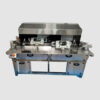

Automatic Visual Vial Dry Powder Inspection Machine
Critical Quality Assurance for Sterile Dry Powder Injectables
In the pharmaceutical manufacturing sector, ensuring the absolute purity and precise volume of dry powder injectables is paramount. Unlike liquid formulations, which easily reveal particulate suspension under standard illumination, dry powder matrices present a unique set of quality control challenges. The Harsiddh Automatic Visual Vial Dry Powder Inspection Machine (HINS-240) is engineered specifically to address these complexities. Acting as a critical gatekeeper in high-speed, sterile powder filling lines, the HINS-240 ensures that every single vial leaving the cleanroom meets the rigorous safety, sterility, and regulatory standards required for patient safety.
Pharmaceutical powders are highly susceptible to environmental and processing discrepancies, such as micro-moisture ingress, vacuum loss, and mechanical stress during capping. These issues manifest as clumping, under-filling, or the inclusion of minute foreign particulates embedded within the powder cake. The HINS-240 provides an optimized, ergonomic, and highly reliable visual inspection environment. Combining motorized mechanical agitation with specialized optics, it empowers operators to detect the subtlest abnormalities before products move to secondary packaging and distribution.
The Complexities of Dry Powder Inspection
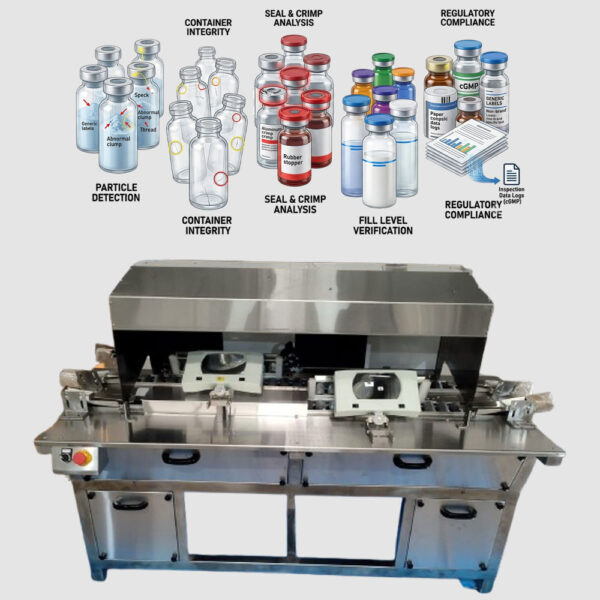
Inspecting lyophilized or dry-filled powders requires a specialized approach. Because the product is a solid or semi-solid cake, contaminants can easily hide beneath the surface or at the base of the vial. Furthermore, defects in the glass container itself—such as hairline cracks, pinholes, or improper aluminum crimping—can compromise the sterile barrier, leading to product degradation or contamination.
The HINS-240 solves this by utilizing an advanced mechanical rotation system. Rather than relying on simple linear transit, the machine continuously spins each vial along its vertical axis. This continuous rotation creates a dynamic viewing angle, causing the powder to shift gently and exposing all surfaces of the cake, the container walls, the neck, and the flip-off seal to the inspector.
High-Efficiency Operational Workflow
The HINS-240 is built to integrate seamlessly into existing high-speed production lines, bridging the gap between the capping station and the labeling machine. Its workflow is optimized to maximize inspection accuracy without causing production bottlenecks.
1. Precision Infeed and Automated Bifurcation
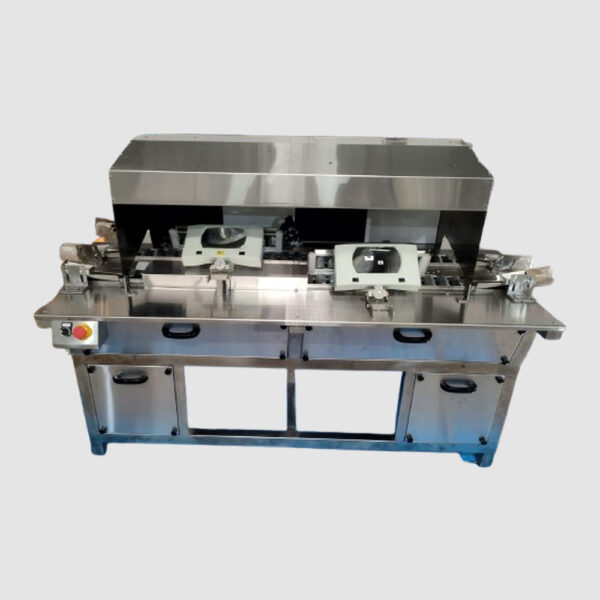
Vials exit the capping machine and enter the HINS-240 via a central, high-tensile conveyor belt. To accommodate the meticulous pace required for manual visual validation without slowing down the upstream filling speeds, the machine features an automated bifurcation system. The incoming single stream of vials is smoothly divided into two parallel, adjoining tracks. This dual-track design effectively doubles the available inspection time per vial by distributing the workload across multiple operator stations simultaneously.
2. Motorized Agitation and 360-Degree Rotation
As the vials progress onto the inspection tracks, they are transferred onto a specialized roller-conveyor mechanism. This motorized system continuously rotates each vial. The controlled spin ensures that the operator receives a comprehensive 360-degree view of the container body, the integrity of the aluminum cap, and the consistency of the powder formulation inside. This step is critical for exposing hidden air pockets, localized clumping, or base defects that would otherwise go unnoticed on a standard linear conveyor.
3. Optimized Visual Examination Environment
At the heart of the HINS-240 is its ergonomically designed inspection zone. Each station is equipped with high-grade magnifying lenses that reduce eye strain and enhance small details. The background features a customizable, high-contrast illumination system, allowing operators to switch between black and white backdrops. This dual-contrast lighting is essential for identifying both light-colored particulate matter (against the dark background) and dark contaminants or glass shards (against the light background).
4. Pneumatic Instant Rejection System
When an operator detects a non-compliant vial—whether it is an under-filled dose, a cracked glass neck, a loose crimp, or a embedded foreign fiber—time is of the essence. The HINS-240 features an instantaneous pneumatic rejection mechanism. The operator simply triggers a localized pneumatic switch, and a precise blast of compressed air or a mechanical gate swiftly diverts the defective vial off the main track and into a secure, designated reject bin. This eliminates the risk of human error associated with manual retrieval.
5. Consolidated Discharge and Downstream Transfer
Vials that successfully pass the rigorous scrutiny of the operators continue their journey down the parallel tracks. At the exit zone of the machine, the dual streams are seamlessly merged back into a single central conveyor line. The accepted, certified-sterile vials are then transferred directly to the automated labeling machine for final secondary packaging.
Key Features & Technological Advantages
- High-Throughput Dual-Track Design: Maximizes operational efficiency by dividing the single-line flow into twin tracks, optimizing the balance between line speed and operator inspection accuracy.
- Ergonomic Operator Stations: Designed to minimize physical fatigue during extended shifts, featuring adjustable magnifying optics and specialized glare-free illumination.
- Variable Speed Drive (VFD): Allows production managers to precisely adjust the conveyor speed and rotation velocity to match different vial sizes and powder characteristics.
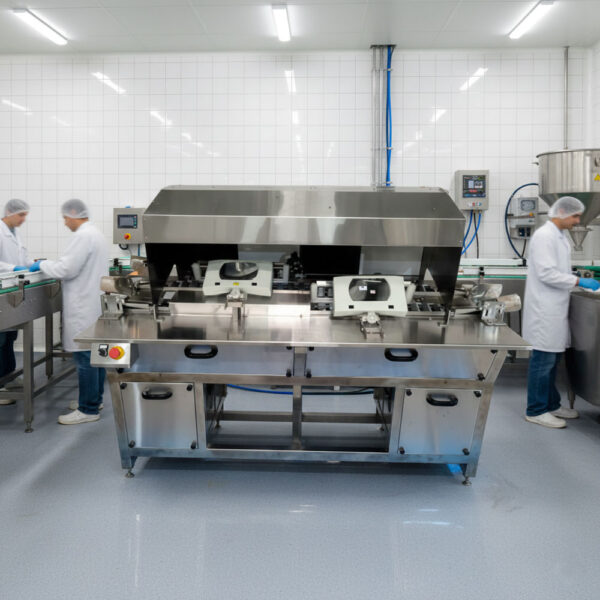
- Robust Stainless Steel Construction: Built entirely from premium-grade AISI Stainless Steel (SS 304/316), conforming strictly to Current Good Manufacturing Practices (cGMP) guidelines for cleanroom environments.
- Versatile Container Compatibility: Easily adaptable to handle a wide range of vial fill volumes and dimensions with minimal changeover parts, reducing downtime during batch transitions.
- Failsafe Rejection Control: The pneumatic sorting system reacts instantly, ensuring that contaminated or structurally compromised vials are completely isolated from the approved batch.
Elevating Compliance and Product Integrity
In the regulatory landscape governed by agencies like the USFDA, EMA, and MHRA, documentation and zero-defect initiatives are non-negotiable. Contaminated injectables pose severe health risks, and a single missed defect can lead to costly product recalls, regulatory sanctions, and damage to brand reputation.
The Harsiddh HINS-240 provides pharmaceutical manufacturers with a reliable, repeatable, and easily validatable methodology for 100% visual inspection. By combining mechanical consistency with the sharp analytical capabilities of trained personnel, the machine closes the security gaps that automated camera systems sometimes miss when dealing with the unpredictable physics of dry powder cakes.
Technical Specification
| Feature | Details (HINS-240) |
|---|---|
| Production Output | Up to 200–240 Vials Per Minute |
| Vial Capacity | 5 ml to 100 ml |
| Vial Diameter Range | 22 mm to 56 mm |
| Number of Operators | Four (2 x 2 Configuration) |
| Power Drive | 1.0 HP to 2.0 HP (Main Machine) |
| Electrical Supply | 230V / 240V, Single Phase, 50 Hz |
| Speed Control | Variable Frequency Drive (VFD) |
| Dimensions (LxWxH) | 3250 mm x 1100 mm x 1270 mm |
Why Choose Harsiddh Pharma Equipment?
Harsiddh is a global leader in designing, manufacturing, and exporting high-performance turnkey packaging solutions for the pharmaceutical and biotech industries. Every machine we engineer undergoes strict quality testing to ensure unmatched durability, minimal maintenance overhead, and seamless integration into modern smart-factories. With the Automatic Visual Vial Dry Powder Inspection Machine (HINS-240), you are investing in a future-proof quality control asset that safeguards your consumers, protects your brand, and elevates your production line’s overall operational efficiency.
Contact our engineering team today to request a quote, schedule a technical consultation, or discuss custom modifications tailored to your specific line configurations.
Frequently Asked Questions
How does the machine ensure a 360-degree thorough inspection?
To ensure no defect goes unnoticed, the machine utilizes a vial rotation mechanism. As vials move along the conveyor, they are picked up by a specialized indexing system that rotates each vial rapidly on its own axis. This high-speed spinning agitates the powder, making any heavy foreign particles or glass fragments more visible to the inspector as the vial slows down in front of the illuminated background.
What kind of lighting and visual aids are used to assist the operator?
The Harsiddh inspection machine is equipped with a high-contrast illumination system, usually consisting of:
Black and White Backgrounds: To help detect both light and dark-colored particulate matter.
Flicker-Free LED Lighting: Provides consistent, high-intensity light that reduces operator eye fatigue while highlighting cracks or impurities.
Magnifying Lens (Optional): Some models include a large magnifying glass to provide a clearer view of the vial's interior and seal integrity.
What is the production capacity and vial size range?
This machine is designed for high-speed pharmaceutical lines:
Output: Depending on the model and the operator's efficiency, it can inspect 60 to 120 vials per minute.
Vial Range: It is highly versatile and can accommodate glass vials ranging from 2ml to 100ml with simple adjustments to the conveyor guides and rotation rollers.
What are the key cGMP and safety features of this machine?
As a cGMP-compliant unit built for sterile environments:
Material Integrity: The exterior frame is constructed from polished SS 304, ensuring it is easy to clean and corrosion-resistant.
Reject System: Many models feature a manual or pneumatic rejection station, allowing the operator to segregate "rejected" vials into a separate bin without stopping the entire production line.
Safe Operation: The machine features a compact, ergonomic design that minimizes manual handling, reducing the risk of vial breakage or contamination.