
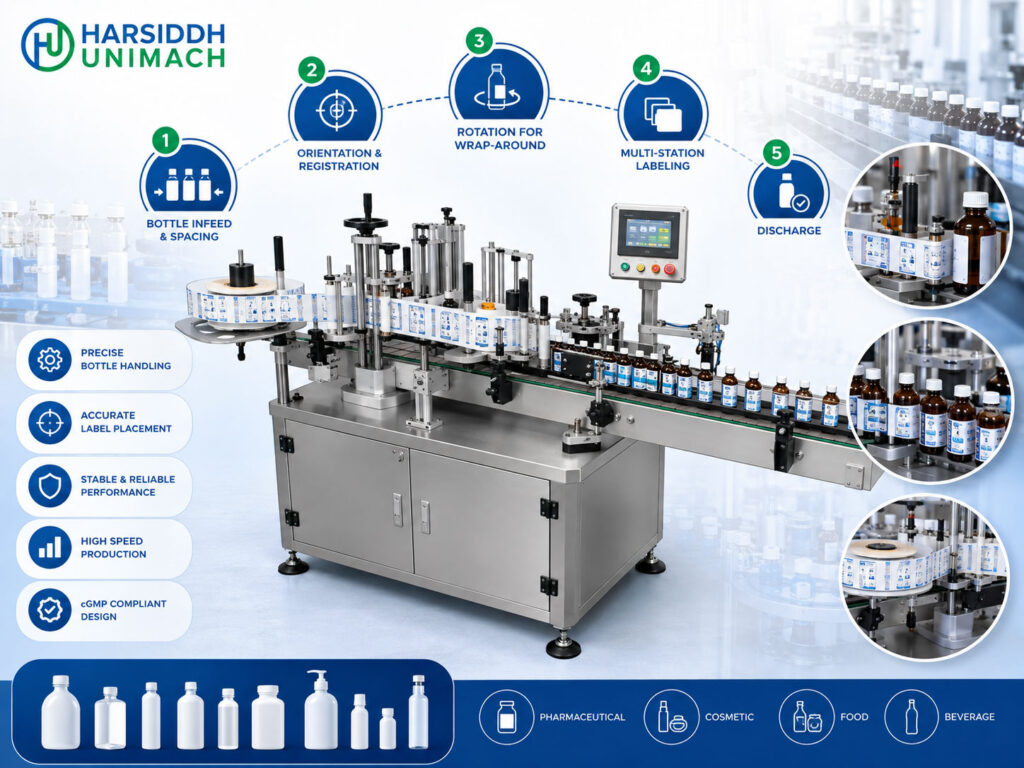
Bottles come in every shape imaginable: tall round syrup bottles, short wide tablet bottles, flat oval shampoo bottles, square sanitiser bottles and tapered cosmetic bottles. They are made of amber glass, clear glass, HDPE, PET and other plastics. And almost every one of them needs a label that sits straight, smooth and in exactly the same place on every bottle.
A bottle labeling machine is designed to do this. The basic idea of peeling a self-adhesive label from its liner and pressing it onto a product is shared by all sticker labellers. If you want that foundation first, read our sticker labeling machine working principle. This article concentrates on what is special about labelling bottles: how bottles of different shapes are handled, how wrap-around and front-and-back labels are applied, and which settings and bottle properties decide the final result.
Why Bottles Need Their Own Labelling Approach
A bottle is not a flat surface. Its shape, material and stability all affect how the label goes on.
| Bottle Factor | Labelling Challenge |
|---|---|
| Round shape | Label must wrap around evenly without skewing |
| Flat or oval faces | Label must be centred on a curved or flat panel |
| Square or rectangular bottles | Labels must sit square to the edges |
| Tapered or conical bottles | Labels tend to fan or skew unless specially handled |
| Light plastic bottles | Tip over easily, may need support |
| Glass bottles | Heavier, stable, but surface may be cold or damp |
| Small diameters | Tight wraps that challenge stiff labels |
| Textured or embossed panels | Can cause bubbles or poor adhesion |
The machine design, handling system and application method are chosen to match the bottle.
The Working Principle for Bottles
Every bottle labeller follows this sequence:
- Bottle infeed – bottles arrive upright on a conveyor.
- Spacing – a separator wheel or feed screw creates an even gap between bottles.
- Stabilising – side guides, belts or a top hold-down belt keep bottles upright and aligned.
- Detection – a sensor triggers the label dispense when each bottle reaches the right position.
- Label dispensing – the label is peeled from its liner at a peel plate and fed out at the bottle’s speed.
- Application – the label is pressed on, either by wrapping the bottle (round bottles) or by pressing against a face (flat bottles).
- Smoothing – rollers, belts or brushes press the label down firmly.
- Coding and inspection – batch details may be printed and labels checked.
- Discharge – labelled bottles move on to packing.
Labelling Round Bottles: Wrap-Around Principle
Round bottles are the most common in pharmaceutical liquids such as syrups, suspensions and tonics.
How wrap-around labelling works
- The bottle travels upright on the conveyor and reaches the labelling station.
- The leading edge of the label meets the bottle surface and sticks.
- A wrap belt on one side, opposite a fixed or padded plate on the other, presses against the bottle and makes it rotate as it moves forward.
- As the bottle rotates, it pulls the label off the peel plate and wraps it around its circumference.
- The label is pressed down along its whole length, and the trailing edge is smoothed into place, sometimes overlapping the leading edge for a full wrap.
Partial vs full wrap
- Partial wrap – the label covers part of the circumference, leaving a viewing window or space for a second label.
- Full wrap – the label goes all the way round, often with an overlap that is pressed firmly so it does not lift.
Getting a good round-bottle label
- The bottle must stand vertically; any lean causes the label to spiral.
- Wrap belt pressure must be even top to bottom.
- Label speed must match the bottle’s surface speed as it rotates.
See the Automatic Round Bottle Sticker Labeling Machine, the bottle sticker labeling machine and the vertical bottle sticker labeling machine. Browse all labeling machines for round bottles.
Labelling Flat, Oval and Square Bottles
Flat and oval bottles are popular for cosmetics, shampoos, lotions, sanitisers and some pharmaceutical liquids. They cannot be rotated to wrap a label, so the label is pressed flat against one or more faces.
How flat-panel labelling works
- Bottles are aligned by side belts so that the face to be labelled is parallel to the label head.
- A top hold-down belt or side belts keep the bottle stable and moving straight.
- The label is dispensed onto the face as the bottle passes the peel plate.
- A series of sponge rollers or brushes presses the label from the centre outwards, removing air.
Front-and-back labelling
Many flat and oval bottles carry two labels: a branded front label and an information-rich back label. Front-and-back labellers use two label heads, one on each side of the conveyor, sometimes offset so each face is labelled in turn. Accurate alignment of both labels relative to each other is a key quality requirement.
See the Automatic Flat Bottle Sticker Labeling Machine, the Automatic Double Side Flat Bottle Sticker Labeling Machine, the Automatic Front and Back Sticker Labeling Machine and the double side flat bottle sticker labeling machine. Browse the labeling machines for flat bottles.
For more on dual-label accuracy, read front and back sticker labeling machine: how to achieve precise dual-side label placement.
Square bottles
Square bottles can be labelled on one face like flat bottles, or on two adjacent faces with two heads. Corner labels that wrap around an edge need careful pressing to avoid lifting.
Oval bottles
Oval bottles have a curved face. The pressing system must follow the curve, so flexible brushes or soft rollers are used instead of rigid rollers.
Labelling Tapered Bottles
On a tapered or conical bottle, the top and bottom diameters differ. A straight rectangular label applied to a taper will naturally fan out and skew. Solutions include:
- Curved (arc-shaped) labels designed to match the taper
- Tilting the label head to match the bottle’s angle
- Special handling that rotates the bottle at matching surface speeds
Tapered bottles should always be tested with actual labels before the machine is finalised.
Shrink Sleeve Labels: An Alternative
For full-body decoration or bottles with complex shapes, some manufacturers use shrink sleeves instead of sticker labels. A printed plastic sleeve is placed over the bottle and shrunk tight by heat. See the Automatic Shrink Sleeve Label Applicator.
Glass vs Plastic Bottles
| Aspect | Glass Bottles | Plastic Bottles (PET, HDPE) |
|---|---|---|
| Stability | Heavy, stable on the conveyor | Light, can tip or wobble |
| Surface | Smooth, but can be cold or damp | May have mould lines, slight flex |
| Labelling issues | Condensation from cold filling, dust | Squeezing under pressure, static |
| Typical handling | Side guides | Side belts and top hold-down belt |
| Adhesive choice | Standard permanent adhesives | May need adhesives suited to the plastic |
HDPE bottles in particular have low surface energy, so the label adhesive must be suitable for them. Discuss bottle material with your label supplier.
Where Labelling Fits in a Bottle Line
A typical liquid bottle line runs:
- Bottle unscrambling and cleaning
- Filling, for example on a volumetric liquid bottle filling machine
- Capping, for example on a bottle screw and ROPP capping machine
- Induction sealing on an induction sealing machine
- Labelling
- Inspection, cartoning and packing
Labelling usually comes after capping so that the bottle is closed, clean and stable. Any product spilled during filling or capping must be cleaned off, because it will stop labels sticking.
For high-output lines, see our high-speed labeling machine working principle. Browse all labeling machines and the labeling machines on Harsiddh Engineering.
Key Settings for Bottle Labelling
| Setting | What It Controls | Effect If Wrong |
|---|---|---|
| Conveyor speed | Bottle movement | Mismatch with label speed |
| Separator wheel/screw spacing | Gap between bottles | Labels bridging two bottles |
| Side guide or belt width | Bottle alignment | Skewed or misplaced labels |
| Top hold-down belt height | Stability of light bottles | Bottles tipping, wobbling |
| Label head height | Vertical label position | Labels too high or low |
| Product sensor delay | Horizontal label position | Labels off-centre |
| Label dispense speed | Synchronisation | Wrinkles or stretching |
| Wrap belt pressure | Rotation and adhesion | Spiralling, bubbles, poor overlap |
| Roller or brush pressure | Smoothing on flat bottles | Bubbles, lifted edges |
Quality Checks
- Position – height and horizontal placement within tolerance
- Straightness – no skew relative to the bottle base
- Smoothness – no wrinkles, bubbles or creases
- Adhesion – no lifted edges or flags, especially on small diameters
- Correct label – right product, right strength, right language
- Code – batch, manufacturing and expiry details present and readable
Troubleshooting Common Bottle Labelling Problems
| Problem | Likely Cause | Corrective Action |
|---|---|---|
| Spiralling labels on round bottles | Bottle leaning, uneven wrap pressure | Adjust guides and wrap belt, check bottle base |
| Labels off-centre on flat bottles | Bottle not aligned, sensor delay wrong | Adjust side belts, reset delay |
| Wrinkles | Label speed too fast | Match speeds |
| Bubbles | Uneven pressing, embossed panel, damp surface | Adjust rollers, dry bottles, review label design |
| Edges lifting (flagging) | Small diameter, stiff label, low-tack adhesive | Use more flexible label or stronger adhesive, increase pressure |
| Bottles falling over | Light bottles, poor support | Use top hold-down belt, adjust spacing |
| Front and back labels misaligned | Heads not synchronised | Re-time heads, check bottle orientation |
| Labels not sticking to HDPE | Adhesive not suited to low-energy plastic | Change adhesive |
Changeover Between Bottle Sizes and Labels
Most bottle lines run several bottle sizes and products, so a fast and repeatable changeover is important. A typical changeover involves:
- Line clearance – removing all labels and bottles from the previous batch to avoid mix-ups
- Changing the label roll and re-threading the web
- Teaching the new label so the gap sensor learns its length
- Adjusting side guides, belts and the top hold-down belt for the new bottle size
- Setting the separator wheel or feed screw for the new bottle diameter
- Adjusting label head height and sensor delay for the new label position
- Running test bottles and checking position, straightness and code before production
Height scales, recorded settings for each product and labelled change parts make this faster and more consistent from shift to shift.
Maintenance Tips
- Clean adhesive build-up from peel plates, rollers and belts.
- Check wrap belts, hold-down belts and side belts for wear and tension.
- Keep sensors clean and correctly aligned.
- Inspect brushes and sponge rollers; replace worn ones.
- Keep change parts and settings recorded for each bottle and label.
How to Choose a Bottle Labeling Machine
- Bottle shapes – round, flat, oval, square, tapered
- Bottle materials – glass or plastic
- Label positions – wrap, front, back, both
- Bottle size range and changeover frequency
- Output to match the filler and capper
- Coding and inspection requirements
- Label material and adhesive compatibility
Frequently Asked Questions
What is the working principle of a bottle labeling machine? Bottles are spaced and stabilised on a conveyor; a sensor triggers a label to be peeled from its liner at a peel plate; the label is then wrapped around a round bottle by a rotating belt, or pressed onto the face of a flat bottle by rollers or brushes.
How are labels wrapped around round bottles? A wrap belt makes the bottle rotate as it moves forward, drawing the label off the peel plate and wrapping it around the bottle.
Can one machine label round and flat bottles? Some machines can be fitted with different application systems, but most are configured for one bottle type. Check with your supplier.
Why do labels spiral on round bottles? Usually because the bottle is leaning or the wrap belt pressure is uneven.
Why won’t labels stick to some plastic bottles? Some plastics, such as HDPE, have low surface energy and need suitable adhesives.
Need a bottle labeling machine for your bottles? Contact our team or send an inquiry with bottle samples, label sizes and output requirements.