
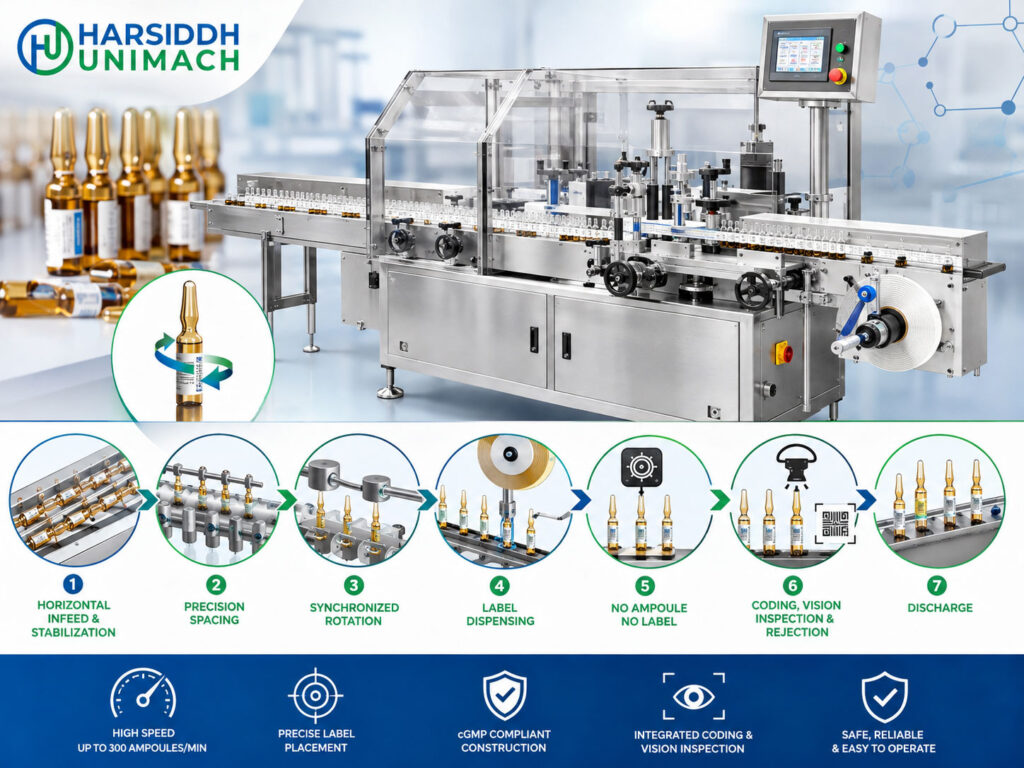
Glass ampoules are among the smallest and most fragile containers in pharmaceutical packaging. A typical ampoule is a slim glass tube, sealed by flame, holding a single dose of an injectable medicine. Yet that small surface must carry critical information: the product name, strength, volume, route of administration, batch number and expiry date. A missing or illegible ampoule label is a serious problem in a hospital where the nurse may have seconds to pick the right injection.
An ampoule labeling machine applies self-adhesive labels to ampoules accurately and gently, at production speeds, without breaking the glass. In this article, we explain how ampoule labellers work, the two main machine designs, how labels are wrapped around such small diameters, and how coding, inspection and handling are managed. We also cover common problems and how to choose the right machine.
For the general principles of applying self-adhesive labels, see our sticker labeling machine working principle.
Why Ampoules Are Difficult to Label
| Ampoule Property | Labelling Challenge |
|---|---|
| Small diameter | Labels must wrap a tight curve and can lift at the edges |
| Fragile glass | Ampoules must not be knocked, pinched or dropped |
| Narrow neck and constriction | Label must avoid the neck and break ring |
| Long, slender shape | Ampoules can roll unevenly or skew |
| Light weight | Easily disturbed by vibration or air flow |
| Small label area | Text must be legible on a very small label |
| Colour rings and breaking dots | Label must not cover important markings |
Because of these properties, ampoule labellers are designed very differently from bottle labellers. Most of them label ampoules lying horizontally, letting them roll as the label wraps around.
Where Labelling Fits in the Ampoule Line
- Ampoule washing
- Depyrogenation in a sterilizing tunnel for ampoules and vials
- Filling and sealing, for example on an eight head or four head ampoule filling and sealing machine
- Sterilisation (where applicable) and leak testing
- Visual inspection for particles, cracks and fill defects
- Labelling
- Tray loading, cartoning and packing
Labelling comes after inspection, so only accepted ampoules are labelled. For more on the filling stage, read what is an ampoule filling machine and how does it work. Inspection best practices are covered in our article on the best practices for ampoule and vial inspection.
Design 1: Horizontal Ampoule Labelling Machine
This is the most common design for ampoules.
Working principle
Ampoules lie horizontally and are carried across the machine. At the labelling point, each ampoule rolls against the label as it is dispensed, wrapping it around its body. Pressing rollers or belts then smooth the label down.
Main components
- Infeed hopper or tray – the operator loads ampoules lying horizontally, all facing the same direction.
- Feed system – a rotating drum, scroll or indexing wheel picks ampoules one at a time from the hopper.
- Transport system – carries ampoules horizontally through the labelling station at even spacing.
- Label unwind and web path – supplies the label roll with controlled tension.
- Gap sensor – detects the gaps between labels.
- Peel plate – separates the label from its liner.
- Product sensor – detects each ampoule.
- Wrapping system – a belt or roller that makes the ampoule roll as the label is applied.
- Pressing rollers – smooth the label down, especially the trailing edge.
- Coding unit – prints batch and expiry details on the label.
- Outfeed tray or collection system – receives labelled ampoules.
- Control panel – speed, label length, position and counts.
Step-by-step process
Step 1: Loading
Inspected ampoules are placed horizontally in the infeed hopper, aligned with their necks pointing the same way.
Step 2: Picking and spacing
A feed drum or scroll picks one ampoule at a time and places it into the transport system at an even pitch. Smooth, gentle transfer is essential to prevent glass-to-glass contact.
Step 3: Detection
As each ampoule approaches the labelling station, a sensor detects it and starts the label dispense timing.
Step 4: Label dispensing
The label web advances and the label is peeled at the peel plate. Its leading edge meets the ampoule body at the set position, away from the neck and constriction.
Step 5: Rolling wrap
A belt or roller presses lightly on the ampoule, making it roll. As the ampoule rolls, it draws the label off the peel plate and wraps it around its body. The label speed is matched to the ampoule’s surface speed to avoid wrinkles.
Step 6: Pressing
Pressing rollers continue to roll the ampoule after the label is applied, pressing the leading and trailing edges firmly. This step is important on small diameters, where the label’s natural stiffness tends to lift the edges.
Step 7: Coding
Batch number, manufacturing date and expiry date are printed on the label, usually before it is dispensed, using a hot-stamp, thermal transfer or other suitable coder.
Step 8: Discharge
Labelled ampoules are delivered to an outfeed tray, ready for tray loading or cartoning.
See the Automatic Horizontal Ampoule Sticker Labeling Machine and the horizontal ampoule sticker labelling machine. For the general horizontal labelling principle, read our horizontal sticker labeling machine working principle.
Design 2: Rotary Ampoule Labelling Machine
Working principle
In a rotary ampoule labeller, ampoules are carried around a rotating star wheel or drum. Each ampoule is held in a pocket and rolled against the label as the star wheel turns. Rotary machines give precise, continuous handling and are suited to medium and higher outputs.
How it works
- Ampoules enter from a hopper or infeed track.
- A star wheel takes each ampoule into a pocket.
- As the star wheel rotates, each ampoule passes the label head.
- The ampoule rolls against a pad or belt, wrapping the label around it.
- Pressing elements smooth the label.
- The labelled ampoule leaves the star wheel and is collected.
See the Automatic Rotary Ampoule Sticker Labeling Machine and the rotary ampoule sticker labeling machine.
Horizontal vs rotary
| Feature | Horizontal Ampoule Labeller | Rotary Ampoule Labeller |
|---|---|---|
| Ampoule orientation | Horizontal, rolling | Held in star wheel pockets |
| Handling | Gentle rolling transport | Precise pocket handling |
| Output | Small to medium | Medium to higher |
| Changeover | Usually simple | Star wheel parts per size |
| Floor space | Compact | Compact to medium |
Browse all labeling machines for ampoules, our full range of labeling machines and the labeling machines on Harsiddh Engineering.
Designing Labels for Ampoules
Good ampoule labelling starts with the label itself:
- Label material – thin, flexible films or papers conform better to small diameters than thick, stiff materials.
- Adhesive – needs enough initial tack to hold the label on a tight curve without lifting.
- Label length – usually long enough to wrap fully with a small overlap, which helps hold the trailing edge down.
- Label height – must fit between the ampoule base and the constriction, leaving any colour rings or breaking point visible.
- Text and code area – must remain legible after wrapping; a clear area is left for batch and expiry printing.
Testing labels on actual ampoules before ordering large quantities saves trouble later.
Gentle Handling of Glass
Ampoules can crack if they hit each other or hard machine parts. Ampoule labellers protect them by:
- Feeding ampoules one at a time with controlled spacing
- Using smooth, sometimes coated, contact surfaces
- Limiting drops and transfers
- Running at speeds that match the ampoule size and glass
- Stopping automatically if an ampoule jams
Broken ampoules must be removed promptly, because glass fragments and spilled product can contaminate the machine and other ampoules.
Inspection After Labelling
Many lines include checks for:
- Label presence – every ampoule labelled
- Label position – correct height and no skew
- Code presence and legibility
- Correct label – right product and strength
Visual inspection before labelling, for example on a Semi-Automatic Visual Ampoule Inspection Machine or a visual ampoule and vial inspection machine, ensures only good ampoules reach the labeller.
Upstream Machines
Ampoules reach the labeller after washing, depyrogenation and filling. Related machines include the rotary ampoule washing machine, the eight head ampoule filling and sealing machine and the four head ampoule filling and sealing machine. Browse our ampoule filling machines.
Key Settings and Their Effects
| Setting | What It Controls | Effect If Wrong |
|---|---|---|
| Feed drum or scroll timing | Ampoule spacing | Ampoules touching, double feeding |
| Label head position | Label height on ampoule | Label on neck or too low |
| Product sensor delay | Label start position | Overlap in the wrong place |
| Label dispense speed | Matching ampoule rolling speed | Wrinkles or stretched labels |
| Wrapping belt pressure | Rolling and adhesion | Skew, poor wrap, breakage if too high |
| Pressing roller pressure | Edge adhesion | Flagging if too low, breakage if too high |
| Web tension | Straight label path | Skewed labels |
| Coder settings | Print quality | Faint or smudged codes |
Troubleshooting Common Problems
| Problem | Likely Cause | Corrective Action |
|---|---|---|
| Label edges lifting (flagging) | Stiff label, low pressure, weak adhesive | Use thinner label, increase pressing, review adhesive |
| Skewed labels | Ampoule not rolling straight, web tracking | Adjust belt and guides, check web path |
| Wrinkled labels | Label speed faster than ampoule | Match speeds |
| Label on the neck | Head position wrong | Adjust head height or ampoule position |
| Broken ampoules | Excessive pressure, harsh transfers, jams | Reduce pressure, smooth transfers, clear jams |
| Missing labels | Gap sensor error, ampoule not detected | Re-teach label, clean and align sensors |
| Faint or missing codes | Coder settings, ribbon or foil | Adjust and service coder |
| Double feeding | Feed timing | Adjust feed drum or scroll |
Maintenance Tips
- Clean adhesive and glass dust from belts, rollers and peel plates.
- Inspect wrapping belts and pressing rollers for wear.
- Clean and check sensors regularly.
- Service the coder and replace ribbons or foils on schedule.
- Keep change parts for each ampoule size labelled and stored.
- Remove broken glass promptly and clean the area.
Changeover Between Ampoule Sizes
Ampoules come in a range of sizes. A changeover usually involves:
- Line clearance of all ampoules and labels from the previous batch
- Fitting feed drum, scroll or star wheel parts for the new size
- Adjusting guides and wrapping belt position
- Changing the label roll and teaching the new label
- Setting label head height and sensor delay
- Running test ampoules and checking label position and code
How to Choose an Ampoule Labeling Machine
- Ampoule sizes to be labelled
- Output – horizontal or rotary design
- Label material and size
- Coding method and code content
- Inspection features for label and code
- Gentle handling design for glass
- Changeover frequency and ease
- GMP documentation
Frequently Asked Questions
What is the working principle of an ampoule labeling machine? Ampoules are fed one at a time, usually lying horizontally. As each ampoule passes the label head, it rolls against a belt or roller, drawing a self-adhesive label off the liner and wrapping it around its body. Pressing rollers then smooth the label down.
Why are ampoules labelled horizontally? Lying horizontally, ampoules can roll smoothly to wrap the label and are handled gently without standing a slender, fragile container upright.
What is the difference between horizontal and rotary ampoule labellers? Horizontal labellers roll ampoules on a transport system; rotary labellers hold ampoules in star wheel pockets. Rotary designs generally suit higher outputs.
Why do labels lift on ampoules? The small diameter makes stiff labels spring back. Thinner, more flexible labels, suitable adhesive and good pressing prevent this.
How are batch and expiry details added? A coder prints them on the label, usually just before it is dispensed.
Looking for an ampoule labeling machine? Contact our team or send an inquiry with your ampoule sizes, label details and output requirements.