
By Harsiddh Unimach Pvt. Ltd. | www.harsiddhunimach.com | info@harsiddhunimach.com
Buying an ampoule filling machine is one of the biggest equipment decisions in an injectable plant. Pick a machine that is too small and you will fight missed deliveries, overtime and a permanent backlog. Pick one that is far too large and you lock up capital, floor space and validation effort for output you may never use. The way out is simple in principle: match the machine’s real, sustained output to your actual production requirement.
In practice, many buyers compare only the speed printed on a brochure. That number is a rated maximum, not what the machine will deliver across a full shift. This guide explains how to calculate the capacity you really need, how head count relates to output, what quietly reduces real-world speed, and how to choose the right model from the ampoule filling machine range with confidence.
What “Capacity” Really Means for an Ampoule Filling Machine
Three different numbers are often mixed up, and confusing them is the root of most capacity mistakes.
Rated speed is the maximum mechanical output, usually quoted in ampoules per minute (BPM) or per hour. It is measured under ideal conditions: small ampoules, a free-flowing water-like liquid and no stops.
Effective speed is what the machine delivers while it is actually running your product. It is lower than rated speed because of fill volume, viscosity, nitrogen flushing time, sealing quality settings and the ampoule size you run.
Net output is what you actually pack per shift or per month, after deducting changeovers, cleaning, adjustments, breaks, material shortages and stoppages.
A correctly sized machine is chosen on net output, not rated speed. Everything below is about bridging that gap.
From Monthly Demand to Head Count
Step 1: Define Your Production Requirement
Before looking at any machine, write down the demand the machine must satisfy:
- Monthly or annual volume of ampoules, including forecast growth over the next three to five years.
- Working days per month and the number of shifts per day.
- Product mix: how many different products and ampoule sizes (for example 1 ml, 2 ml, 5 ml, 10 ml) share the machine.
- Batch sizes and how often the machine switches between them.
- Peak demand periods, such as tender supplies or seasonal products.
The product mix matters as much as the volume. A plant making three million ampoules of a single product needs a very different machine from one making the same quantity across twelve products with frequent changeovers.
Step 2: Convert Demand Into a Required Machine Speed
Use this straightforward sequence:
- Daily requirement = monthly volume ÷ working days
- Productive minutes per day = scheduled hours × 60 × availability factor
- Required effective speed (ampoules/min) = daily requirement ÷ productive minutes
- Add a safety buffer of about 10 percent for variation and growth
- Required rated speed = buffered effective speed ÷ performance factor
A realistic availability factor for a well-run pharmaceutical line is around 70 to 80 percent once changeovers, cleaning and routine stops are included. A realistic performance factor is around 80 to 90 percent of rated speed.
Worked Example 1: Medium-Scale Production
A plant needs 500,000 ampoules per month, runs 25 days a month and operates one 8-hour shift.
- Daily requirement: 500,000 ÷ 25 = 20,000 ampoules
- Productive time: 8 hours × 60 × 75% = 360 minutes
- Required effective speed: 20,000 ÷ 360 ≈ 56 per minute
- With a 10% buffer: ≈ 61 per minute
- At 85% performance, required rated speed: ≈ 72 per minute
This points directly to a four-head machine, ideally one that sits comfortably in the upper part of its range rather than at its limit.
Worked Example 2: High-Volume Production
A plant needs 3,000,000 ampoules per month, runs 25 days and operates two 8-hour shifts.
- Daily requirement: 3,000,000 ÷ 25 = 120,000 ampoules
- Productive time: 16 hours × 60 × 75% = 720 minutes
- Required effective speed: 120,000 ÷ 720 ≈ 167 per minute
- With a 10% buffer: ≈ 183 per minute
- At 85% performance, required rated speed: ≈ 215 per minute, or roughly 12,900 per hour
This requirement belongs to the eight-head, high-speed class of machines.
Step 3: Match the Required Speed to Head Count
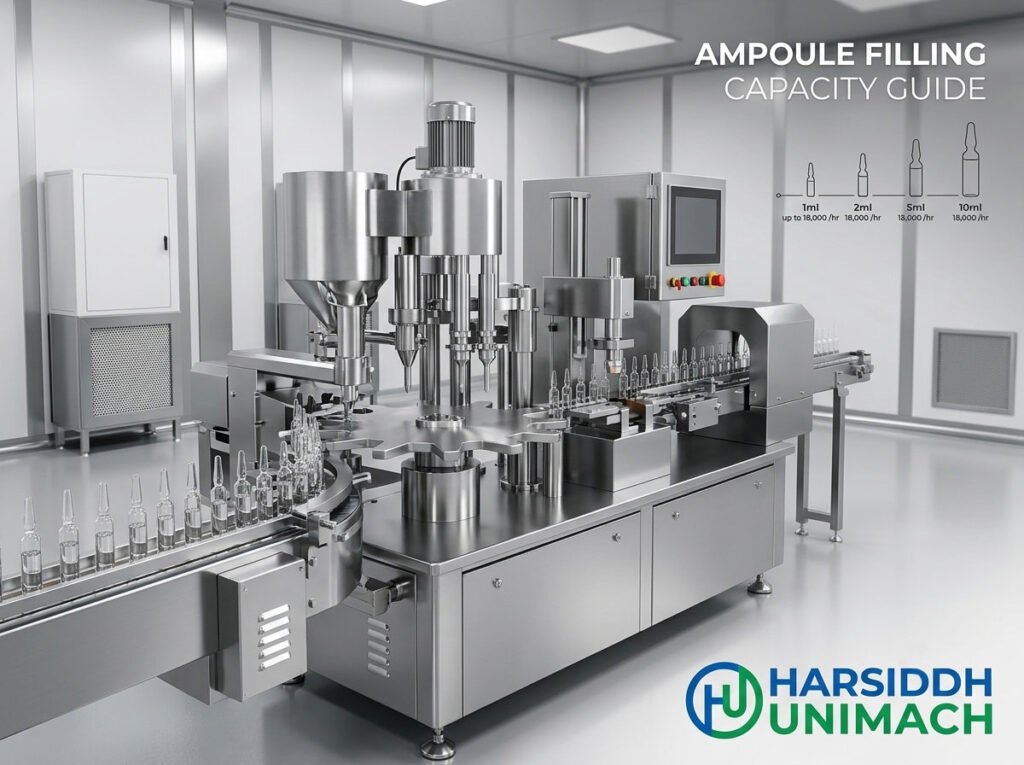
In a multi-head ampoule filler, each head fills and seals in parallel, so head count is the main driver of output. The table below gives typical working ranges for our machines.
| Machine class | Typical use | Approximate output |
|---|---|---|
| Single head | Small batches, trials, low-volume products | Entry-level output |
| Two head | R&D, pilot and small batch production | About 30 to 50 BPM |
| Four head | Medium-scale commercial production | About 70 to 100 BPM |
| Six head | Growing plants that have outgrown four heads | Between four and eight head output |
| Eight head | High-volume, continuous industrial production | Up to 12,000 to 18,000 ampoules per hour |
Our range covers every step of this ladder:
- Single Head Ampoule Filling and Sealing Machine and Small Scale Ampoule Filling Sealing Machine for Lab for development work and low volumes
- Two Head Ampoule Filling Sealing Machine for pilot batches and small commercial runs
- Four Head Ampoule Filling and Sealing Machine for medium-scale production
- Six Head Ampoule Filling and Sealing Machine for the step between mid-range and high volume
- Eight Head Ampoule Filling Sealing Machine, High Speed Eight Head Closed Ampoule Filler Sealer and High Speed Vertical Ampoule Filling Sealing Machine for continuous, high-volume lines
Step 4: Understand What Reduces Real-World Capacity
Two plants can buy the same machine and get very different net output. These are the factors that explain the difference.
Ampoule Size and Fill Volume
Larger fill volumes need longer filling strokes and more time per cycle. A machine that runs very fast on 1 ml ampoules will run slower on 10 ml or 25 ml. Always size capacity against your largest and most frequently used ampoule, not your smallest.
Liquid Characteristics
Viscous solutions, suspensions and foaming products cannot be filled as fast as water-thin liquids without losing accuracy or wetting the ampoule neck. If your product behaves differently from water, expect the effective speed to be lower than the brochure figure. Our servo based and peristaltic based ampoule fillers suit products where gentle, controlled dosing matters more than raw speed.
Nitrogen Flushing and Sealing
Oxygen-sensitive formulations need pre- and post-fill nitrogen purging, which adds process time. Draw-off sealing, which produces a smooth, rounded, leak-proof seal, also needs a controlled flame dwell. These steps protect product quality and should be built into your capacity calculation, not treated as an afterthought.
Fill Accuracy Targets
Pushing a machine to its limit usually widens volume variation. If your specification demands tight dose accuracy, you will run below the maximum speed. Our guide on ampoule filling machine filling accuracy and how to control volume variation explains how speed and accuracy trade off.
Changeover Frequency
If you run several ampoule sizes, every changeover consumes productive time. Over a month, frequent changeovers can remove more capacity than a lower head count would. Read our article on reducing ampoule filling machine changeover downtime between different ampoule sizes to see how format parts, tool-less adjustments and planned sequencing protect output.
Maintenance Condition
Worn change parts, drifting pumps and poorly maintained sealing systems cause micro-stoppages that never show up as formal downtime but steadily erode output. A disciplined routine, such as the one in our ampoule filling machine maintenance checklist, keeps real speed close to rated speed.
Operator Skill and Material Supply
A machine can only run as fast as ampoules are fed to it. Late glass supply, broken ampoules in the hopper and slow manual loading all cut net output regardless of head count.
Step 5: Balance the Entire Line, Not Just the Filler
The filling machine is the centre of the line, but the line only produces as fast as its slowest station. Before you finalise capacity, check every machine around it:
- Upstream washing and sterilisation must supply clean ampoules at least as fast as the filler consumes them. Our washing machines are available in configurations to match different throughputs.
- Downstream inspection must keep pace with filled output, otherwise a queue builds up and slows the filler. See our inspection machines.
- Labelling must absorb the full output, so review the labeling machines range and our guide to front and back sticker labeling for precise dual-side label placement.
If you want a fully integrated solution, an injectable ampoule filling line is engineered so that every station is matched in speed from the start. Plants that also fill vials can apply the same line-balancing logic described in our article on how to calculate actual vial filling line speed and production output.
Step 6: Plan for Growth Without Overbuying
Capacity planning is about the next five years, not just next quarter. A few practical rules help:
- Run the machine at roughly 70 to 85 percent of its effective capacity in normal operation. This leaves headroom for peaks and keeps wear manageable.
- Choose a model that can absorb 30 to 50 percent growth before you need another machine.
- Consider modular growth. Some plants buy a four-head machine now and add a second line later, which spreads investment and gives redundancy.
- Avoid buying far ahead of demand. An oversized machine running at low utilisation still requires full validation, qualification and maintenance.
Redundancy is also a capacity decision. Two smaller machines can keep production moving if one is down for service, while a single large machine concentrates the risk.
Common Capacity Planning Mistakes to Avoid
- Using rated speed as the plan. Always convert to net output.
- Ignoring the largest ampoule size. Capacity on 1 ml does not hold on 10 ml.
- Forgetting changeover and cleaning time. These are fixed costs of a multi-product plant.
- Sizing for today’s demand only. Growth can make a tight machine obsolete within a year or two.
- Overlooking the rest of the line. A fast filler cannot fix a slow inspection stage.
- Skipping a trial. A trial run with your own product is the most reliable capacity test available.
Quick Capacity Selection Checklist
Use this list before you request a quotation:
- Monthly volume and growth forecast confirmed
- Working days and shifts defined
- Ampoule sizes and fill volumes listed
- Product viscosity and nitrogen requirements known
- Required effective speed calculated, with buffer
- Required rated speed derived from performance factor
- Upstream and downstream stations checked for matching speed
- Changeover frequency estimated
- Utilities available, including the gases needed for sealing
- Future expansion space allowed for
Why Choose Harsiddh Unimach for Your Ampoule Filling Machine
Harsiddh Unimach Pvt. Ltd. has been manufacturing and exporting pharmaceutical machinery since 1988 from Ahmedabad, India. We are an ISO 9001:2015 and CE-certified manufacturer, and our ampoule filling and sealing machines are built to cGMP standards, with SS 316L contact parts, draw-off sealing, integrated nitrogen flushing, a “No Ampoule, No Filling” safeguard and a synchronised single-point drive. Models run from compact laboratory machines to high-speed eight-head systems, so you can find a machine sized to your real requirement rather than the nearest standard option.
Our engineers will help you work through the calculation above using your own volumes, ampoule sizes and product characteristics, and recommend the head count and configuration that fits. Browse the full ampoule filling machine category, or explore our complete range of vial filling machines and liquid filling machines if your portfolio extends beyond ampoules.
Frequently Asked Questions
How do I calculate the right ampoule filling machine capacity?
Divide your monthly volume by working days to get the daily requirement, divide that by your productive minutes per day to get the required effective speed, add a 10 percent buffer, and then divide by the expected performance factor (typically 80 to 90 percent) to find the rated speed you should look for.
Is rated speed the same as actual output?
No. Rated speed is a maximum under ideal conditions. Actual output is lower because of ampoule size, liquid properties, nitrogen flushing, accuracy requirements, changeovers and routine stoppages.
Which machine suits medium-scale production?
A four-head ampoule filling and sealing machine, with an approximate output of 70 to 100 BPM, is the usual choice for medium-scale commercial production. For higher requirements, consider a six-head or eight-head model.
Can one machine handle different ampoule sizes?
Yes. Our machines are designed for quick changeover between sizes using change parts such as star wheels and ampoule racks, typically covering 1 ml to 10 ml or 1 ml to 25 ml depending on the model. Frequent changeovers reduce net output, so include them in your calculation.
Should I buy a machine larger than my current need?
A modest margin of about 30 to 50 percent is sensible for growth. Buying far beyond that increases cost, floor space and validation effort without improving results.
Get the Right Capacity for Your Plant
Tell us your volumes, ampoule sizes and product details, and our team will recommend the right model within 24 business hours. Contact Harsiddh Unimach Pvt. Ltd. at info@harsiddhunimach.com, call +91 9825099693, or visit www.harsiddhunimach.com to request a tailored technical proposal.