
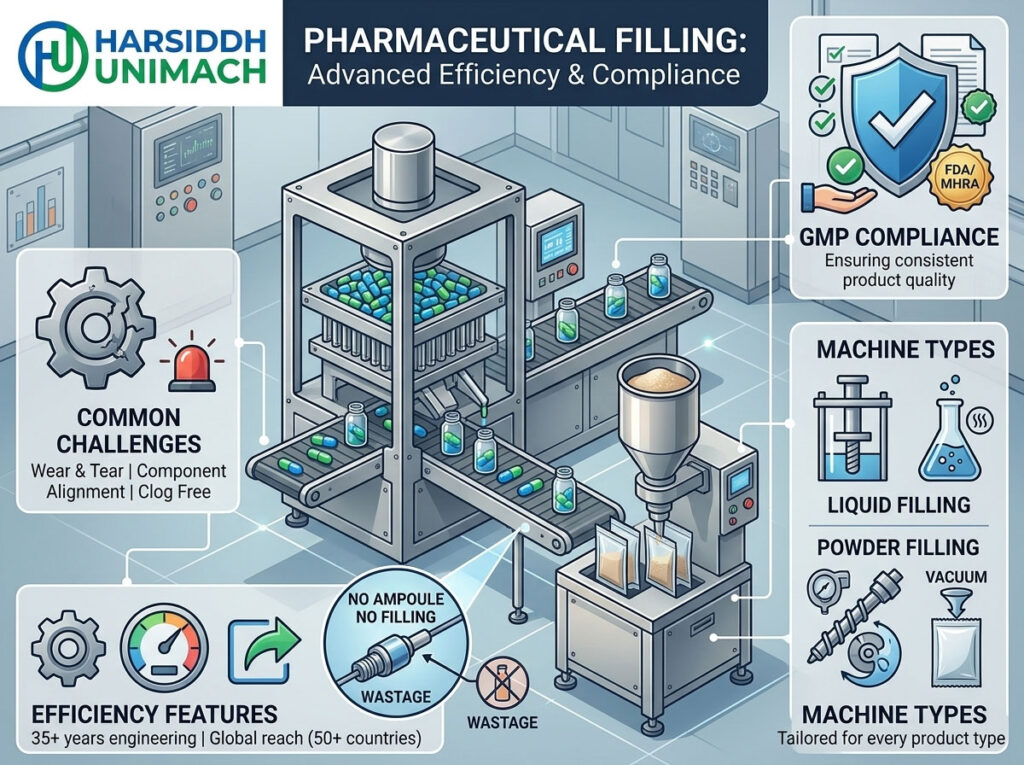
From the outside, a pharmaceutical filling machine may look much as it did decades ago: containers move in, product is dispensed, closures go on and containers move out. Inside, however, the technology has changed considerably. Mechanical cams and hand-set linkages have given way to servo motors and programmable controls. Simple timers have been replaced by sensors and feedback loops. Paper logs are increasingly supplemented by electronic records.
These advances matter because they serve two goals that every pharmaceutical manufacturer shares: efficiency (more good product, less waste and downtime) and compliance (consistent quality, contamination control and reliable records). The best technologies deliver both at once.
This article takes a closer look at the key technologies inside modern pharmaceutical filling machines, explaining how each one works in practical terms and what it contributes to efficiency and compliance. It is intended to help engineers, production managers and quality teams understand what to look for and what questions to ask when evaluating equipment.
For practical day-to-day strategies, see our separate article on running compliant, efficient filling lines. For the regulatory side, see our guide to GMP compliance in filling lines.
Technology Overview
| Technology | Efficiency Benefit | Compliance Benefit |
|---|---|---|
| Servo-driven dosing and motion | Faster changeovers, optimised fill profiles | Consistent, repeatable doses |
| PLC and HMI with recipes | Quick product changes, fewer setup errors | Controlled settings, access levels |
| Sensors and interlocks | Fewer spills and jams | Prevents filling without containers or closures |
| Weight checking | Lower overfill, early drift detection | Evidence of dose accuracy |
| Disposable product paths | Faster cleaning and changeover | Reduced cross-contamination risk |
| Nitrogen flushing | Fewer stability-related rejects | Protects oxygen-sensitive products |
| Barrier systems (RABS, isolators) | Fewer contamination-related losses | Higher sterility assurance |
| Inspection systems | Removes defects before release | Supports defect control |
| Data recording and audit trails | Faster investigations and batch review | Supports data integrity |
| Condition monitoring and predictive maintenance | Less unplanned downtime | Equipment stays in a validated state |
The sections below explore each in more detail.
1. Servo-Driven Dosing and Motion
Traditional filling machines used a single main motor with cams, gears and linkages to drive every movement. Changing a fill volume or timing meant mechanical adjustment, often by trial and error.
In a servo-driven machine, individual axes, such as piston stroke, needle movement or container indexing, are driven by servo motors under electronic control. This allows:
- precise, programmable fill volumes set from the operator panel
- custom motion profiles, such as filling slowly at first to avoid splashing, faster in the middle and slowly again at the end
- bottom-up filling, where needles rise with the liquid level to reduce foaming
- stored settings for each product and format
Efficiency: faster changeovers and optimised filling speeds for each product. Compliance: consistent doses and repeatable settings with less dependence on operator skill.
Our article on how servo-driven vial filling systems outperform mechanical lines explains the engineering in depth. An automatic servo based vial filling machine is an example of this technology applied to injectables. Which axes are servo-driven varies by machine, so confirm this for any model you evaluate.
2. PLC Control, HMI and Recipe Management
Modern fillers are controlled by a Programmable Logic Controller (PLC) with a touchscreen Human Machine Interface (HMI). Together they provide:
- recipe management: fill volumes, speeds and timings stored for each product
- user access levels: operators, supervisors and engineers have different permissions
- alarm management: faults are displayed with clear messages and recorded
- production counters: good, rejected and total containers
Efficiency: product changes become a matter of selecting a recipe; clear diagnostics shorten fault-finding. Compliance: critical settings are protected from unauthorised change, and events are recorded for batch documentation.
3. Sensors, Interlocks and Error Prevention
Sensors allow the machine to react to what is actually happening rather than following a fixed sequence blindly. Common examples include:
- no-container, no-fill: the machine dispenses only when a container is present
- no-stopper or no-cap detection: identifies containers that missed a closure
- product level control: keeps the supply tank or hopper within its working range
- container jam detection: stops the machine before damage occurs
- door and guard interlocks: stop motion when guards are opened
Efficiency: fewer spills, less cleaning, fewer jams and less damage. Compliance: prevents defective containers from continuing and protects operators.
4. Fill Weight Checking
Fill accuracy is a critical quality attribute. Many lines check fill weight with balances at defined intervals, while more advanced systems integrate weighing into the line to check samples or individual containers automatically.
Efficiency: weight data allows tighter control of fill volume, so overfill targets can be reduced. Drift is detected early, before many containers are affected. Compliance: provides documented evidence that doses are within limits.
Whatever the method, balances must be calibrated and checks recorded according to your procedures.
5. Disposable and Easy-Clean Product Paths
Cleaning product-contact parts is one of the most time-consuming parts of changeover, and cleaning validation adds documentation work. Two technologies help:
- Peristaltic dosing, where the product flows only through disposable or dedicated tubing, never touching the pump. A peristaltic based liquid filling machine or an automatic peristaltic based ampoule filling machine uses this principle.
- Quick-release piston pumps and manifolds that can be removed without tools for cleaning and sterilisation.
Efficiency: shorter changeovers and simpler cleaning. Compliance: reduced cross-contamination risk; single-use paths can reduce cleaning validation requirements, although they must still be qualified.
6. Nitrogen Flushing and Inert Gas Protection
Some injectables degrade on contact with oxygen. Filling machines can flush containers with nitrogen before and/or after filling to reduce oxygen in the headspace. For ampoules, nitrogen is often applied before sealing.
Efficiency: reduces product losses and stability failures. Compliance: supports product stability as defined in your product specifications.
Our article on the role of nitrogen flushing in preserving injectable drug stability explains how this works.
7. Barrier Technology for Sterile Filling
For aseptic filling, protecting the critical zone from people is essential. Technologies include:
- unidirectional (laminar) airflow over the filling and stoppering area
- Restricted Access Barrier Systems (RABS), with rigid walls and glove ports
- isolators, fully enclosed and decontaminated before use
Efficiency: fewer contamination-related batch losses and, with isolators, potentially lower background cleanroom requirements. Compliance: higher sterility assurance and fewer direct interventions.
Our article on the rise of RABS and isolators in modern vial filling machines compares these approaches.
8. Integrated Container Preparation
In sterile lines, filling machines increasingly work as part of integrated systems in which washed containers pass directly through a sterilizing tunnel for ampoules and vials into the filling zone. An automatic liquid vial filling line coordinates washing, depyrogenation, filling, stoppering and capping.
Efficiency: matched speeds, no manual transfers, compact layout. Compliance: containers stay protected from preparation to closure.
9. Specialised Filling Technologies for Demanding Products
Different products and containers have driven specialised machine designs:
- Sterile powders: an injectable dry powder filling machine with vial rubber stoppering doses powder by volume and stoppers vials in one machine.
- High-speed ampoules: a high speed eight head vertical ampoule filling and sealing machine increases output while handling ampoules gently.
- Prefilled syringes: an automatic prefilled syringe filling and stoppering machine handles very small volumes and plunger placement.
- Ophthalmic products: an automatic eye and ear drop filling line combines filling, plugging and capping.
10. Inspection After Filling
Filled and sealed containers are inspected for visible particles, fill level, cosmetic defects and closure problems. Inspection methods range from manual and semi-automatic visual inspection, where trained inspectors examine containers under controlled lighting with rotation, to fully automated camera-based systems.
Equipment such as a semi-automatic visual vial inspection machine or a visual ampoule and vial inspection machine helps inspectors work consistently. An automatic external vial washing machine removes residue from the outside of vials before inspection and labelling.
Our article on vial filling machine inspection points to monitor during production covers what to check during the run.
Efficiency: removes defective units before labelling and packing. Compliance: supports defect control and product quality requirements.
11. Data Recording and Data Integrity
As filling machines become more electronic, the data they produce becomes part of the quality record. Features to consider include:
- batch data: counts, rejects, recipes used and alarms
- audit trails: records of who changed what setting and when
- secure user login with unique IDs
- data export to batch records or plant systems
Where electronic records are used for GMP decisions, data integrity principles apply: records must be attributable, legible, contemporaneous, original and accurate. Your QA team should define which records the machine must keep and how they are reviewed and stored.
Efficiency: faster investigations and batch review. Compliance: reliable, traceable records.
12. Condition Monitoring and Predictive Maintenance
Instead of waiting for parts to fail or replacing them strictly by calendar, some modern systems monitor machine condition, such as motor load, cycle counts or vibration, to predict when maintenance is needed.
Efficiency: reduces unplanned downtime and avoids unnecessary part replacement. Compliance: keeps equipment performing within its qualified parameters.
Looking further ahead, data analysis and artificial intelligence are beginning to support process monitoring and maintenance planning in pharmaceutical manufacturing. Our article on innovations in pharma machinery and how AI is shaping them explores this trend.
Choosing the Right Technologies for Your Operation
Not every operation needs every technology. The right combination depends on:
| Factor | Influence on Technology Choice |
|---|---|
| Product sterility | Barrier systems and integrated preparation for aseptic products |
| Product value | Precise dosing, low-loss product paths and weight checking for high-value products |
| Oxygen sensitivity | Nitrogen flushing |
| Product mix | Recipes, servo control and quick-release parts for frequent changeovers |
| Volume | Higher automation and integration for larger volumes |
| Data requirements | Electronic records and audit trails where needed |
| Budget | Prioritise technologies with the greatest impact on your losses and risks |
Start by identifying your biggest efficiency losses and compliance risks, then choose the technologies that address them most directly.
A Practical Roadmap for Adopting New Technology
Few plants replace everything at once. A step-by-step approach spreads cost and risk:
- Fix the basics first: reliable sensors, interlocks and reject systems prevent the most common losses.
- Improve dosing control: servo dosing and regular weight checks reduce overfill and variation.
- Shorten changeovers: recipes and quick-release or disposable product paths release production time.
- Strengthen protection: for sterile products, review filling zone protection and interventions.
- Build data capability: add electronic records and audit trails where they support your quality system.
- Move towards predictive maintenance once reliable machine data is available.
Each step should be justified by data on your own losses and risks, and every change to a qualified line should pass through change control.
Questions to Ask When Evaluating Technology
- Which axes are servo-driven, and what settings are stored in recipes?
- What sensors and interlocks are included as standard?
- How is fill accuracy checked and recorded?
- Which product-contact parts are disposable or quick-release?
- Is nitrogen flushing available, and at which stages?
- What filling zone protection is offered for sterile products?
- What data does the machine record, and does it support audit trails?
- What documentation is provided to support qualification of these features?
- What training and spare parts support is available?
Frequently Asked Questions
Do advanced technologies make validation harder? They add functions to qualify, such as recipes and electronic records, but they can also reduce variability and make processes easier to control. Plan qualification of these features from the start.
Is a servo machine always better than a mechanical one? Servo machines offer flexibility and precision, especially with frequent changeovers. Mechanical machines can still suit simple, stable, high-volume applications.
Are electronic records required? GMP does not require electronic records, but where they are used for GMP purposes, data integrity requirements apply.
Can older machines be upgraded with new technology? Some upgrades, such as new controls, sensors or dosing systems, are possible. Any upgrade should go through change control and appropriate requalification.
Explore Advanced Filling Technology With Harsiddh
Harsiddh Unimach designs and manufactures filling machines and lines that combine precise dosing, practical automation and hygienic construction for injectables, ampoules, eye drops, oral liquids, powders and more. Our team can help you identify which technologies will make the biggest difference to your efficiency and compliance.
Contact us through our contact page or send your requirements through our inquiry form.