
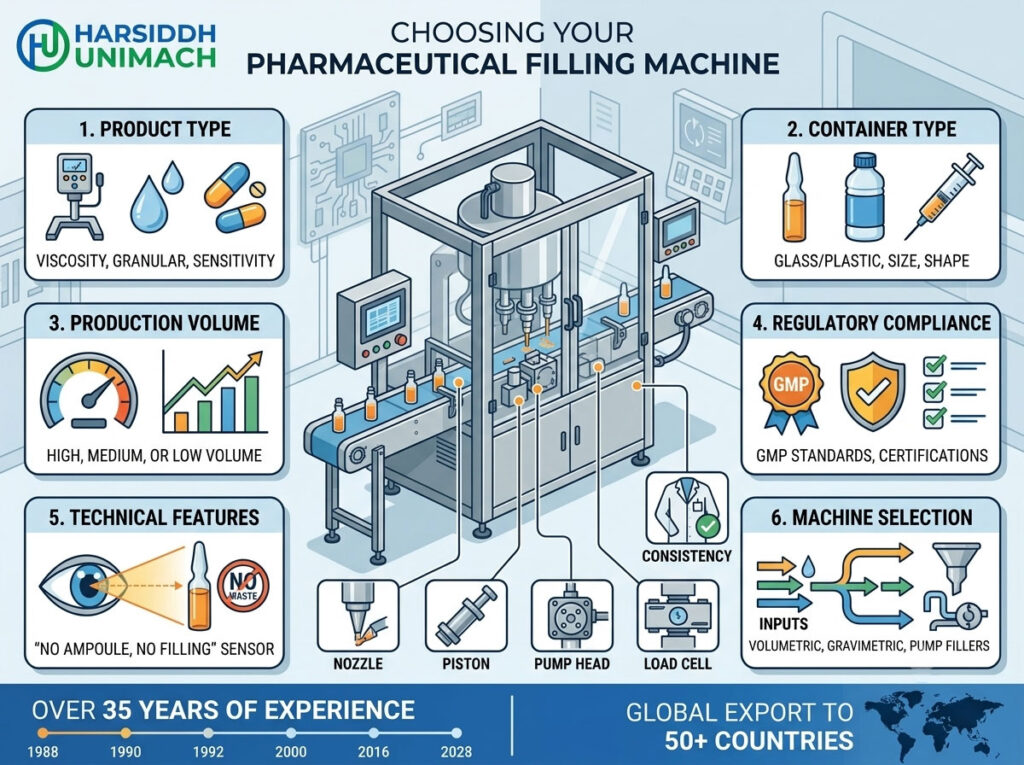
Every pharmaceutical filling operation sits somewhere on a scale. At one end is an operator filling containers by hand or with a simple bench-top unit. At the other is a fully integrated line where containers are washed, sterilised, filled, closed and labelled with operators supervising rather than handling. Between them lie semi-automatic machines and automatic stand-alone machines.
Choosing where your operation should sit on this scale is one of the most important decisions in selecting a filling machine. Too little automation and you face high labour costs, inconsistent quality and limited capacity. Too much and you tie up capital in a complex line that is under-used and hard to change over.
This guide explains how to choose the right level of automation for your pharmaceutical filling machine. It compares each level on output, consistency, labour, compliance, flexibility and cost, and shows how to work out when moving up a level pays off.
Other guides in this series help you choose by dosage form and by sterility requirement. Our article on choosing a filling machine for every stage of production looks at the same question from the point of view of company growth.
The Four Levels of Filling Automation
Level 1: Manual Filling
Operators fill containers using hand-held dispensers, syringes, pipettes or simple manual pumps, and close them by hand or with hand tools.
Typical use: R&D, formulation trials, very small clinical batches and stability samples.
Strengths: very low investment, maximum flexibility, minimal setup time.
Limitations: slow, highly operator-dependent, difficult to control and document consistently, unsuitable for routine commercial production.
Level 2: Semi-Automatic Machines
The machine performs the critical operation, such as dosing, sealing or capping, while an operator loads and unloads containers or starts each cycle, often with a foot pedal or button.
Examples:
- Tube filling: a semi-automatic aluminium tube filling and sealing machine or a semi-automatic plastic tube filling machine
- Vial sealing and capping: a semi-automatic vial cap sealing machine or a semi-automatic screw capping machine
- Washing: a semi-automatic multijet vial washing machine, a semi-automatic multijet ampoule washing machine or a semi-automatic rotary bottle washing machine
Typical use: small-scale production, pilot batches, start-ups, multi-product operations with short runs.
Strengths: consistent dosing or sealing, modest investment, simple operation and changeover, small footprint.
Limitations: output limited by operator speed, labour-intensive, more handling, and therefore more variability and contamination risk than automatic machines.
Level 3: Automatic Stand-Alone Machines
Containers are fed, filled and discharged automatically, usually on a conveyor. The operator sets up the machine, supplies components and monitors performance. Separate automatic machines may be linked by conveyors to form a line.
Examples: automatic multi-head liquid fillers, automatic powder fillers, an automatic lami tube filling machine, an automatic vial filling and stoppering machine, or an automatic linear vial washing machine upstream.
Typical use: routine commercial production at small to high volumes.
Strengths: higher, steadier output, reduced labour per unit, better consistency, features such as no-container, no-fill and automatic rejection.
Limitations: higher investment, longer changeovers than simple semi-automatic machines, needs trained operators and maintenance support.
Level 4: Fully Integrated Lines and Monoblocks
Several operations are combined into one coordinated system: for example, washing, depyrogenation, filling, stoppering and capping for vials, or filling and capping in a single monoblock.
Examples:
- an automatic liquid vial filling line
- an automatic ampoule filling line
- a liquid bottle filling and capping monoblock
- an automatic dry syrup powder filling line
Typical use: medium to high-volume production, sterile injectables, plants that want to minimise handling and footprint.
Strengths: matched speeds, minimal manual handling, smallest risk of contamination and mix-ups between steps, simplified qualification as one system.
Limitations: highest investment, more complex to maintain, a fault in one section stops the whole line.
Comparing the Levels
| Factor | Manual | Semi-Automatic | Automatic Stand-Alone | Integrated Line |
|---|---|---|---|---|
| Output | Very low | Low to moderate | Moderate to high | Moderate to very high |
| Dose consistency | Operator-dependent | Good | Very good | Very good |
| Labour per unit | Very high | High | Low | Lowest |
| Handling and contamination risk | Highest | Moderate | Lower | Lowest |
| Changeover | Fastest | Fast | Moderate | Longer, depends on design |
| Flexibility | Highest | High | Moderate | Lower for frequent changes |
| Investment | Lowest | Low | Medium to high | Highest |
| Footprint | Bench | Small | Medium | Compact per output, larger overall |
| Typical stage | R&D | Pilot, small production | Commercial production | High-volume or sterile production |
Factors That Decide the Right Level
1. Volume and Batch Size
Volume is usually the strongest driver. Low annual volumes and small batches rarely justify full automation, while high volumes quickly make manual and semi-automatic processes uneconomic.
2. Product Value and Sensitivity
High-value products, such as biologics, benefit from the precision and low product loss of automatic dosing, even at modest volumes. Sterile products benefit from automation because it reduces manual interventions.
3. Sterility Requirements
For sterile injectables, minimising human contact with open containers is a priority. Automatic and integrated lines, often with barrier systems, are generally preferred for routine sterile production. Semi-automatic equipment may still be used for small-scale or development work under appropriate controls.
4. Product Mix and Changeover Frequency
Plants running many products in short campaigns need equipment that changes over quickly. Semi-automatic machines or flexible automatic machines with quick-release parts and stored recipes may suit better than a high-speed line designed for long runs.
5. Labour Availability and Cost
Where skilled labour is scarce or expensive, automation reduces dependence on operators. Where labour is available and affordable, semi-automatic equipment may remain cost-effective for longer.
6. Consistency and Compliance
Automation reduces variability from operator to operator and shift to shift. Features such as recipes, access control, alarm logs and automatic rejection make documentation and compliance easier.
7. Space and Utilities
Integrated lines often fit more output into less space than separate machines. But all automatic equipment needs reliable power, compressed air and, for sterile lines, additional utilities.
8. Budget and Payback
Higher automation costs more upfront but usually reduces labour, waste and rejects. The question is how long it takes for the savings to repay the extra investment.
Working Out When Automation Pays Off
A simple payback calculation helps compare levels.
Payback period (years) = Extra investment ÷ Annual savings
Annual savings typically include:
- reduced labour (fewer operators per shift)
- reduced product loss (lower overfill and spillage)
- fewer rejects and less rework
- higher output from the same shift pattern, avoiding extra shifts or a second machine
Illustrative example (arbitrary cost units, not data for any machine): moving from semi-automatic to automatic filling costs an extra 30 units. The automatic machine saves 6 units a year in labour and 4 units a year in reduced product loss and rejects, a total of 10 units a year.
Payback = 30 ÷ 10 = 3 years
If the machine will be used for many years beyond the payback period, the investment is likely to be worthwhile. Our ROI analysis of automatic and semi-automatic vial fillers explores this in more detail for vial filling.
Remember to include costs that rise with automation, such as maintenance, spare parts and qualification, and benefits that are harder to measure, such as reduced compliance risk.
Mixing Automation Levels on One Line
Automation does not have to be all or nothing. Many lines combine levels to balance cost and performance:
- an automatic filler with a semi-automatic capper for a small production line
- semi-automatic washing feeding an automatic filler
- an automatic line with a semi-automatic station for special packs
When mixing levels, make sure the slowest step still meets your output target and that manual steps do not introduce unacceptable contamination or mix-up risks.
Upgrading Your Automation Over Time
Many companies move up the automation scale as they grow:
- Start-up: semi-automatic machines for initial products and small batches.
- Growth: automatic stand-alone machines for the main products, keeping semi-automatic machines for small runs and development.
- Scale: integrated lines for high-volume or sterile products.
To make upgrades easier:
- choose equipment from a supplier with a range that covers each level
- keep container and closure specifications consistent so change parts can be reused or matched
- plan floor space and utilities for future machines
- consider whether semi-automatic machines can remain useful as pilot or backup equipment
The Role of Servo Technology
Modern automatic machines increasingly use servo drives for dosing and motion. Servo control allows fill volumes and motion profiles to be stored in recipes, improving consistency and reducing changeover time. Our article on how servo-driven vial filling systems outperform mechanical lines explains the engineering benefits.
What Automation Means for Your People
Automation changes the work, not just the machine. Moving up a level usually means:
- fewer repetitive manual tasks, such as loading containers or pressing a pedal for every cycle
- more supervisory and technical roles, such as setting up recipes, monitoring performance and troubleshooting
- greater need for maintenance skills, including mechanical, electrical and control system knowledge
- new training requirements for operators, technicians and supervisors
Plan for this early. Involve operators in the selection and FAT, train maintenance staff before the machine arrives, and update SOPs and training records so the team is ready on day one.
Questions to Ask Suppliers About Automation
- What output can I expect at each automation level with my product and containers?
- How many operators are needed per shift for each option?
- How long does a typical changeover take?
- Which settings are stored in recipes, and which need manual adjustment?
- Can the machine be upgraded later, for example by adding heads or linking to other machines?
- What maintenance skills and spare parts are needed?
Quick Decision Guide
| If Your Situation Is… | Consider… |
|---|---|
| R&D, formulation trials, stability samples | Manual or lab-scale equipment |
| Small batches, many products, limited budget | Semi-automatic machines |
| Growing commercial volumes, a few main products | Automatic stand-alone machines |
| High volumes or sterile injectables | Integrated automatic lines |
| Limited space with moderate to high output | Monoblocks or compact lines |
| Mixed portfolio of large and small products | A combination of automatic and semi-automatic equipment |
Common Mistakes
- Automating too early. Expensive lines sitting idle tie up capital.
- Automating too late. Labour costs, inconsistency and capacity limits hold back growth.
- Ignoring changeovers. A high-speed line with long changeovers may produce less than a flexible machine in a multi-product plant.
- Forgetting maintenance capability. Automatic equipment needs trained technicians and spare parts.
- Mixing levels without balancing speeds. A slow manual step can cap the output of an automatic line.
Frequently Asked Questions
Is semi-automatic filling acceptable under GMP? Yes, when the process is validated, controlled and documented. GMP does not require a particular level of automation, but your process must consistently produce product of the required quality.
When should I move from semi-automatic to automatic? When volume, labour cost, consistency needs or compliance considerations make the payback on automatic equipment attractive.
Do sterile products always need automatic filling? Routine commercial sterile filling generally uses automatic equipment to minimise interventions. The right approach depends on your product, batch size and regulatory expectations.
Can semi-automatic machines be linked into a line? Some can be used alongside automatic machines, but output will be limited by the slowest manual step.
What does a fully integrated line offer over separate automatic machines? Matched speeds, less handling, a smaller footprint per unit of output and simpler qualification as one system.
Find the Right Level of Automation With Harsiddh
Harsiddh Unimach manufactures semi-automatic machines, automatic filling, capping and sealing machines and fully integrated lines for vials, ampoules, bottles, tubes and powders. Whether you are starting with small batches or scaling up to high-volume production, our team can help you choose the level of automation that fits your products, volumes and budget.
Contact us through our contact page or share your requirements through our inquiry form.