
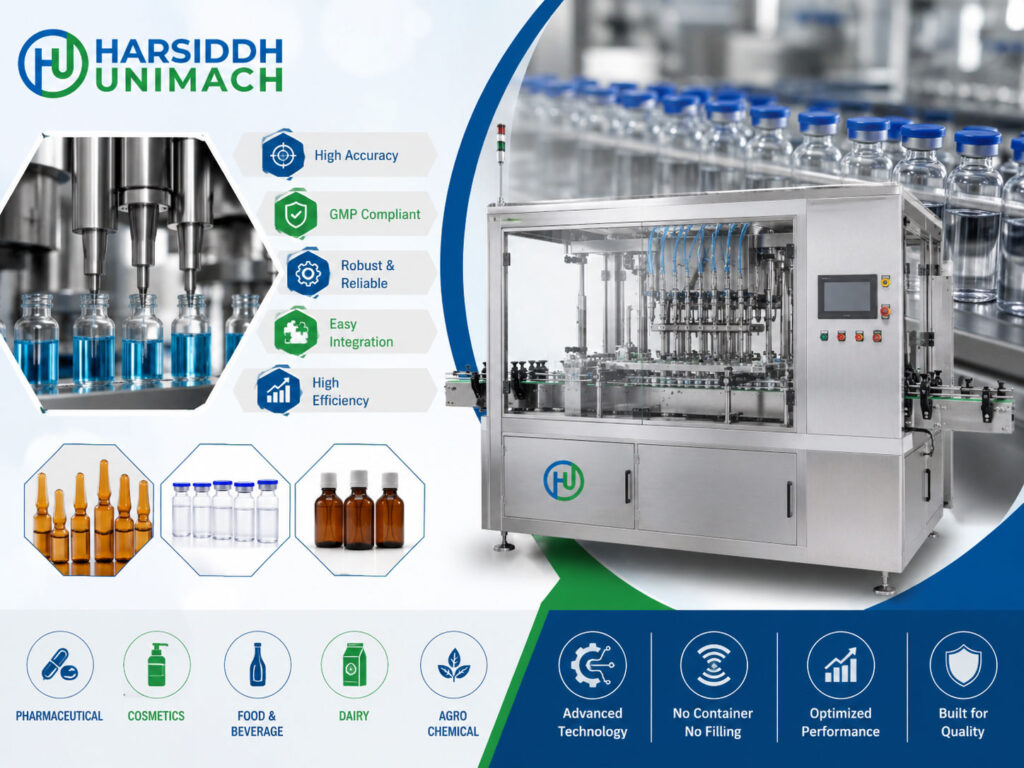
The filling machine is often the heart of a pharmaceutical production line. It determines how accurately each dose is delivered, how much product is wasted, how quickly you can change between products and, in sterile production, how well the product is protected from contamination. Choosing the right one is a decision that shapes your output, quality and costs for many years.
But “filling machine” covers a very wide range of equipment: vial fillers, ampoule fillers, syrup fillers, powder fillers, tube fillers, tablet counters and more. The first and most important step is to match the machine family to your dosage form and container. Only then do the finer decisions about technology, output and features make sense.
This guide gives you a practical framework: first identify the right machine family, then work through the key decisions in order. Along the way, we link to more detailed guides for each product type.
Step 1: Start with Your Dosage Form and Container
Different dosage forms need fundamentally different filling machines. Use this table as a starting point:
| Dosage Form | Container | Machine Family | Key Considerations |
|---|---|---|---|
| Liquid injectables | Vials | Vial filling and stoppering machines | Aseptic design, accuracy, stoppering |
| Liquid injectables | Ampoules | Ampoule filling and sealing machines | Flame sealing, nitrogen, ampoule types |
| Liquid injectables | Pre-filled syringes | PFS filling and stoppering machines | Nested handling, plunger placement |
| Dry powder injectables | Vials | Powder filling and stoppering machines | Vacuum dosing, containment |
| Oral liquids (syrups, suspensions) | Bottles | Liquid bottle fillers | Viscosity, suspensions, foam control |
| Dry syrups | Bottles | Dry syrup powder fillers | Humidity, dust, auger dosing |
| Creams, ointments, gels | Tubes, jars | Tube fillers, piston fillers | Viscosity, sealing type, temperature |
| Tablets and capsules | Bottles | Counting and filling machines | Counting accuracy, dust, breakage |
Once you know the machine family, you can focus on the right suppliers, specifications and detailed guides:
- For injectables in general, read how to select the right filling machine for injectable manufacturing.
- For vials, read the vial filling machine selection guide.
- For ampoules, read how to choose the right ampoule filling machine.
Step 2: Understand Your Product in Detail
Within each machine family, product properties drive the technical choices:
- Viscosity – thin, medium or thick; does it change with temperature?
- Suspended solids – do particles need to be kept uniform?
- Foaming – does the product foam when agitated or splashed?
- Shear sensitivity – can it tolerate pumping without damage?
- Oxygen sensitivity – is nitrogen protection needed?
- Flow properties (powders) – free-flowing or cohesive, density stability
- Moisture sensitivity (powders and solids) – humidity control requirements
- Sterility – aseptic filling or terminal sterilisation
- Potency or hazard – does the product require containment for operator safety?
Write these properties down before speaking to suppliers. They form the basis of your user requirement specification.
Step 3: Choose the Dosing Technology
The dosing technology determines accuracy, cleaning effort and product handling.
For liquids
| Technology | How It Works | Typical Pharma Use |
|---|---|---|
| Piston (volumetric) | Fixed stroke volume | Syrups, oral liquids, injectables |
| Servo piston | Programmable stroke | Multi-product lines, high accuracy |
| Peristaltic | Rollers squeeze tubing | Sterile injectables, minimal product contact |
| Gear or lobe pump | Revolutions | Viscous liquids, larger volumes |
| Time-pressure / flow meter | Measured flow | Specific high-accuracy applications |
| Weight filling | Load cell | Larger volumes, density-independent filling |
For a detailed comparison, read liquid filling machine technologies compared and weight-based vs volumetric filling.
For powders
| Technology | How It Works | Typical Pharma Use |
|---|---|---|
| Vacuum powder wheel | Vacuum fills precision ports | Sterile dry powder injections in vials |
| Auger | Screw revolutions | Dry syrups, bulk powders in bottles |
| Measuring cup | Fixed cup volume | Free-flowing granules |
For semi-solids
Piston pumps with suitable hoppers, valves and nozzles, often with temperature control, are standard for creams, ointments and gels.
For solids
Electronic sensor counting is the most common method for tablets and capsules in bottles.
Step 4: Determine the Right Output
Calculate your output requirement realistically:
- Start with annual demand per product.
- Divide by working days and shifts.
- Allow for realistic efficiency, including changeovers, cleaning, breaks and stoppages.
- Add headroom for growth over the next few years.
This gives you the machine speed you actually need. Then choose the configuration, such as number of heads, that meets it.
Avoid the two common mistakes
- Undersizing creates a bottleneck that forces overtime and limits growth.
- Oversizing increases investment, change parts, complexity and start-up losses without real benefit.
Step 5: Decide on the Level of Automation
| Level | Description | Best For |
|---|---|---|
| Manual / tabletop | Operator does most tasks | R&D, very small batches |
| Semi-automatic | Machine doses; operator handles containers | Small batches, start-ups, pilot production |
| Automatic standalone | Machine handles containers and dosing | Regular production |
| Monoblock | Several steps (e.g. fill, stopper, cap) on one frame | Space-saving, fewer transfers |
| Complete integrated line | Washing to labelling, synchronised | High-volume, dedicated production |
Higher automation improves consistency and reduces labour, but increases investment and complexity. Match the level to your current volumes and realistic growth.
Step 6: Plan for Flexibility and Changeover
If you run several products or container sizes, changeover performance matters as much as speed:
- How long does a full changeover take?
- How many change parts are needed, and are they tool-less?
- Can settings be stored as recipes (servo machines)?
- How easy is it to clean product contact parts?
- Can the machine handle future products or container sizes?
A slightly slower machine with fast, simple changeovers often outperforms a faster machine on a multi-product line.
Step 7: Confirm GMP and Compliance Requirements
Every pharmaceutical filling machine must support GMP. Check:
- Materials of product contact parts and their certificates
- Surface finish and cleanability; no dead zones
- Documentation – design documents, IQ/OQ support, FAT and SAT protocols
- Control system – user access levels, alarms, data recording and audit trails where required
- Contamination control – laminar airflow, RABS or isolator compatibility for sterile products
- Safety – guarding, interlocks and emergency stops
Align requirements with your quality team early and with current applicable regulatory guidance.
Step 8: Plan Line Integration
The filler must work with the machines before and after it:
- Washing, depyrogenation and sterilisation (for injectables)
- Capping, stoppering, sealing or crimping
- Inspection, labelling, serialization and packing
Check speed matching, transfer design, heights and control communication. Buying an integrated line from one supplier can simplify responsibility and integration.
Step 9: Check Utilities and Facility Fit
- Floor space, layout and access for maintenance and cleaning
- Electrical supply
- Compressed air quality and volume
- Vacuum, nitrogen, gas and oxygen (depending on machine type)
- Room classification, airflow and environmental control (temperature, humidity)
Confirming utilities early avoids costly surprises during installation.
Step 10: Evaluate Suppliers and Total Cost of Ownership
Supplier evaluation
- Experience with your dosage form and similar products
- Willingness to run trials with your product
- Documentation quality and qualification support
- Training, spare parts and service support
- References from existing customers
Total cost of ownership
Consider all costs over the machine’s life:
| Cost Element | What to Consider |
|---|---|
| Purchase price | Scope of supply, options, change parts |
| Installation and qualification | Effort, documentation, time |
| Product loss | Overfill, start-up waste, rejects |
| Utilities | Power, air, vacuum, gases |
| Maintenance and spares | Wear parts, service visits |
| Downtime | Reliability, service response |
| Changeovers | Time lost per changeover × number per year |
A machine with a higher purchase price but lower product loss, faster changeovers and better reliability often delivers better value.
Common Mistakes to Avoid
- Choosing on purchase price alone – a cheaper machine can cost more over its life through rejects, overfill, downtime and slow changeovers.
- Ignoring future products – today’s single product may be joined by new formulations, strengths or containers.
- Skipping product trials – accuracy and handling should be proven on your own product, not assumed.
- Treating the filler in isolation – the slowest machine in the line sets the output, not the filler’s rated speed.
- Late involvement of quality and engineering – documentation, utilities and contamination control requirements discovered late cause delays.
- Underestimating training and support – even the best machine performs poorly without trained operators and responsive service.
Writing a User Requirement Specification (URS)
A clear URS is the foundation of a good purchase. It tells suppliers exactly what you need and becomes the reference for testing and qualification. A typical URS for a filling machine includes:
- Scope – what the machine must do and what is excluded
- Products – properties, fill volumes and tolerances
- Containers and closures – sizes, materials, drawings
- Output – required speed and efficiency
- Process requirements – nitrogen, temperature control, containment, sterility
- Materials and finishes – for product contact parts
- Controls and data – user levels, alarms, recipes, data recording
- Utilities – available supplies and their quality
- Documentation – manuals, drawings, certificates, qualification support
- Testing – FAT, SAT and acceptance criteria
Sharing the URS with several suppliers makes their proposals easier to compare on equal terms.
Machine Families at a Glance
To explore options for each dosage form:
- Oral liquids – the volumetric liquid bottle filling machine and our liquid filling machines
- Liquid injectables in vials – the liquid vial filling machine with rubber stoppering and our vial filling machines
- Ampoules – the eight head ampoule filling and sealing machine
- Pre-filled syringes – the pre-filled syringe filling and stoppering machine
- Dry powder injectables – the single wheel injectable dry powder vial filling with rubber stoppering machine
- Dry syrups – the rotary dry syrup powder filling machine and our powder filling machines
- Creams, ointments and gels – the automatic single head tube filling machine (HTF-40A), the lotion and gel filling machine and our tube filling machines
- Tablets and capsules – the tablet and capsule counting and filling machine
Making the Most of Trials and the FAT
Before the machine ships, use product trials and the factory acceptance test (FAT) to confirm it meets your URS. Run your own product or a suitable placebo in your own containers, check fill accuracy across all heads over an extended run, time a full changeover, test safeguards such as no container-no fill, and review the documentation and operator interface. Agree any corrections with the supplier before dispatch, so installation and qualification at your site go smoothly.
Selection Checklist
- Dosage form and container defined
- Product properties documented
- Dosing technology selected
- Output requirement calculated with efficiency and growth
- Automation level chosen
- Changeover and flexibility needs defined
- GMP and documentation requirements confirmed
- Line integration planned
- Utilities and facility checked
- Suppliers evaluated, trials arranged
- Total cost of ownership compared
Frequently Asked Questions
What is the first step in choosing a pharmaceutical filling machine? Identify your dosage form and container. This determines the machine family, such as vial filler, ampoule filler, syrup filler, powder filler, tube filler or tablet counter.
How do I choose between filling technologies? Base the choice on product properties, fill volume, accuracy needs, cleaning strategy and number of products.
Should I buy a semi-automatic or automatic machine? Semi-automatic machines suit small batches and start-ups; automatic machines and integrated lines suit regular and high-volume production.
Why is total cost of ownership important? Running costs, product loss, changeovers and downtime often outweigh purchase price over the machine’s life.
Should I run trials before buying? Yes. Trials with your own product and containers are the best way to confirm accuracy, handling and suitability.
Need help choosing the right filling machine? Contact our team or send an inquiry with your dosage form, container, product details and output targets.