
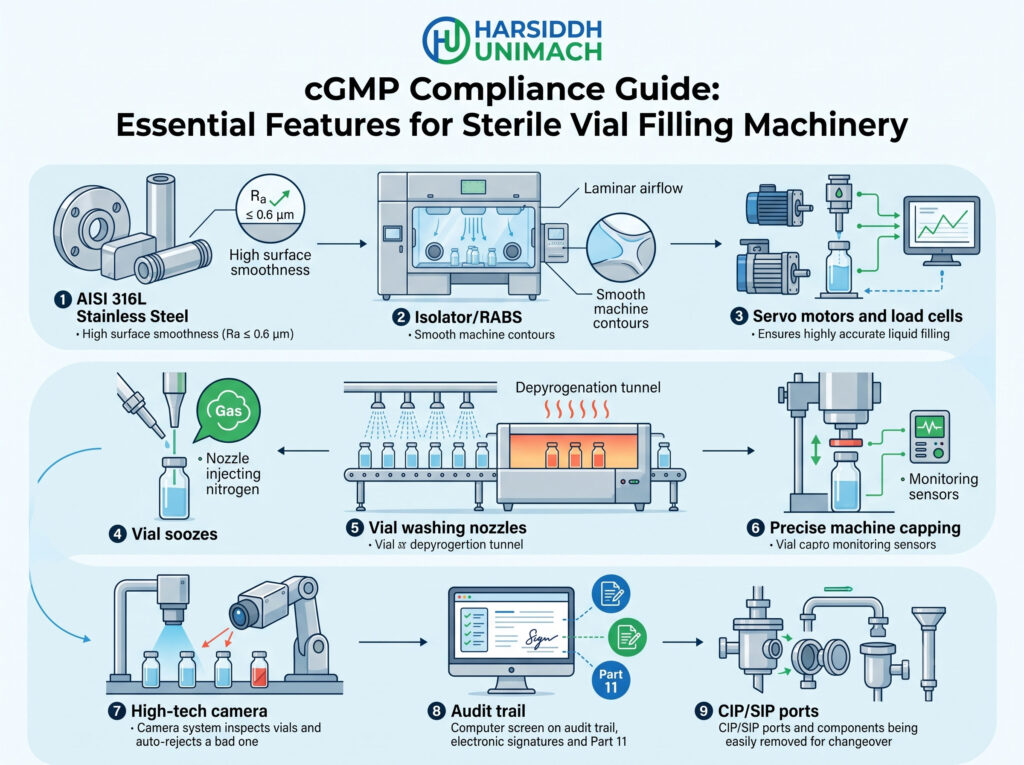
Sterile injectables are among the most tightly regulated products in pharmaceutical manufacturing. Because they are injected directly into the body, there is no margin for contamination, incorrect dosing or closure failure. Current Good Manufacturing Practice (cGMP) requires that every element of the process, including the equipment, is designed, built, installed, operated and maintained to protect product quality and patient safety.
A vial filling machine does not make a process compliant on its own. Compliance depends on the whole system: facility, people, procedures, materials and equipment. But the machine plays a central role. Poorly designed equipment makes compliance difficult, while well-designed equipment makes it easier to achieve and demonstrate.
This guide explains the essential features to look for in sterile vial filling machinery from a cGMP perspective, grouped into design, materials, aseptic features, controls and data, safety and interlocks, and documentation and qualification. Specific requirements depend on your products, markets and the current regulatory guidance that applies to you, such as GMP guidance for sterile medicinal products, so always confirm details with your quality and regulatory teams. Regulatory expectations also evolve over time, so features that were optional a few years ago, such as audit trails on machine controls or designs that minimise interventions, are increasingly seen as standard.
1. Hygienic and Aseptic Design
Design principles
- Smooth, cleanable surfaces with no crevices, sharp internal corners or hidden areas where contamination can collect
- Minimal horizontal surfaces above open vials, where particles could settle
- Sloped surfaces and drainable designs so cleaning liquids do not pool
- Separation of mechanical drives from the product zone, for example by placing motors and gearboxes below a sealed table top
- Sealed penetrations where shafts pass through the table, to prevent particles reaching the critical zone
- First air protection – no machine parts or operator actions should obstruct clean unidirectional air flowing over open vials and stoppers
Why it matters
Hygienic design reduces contamination risk, simplifies cleaning and disinfection, and makes environmental monitoring results easier to maintain within limits.
2. Materials and Surface Finish
Product contact parts
- Stainless steel of suitable grade for parts contacting product, such as pumps, manifolds and needles
- Approved elastomers and plastics for seals, gaskets and tubing, compatible with the product and cleaning or sterilisation methods
- Material certificates for all product contact parts
- Defined surface finish on product contact surfaces
Non-contact parts
- Corrosion-resistant materials that tolerate cleaning agents and disinfectants
- No materials that shed particles in the critical zone
3. Sterilisable and Single-Use Product Paths
The product path must be sterile when production begins. Machines should support:
- Easy removal of product contact parts for cleaning and sterilisation, for example in an autoclave
- Clean-in-place and sterilise-in-place capability where designed for it
- Single-use fluid paths, such as pre-sterilised tubing sets for peristaltic pumps, which reduce cleaning validation and cross-contamination risk
- Aseptic connections for assembling sterile parts in the critical zone
The choice between reusable piston pumps and single-use peristaltic paths affects cleaning validation effort, so it should be considered early in the design.
4. Barrier Compatibility
Modern sterile manufacturing increasingly uses Restricted Access Barrier Systems (RABS) or isolators to separate operators from the critical zone. Filling machines should be designed to:
- Fit inside barrier enclosures with suitable dimensions and access
- Allow necessary interventions through glove ports
- Withstand decontamination agents used in isolators
- Minimise the need for interventions through reliable, automated operation
Read the rise of RABS and isolators in modern pharmaceutical vial filling machines and a complete guide to aseptic packaging for liquid injectables.
5. Minimising Interventions
Every manual intervention in the critical zone is a contamination risk. Machines should reduce interventions by:
- Reliable vial handling with correct change parts and accurate timing
- Automatic stopper feeding with sufficient bowl capacity
- Automatic weight checking where appropriate, to reduce manual sampling
- Clear alarms that allow operators to diagnose problems without opening barriers unnecessarily
- Designed intervention procedures for unavoidable tasks, such as clearing a fallen vial
6. Accurate, Controlled Dosing
cGMP requires that each vial receives the correct dose. Machines should provide:
- Accurate, repeatable dosing demonstrated during qualification
- Individual head adjustment to balance fill across heads
- In-process weight control, manual or automatic
- No vial, no fill to prevent product spillage
- Controlled filling motions – diving needles and speed profiles that prevent splashing and foaming
Servo-driven systems help achieve these goals; read how servo-driven vial filling systems outperform mechanical lines. For oxygen-sensitive products, nitrogen purging may also be required; read the role of nitrogen flushing in preserving injectable drug stability.
7. Reliable Stoppering and Sealing
Container closure integrity is essential. Machines should provide:
- Accurate stopper placement to the correct depth
- Stopper presence detection with rejection of vials without stoppers
- Consistent crimping on the cap sealing machine, with force set and verified
Read vial capping machine: how crimping force affects container closure integrity. See the vial cap sealing machine.
8. Controls, Data Integrity and Electronic Records
Computerised systems on filling machines must support data integrity. Key features include:
| Feature | Purpose |
|---|---|
| User access levels | Restrict functions by role (operator, supervisor, engineer, administrator) |
| Unique user log-in | Attribute actions to individuals |
| Audit trails | Record changes to recipes, parameters and settings, with who, what and when |
| Recipe management | Controlled storage and selection of approved settings |
| Alarm and event logging | Record alarms, stops and interventions |
| Secure data storage | Protect records from loss or unauthorised change |
| Time synchronisation | Accurate, consistent time stamps |
| Electronic signatures | Where required by your procedures and applicable regulations |
Data integrity expectations follow principles such as data being attributable, legible, contemporaneous, original and accurate. Control systems should be specified and validated accordingly, in line with applicable regulations for electronic records.
9. Safety Interlocks and Process Safeguards
- Guard interlocks that stop the machine safely when doors or barriers are opened
- Emergency stops at accessible positions
- No vial, no fill and no vial, no stopper logic
- Low product and low stopper level alarms
- Utility monitoring – compressed air, vacuum and nitrogen pressure where critical
- Reject systems for vials with detected faults
10. Documentation, Qualification and Lifecycle
Documentation package
A cGMP-ready supplier should provide:
- Functional and design specifications
- Drawings: general arrangement, electrical, pneumatic and P&ID where relevant
- Material certificates and surface finish documentation
- Software documentation and version records
- Operation and maintenance manuals
- Spare parts lists
- Calibration certificates for critical instruments
Qualification
Equipment is typically qualified through a structured lifecycle:
- User requirement specification (URS) – what you need
- Design qualification (DQ) – confirming the design meets the URS
- Factory acceptance test (FAT) – testing at the supplier
- Site acceptance test (SAT) – testing after installation
- Installation qualification (IQ) – verifying correct installation
- Operational qualification (OQ) – verifying functions across operating ranges
- Performance qualification (PQ) – demonstrating consistent performance with product or simulations
For aseptic processes, process simulation (media fills) is part of demonstrating the process as a whole.
Lifecycle management
- Change control for any modifications to hardware, software or settings
- Preventive maintenance and calibration programmes
- Periodic review of performance and qualification status
- Training records for operators and maintenance staff
Our vial filling line checklist: 7 things to evaluate before buying offers a practical buyer’s view.
11. Compatibility with Cleaning, Disinfection and Monitoring
Sterile areas are cleaned and disinfected regularly, and the environment is monitored continuously. The filling machine should support these activities:
- Resistance to disinfectants and sporicides used in your cleanroom, without corrosion or surface damage
- Easy access for wiping and disinfecting surfaces around the critical zone
- Space and mounting points for environmental monitoring equipment, such as particle counter probes and settle plates, positioned close to open vials without obstructing airflow
- Airflow visualisation – the machine layout should allow smoke studies to confirm that clean air sweeps over open containers as intended
Common Equipment-Related Compliance Gaps
Audits and inspections often highlight equipment-related issues such as:
- Hard-to-clean areas where residues or particles accumulate
- Unrestricted access to change settings or recipes on the HMI
- Missing or incomplete audit trails for critical parameter changes
- Interventions not adequately designed or documented
- Incomplete documentation – missing material certificates, drawings or software records
- Calibration gaps for critical instruments such as pressure sensors or load cells
- Uncontrolled changes to machine hardware or software
Selecting equipment with good design and complete documentation, and managing it through change control, prevents many of these findings.
Supplier Evaluation Checklist
- Experience with sterile vial filling and aseptic processing
- Hygienic design with drives separated from the product zone
- Material certificates and surface finish documentation available
- Sterilisable or single-use product path options
- Compatibility with RABS or isolators
- Data integrity features: access control, audit trails, secure records
- Complete documentation package and qualification support
- FAT and SAT protocols offered
- Training, spare parts and service support
Applying a Risk-Based Approach
cGMP expects manufacturers to understand and control the risks in their processes. For equipment, a risk-based approach means identifying where the machine could affect product quality, such as contamination, dosing errors, closure failures or data loss, and making sure each risk is controlled through design, procedures or monitoring. Tools such as failure mode and effects analysis are often used during design review and qualification planning. Focusing qualification and monitoring effort on the highest-risk functions, such as dosing accuracy, stoppering and the integrity of the critical zone, gives the greatest benefit for the effort spent.
People and Procedures
Even the best-designed machine relies on trained people and clear procedures. Operators must understand aseptic techniques, correct intervention methods and how to respond to alarms. Maintenance staff must follow approved procedures and document their work. Standard operating procedures, training records and regular refresher training are all part of maintaining compliance throughout the machine’s life.
The Complete Sterile Vial Line
cGMP considerations apply to every machine in the line:
- Washing – such as the linear vial washer
- Depyrogenation – such as the sterilizing tunnel for ampoules and vials
- Filling and stoppering – such as the Automatic Servo Based Vial Filling Machine, the Automatic Injectable Liquid Vial Filling and Stoppering Machine or the liquid vial filling machine with rubber stoppering; for powders, the single wheel injectable dry powder vial filling with rubber stoppering machine
- Cap sealing – followed by external washing on an automatic external vial washing machine
- Inspection – such as the visual ampoule and vial inspection machine
Integrated solutions such as the automatic liquid vial filling line bring these steps together. Browse our vial filling machines and the vial filling machines for liquid vials.
Frequently Asked Questions
Can a vial filling machine be “cGMP certified”? Machines are not certified on their own. Compliance is achieved by the manufacturer through suitable equipment, facilities, procedures, qualification and operation. Well-designed equipment and documentation make compliance easier.
What are the most important cGMP features of a sterile vial filler? Hygienic and aseptic design, suitable materials, sterilisable product paths, barrier compatibility, accurate dosing, reliable stoppering, data integrity controls, safeguards and complete documentation.
Why are drives placed below the table on aseptic machines? To keep mechanical components and their particles away from the critical zone above the table.
What documentation should a supplier provide? Specifications, drawings, material certificates, software documentation, manuals, spare parts lists, calibration certificates and FAT/SAT and qualification support.
How do barrier systems relate to the filling machine? The machine must fit inside RABS or isolators, allow interventions through glove ports and withstand decontamination.
Planning a cGMP-compliant sterile vial line? Contact our team or send an inquiry with your product, vial formats and regulatory requirements.