
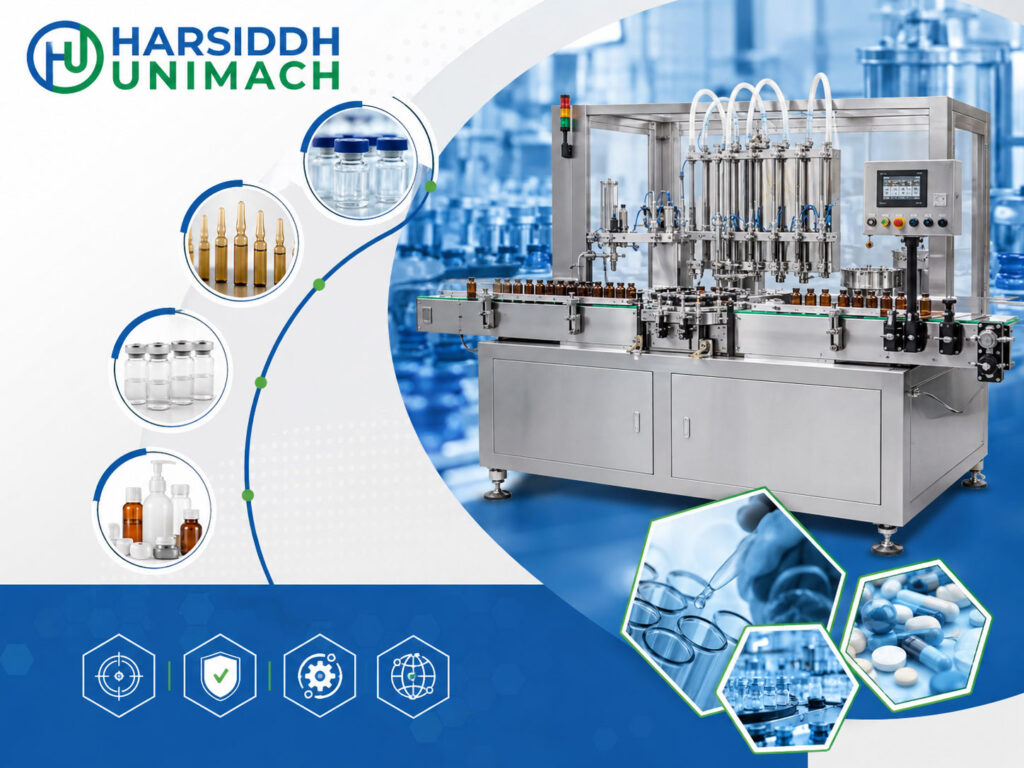
A pharmaceutical start-up preparing its first commercial batches, a growing company adding a second shift, a contract manufacturer juggling dozens of products and a large plant producing one product around the clock all need filling machines. But they do not need the same filling machine.
Most buying guides focus on product and technology: which dosing method, which container, which features. Those questions matter, and we cover them in our main guide on how to choose the right filling machine for your pharmaceutical production line. This article looks at the question from a different angle: your production stage and growth plans.
The right machine for a company making small clinical batches is very different from the right machine for a high-volume generic producer. Choosing a machine that fits your stage, and that can grow with you, protects your investment and avoids both bottlenecks and wasted capacity.
Why Production Stage Matters
| Production Stage | Main Priorities | Typical Risks |
|---|---|---|
| R&D and pilot | Flexibility, low product loss, small batches | Overinvesting in capacity not needed |
| Start-up commercial | Reliable quality, moderate output, controlled cost | Machine too small for early growth |
| Scale-up | Higher output, consistency, less labour | Bottlenecks, quality drift as speed rises |
| High-volume dedicated | Maximum output, efficiency, automation | Inflexibility if product mix changes |
| Multi-product / contract | Fast changeovers, wide format range, documentation | Long changeovers eat into capacity |
Each stage favours different machine characteristics. Let’s look at them in turn.
Stage 1: R&D, Clinical and Pilot Batches
What matters
- Small batch sizes – often only a few hundred or a few thousand units
- Minimal product loss – development product is expensive and scarce
- Flexibility – many different formulations, volumes and containers
- Easy cleaning – frequent product changes
- Documentation – clinical batches still require GMP compliance
Suitable machines
- Single head or tabletop fillers, which handle small batches with low hold-up volume
- Semi-automatic machines, where an operator loads containers and the machine doses accurately
- Peristaltic dosing for injectables, because product only touches replaceable tubing
For ampoules, a single head ampoule filling and sealing machine or the Automatic Single Head Ampoule Filling and Sealing Machine is a common choice. Read about the working principle of a small-scale ampoule filling and sealing machine.
Stage 2: Start-Up Commercial Production
What matters
- Reliable quality from day one, because every batch is commercial
- Moderate output that matches early demand
- Controlled investment while revenue is building
- Room to grow without immediately replacing equipment
Suitable machines
Semi-automatic and smaller automatic machines often fit well here. Typical examples include:
- Semi-automatic tube filling for creams and ointments, such as the Semi-Automatic Plastic Tube Filling Machine or the semi-automatic aluminium tube filling and sealing machine
- Semi-automatic capping, such as the semi-automatic screw capping machine or the semi-automatic ROPP capping machine
- Semi-automatic washing, such as the semi-automatic rotary bottle washing machine
- Smaller automatic fillers with two or four heads for liquids, vials or ampoules
Semi-automatic or automatic?
| Factor | Semi-Automatic | Automatic |
|---|---|---|
| Investment | Lower | Higher |
| Output | Limited by operator speed | Consistent, higher |
| Labour | Higher | Lower |
| Consistency | Depends on operator | Machine-controlled |
| Flexibility | Very high | High, depending on design |
| Best for | Small batches, many products, start-ups | Regular production, growing volumes |
For a detailed financial comparison, read automatic vs semi-automatic vial fillers: ROI analysis for growing pharma labs.
Stage 3: Scale-Up
What matters
- Higher output as demand grows
- Lower labour per unit through automation
- Consistent quality at higher speeds
- Integration of filling with washing, sealing, inspection and labelling
Suitable machines
- Automatic multi-head fillers, for example four or six head machines
- Monoblock machines that combine filling with stoppering or capping on one frame, saving space and reducing transfers; read monoblock vial filling, stoppering and capping explained or see the Automatic Liquid Bottle Filling and Capping Machine (Monoblock)
- Automatic vial filling and stoppering, such as the liquid vial filling machine with rubber stoppering
- Compact integrated lines, such as the automatic liquid vial filling line
Watch-outs
As speed rises, problems that were minor at low output, such as small fill variations, micro-stops or breakage, can become significant. Choose machines with good process control and plan for operator training.
Stage 4: High-Volume Dedicated Production
What matters
- Maximum output with high efficiency
- Automation from container infeed to packing
- Reliability and preventive maintenance
- Data for monitoring performance and quality
Suitable machines
- High-speed multi-head fillers, such as the high-speed eight head vertical ampoule filling and sealing machine
- Fully integrated lines with synchronised washers, tunnels, fillers, sealers, inspection and labelling
- Integrated solid-dose lines, such as the tablet and capsule counting and filling line
For ampoules, compare configurations in ampoule filling and sealing machines comparison: single head, 2 head, 4 head and 6 head models.
Watch-outs
High-volume lines are efficient for stable products but can be inflexible. If your product mix may change, consider designs with recipe management and reasonable changeover times.
Stage 5: Multi-Product and Contract Manufacturing
Contract manufacturers and companies with large portfolios face a special challenge: many products, many container sizes and frequent changeovers.
What matters
- Fast, simple changeovers with tool-less parts and stored recipes
- Wide format range to handle many container sizes
- Easy cleaning to prevent cross-contamination
- Strong documentation for multiple clients and audits
- Servo technology for digital setting of volumes and motions
Suitable machines
Servo-driven automatic machines with recipe storage, peristaltic options for easy product changes and quick-release change parts are well suited. A slightly lower rated speed is often acceptable if changeovers are much faster.
Dosage Form by Stage: What Typically Changes
| Dosage Form | Early Stage | Growth Stage | High Volume |
|---|---|---|---|
| Liquid vials | Single head or tabletop filler, manual stoppering | Automatic filling and stoppering, separate cap sealer | Integrated washing, tunnel, filling, sealing line |
| Ampoules | Single head filling and sealing | Two or four head automatic machine | Six or eight head machines in a complete line |
| Oral liquids | Semi-automatic piston filler | Automatic multi-head filler, separate capper | Monoblock or rotary filling and capping line |
| Creams and ointments | Semi-automatic tube filler | Automatic single head tube filler | Double head or higher-output tube lines |
| Tablets and capsules | Small counting machine | Automatic counter with capper | Integrated counting, capping, sealing and labelling line |
| Powders | Semi-automatic auger filler | Automatic auger or powder wheel filler | Integrated powder lines with closing and inspection |
Three Illustrative Scenarios
These simplified scenarios show how stage changes the decision. They are examples only, not recommendations for any specific company.
Scenario A: A new injectable start-up
A company is launching its first injectable product in vials with modest initial demand and several products in development. A compact automatic vial filler with stoppering, plus a separate cap sealer, gives GMP-compliant production without the cost of a full high-speed line. Peristaltic dosing helps switch between development products easily. Room is left in the facility for a washer and tunnel later.
Scenario B: A growing oral liquids manufacturer
A company filling syrups on semi-automatic equipment finds that labour and output limits are holding back sales. An automatic multi-head piston filler with a matched capper, or a monoblock filling and capping machine, increases output and consistency. The original semi-automatic filler stays in use for small batches and trials.
Scenario C: A contract manufacturer with many clients
A contract manufacturer runs dozens of products in different bottle sizes. The priority is fast, repeatable changeovers and strong documentation. Servo-driven machines with stored recipes, quick-release change parts and clear cleaning procedures deliver more real output than a faster but less flexible machine.
Questions to Ask Before You Buy
- What is our realistic demand today, and in three to five years?
- How many products and container sizes will this machine run?
- How often will we change over, and how long can we afford each changeover to take?
- What batch sizes do we typically run?
- What level of labour is available and affordable?
- Will this machine need to be integrated into a larger line later?
- Can the machine be upgraded, or will we need to replace it?
- What is the total cost of ownership over its expected life?
Common Mistakes at Each Stage
- Early stage: buying high-speed equipment too soon, tying up capital in capacity that sits idle.
- Start-up: buying the cheapest machine without considering accuracy, documentation or growth.
- Scale-up: adding speed without improving upstream and downstream machines, creating new bottlenecks.
- High volume: choosing a machine so specialised that a change in product mix makes it obsolete.
- Multi-product: focusing on rated speed instead of changeover time and cleaning.
Planning an Upgrade Path
Few companies stay at one stage forever. Planning ahead avoids replacing equipment too early:
- Choose upgradeable machines – for example, fillers that can accept additional heads, nitrogen systems or servo drives later.
- Design the room for growth – leave space and utilities for a larger machine or additional equipment.
- Standardise where possible – similar control systems and change part designs simplify training and spares.
- Keep early machines useful – a semi-automatic machine can continue for small batches, R&D or special products after an automatic line is installed.
- Reassess regularly – review demand forecasts and line performance at least yearly.
Don’t Forget the Rest of the Line
Whatever stage you are at, the filler is only one part of the process. Washing, depyrogenation, capping or sealing, inspection, labelling and packing all need to keep pace. When moving to a larger filler, check that upstream and downstream equipment can handle the new output, or plan to upgrade them at the same time. Matching the whole line avoids the common situation where a new high-speed filler spends much of its time waiting for a slower capper or labeller. Facility factors matter too: room size, utilities, cleanroom classification and staff training should all be reviewed as production grows.
Budget and Return on Investment
At every stage, consider total cost of ownership rather than purchase price alone:
- Labour savings from automation
- Product savings from accurate dosing and fewer rejects
- Capacity gains from higher output or faster changeovers
- Quality benefits from consistent, machine-controlled processes
- Maintenance and spares over the machine’s life
Our article on how to calculate filling machine ROI for manufacturing plants explains how to put numbers to these factors.
Quick Guide: Matching Machine to Stage
| Your Situation | Consider |
|---|---|
| Developing new products, small clinical batches | Tabletop or single head fillers, semi-automatic machines, peristaltic dosing |
| First commercial launch, modest demand | Semi-automatic or small automatic machines with room to grow |
| Demand growing, labour becoming a constraint | Automatic multi-head fillers, monoblock machines |
| One high-volume product | High-speed fillers and fully integrated lines |
| Many products, frequent changeovers | Servo machines with recipes and quick-release parts |
Frequently Asked Questions
Should a new pharmaceutical company start with semi-automatic machines? Often, yes. Semi-automatic machines offer flexibility and lower investment for small batches. Many companies later add automatic machines as volumes grow.
When is it time to move to automatic filling? When labour costs, output limits or consistency requirements outweigh the extra investment, or when demand consistently exceeds what semi-automatic equipment can deliver.
What should contract manufacturers prioritise? Fast changeovers, wide format ranges, easy cleaning and strong documentation.
Can a filling machine be upgraded later? Many machines can be upgraded with additional heads, servo drives or nitrogen systems. Ask suppliers about upgrade options before buying.
Is the highest-speed machine always the best investment? No. A machine sized and configured for your real demand and product mix usually delivers better value.
Not sure which machine fits your stage of growth? Contact our team or send an inquiry with your products, batch sizes and growth plans.