
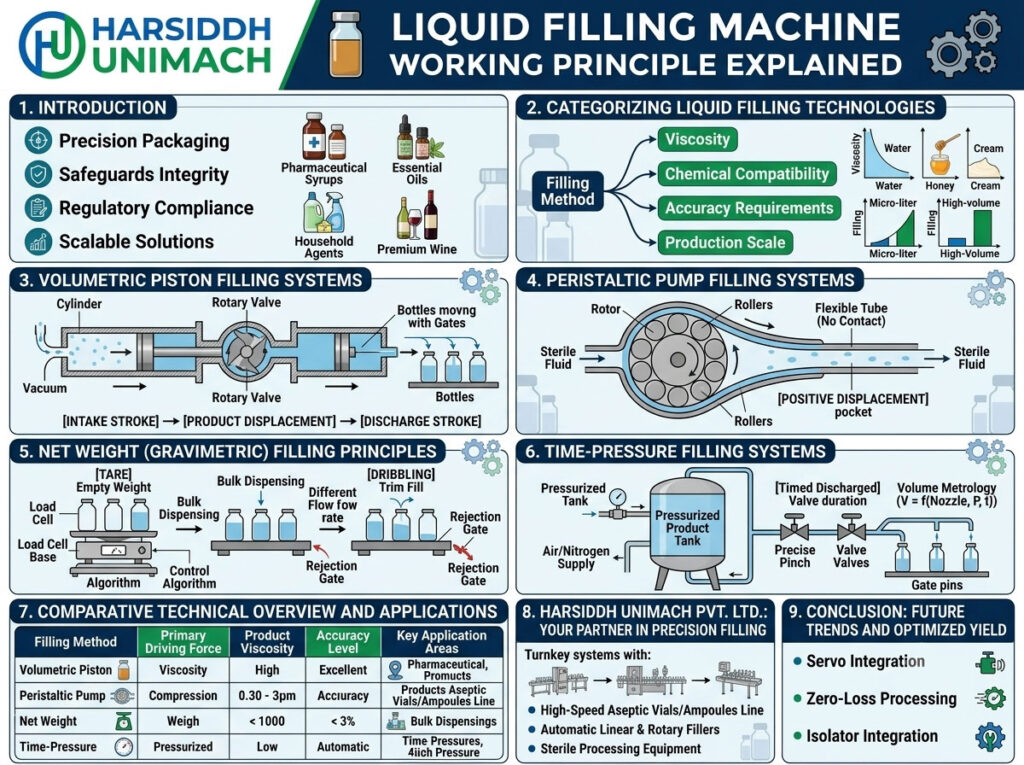
Every liquid filling machine, from a simple tabletop unit to a high-speed pharmaceutical line, is built on one of a small number of physical principles. Some rely on gravity, some on displacement, some on pressure or vacuum, and some on weighing. Each principle measures the dose in a different way — and that is why each one suits certain products and containers better than others.
Understanding these principles helps you choose the right machine, set it up correctly and solve problems when results drift. In this guide, we explain the working principle behind each major type of liquid filling machine: the physics, how the dose is controlled, what affects accuracy and where each principle works best.
If you want to follow the complete sequence of a filling line — from bottle infeed to capping and labelling — see our companion article on how a liquid filling machine works, step by step. This article focuses on what happens at the heart of the machine: the dosing principle itself.
The Three Ways to Measure a Dose
All liquid filling principles measure the dose in one of three ways:
- By level – fill each container to the same height.
- By volume – deliver the same volume to each container.
- By weight – deliver the same mass to each container.
Within these three groups, machines use different physical mechanisms. Let’s look at each.
1. Gravity Filling Principle
How it works
A gravity filler stores liquid in a tank mounted above the filling nozzles. When a valve opens, liquid flows down into the container under its own weight. The machine controls the dose by how long the valve stays open.
The physics
The flow rate through a valve depends on the height of liquid above it (the “head”), the valve opening and the liquid’s viscosity. If the liquid level in the tank and the product properties stay constant, the flow rate is constant — so a fixed opening time delivers a fixed volume. This is why gravity fillers use level sensors to keep the tank level within a narrow band.
What affects accuracy
- Changes in tank level (head pressure)
- Changes in viscosity due to temperature
- Partially blocked or worn valves
- Foaming at the nozzle
Best for
Thin, free-flowing liquids such as water, solvents, juices, vinegar, sanitisers and many chemicals. Gravity filling is simple, economical and gentle.
See the Automatic Gravity Based Liquid Filling Machine and our gravity based liquid filling machine.
2. Level (Overflow) Filling Principle
How it works
Overflow fillers fill each container to a precise visual level. A special nozzle seals against the container neck. Liquid flows in until it reaches a return port at a set height; any excess flows back through the return line to the tank.
The physics
The fill level is set by the position of the return port inside the container neck. Once liquid rises to that point, it has nowhere to go but back to the tank, so every container is filled to the same height regardless of small variations in container volume.
Best for
Clear bottles on retail shelves, where a uniform appearance matters — for example, beverages, cosmetics and household products. Because container volumes vary slightly, level filling is not used where precise dose volume is critical.
3. Piston (Positive Displacement) Filling Principle
How it works
A piston moves back and forth inside a precision cylinder. On the suction stroke, the piston draws product into the cylinder through an inlet valve. On the delivery stroke, it pushes that exact volume out through the nozzle. A rotary or check valve switches between inlet and outlet.
The physics
Piston filling is positive displacement: the volume delivered equals the cylinder’s cross-sectional area multiplied by the piston stroke. Because the piston physically pushes the product, the volume is largely independent of viscosity — which is why piston fillers handle everything from thin liquids to thick creams.
What affects accuracy
- Worn piston seals allowing leakage
- Air in the product, which compresses instead of being displaced
- Valve timing and wear
- Very low viscosity products that may drip without suitable nozzles
Best for
A wide range of viscosities — syrups, suspensions, oils, lotions, creams, gels and pastes. Servo-driven pistons allow the stroke to be set electronically. See our servo based piston filling machine, and read more about the working principle of servo based liquid filling machines.
Multi-nozzle volumetric (syringe) fillers
A common variation for pharmaceutical syrups uses several syringe-type pistons driven together, filling multiple bottles at once with identical doses. See our volumetric bottle liquid filler.
4. Pump-Based Filling Principle
How it works
A pump delivers product from a supply tank to the nozzle. The dose is controlled by how many revolutions the pump makes, counted precisely by a servo motor.
Common pump types
- Gear pumps: two meshing gears trap and move a fixed volume of liquid with each rotation. They deliver smooth, low-pulsation flow and suit oils, detergents and medium-viscosity liquids.
- Lobe pumps: similar to gear pumps but with rounded lobes, gentler on products with particles.
- Progressive cavity pumps: a rotating screw moves product through a series of cavities, ideal for very thick or particle-laden products.
The physics
Each revolution of a positive displacement pump moves a known volume. As long as there is no slip (leakage back through the pump), dose volume is proportional to revolutions.
Best for
Medium to high viscosity liquids and continuous, high-speed filling. See the Automatic Servo Based Gear Pump Filling Machine and our servo based gear pump filling machine. For oils and thicker products, see our servo based oil and viscous filling machine.
5. Peristaltic Filling Principle
How it works
A flexible tube runs around a rotor fitted with rollers. As the rotor turns, the rollers squeeze the tube, trapping a pocket of liquid and pushing it forward towards the nozzle. When the roller moves on, the tube springs back, drawing in more liquid behind it.
The physics
Each rotation moves a predictable volume determined by the tube’s internal diameter and the roller geometry. The product only touches the inside of the tube — never the pump mechanism.
What affects accuracy
- Tube wear and elasticity changes over time
- Tube material and wall thickness consistency
- Supply pressure and product viscosity
Best for
Small volumes, sterile products and high-value liquids, such as eye drops, injectables, diagnostics and biologics. Single-use tubing eliminates cross-contamination and cleaning validation between batches. See our peristaltic based liquid filling machine and our automatic eye/ear drop filling line.
6. Vacuum Filling Principle
How it works
The nozzle seals against the container mouth and a vacuum is applied, drawing liquid from the supply tank into the container. When the liquid reaches the level of the vacuum port, it is drawn into an overflow line and returned to the tank.
Best for
Fragile glass containers and small containers that need consistent level filling, such as perfume bottles and some ampoule applications. Vacuum filling also prevents filling of cracked containers, since they cannot hold vacuum.
7. Pressure Filling Principle
How it works
Product is pushed from a pressurised tank or by a pump through the nozzle. Pressure overcomes the resistance of thicker liquids and increases flow rate.
Time-pressure filling
A refined version controls the dose by valve opening time at a carefully controlled pressure. With constant pressure, temperature and viscosity, a fixed time delivers a fixed volume. Time-pressure filling is gentle and has few moving parts in contact with the product, but it requires precise control of all variables.
Best for
Medium-viscosity products and applications where minimal mechanical contact with the product is preferred.
8. Flow Meter Filling Principle
How it works
Liquid flows through a meter that measures the volume (or mass) passing through it. When the target quantity is reached, the controller closes the valve.
Types of meters
- Magnetic flow meters: measure volume flow of conductive liquids using an electromagnetic field.
- Mass (Coriolis) flow meters: measure mass flow directly, unaffected by density changes.
Best for
Clean, homogeneous liquids filled at high speed, such as water, beverages and certain chemicals. Flow meters have few moving parts and are easy to clean.
9. Net Weight Filling Principle
How it works
Each container sits on a load cell — an electronic weighing sensor — throughout filling. The machine tares the empty container, opens the valve for a fast “bulk” fill, slows to a “dribble” fill as the target approaches, and closes the valve exactly at the target weight.
The physics
Weight is measured directly, so density changes caused by temperature, aeration or batch variation are automatically compensated. The machine also corrects for product still “in flight” between the valve and the container when it closes.
Best for
Larger containers, high-value products, products sold by weight and liquids with variable density, such as edible oils and lubricants. See our load cell based liquid filling machine.
Comparison of Working Principles
| Principle | Measures | Best Viscosity Range | Typical Products | Key Strength |
|---|---|---|---|---|
| Gravity | Volume (by time) | Thin | Water, solvents, sanitisers | Simple, economical |
| Overflow / level | Level | Thin to medium | Beverages, cosmetics | Uniform appearance |
| Piston | Volume (displacement) | Thin to very thick | Syrups, creams, pastes | Versatile, accurate |
| Gear / lobe pump | Volume (revolutions) | Medium to high | Oils, detergents, shampoos | Smooth, continuous |
| Peristaltic | Volume (revolutions) | Thin to medium | Eye drops, injectables | Sterile, no cross-contamination |
| Vacuum | Level | Thin | Perfumes, fragile glass | Gentle, rejects cracked containers |
| Time-pressure | Volume (by time) | Thin to medium | Sensitive liquids | Few moving parts |
| Flow meter | Volume or mass | Thin | Water, beverages | Fast, hygienic |
| Net weight | Weight | Thin to thick | Oils, chemicals, large packs | Compensates density |
For a deeper look at choosing between them, read liquid filling machine technologies compared.
How Product Properties Influence the Principle
Viscosity
Thin liquids flow freely and suit gravity, flow meter and peristaltic fillers. Thick liquids need positive displacement — piston or pump — to move reliably. Very thick products may need heated hoppers and large-bore nozzles. Learn more in high viscous liquid filling machine working principle, and see the Automatic Honey Filling Machine as an example.
Foaming
Foamy products such as shampoos, detergents and some sanitisers need bottom-up filling with diving nozzles and slower fill speeds to prevent overflow. Our article on sanitizer filling machine working principle explains how this is handled for alcohol-based products.
Particles
Suspensions and products with particles need nozzles and valves that won’t clog, and agitators to keep particles evenly distributed.
Temperature sensitivity
Products whose viscosity or density changes with temperature may be better suited to weight-based filling or require temperature control.
Sterility
Sterile products favour principles with closed, easily sterilised product paths — especially peristaltic and piston systems designed for aseptic use.
Supporting Features That Make Any Principle Work
Regardless of the dosing principle, several features are essential for clean, accurate filling:
- Drip control: suck-back, shut-off nozzles or drip trays prevent product from dripping after the dose.
- Diving nozzles: fill from the bottom up to reduce foaming and splashing.
- No-container-no-fill sensing: prevents dispensing when no container is present.
- Level control in supply tanks: keeps conditions stable for consistent dosing.
- Servo control: improves repeatability and makes changeovers faster.
- Recipe management: stores settings for each product and container.
Choosing the Right Principle
Ask these questions:
- What is the product’s viscosity and behaviour? Thin, thick, foamy, particulate or sensitive?
- How is the product sold? By volume, by weight or by visual level?
- What fill volumes and accuracy do you need?
- Is the product sterile or high-value?
- What output is required?
- How often will you change products?
The answers will point you clearly towards one or two suitable principles. Explore our full range of liquid filling machines and the liquid filling machines on Harsiddh Engineering.
Frequently Asked Questions
What is the working principle of a liquid filling machine? A liquid filling machine measures a dose by level, volume or weight and delivers it into each container using principles such as gravity, piston displacement, pumps, vacuum, pressure, flow meters or weighing.
Which filling principle is most accurate? It depends on the product and volume. Piston and peristaltic systems are very accurate for small and medium volumes; net weight filling excels for larger containers and variable-density products.
Why do piston fillers handle thick products well? Because they use positive displacement: the piston physically pushes a fixed volume out, regardless of viscosity.
What is the difference between gravity and overflow filling? Gravity filling delivers a set volume by valve time, while overflow filling fills each container to the same visual level and returns excess liquid to the tank.
When should I use weight-based filling? For large containers, high-value products, products sold by weight or liquids whose density varies with temperature or batch.
Need help choosing the right liquid filling principle? Contact our team or send an inquiry to discuss your product.