
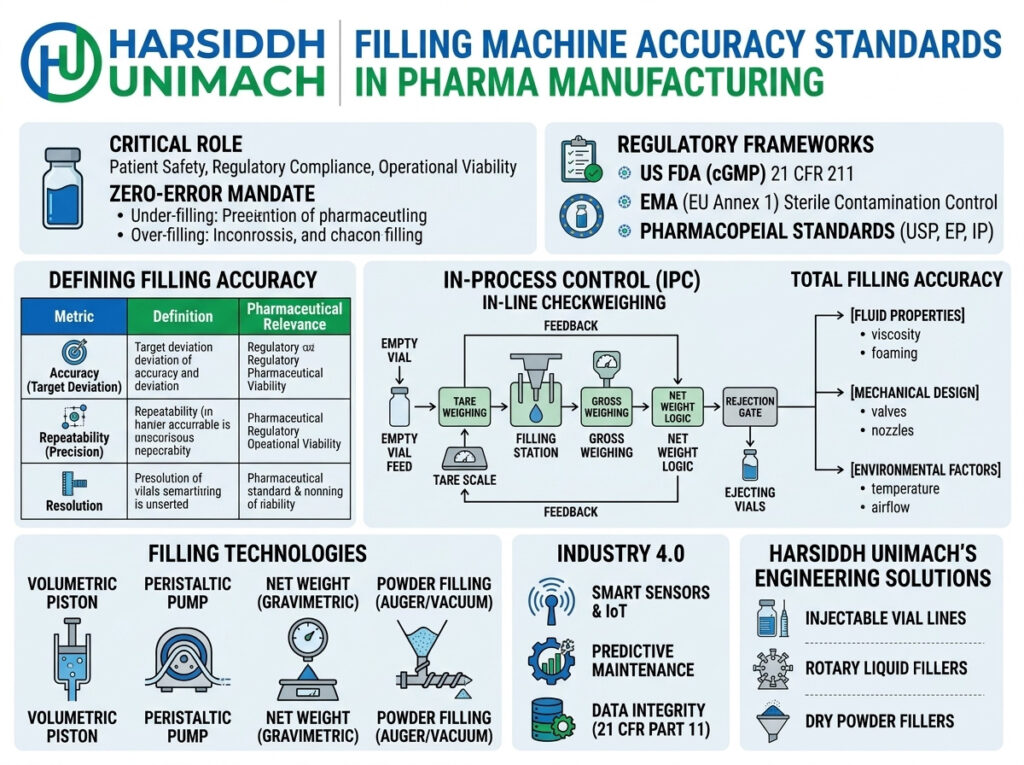
In pharmaceutical manufacturing, “close enough” is never good enough. Every vial, ampoule or bottle must contain the right amount of medicine — enough to deliver the labelled dose, but not so much that valuable product is wasted or the patient receives more than intended. Filling accuracy affects patient safety, regulatory compliance, product cost and brand trust.
Yet accuracy is often misunderstood. What tolerance is acceptable? Which standards apply? How should fill targets be set, and how often should they be checked? What should a filling machine be capable of before it is accepted?
This guide answers those questions. We explain the key concepts, outline the standards and regulatory expectations that shape filling accuracy, show how to set targets and controls, and explain how machine design and validation support consistent results.
Why Filling Accuracy Matters
- Patient safety: an underfilled injectable may not deliver the full dose; an overfilled one may contain more drug than intended.
- Regulatory compliance: pharmacopoeias and legal metrology rules set requirements for content and labelled quantity.
- Cost control: overfilling gives away product on every container — a significant loss for high-value drugs.
- Batch acceptance: fill weight results are part of the batch record, and failures can lead to rejection or investigation.
- Process confidence: consistent fills show that the process is in control.
Accuracy vs Precision
These two terms are often used interchangeably, but they mean different things:
- Accuracy is how close the average fill is to the target.
- Precision is how close individual fills are to each other — the spread or variation.
A machine can be precise but inaccurate (all fills tightly grouped but off-target) or accurate but imprecise (average on target but wide variation). Good filling requires both. Precision is often expressed as standard deviation or relative standard deviation (%RSD); accuracy as the deviation of the mean from target.
In practice, precision is usually the harder problem. An accurate average can be achieved by adjusting the target, but reducing variation depends on machine design, product behaviour and process control.
The Standards and Requirements That Apply
Filling accuracy in pharmaceuticals is shaped by several layers of requirements. Manufacturers should always refer to the current editions applicable to their products and markets.
Pharmacopoeial requirements
Pharmacopoeias set tests that indirectly define how accurately containers must be filled:
- Extractable volume / container content for injections: tests in the European Pharmacopoeia (2.9.17) and the United States Pharmacopeia (<697>) ensure that each injectable container holds enough product to withdraw and administer the labelled volume. This is why parenteral containers typically carry a small, justified overfill.
- Uniformity of dosage units: for single-dose preparations such as powders for injection, tests based on mass or content uniformity (for example USP <905> and Ph. Eur. 2.9.40) assess unit-to-unit consistency.
- Deliverable volume: for oral liquids, tests such as USP <698> check that the labelled volume can be delivered from the container.
- National pharmacopoeias: the Indian Pharmacopoeia and others contain corresponding requirements for products in their markets.
Legal metrology
Packaged products sold by declared quantity must comply with legal metrology rules. In India, the Legal Metrology (Packaged Commodities) Rules define permissible errors for net quantity. Other countries have equivalent regulations. Pharmaceutical manufacturers must ensure that their fill targets and controls meet both pharmacopoeial and legal requirements.
GMP expectations
GMP guidelines require that critical process parameters, including fill volume or weight, are defined, validated and monitored. This means:
- Documented fill targets and limits
- Validated filling equipment
- In-process controls at defined frequencies
- Calibrated balances and instruments
- Investigation of out-of-limit results
Our cGMP compliance guide for sterile vial filling machinery explains the machine features that support these expectations.
Company specifications
Within these external requirements, each company defines its own internal specifications — target, alert limits and action limits — based on product risk, process capability and cost.
Setting the Fill Target
Setting the right fill target involves several steps:
- Start with the labelled quantity, for example 5 ml.
- Add the required overage to meet extractable volume or deliverable volume requirements, considering container and product characteristics such as viscosity and hold-up in the container.
- Convert to weight if fills are checked gravimetrically, using the product’s density at the filling temperature.
- Set tolerance limits around the target, based on regulatory requirements and the machine’s demonstrated capability.
Worked example
A product has a labelled volume of 5.0 ml. Development studies show that a target fill of 5.20 ml is needed to reliably meet extractable volume requirements. The product density is 1.02 g/ml.
- Target fill weight = 5.20 ml × 1.02 g/ml = 5.304 g
- With internal limits of ±1% around target, the acceptable range would be approximately 5.251 g to 5.357 g.
These figures are for illustration only. Each product’s target and limits must be justified by development data and regulatory requirements.
Alert and Action Limits
Most manufacturers use two levels of control around the target:
- Alert limits: an early warning that the process is drifting. The operator adjusts the machine and increases checking.
- Action limits: a point at which the process is out of control. The machine is stopped, affected containers are segregated and an investigation is initiated.
Specification limits — the boundaries defined by registration and pharmacopoeial requirements — sit outside these internal limits, so corrective action happens well before product is at risk.
In-Process Fill Weight Checks
How they work
At defined intervals, containers are taken from each filling nozzle and weighed — either by tare-and-gross weighing or using pre-weighed containers — to calculate the net fill. Results are recorded and compared with limits.
How often?
Frequency depends on product risk, machine stability and batch size. Common practices include checks at start-up, at regular intervals throughout the batch, after any stoppage or adjustment, and at the end of the batch. Every nozzle should be covered.
Automated checking
Some lines use automatic check-weighing, where an integrated balance weighs sample containers automatically and feeds data back to the filling machine. Servo systems can then adjust each nozzle individually to correct drift.
Statistical Process Control
Plotting fill weight results on control charts turns individual checks into a picture of process behaviour:
- X-bar charts show whether the average fill is shifting.
- Range or standard deviation charts show whether variation is increasing.
- Trends — such as a gradual drift upward — can be spotted before limits are breached.
Process capability indices (Cp and Cpk) compare the spread of fills with the specification width. A higher Cpk means the process comfortably fits within limits; a low Cpk means fills are at risk of falling outside them. Capability studies are also valuable when comparing machines or validating new equipment.
What Affects Filling Accuracy?
Many factors influence how accurately a machine fills:
- Dosing technology – piston, peristaltic, time-pressure, gravimetric or volumetric systems behave differently
- Product properties – viscosity, density, temperature, foaming and surface tension
- Machine condition – wear on pistons, seals, valves and tubing
- Air in the product path – bubbles cause short fills
- Supply pressure and level – fluctuations change the delivered volume on some systems
- Machine speed – faster filling can reduce accuracy if not properly controlled
- Nozzle design and drip control – drips and splashes cause variation
- Environment – temperature changes affect product density and viscosity
Our article on what factors affect vial filling dose precision explores these in more detail.
How Machine Technology Supports Accuracy
Servo-driven piston dosing
Servo motors control the piston stroke electronically, delivering highly repeatable doses and allowing each nozzle to be fine-tuned. See the Automatic Servo Based Vial Filling Machine and our servo based piston filling machine.
Peristaltic dosing
Peristaltic pumps offer excellent accuracy for small volumes, with single-use tubing that removes cleaning variability. Tubing quality and calibration are critical. See the Automatic Peristaltic Based Liquid Filling Machine and our peristaltic based liquid filling machine.
Weight-based filling
Load cell fillers weigh each container as it fills, compensating automatically for density changes — ideal for larger volumes and products sold by weight. See the Automatic Load Cell Based Liquid Filling Machine and our load cell based liquid filling machine. For a comparison of approaches, read weight-based vs volumetric filling.
Volumetric syringe fillers for oral liquids
Multi-nozzle volumetric fillers deliver consistent doses for syrups and suspensions. See our volumetric bottle liquid filler.
Powder dosing
For sterile powders, vacuum-pressure powder wheels compact powder into precise bores, as in the double wheel injectable dry powder filling machine. For non-sterile powders, auger fillers such as our single and double head auger type powder filling machine control dose by screw rotations.
Demonstrating Accuracy During Validation
Filling accuracy is a key part of equipment qualification:
- Factory acceptance testing (FAT): the supplier demonstrates fill accuracy using water or a placebo at agreed volumes and speeds.
- Operational qualification (OQ): accuracy and precision are tested across the operating range — minimum and maximum volumes, speeds and container sizes.
- Performance qualification (PQ): the machine is run with actual product or a representative placebo under normal conditions, typically over several runs, to demonstrate consistent performance.
Acceptance criteria should be defined in advance, based on product requirements and process capability. Our guide to IQ, OQ and PQ for automatic vial filling equipment explains each stage.
Balancing Accuracy and Overfill Cost
Tighter precision allows the fill target to be set closer to the minimum required, reducing overfill without increasing the risk of underfilling. For high-value products such as biologics, this can deliver significant savings. Learn more in precision dosing strategies for high-value biologics.
Investigating Out-of-Limit Fill Results
When a fill weight check exceeds an action limit, a structured response protects both product and process:
- Stop and contain: stop the affected nozzle or machine and segregate containers filled since the last acceptable check.
- Verify the measurement: confirm the balance is calibrated and the weighing was performed correctly.
- Identify the cause: check for air in the line, worn parts, product temperature changes, supply problems or incorrect settings.
- Correct and confirm: fix the cause, then perform increased checks to prove the process is back under control.
- Assess the impact: decide, under quality oversight, how segregated containers are handled — for example by 100% weight checking.
- Document and trend: record the event and review it alongside other deviations to prevent recurrence.
Best Practices for Consistent Fill Accuracy
- Choose the right dosing technology for the product and volume.
- Prime the system properly and eliminate air from the product path.
- Control product temperature to keep density and viscosity stable.
- Calibrate balances regularly and use appropriate resolution for the fill weight.
- Check every nozzle at defined intervals and after any adjustment.
- Trend results using SPC to detect drift early.
- Maintain pumps, seals and tubing on a preventive schedule.
- Document targets, limits and actions clearly in batch records.
- Train operators to understand why accuracy matters and how to respond to results.
Frequently Asked Questions
What is an acceptable fill accuracy in pharmaceutical manufacturing? It depends on the product, dosage form and regulatory requirements. Limits are defined by pharmacopoeial tests, legal metrology rules and internal specifications justified by process capability.
Why do injectable containers contain more than the labelled volume? A small overfill ensures the labelled volume can actually be withdrawn and administered, accounting for liquid left in the container, needle and syringe.
What is the difference between accuracy and precision? Accuracy is how close the average fill is to target; precision is how consistent individual fills are.
How often should fill weights be checked? At start-up, at regular intervals during the batch, after stoppages or adjustments, and at the end of the batch — for every nozzle.
Which filling technology is most accurate? It depends on volume and product. Servo piston and peristaltic systems excel for small injectable volumes, while load cell systems are excellent for larger fills.
Need a filling machine that meets your accuracy requirements? Explore our vial filling machines, vial filling machines for liquid vials, ampoule filling machines for open ampoules and liquid filling machines, contact our team or send an inquiry.