
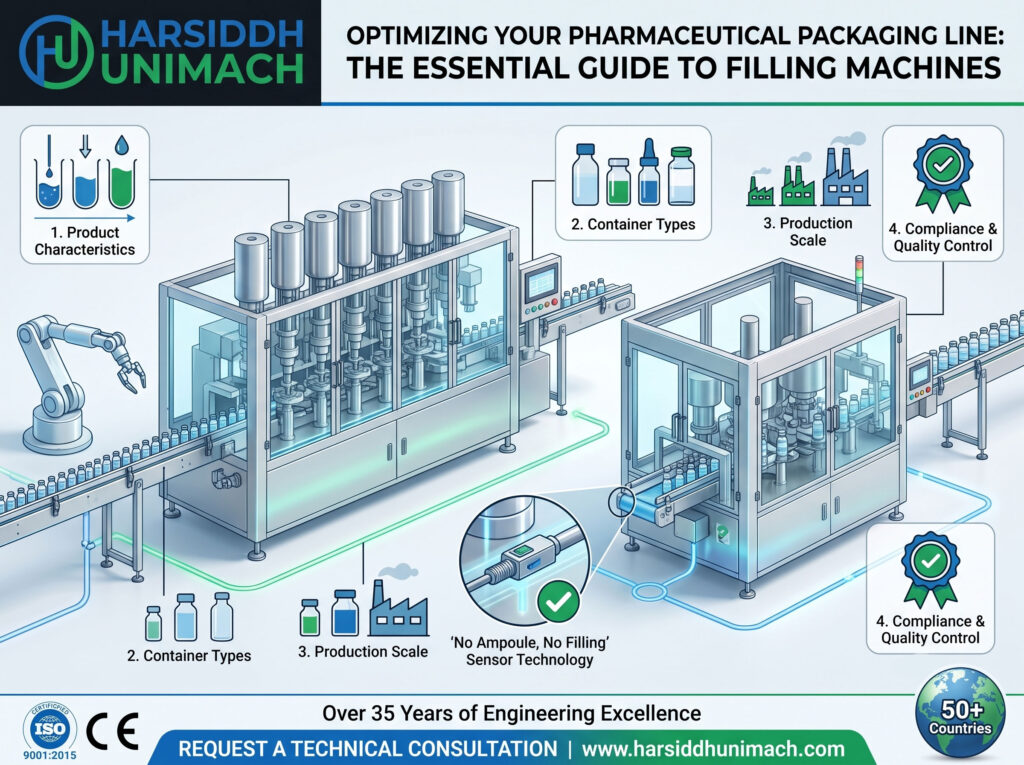
Every pharmaceutical packaging line has one machine that sets the pace for everything else: the filling machine. Washers, unscramblers, cappers, sealers and labellers all matter, but the filler is where the product meets the container, where the most expensive material is handled and where accuracy is most closely checked. If the filler is slow, inaccurate or unreliable, the whole line suffers.
That makes the filling machine the natural starting point for any line optimisation project. Get the filler right, and balance the rest of the line around it, and you gain output, reduce waste and make compliance easier.
This guide explains how to optimise your pharmaceutical packaging line with the filling machine at its centre. It covers choosing the right filling technology, balancing line speeds, improving accuracy, reducing changeover time, integrating upstream and downstream machines and deciding when an upgrade makes sense.
Why the Filling Machine Is the Heart of the Line
The filler has a bigger influence on line performance than any other machine, for several reasons:
- It handles the product. Product is usually the most valuable material on the line. Overfill, spillage and rejects at the filler cost real money.
- It controls dose accuracy. Fill quantity is a critical quality attribute. An inaccurate filler creates compliance risk as well as waste.
- It is often the bottleneck. Filling takes time, especially for viscous products, powders or large volumes, so the filler is frequently the slowest machine in the line.
- It is the hardest to clean and change over. Product-contact parts must be cleaned thoroughly between products, which drives changeover time.
Because of this, improvements at the filler tend to deliver the largest gains for the whole line.
Step 1: Match the Filling Technology to Your Product
The first and most important optimisation is using the right filling principle for the product. A filler that suits the product runs faster, fills more accurately and needs less adjustment.
| Product Type | Common Filling Principles | Typical Considerations |
|---|---|---|
| Thin liquids (syrups, solutions) | Gravity, piston, peristaltic, flow-based | Foaming, drip control, bottle size range |
| Viscous liquids, creams, gels | Piston, gear pump | Product flow, temperature, drip control |
| Sterile injectables | Piston, peristaltic | Accuracy at small volumes, sterility, product loss |
| Free-flowing powders | Auger, vacuum or disc dosing | Powder density, flow, dust control |
| Non-free-flowing powders | Auger | Bridging, consistent density |
| Creams and ointments in tubes | Piston-based tube fillers | Viscosity, tail cut-off, sealing |
For oral liquids, an automatic gravity based liquid filling machine suits thin, free-flowing products, while an automatic peristaltic based liquid filling machine keeps the product inside disposable tubing, which simplifies cleaning and changeover. Our comparison of liquid filling machine technologies: gravity, piston, gear pump, peristaltic and flow meter explains each option in more detail. You can browse the full range of liquid filling machines and bottle filling machines for oral liquids.
For powders, an automatic auger type powder filling machine is widely used for dry syrups and other powders. Our guide to types of powder filling machines: auger, gravity and vacuum explains the differences. See also our dry powder filling machines and injectable powder filling machines for sterile powder in vials.
For semi-solids, cream and ointment filling machines handle viscous products in tubes and jars.
Key questions when matching technology:
- What is the product’s viscosity, and does it change with temperature?
- Does it foam, string, drip or separate?
- Is it sterile, and must the product path be disposable or sterilisable?
- What range of fill volumes and container sizes will you run?
- How valuable is the product, and how much loss can you accept?
Step 2: Balance the Line Around the Filler
A packaging line is only as fast as its slowest machine. If the capper or labeller cannot keep up with the filler, the filler stops and starts, which reduces output and can affect fill accuracy.
A common approach is to make the filler the planned bottleneck and set the machines before and after it to run somewhat faster. This means:
- Upstream machines (unscrambler, washer) run slightly faster than the filler, so the filler always has containers waiting.
- Downstream machines (capper, sealer, labeller) run slightly faster than the filler, so they clear containers quickly and never back up into the filling zone.
- Buffers (accumulation tables or conveyor sections) absorb short stops so a brief jam at the labeller does not stop the filler.
Illustrative example (not performance data for any machine): if the filler is set at 60 containers per minute, the unscrambler and capper might be set to around 70 per minute and the labeller to around 75 per minute. The exact margins depend on your machines, containers and how often short stops occur, so agree them with your supplier.
An automatic bottle unscrambler feeds containers steadily to the filler, and a linear bottle washing machine cleans them before filling.
Step 3: Improve Fill Accuracy and Reduce Overfill
Fill accuracy affects both compliance and cost. Underfilling is a compliance failure: the patient does not receive the labelled dose. To avoid underfills, many manufacturers set the target slightly above the labelled quantity. But the less accurate the filler, the higher that overfill must be, and overfill is product given away.
Illustrative example: suppose a line fills 10,000 bottles of 100 ml a day. If filler variation forces an average overfill of 2 ml per bottle, that is 20 litres of product given away each day. If a more accurate filler allows the average overfill to drop to 0.5 ml, the giveaway falls to 5 litres a day, a saving of 15 litres daily. Use your own volumes, overfill and product cost to calculate what accuracy is worth to you.
Ways to improve accuracy:
- Choose the right technology for the product (Step 1).
- Use servo-driven dosing, where fill volume is set digitally and held consistently. Our article on how servo-driven vial filling systems outperform mechanical lines explains the benefits, which apply to many filler types.
- Control product conditions. Keep product temperature and level in the supply tank consistent, as these can affect fill volume.
- Maintain wear parts. Worn piston seals, valves and tubing cause drift.
- Check fills regularly and trend the results to spot drift early.
- Fine-tune nozzles to stop drips and foaming, which cause both inaccuracy and mess.
Step 4: Choose the Right Number of Heads
Many fillers come in single, double, four, six or eight-head versions. More heads increase output, because several containers are filled at once, but they also add cost, complexity and cleaning time.
| Consideration | Fewer Heads | More Heads |
|---|---|---|
| Output | Lower | Higher |
| Machine cost | Lower | Higher |
| Changeover and cleaning | Faster | Longer |
| Footprint | Smaller | Larger |
| Best for | Small batches, many products | Long runs, high volumes |
Choose the number of heads based on realistic demand, batch sizes and how often you change products, not just the highest possible speed.
Step 5: Cut Changeover and Cleaning Time
On lines that run many products, changeover time can cost more output than slow running. Optimising changeovers at the filler gives large gains:
- Quick-release product-contact parts that can be removed without tools.
- Disposable product paths, such as peristaltic tubing, which remove the need to clean and validate cleaning of the pump.
- Stored recipes on servo machines so fill volumes and settings change at the press of a button.
- Format parts marked for each container size.
- Preparation before the stop, with cleaned parts, components and documents ready.
Step 6: Integrate the Filler With the Rest of the Line
Separate machines connected by conveyors work, but every transfer is a possible point of jams, tipping and container damage. Integration reduces these risks.
- Monoblock machines combine filling and capping in one frame, with a single drive and controlled transfer. A liquid bottle filling and capping monoblock saves floor space and reduces handling.
- Matched downstream machines such as capping machines and labeling machines should be specified for the same containers and speeds as the filler.
- Common controls let machines start, stop and slow down together, reducing jams.
- Consistent change parts across the line make changeovers simpler.
Step 7: Reduce Downtime and Minor Stops
Even a well-chosen filler loses output to breakdowns and minor stops. Common causes include:
- containers jamming or tipping at infeed
- nozzles dripping or blocking
- product supply running low
- sensors misreading containers
- worn parts causing intermittent faults
Address these with planned maintenance, good container quality, correct conveyor and guide settings and trained operators. Our article on understanding common causes of downtime in pharmaceutical filling lines explores this in depth.
Step 8: Build in Compliance From the Start
An optimised line must also be a compliant one. Features that support compliance often improve efficiency too:
- No-container, no-fill prevents spillage and cleaning stops.
- Reject systems remove faulty containers automatically, without stopping the line.
- Hygienic design shortens cleaning.
- Recipes and access control prevent incorrect settings.
- Documentation supports faster qualification.
For practical approaches, see our article on strategies for ensuring compliance and efficiency in pharmaceutical filling lines.
Step 9: Measure, Then Improve
Optimisation should be based on data, not guesswork. Track:
- Output per shift and per product
- Downtime by cause (breakdowns, changeovers, minor stops)
- Rejects by cause (fill weight, closure, label)
- Fill accuracy trends
- Changeover times
Many plants combine these into Overall Equipment Effectiveness (OEE), which multiplies availability, performance and quality. Whatever measure you use, focus first on the biggest losses.
When to Upgrade Your Filling Machine
Sometimes the best optimisation is a new filler. Consider an upgrade when:
- the filler is consistently the bottleneck and demand is growing
- fill accuracy forces high overfill or causes frequent rejects
- changeovers are long because of manual settings and difficult cleaning
- spare parts are hard to find for an older machine
- the machine cannot handle new products or container sizes
- compliance expectations have moved beyond what the machine supports
Before buying, define what the new filler must achieve: products, containers, fill range, speed, accuracy, changeover time and compliance needs. A clear User Requirement Specification (URS) helps suppliers propose the right solution.
Upgrade or Replace: A Quick Comparison
| Option | Advantages | Limitations |
|---|---|---|
| Upgrade existing filler (new heads, servo drive, nozzles) | Lower cost, less disruption | Limited by original design; needs change control |
| Add a second filler | More capacity, backup if one fails | More space, operators and cleaning |
| Replace with a new filler | Latest technology, better accuracy and changeover | Higher cost, requalification needed |
| Replace with an integrated line | Best balance and handling | Highest investment, longer project |
Whatever you choose, any change to a qualified line should go through your change control process.
Optimisation Checklist
- Is the filling technology right for each product?
- Is the filler the planned bottleneck, with faster upstream and downstream machines and suitable buffers?
- Is fill accuracy measured, trended and good enough to keep overfill low?
- Is the number of heads right for your volumes and batch sizes?
- Are changeovers quick, standardised and prepared in advance?
- Are transfers between machines smooth, or would a monoblock help?
- Are downtime and rejects tracked by cause?
- Are wear parts replaced before they cause drift?
- Does the line include compliance features that also save time?
- Is it time to upgrade?
Frequently Asked Questions
Which filling machine is best for pharmaceutical liquids? It depends on the product’s viscosity, sterility, fill volume and batch sizes. Gravity, piston and peristaltic fillers each suit different applications.
How can I increase output without buying a new line? Look first at changeovers, minor stops and line balance. Small improvements in these areas often release significant capacity.
Does a faster filler always increase line output? Only if the rest of the line can keep up. A faster filler feeding a slow capper or labeller simply moves the bottleneck.
How do I reduce overfill? Improve fill accuracy through the right technology, servo dosing, consistent product conditions, good maintenance and regular checks.
Can one filler handle several products? Yes, with suitable change parts and cleaning procedures, as long as the products fall within the machine’s range.
Optimise Your Line With Harsiddh
Harsiddh Unimach manufactures filling machines for liquids, powders, creams, injectables and more, along with unscramblers, washers, cappers, sealers and labellers to complete the line. Our team can review your products, containers and output targets and recommend a filler and line configuration that is balanced, accurate and easy to change over.
Get in touch through our contact page or send your requirements through our inquiry form.