
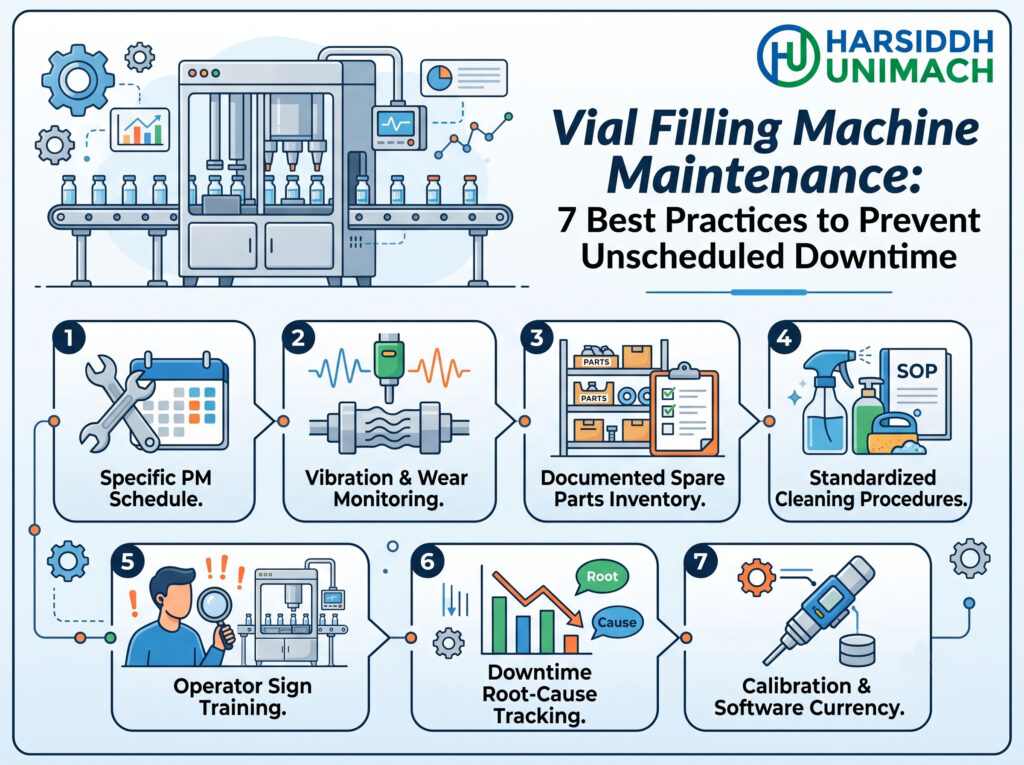
An unexpected breakdown on a vial filling line is costly in every sense. Production stops, batches are delayed, product may be at risk and, in aseptic filling, an intervention to repair the machine can lead to discarded vials, deviations and investigations. Many of these breakdowns are preventable.
Good maintenance keeps vial filling machines running reliably, accurately and in their qualified state. It is not only about fixing what breaks; it is about preventing failures before they happen and detecting problems early.
This article presents seven best practices for maintaining vial filling machines, from structured preventive schedules to failure analysis, with GMP considerations that apply in pharmaceutical environments.
Why Maintenance Matters So Much on Vial Lines
| Consequence of Poor Maintenance | Impact |
|---|---|
| Unscheduled breakdowns | Lost production, missed delivery dates |
| Fill weight drift | Overfill, rejects, out-of-specification results |
| Stoppering or capping faults | Container closure risks, rejects |
| Vial breakage | Glass particles, product loss, line clearance |
| Interventions in the aseptic zone | Contamination risk, discarded vials |
| Loss of qualified state | Requalification, deviations, audit findings |
Best Practice 1: Build a Structured Preventive Maintenance Schedule
A preventive maintenance (PM) schedule defines what is checked, cleaned, adjusted or replaced, and when. Base it on the supplier’s recommendations, your operating hours and your own experience.
Example schedule structure
| Frequency | Typical Tasks |
|---|---|
| Every batch or shift | Visual check of needles, stopper track and transfer parts; check for unusual noise; verify sensors; clean glass fragments or product residues |
| Weekly | Inspect pump seals or tubing condition, star wheels and guides; check pneumatic connections for leaks; check stoppering head condition |
| Monthly | Inspect drives, belts, bearings and cams; check timing and alignment; verify safety interlocks |
| Quarterly / half-yearly | Replace scheduled wear parts; deeper inspection of drive train and servo axes; review control system backups |
| Annually | Major service, comprehensive calibration, supplier inspection where appropriate |
Plan PM activities during scheduled downtime, such as between campaigns or during planned cleaning, so they do not interrupt production.
Best Practice 2: Keep Critical Spare Parts on Site
When a critical part fails, waiting for a replacement can turn a short repair into days of downtime. Identify critical spares: parts whose failure would stop production and which have long lead times.
Typical critical spares for vial fillers
- Pump seals, O-rings, valves or complete pump sets
- Peristaltic tubing sets and pump head rollers
- Filling needles and nozzle parts
- Stopper bowl and track parts
- Star wheels, guides and change parts for each vial size
- Sensors (vial presence, stopper presence, level)
- Belts, bearings and couplings
- Servo drives or motors for critical axes (depending on risk and lead time)
- Crimping rollers or heads for cap sealers
Keep spares identified, stored correctly and recorded, so you know what is available. Review the list as you learn which parts fail most often.
Best Practice 3: Inspect and Replace Wear Parts Proactively
Wear parts gradually lose performance long before they fail completely. Replacing them on condition or on schedule prevents both breakdowns and quality drift.
| Component | What to Look For | Effect If Neglected |
|---|---|---|
| Piston pump seals | Leaks, scoring, stiffness | Fill weight drift, product leaks |
| Peristaltic tubing | Flattening, cracks, discolouration | Inaccurate fills, particles |
| Filling needles | Bends, damage, blockage | Splashing, misfills, vial neck contact |
| Star wheel pockets | Wear, chips, deformation | Vial jams and breakage |
| Guides and rails | Wear, misalignment | Vial tipping, impacts |
| Stoppering heads | Wear of pick-up parts, misalignment | Missing or poorly seated stoppers |
| Crimping rollers | Wear, damage | Loose or uneven crimps, cracked vials |
| Belts and bearings | Noise, play, wear | Timing errors, breakdowns |
For machines using peristaltic dosing, such as the peristaltic based liquid filling machine, tubing replacement schedules are particularly important.
Best Practice 4: Calibrate and Verify Critical Instruments
Accurate measurements are essential for quality. Critical instruments include:
- Balances and load cells used for fill weight checks
- Pressure gauges and transmitters for nitrogen, compressed air and vacuum
- Temperature sensors where product or process temperature is monitored
- Speed and position sensors that affect timing
- Crimping force or torque indicators on cap sealers
Calibrate them at defined intervals using traceable standards, record results and investigate any out-of-tolerance findings for their impact on product made since the last calibration.
Best Practice 5: Clean in a Way That Protects the Machine
Cleaning and disinfection are essential in pharmaceutical production, but they can also damage equipment if done incorrectly.
- Use approved cleaning agents and disinfectants compatible with machine materials
- Avoid excessive force when cleaning sensors, needles and precision parts
- Dry parts properly before reassembly to prevent corrosion
- Remove glass fragments thoroughly after breakage to prevent damage to moving parts
- Follow the manufacturer’s dismantling procedures to avoid bending or misaligning parts
Best Practice 6: Involve Operators in Daily Care
Operators see the machine every day and are often the first to notice changes. Involving them in routine care, sometimes called autonomous maintenance, catches problems early.
Operator responsibilities
- Daily visual inspections and cleaning
- Listening for unusual noises and noticing vibrations
- Checking for leaks and loose parts
- Reporting minor problems promptly
- Recording observations in logbooks
Training
Train operators and maintenance staff on the machine’s design, correct changeover methods, common faults and safe working. Changeovers are a frequent source of damage and misalignment; read vial filling machine changeover: best practices for faster product and format changes.
Best Practice 7: Record, Analyse and Learn from Failures
Every failure contains information that can prevent the next one.
- Record every breakdown and minor stop – time, duration, component, cause and action taken
- Analyse trends – which components fail most often? Under what conditions?
- Find root causes – use simple tools such as “5 Whys” to go beyond the immediate fix
- Update the PM plan – adjust frequencies and add tasks based on experience
- Use machine data – servo drives and controllers on modern machines record alarms and can reveal developing problems, such as increasing motor current
For a wider view of downtime causes, read maximizing efficiency in pharmaceutical filling lines: understanding common causes of downtime.
GMP Considerations for Maintenance
In pharmaceutical environments, maintenance must support compliance as well as reliability:
- Approved procedures for maintenance tasks, especially in classified areas
- Maintenance in aseptic areas – plan tasks to minimise impact on the critical zone; follow cleaning and disinfection procedures after work; consider environmental monitoring and line clearance
- Change control – modifications to parts, settings or software must be evaluated; like-for-like replacement is usually handled differently from changes
- Documentation – record all maintenance and calibration activities
- Impact on qualification – significant repairs or changes may require partial requalification; read automatic vial filling equipment validation: IQ, OQ and PQ explained
For design features that make maintenance and compliance easier, read our cGMP compliance guide: essential features for sterile vial filling machinery.
Reactive, Preventive and Predictive Maintenance
| Approach | Description | Advantages | Limitations |
|---|---|---|---|
| Reactive | Fix equipment when it breaks | No planning effort | Unplanned downtime, higher repair costs, quality risk |
| Preventive | Service and replace parts at fixed intervals | Fewer breakdowns, planned work | Parts may be replaced earlier than needed |
| Predictive | Monitor condition and act when signs of wear appear | Maintenance only when needed, early warning | Requires sensors, data and analysis |
Most vial lines use a combination: preventive maintenance as the foundation, with predictive elements added where data is available, and reactive maintenance kept to a minimum.
Measuring Maintenance Performance
Tracking a few simple indicators shows whether your maintenance programme is working:
- Unplanned downtime hours per month
- Mean time between failures for critical machines or components
- Mean time to repair – how quickly breakdowns are resolved
- Percentage of planned vs unplanned maintenance work
- PM compliance – how many scheduled tasks are completed on time
- Spare parts availability when needed
Review these indicators regularly with production and quality teams, and use them to target improvements.
Working with Your Machine Supplier
Your machine supplier is an important maintenance partner. Ask for:
- Recommended PM schedules and task lists for each machine
- Recommended spare parts lists, including critical items and lead times
- Training for maintenance technicians
- Remote support for troubleshooting
- Periodic service visits for major inspections or adjustments
- Upgrade advice when parts become obsolete or improved designs are available
A good relationship with your supplier shortens repair times and helps keep the machine performing as designed throughout its life.
Lubrication and Mechanical Care
Mechanical components such as cams, gears, bearings and guide rods need correct lubrication to run smoothly and last long. On pharmaceutical machines, lubrication must be managed carefully:
- Use lubricants approved for the application, including food-grade or pharmaceutical-compatible types where there is any risk of incidental contact
- Apply the right amount – too much lubricant can attract dust or migrate towards product areas
- Follow the supplier’s schedule for each lubrication point
- Keep lubrication away from the critical zone on aseptic machines; drives below the table make this easier
Maintaining the Whole Line
The filler is only one machine. Apply the same principles across the line:
- Washer – nozzles, pumps, filters and grippers on a linear vial washer
- Tunnel – heaters, fans, HEPA filters and belt on the sterilizing tunnel for ampoules and vials
- Filler – pumps, needles, stoppering and transport on machines such as the Automatic Servo Based Vial Filling Machine or the liquid vial filling machine with rubber stoppering
- Cap sealer – crimping rollers, cap feeding and drives on the vial cap sealing machine or the Automatic Four Head Vial Cap Sealing Machine
- External washer – nozzles and drying on the automatic external vial washing machine
- Inspection – lighting, rollers and drives on the visual ampoule and vial inspection machine
- Labeller – peel plate, rollers and sensors on the vial sticker labeling machine; see also high-speed labeling machine maintenance
Integrated solutions such as the automatic liquid vial filling line benefit from a coordinated maintenance plan across all machines. If you also run ampoule lines, see our ampoule filling machine maintenance checklist.
Signs Your Vial Filler Needs Attention
- Fill weights drifting or varying between heads
- More frequent minor jams or vial tipping
- Increased vial breakage at specific points
- Missing or poorly seated stoppers
- Unusual noises, vibrations or heat from drives
- Rising number of alarms
- Leaks of product, air or lubricant
Acting on these signs during planned downtime is far cheaper than repairing a failure mid-batch. Breakage in particular has several root causes; read top 5 causes of vial breakage on high-speed filling lines.
Frequently Asked Questions
How often should a vial filling machine be maintained? Daily checks by operators, plus weekly, monthly and longer-interval preventive tasks based on the supplier’s recommendations and your operating experience.
Which spare parts should I keep on site? Parts whose failure would stop production and that have long lead times, such as pump seals or sets, tubing, needles, sensors, change parts and crimping rollers.
Can operators perform maintenance? Operators can carry out routine checks and simple care tasks after training; more complex work should be done by trained maintenance staff.
Does maintenance affect GMP compliance? Yes. Maintenance must follow approved procedures, be documented and, where it involves changes, go through change control.
How can I predict failures? Track failure data and machine signals such as alarms and motor current, and look for trends that indicate wear before a breakdown occurs.
Want help building a maintenance plan for your vial line? Contact our team or send an inquiry for spare parts, service support and training.