
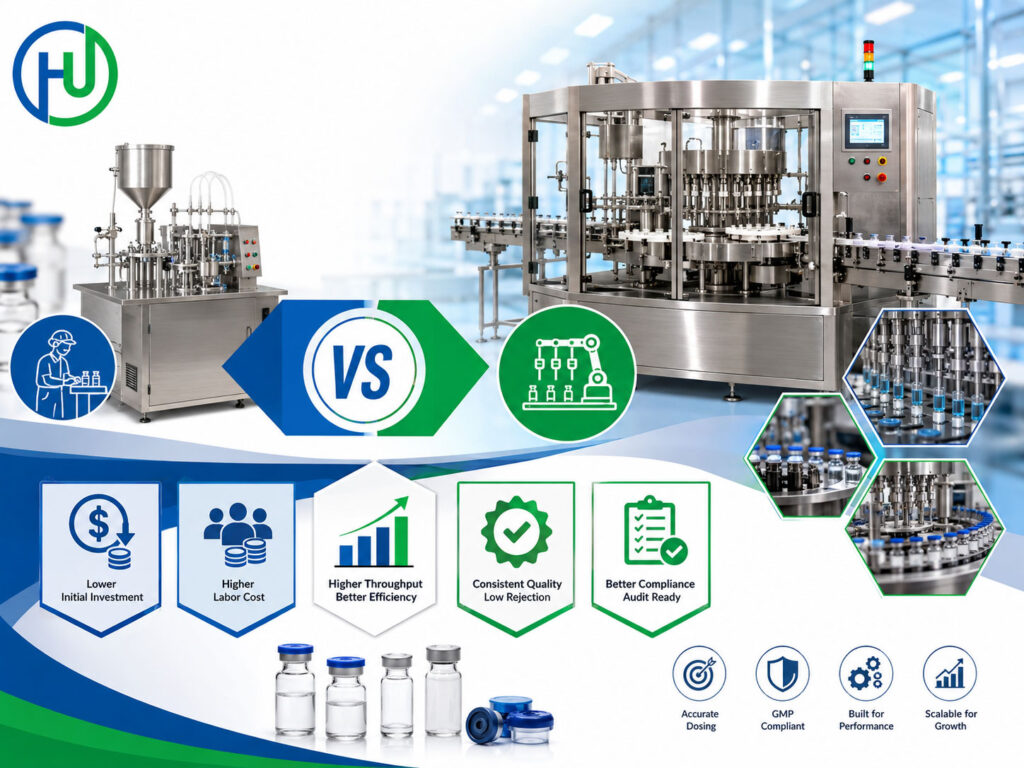
For a growing pharmaceutical lab, contract manufacturer or small injectable producer, the step from semi-automatic to automatic vial filling is one of the most important investment decisions. Semi-automatic fillers are affordable, flexible and well suited to small batches. Automatic fillers offer higher output, lower labour and more consistent quality, but at a higher price.
The right choice depends not on which machine is “better” in general, but on which delivers the best return on investment (ROI) for your situation today and over the next few years. This article explains how semi-automatic and automatic vial fillers differ, which costs and benefits to include in an ROI analysis, walks through an illustrative example, and helps you recognise when it is time to upgrade.
Semi-Automatic vs Automatic: How They Differ
Semi-automatic vial fillers
- An operator places vials under the filling nozzles, often by hand or using a simple tray or indexing table
- The machine doses the liquid accurately when triggered by the operator or a sensor
- Stoppering may be manual, semi-automatic or on a separate machine
- Low investment, small footprint, quick product changes
Automatic vial fillers
- Vials are fed automatically from a turntable or tunnel into star wheels or indexing systems
- Multiple heads fill vials simultaneously
- Stoppering is usually integrated
- Sensors, interlocks and data recording are built in
- Higher investment, higher output and lower labour per vial
Examples include the Two Head Liquid Vial Filling Stoppering Machine, the Four Head Liquid Vial Filling Stoppering Machine and the liquid vial filling machine with rubber stoppering.
| Factor | Semi-Automatic | Automatic |
|---|---|---|
| Investment | Lower | Higher |
| Output | Limited by operator speed | Higher, consistent |
| Labour per vial | Higher | Lower |
| Fill consistency | Good, operator-influenced | Very good, machine-controlled |
| Stoppering | Often manual or separate | Usually integrated |
| Contamination risk | More manual handling | Less handling, barrier-ready designs |
| Data and documentation | Limited | Recipes, alarms, records |
| Flexibility | Very high | High, with change parts and recipes |
| Footprint | Small | Larger |
The Costs to Include in an ROI Analysis
Investment costs
- Machine purchase price
- Change parts for your vial sizes
- Installation and commissioning
- Qualification (IQ, OQ, PQ) effort
- Facility changes, such as space, utilities and barrier systems
- Training
Running costs
- Labour – operators per shift
- Product loss – overfill, priming, rejects
- Consumables – tubing, seals, stoppers wasted
- Maintenance and spares
- Utilities – power, compressed air, nitrogen
- Downtime – breakdowns and changeovers
The Benefits to Include
1. Labour savings
Automatic machines usually need fewer operators per unit of output. In a semi-automatic process, operators may be fully occupied loading vials and placing stoppers. An automatic machine can often be run by one operator who supervises, loads materials and performs checks.
2. Higher output and capacity
Automatic machines fill more vials per hour. If your demand exceeds what semi-automatic equipment can produce, the extra capacity has real value: it allows more batches, new products or contract work without adding shifts.
3. Reduced overfill and product loss
Machine-controlled dosing, especially with servo drives, reduces fill variation. Lower variation means the target fill can be set closer to the minimum required, reducing overfill across every vial. For high-value products, this can be one of the largest savings. Read how servo-driven vial filling systems outperform mechanical lines.
4. Quality and compliance
Automatic machines reduce manual handling, which lowers contamination risk and operator-dependent variation. Built-in safeguards such as “no vial, no fill” and stopper detection, plus recipe control and data recording, support GMP compliance and simplify batch documentation.
5. Fewer rejects
Consistent filling and stoppering reduce rejects for fill weight and closure defects.
6. Ergonomics and staff retention
Repetitive manual loading can be tiring. Automation improves working conditions and can help retain skilled staff for higher-value tasks.
An Illustrative ROI Example
The figures below are purely illustrative and expressed in generic currency units, to show how an ROI calculation works. Your own numbers will differ.
Situation: A growing lab currently fills vials on semi-automatic equipment and is considering an automatic filler.
| Item | Illustrative Value |
|---|---|
| Additional investment for automatic filler (including installation and qualification) | 100 units |
| Annual labour saving | 30 units |
| Annual saving from reduced overfill and rejects | 15 units |
| Annual contribution from extra capacity (additional batches) | 20 units |
| Total annual benefit | 65 units |
Simple payback period = Additional investment ÷ Annual benefit = 100 ÷ 65 ≈ 1.5 years (about 18 months).
In this example, the automatic filler pays back its extra cost in roughly a year and a half, then continues to deliver savings. If demand were lower and the extra capacity had no value, the annual benefit would fall to 45 units and the payback would lengthen to about 2.2 years.
This shows why it is important to use realistic figures, especially for extra capacity: capacity only has value if you can sell or use it. Similarly, labour savings only become real if staff can be redeployed to other valuable work, or if the automatic machine avoids hiring additional operators as volumes grow.
Testing the assumptions: a simple sensitivity check
Because ROI depends on estimates, it helps to see how the result changes when key figures change. Using the same illustrative example:
| Scenario | Annual Benefit | Simple Payback |
|---|---|---|
| Base case | 65 units | about 1.5 years |
| Extra capacity not used | 45 units | about 2.2 years |
| Lower labour saving (20 instead of 30) | 55 units | about 1.8 years |
| Higher product saving (25 instead of 15) | 75 units | about 1.3 years |
| High-value product with larger overfill saving (35 instead of 15) | 85 units | about 1.2 years |
The pattern is typical: for high-value products, reduced overfill can shorten payback considerably, while unused capacity lengthens it. Running a similar check with your own figures shows which assumptions matter most.
Factors That Shift the Balance
Towards semi-automatic
- Very small batches or clinical supplies
- Many products with frequent changeovers and low volumes
- Limited budget or facility space
- Uncertain demand
- Products in early development
Towards automatic
- Demand consistently above semi-automatic capacity
- High labour costs or difficulty finding operators
- High-value products where overfill is costly
- Regulatory or customer expectations for reduced manual handling
- Need for data recording and recipe control
- Plans for barrier systems (RABS or isolators)
For a broader discussion of capacity, read small vial machine vs high-speed vial lines: how to choose the right capacity and choosing the right filling machine for every stage of pharma production.
Looking Beyond Payback
Simple payback is easy to understand, but it does not tell the whole story. Once the extra investment has been recovered, the automatic machine keeps delivering savings every year of its working life. A fuller analysis may also consider:
- Total savings over the machine’s expected life, not just until payback
- Discounted measures such as net present value, which account for the timing of costs and savings
- Residual value of the semi-automatic equipment, which may be kept, redeployed or sold
- Risk reduction – fewer contamination risks, deviations and investigations, which are hard to quantify but valuable
Finance teams often prefer these broader measures for larger investments.
Practical Questions to Ask Before Deciding
- How many vials do we need to fill per year now, and in three to five years?
- How many operators does our current process need per shift?
- What is the value of the product lost to overfill and rejects each year?
- Do we have customers, contracts or products waiting for extra capacity?
- What do auditors and customers expect regarding manual handling and data?
- Do we have the space, utilities and skills to run an automatic machine?
- What will happen to our existing semi-automatic equipment?
Clear answers to these questions make the ROI analysis realistic and the decision easier to justify.
Signs It Is Time to Upgrade
- Operators cannot keep pace with demand
- Overtime or extra shifts are regular
- Fill weight variation is higher than you would like
- Customers or auditors question manual handling
- Rejects and rework are rising
- New contracts or products require more capacity
- Operator fatigue or turnover is a concern
Hidden Costs and Risks to Consider
An honest ROI analysis also includes less obvious factors:
- Qualification time – the machine produces no saleable product until IQ, OQ and PQ are complete
- Learning curve – output and efficiency may be lower in the first weeks while operators gain experience
- Change parts – additional vial sizes may require extra parts
- Facility changes – space, utilities, cleanroom modifications or barrier systems
- Spare parts stock – an initial investment in critical spares
- Line balance – upstream and downstream machines may also need upgrading
Ignoring these can make payback look shorter than it really is.
A Hybrid Approach
Many growing labs do not replace semi-automatic equipment immediately. Instead, they:
- Add an automatic filler for their highest-volume products
- Keep semi-automatic machines for small batches, clinical supplies and new products
- Gradually automate washing, sealing and labelling as volumes grow
This approach spreads investment, protects flexibility and lets the team build experience with automation step by step.
Don’t Forget the Rest of the Line
Upgrading the filler may require upgrading other equipment so the line stays balanced:
- Vial washing – from a Semi-Automatic Multijet Vial Washing Machine to an automatic washer such as the rotary vial washing machine
- Depyrogenation – a sterilizing tunnel for ampoules and vials for continuous feeding
- Cap sealing – from a Semi-Automatic Vial Cap Sealing Machine to an automatic vial cap sealing machine
- External washing – an automatic external vial washing machine
- Inspection – a visual ampoule and vial inspection machine
- Labelling – a vial sticker labeling machine
Include these costs and benefits in your ROI if they are part of the upgrade. Browse the vial cappers and vial filling machines for liquid vials.
A Step-by-Step ROI Approach
- Measure your current process – output, labour, fill variation, rejects, downtime
- Estimate future demand – realistically, for the next few years
- Define the automatic option – machine, change parts, installation, qualification, facility changes
- Estimate savings – labour, product, rejects, downtime
- Value extra capacity – only if it can be used
- Calculate payback and ROI – simple payback, and if needed, discounted measures
- Consider non-financial factors – compliance, quality, ergonomics, customer expectations
- Decide and plan – including timing, qualification and training
For more detail on ROI calculation methods, read how to calculate filling machine ROI for manufacturing plants. For budgeting strategies, see cost-effective solutions for pharmaceutical and cosmetic packaging machinery.
Frequently Asked Questions
Is an automatic vial filler always better than a semi-automatic one? No. Semi-automatic fillers are often the better investment for small batches, early development and uncertain demand. Automatic fillers deliver better ROI when volumes, labour costs or quality requirements justify them.
What is the biggest saving from automation? It varies. For many labs it is labour; for high-value products, reduced overfill can be the largest saving.
How is payback calculated? Simple payback equals the additional investment divided by the annual net benefit.
Should I include qualification costs? Yes. IQ, OQ and PQ effort is part of the real investment in any GMP environment.
Can I keep my semi-automatic filler after upgrading? Yes. Many labs keep semi-automatic equipment for small batches, trials and special products.
Considering an upgrade to automatic vial filling? Contact our team or send an inquiry with your current output, vial sizes and growth plans, and we will help you evaluate the options.