
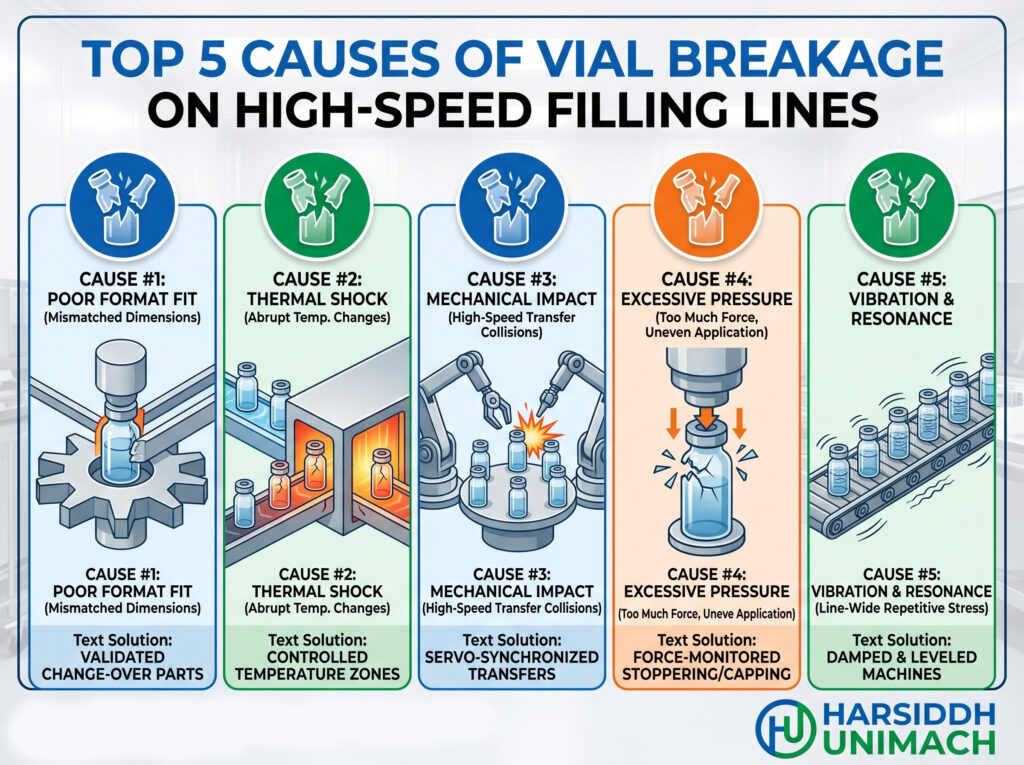
A broken vial on a filling line is never just one lost container. In sterile injectable production, breakage can scatter glass particles, spill product, stop the line, trigger line clearance and investigation, and in some cases put an entire batch at risk. On high-speed lines, where hundreds of vials pass every station each minute, even a small breakage rate quickly adds up to significant losses.
Most vial breakage is preventable. It usually comes down to a handful of root causes that can be identified and controlled. In this article, we explain the five most common causes of vial breakage on high-speed filling lines, how to recognise each one and what you can do to prevent it. For a broader view of the difficulties of fast vial lines, read challenges in high-speed vial processing and their solutions.
Why Vial Breakage Matters
| Consequence | Impact |
|---|---|
| Glass particles | Risk of contamination of nearby vials and the filling zone |
| Product loss | Spilled product, especially costly for high-value injectables |
| Line stoppage | Time lost to clear glass and clean the area |
| Intervention in the aseptic zone | Possible discarding of exposed vials and documentation |
| Investigation | Deviations, root cause analysis and corrective actions |
| Cracked but unbroken vials | Risk to container closure integrity if not detected |
Reducing breakage improves quality, yield and productivity together.
Cause 1: Glass Quality and Dimensional Variation
What happens
Vials that are out of tolerance or contain defects are more likely to break. Common issues include:
- Dimensional variation – diameter, height or neck dimensions outside specification, causing poor fit in star wheels and guides
- Wall thickness variation – thin spots that crack under stress
- Surface defects – scratches, chips or checks (small cracks) from glass manufacturing or transport
- Residual stress – inadequate annealing during glass manufacture
How to recognise it
- Breakage concentrated in particular vial lots or suppliers
- Breakage at random positions rather than one station
- Visible defects on incoming inspection
How to prevent it
- Specify tolerances clearly with your glass supplier and check incoming lots
- Inspect incoming vials for dimensional and visual defects
- Handle cartons and trays carefully in the warehouse to avoid transit damage
- Track breakage by lot to identify problem batches quickly
Cause 2: Thermal Shock
What happens
Glass breaks when it experiences rapid temperature changes, especially when one part of the vial is much hotter or colder than another. On injectable lines, vials pass through a depyrogenation tunnel at high temperatures and must be cooled before filling. If vials leave the tunnel too hot, or meet cold air, cold surfaces or cold product, thermal stress can crack them.
How to recognise it
- Breakage at the tunnel outfeed or the first stations after it
- Cracks that appear shortly after vials contact the filling machine or product
- Increased breakage when the tunnel’s cooling zone is not working correctly
How to prevent it
- Ensure the tunnel cooling zone brings vials to a suitable temperature before outfeed
- Monitor vial temperature at the tunnel exit during qualification and routinely
- Avoid cold drafts at the tunnel exit and infeed turntable
- Maintain balanced airflow in the tunnel’s heating and cooling zones
- Plan start-up and stoppages so vials are not left in hot zones or exposed to sudden cooling
See the sterilizing tunnel for ampoules and vials. Washers also introduce temperature changes; well-designed machines such as the rotary vial washing machine and the linear vial washer manage water temperatures and handling gently.
Cause 3: Mechanical Impact at Transfers
What happens
This is often the most common cause on high-speed lines. Vials collide with each other or with machine parts during transfers between conveyors, turntables, star wheels and machines. Typical impact points include:
- Infeed and outfeed turntables, where vials crowd together
- Star wheel transfers, where timing errors cause vials to hit pocket edges
- Guide rails, where vials are pushed against fixed surfaces
- Conveyor transitions, where height or speed mismatches cause tipping
- Accumulation zones, where vials press against each other under back pressure
How to recognise it
- Breakage concentrated at specific transfer points
- Chips and impact marks on vials near these points
- Increased breakage at higher speeds or after changeovers
How to prevent it
- Correct change parts – star wheels, guides and scrolls matched exactly to the vial size
- Accurate timing between star wheels and transfer points
- Smooth transitions – conveyors at the same height and synchronised speeds
- Soft or coated contact surfaces where appropriate
- Wear checks – worn star wheel pockets and guides lose precision
- Gentle acceleration – servo-driven transport can reduce sudden movements
Integrated lines, such as the automatic liquid vial filling line, are designed with matched transfers between machines, reducing impact points.
Cause 4: Excessive Force During Stoppering and Capping
What happens
Closing operations apply force to the vial:
- Stoppering – pushing the rubber stopper into the vial neck
- Cap sealing (crimping) – rolling the aluminium seal under the neck flange
If forces are too high, vials are misaligned, or vial or component dimensions are out of tolerance, the neck or shoulder can crack. Sometimes the crack is not visible immediately but compromises closure integrity.
How to recognise it
- Breakage or cracks at the stoppering or capping station
- Cracks in the neck or flange area
- Breakage linked to particular vial or stopper lots
How to prevent it
- Set stoppering depth and force correctly for each vial and stopper combination; read vial filling machine stoppering: how stopper placement affects container closure quality
- Set crimping force correctly and verify regularly; read vial capping machine: how crimping force affects container closure integrity
- Centre vials accurately under stoppering and crimping heads
- Check component dimensions – vials, stoppers and seals must be compatible
Machines include the liquid vial filling machine with rubber stoppering, the vial cap sealing machine and the Automatic Eight Head Vial Cap Sealing Machine.
Cause 5: Line Pressure, Speed Mismatch and Jams
What happens
When machines on a line are not well balanced, vials accumulate and push against each other. High back pressure on accumulation tables and conveyors increases glass-to-glass contact and stress. Jams caused by fallen vials, wrong change parts or upstream stoppages can trap vials and crush them when the line restarts.
How to recognise it
- Breakage in accumulation zones and on turntables
- Breakage after line stops and restarts
- Higher breakage when one machine runs much faster than the next
How to prevent it
- Balance line speeds so downstream machines can always accept vials
- Control accumulation pressure with sensors that slow or stop upstream machines
- Clear jams carefully and check for cracked vials before restarting
- Train operators on correct restart procedures
- Maintain sensors and guides to prevent jams in the first place
Read maximizing efficiency in pharmaceutical filling lines: understanding common causes of downtime for more on line balance.
Breakage Hot Spots: A Quick Reference
| Line Area | Most Likely Cause | First Check |
|---|---|---|
| Washer infeed and outfeed | Impact, worn grippers or guides | Change parts, alignment |
| Tunnel outfeed | Thermal shock | Cooling zone performance, vial temperature |
| Filler infeed turntable | Crowding and back pressure | Accumulation control, turntable speed |
| Star wheel transfers | Timing errors, wrong or worn change parts | Timing, pocket condition |
| Stoppering station | Excessive force, misalignment | Stoppering depth and centring |
| Cap sealing station | Excessive crimping force | Force setting, vial and seal dimensions |
| Accumulation tables | Glass-to-glass pressure | Line balance, pressure sensors |
| Inspection and labelling | Weakened or cracked vials failing | Upstream causes |
Does Higher Speed Mean More Breakage?
Not necessarily, but higher speeds leave less margin for error. Small timing deviations, minor wear and slight dimensional variations that cause no problems at low speed can lead to impacts at high speed. Lines designed for high output use precise servo control, accurately machined change parts and well-balanced transfers to keep breakage low. When choosing capacity, consider whether your products and vial formats really need a high-speed line, or whether a smaller, more flexible machine would serve you better. Read small vial machine vs high-speed vial lines: how to choose the right capacity.
When increasing speed on an existing line, do it gradually, monitoring breakage at each step, and correct any emerging issues before going faster.
The Role of Operators
Operators play a key part in preventing breakage:
- Correct changeovers – fitting the right parts in the right positions and checking timing
- Careful jam clearance – removing fallen or trapped vials without forcing the machine
- Observation – noticing unusual noises, chipped vials or repeated small jams
- Reporting – recording every breakage so patterns can be analysed
Training, clear procedures and a culture where breakage is reported rather than quietly cleared all help reduce breakage over time.
Detecting Cracked Vials
Not every damaged vial breaks completely. Hairline cracks may go unnoticed and compromise closure integrity. Detection methods include:
- Visual inspection of filled and sealed vials, for example on a visual ampoule and vial inspection machine; browse our inspection machines
- Container closure integrity testing as defined in your quality procedures
- Careful handling during external washing, for example on an automatic external vial washing machine, and labelling, such as on a vial sticker labeling machine, where weakened vials may reveal themselves
Responding to a Breakage Event
When a vial breaks in the filling area, a clear and consistent response protects product quality:
- Stop the affected section of the line safely
- Identify affected vials – those near the breakage that may have been exposed to glass particles or spilled product
- Remove glass and clean the area according to your procedure, using suitable tools
- Document the event – location, time, cause if known and actions taken
- Assess impact on the batch with quality assurance
- Restart carefully, checking that change parts and guides are undamaged
Having a written procedure, and training operators to follow it, ensures that every breakage is handled correctly and contributes data to your breakage reduction plan.
Building a Breakage Reduction Plan
- Record every breakage – location, time, vial lot, machine settings and line speed
- Map breakage hot spots along the line
- Analyse patterns – by station, lot, shift, speed and changeover
- Identify root causes using the five categories above
- Act – fix change parts, timing, temperatures, forces or line balance
- Verify – confirm breakage has reduced
- Standardise – update procedures, maintenance schedules and training
Maintenance Practices That Reduce Breakage
- Inspect star wheels, guides and scrolls for wear and damage
- Check timing and alignment after changeovers and maintenance
- Verify tunnel temperature profiles and cooling performance
- Calibrate stoppering and crimping forces
- Clean glass fragments thoroughly after any breakage
Read vial filling machine maintenance: 7 best practices to prevent unscheduled downtime and vial filling machine changeover: best practices for faster product and format changes.
Frequently Asked Questions
What is the most common cause of vial breakage on filling lines? Mechanical impact at transfer points is often the most common, followed by thermal shock, excessive closing forces, glass defects and line pressure.
How does the depyrogenation tunnel cause breakage? If vials are not cooled properly before leaving the tunnel, or meet cold air or surfaces, thermal stress can crack the glass.
Can stoppering or capping crack vials? Yes. Excessive force, misalignment or incompatible component dimensions can crack the neck or flange.
How can I find where breakage occurs? Record the location of every breakage and look for patterns by station, lot, speed and changeover.
Are cracked vials always visible? No. Hairline cracks may not be visible, so inspection and container closure integrity testing are important.
Struggling with vial breakage on your line? Contact our team or send an inquiry to discuss your line, vial formats and breakage patterns.