
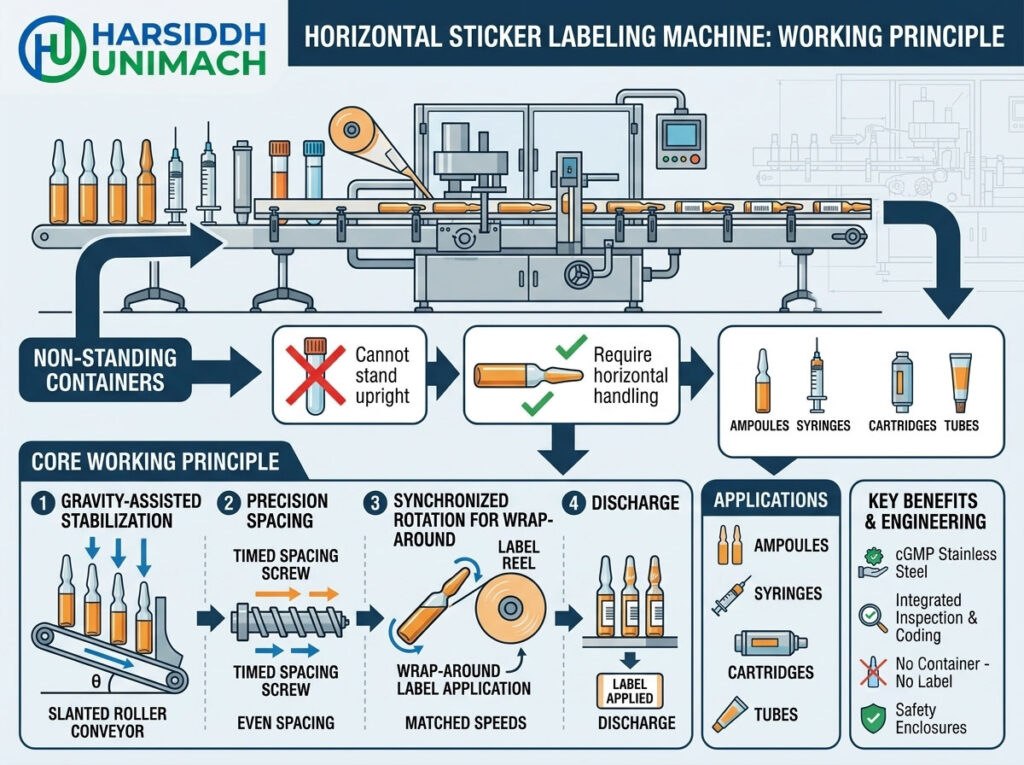
Most labelling machines work with products standing upright on a conveyor. That is perfect for bottles and jars, which stand steadily on a flat base. But many pharmaceutical and healthcare products cannot stand up reliably: ampoules with narrow bases, small vials, pre-filled syringes, insulin pens, test tubes, lip balm sticks, inhaler canisters and small cylindrical containers. Standing them on end would make them wobble, tip over or jam.
For these products, the answer is a horizontal sticker labeling machine. The product lies on its side and rolls as the self-adhesive label is applied, giving a smooth, accurate wrap-around label without ever needing to stand on end.
In this article, we explain how horizontal labellers work, their main components, the step-by-step labelling process, which products they suit, how they compare with vertical labellers and how to set them up and troubleshoot common problems. For the basic principles shared by all self-adhesive labellers, read our sticker labeling machine working principle.
Why Label Products Horizontally?
| Product Characteristic | Problem When Standing Upright | How Horizontal Labelling Helps |
|---|---|---|
| Small or narrow base | Tips over easily | Product lies stable on its side |
| High length-to-diameter ratio | Wobbles, labels skew | Rolls evenly along its length |
| Rounded or pointed ends | Cannot stand at all | No need to stand |
| Very small diameter | Hard to rotate with belts | Rollers rotate it precisely |
| Fragile glass | Risk of falling and breaking | Gentle, low-height handling |
| Light weight | Easily disturbed | Held securely between rollers |
Products Commonly Labelled Horizontally
- Ampoules – glass ampoules of various sizes
- Small vials – especially very small or tall, narrow vials
- Pre-filled syringes and cartridges
- Insulin and injection pens
- Test tubes and sample tubes
- Collapsible tubes – plastic, lami and aluminium, often before filling
- Inhaler canisters
- Lip balms, stick products and small cosmetic cylinders
- Pens, markers and similar small cylindrical items
Main Components of a Horizontal Sticker Labeling Machine
- Infeed hopper or tray – holds products lying horizontally, all facing the same way.
- Feeding device – a rotating drum, scroll, star wheel or belt that separates products one at a time.
- Horizontal transport – rollers, a V-belt or a chain with pockets that carries products through the machine at even spacing.
- Product sensor – detects each product and triggers the label dispense.
- Label unwind – holds the label roll with controlled tension.
- Guide rollers – steer the label web.
- Label gap sensor – detects the gap between labels.
- Coding unit – prints batch, manufacturing and expiry details on the label.
- Peel plate – separates the label from its liner.
- Drive roller – stepper or servo driven, advances the label web.
- Wrapping system – a belt or roller that presses on the product and makes it roll.
- Pressing rollers – smooth the label down along its full length.
- Liner rewind – collects used backing paper.
- Outfeed tray or chute – collects labelled products.
- Control panel – sets speed, label length, position and counts.
Step-by-Step Working Principle
Step 1: Loading
Products usually arrive at the labeller after inspection, for example on a visual ampoule and vial inspection machine, so that only accepted units are labelled. The operator loads products into the infeed hopper, lying horizontally and aligned in the same direction. For ampoules, the necks point the same way; for tubes, the caps point the same way.
Step 2: Feeding and spacing
The feeding device picks up one product at a time and places it onto the horizontal transport at a fixed pitch. Even spacing ensures that only one label is applied to each product and that the label head has time to prepare the next label.
Step 3: Coding
As the label web moves towards the peel plate, the coder prints variable information such as batch number and expiry date on each label.
Step 4: Detection
The product sensor detects each product as it approaches the labelling station and starts a timing delay. This delay determines where on the product’s circumference the label begins.
Step 5: Label dispensing
At the end of the delay, the drive roller advances the web. The liner bends sharply around the peel plate, and the label separates and moves forward. Its leading edge meets the product at the set position along its length.
Step 6: Rolling wrap
A moving belt or roller presses lightly on top of the product, making it roll as it moves forward. As the product rolls, it draws the label off the peel plate and wraps it around its circumference. The label speed is matched to the product’s surface speed so the label goes on smoothly without wrinkles or stretching.
Step 7: Pressing
After the label is wrapped, the product continues to roll between pressing rollers. These press the label firmly along its full length, paying special attention to the leading and trailing edges, which tend to lift on small diameters.
Step 8: Discharge
The labelled product is delivered to the outfeed tray or chute, ready for packing, tray loading or the next process.
Horizontal Labellers from Harsiddh
- Automatic Horizontal Ampoule Sticker Labeling Machine
- Horizontal ampoule sticker labelling machine
- Automatic Tube Labeling Machine
- Automatic Test Tube Sticker Labeling Machine
- Automatic Inhaler Labeling Machine
For product-specific details, read our ampoule labeling machine working principle and tube labeling machine working principle.
Pre-filled syringes are a growing format that often needs horizontal labelling after filling and stoppering, for example after a pre-filled syringe filling and stoppering machine.
Horizontal vs Vertical Sticker Labelling
| Feature | Horizontal Labeller | Vertical Labeller |
|---|---|---|
| Product orientation | Lying on its side | Standing upright |
| Best for | Small, narrow, unstable cylindrical products | Bottles, jars and stable containers |
| Rotation method | Product rolls between belts or rollers | Wrap belt rotates standing container |
| Handling of fragile items | Gentle, low drop height | Risk of tipping for unstable items |
| Typical products | Ampoules, small vials, syringes, pens, tubes | Round bottles, vials, jars |
| Label positions | Wrap-around along the body | Wrap-around, front, back, top |
Vials can be labelled either way, depending on their size and stability. Standard vials are often labelled upright, for example on the Automatic Vial Sticker Labeling Machine or the vertical vial sticker labeller, while very small or tall, narrow vials may suit horizontal labelling. For bottles, see the labeling machines for round bottles.
For higher outputs with ampoules, a rotary design can also be used; see the rotary ampoule sticker labeling machine.
Browse the labeling machines for ampoules, the labeling machines for vials, our full range of labeling machines and the labeling machines on Harsiddh Engineering.
Designing Labels for Horizontal Labelling
Small cylindrical products put particular demands on labels:
- Flexibility – thin, flexible materials conform to small diameters without springing back.
- Adhesive tack – strong initial tack holds edges down on tight curves.
- Overlap – a small overlap on full-wrap labels helps hold the trailing edge.
- Position – the label must avoid necks, shoulders, flanges, caps and plunger areas.
- Legibility – text and codes must remain readable once wrapped around a small diameter; barcodes usually run along the product’s length.
Test labels on real products before ordering large quantities.
Transport Systems Used in Horizontal Labellers
Different products need different ways of being carried and rolled:
- Roller conveyors – pairs of rollers support the product and rotate it during labelling. Common for ampoules, vials and tubes.
- V-belt transport – products sit in the groove between two belts, which keeps them centred and moving straight.
- Pocketed chains or star wheels – each product sits in its own pocket, giving precise spacing for small or irregular items.
- Top belts – a belt running above the products holds them down and makes them roll as the label is applied.
The choice depends on product diameter, length, weight and fragility. Glass products such as ampoules benefit from soft, smooth contact surfaces and low drop heights, while plastic products like pens and tubes can tolerate firmer handling.
Quality Checks on Labelled Products
- Label presence on every product
- Correct position along the length and around the circumference
- No skew, wrinkles or bubbles
- Edges firmly stuck, especially on small diameters
- Code present, correct and legible
- Barcode readable, where used
Sensors or cameras can check label presence and code automatically; manual checks at set intervals confirm overall quality.
Key Settings and Their Effects
| Setting | What It Controls | Effect If Wrong |
|---|---|---|
| Feed timing | Product spacing | Double feeding, labels bridging products |
| Label head position | Label position along the product | Label on neck, cap or flange |
| Sensor delay | Start point on circumference | Overlap in the wrong place |
| Label speed | Matching product rolling speed | Wrinkles or stretching |
| Wrapping belt pressure | Rolling and adhesion | Skew or poor wrap if low; damage if high |
| Pressing roller pressure | Edge adhesion | Flagging if low; breakage or deformation if high |
| Web tension | Straight label path | Skewed labels |
| Coder settings | Print quality | Faint or missing codes |
Troubleshooting Common Problems
| Problem | Likely Cause | Corrective Action |
|---|---|---|
| Labels lifting at the edges | Stiff label, low pressure, weak adhesive | Use thinner, more flexible label; increase pressing |
| Skewed labels | Product not rolling straight, web tracking | Adjust belts, guides and web path |
| Wrinkled labels | Label faster than product surface | Match speeds |
| Labels on the wrong area | Head position or product alignment | Adjust head and infeed alignment |
| Double feeding | Feed timing or worn feed parts | Adjust or replace feed parts |
| Broken glass products | Excessive pressure or harsh transfers | Reduce pressure, smooth transfers |
| Missing labels | Sensor misalignment, web break | Re-teach label, clean sensors, re-thread |
| Products not rolling | Wrong belt height, worn belt | Adjust height, replace belt |
Maintenance Tips
- Clean adhesive build-up from peel plate, belts and rollers.
- Inspect wrapping belts and pressing rollers for wear and hardening.
- Check feed drums, scrolls and pockets for wear.
- Clean and align sensors regularly.
- Service the coder and replace consumables on schedule.
- Keep change parts for each product size labelled and stored together.
- Remove broken glass promptly and clean thoroughly.
Changeover Between Products
A typical changeover includes:
- Line clearance of all products and labels from the previous batch
- Fitting feed parts and guides for the new product size
- Adjusting wrapping belt and pressing roller positions
- Loading the new label roll and teaching the label length
- Setting label head position and sensor delay
- Updating the coder
- Running test products and checking label position, adhesion and code
How to Choose a Horizontal Sticker Labeling Machine
- Products – ampoules, vials, syringes, pens, tubes or others
- Diameter and length range
- Label size and material
- Output – horizontal or rotary design
- Coding and inspection needs
- Gentle handling for glass or delicate items
- Changeover frequency
- Integration with upstream filling and downstream packing
Frequently Asked Questions
What is the working principle of a horizontal sticker labeling machine? Products are fed lying on their side and carried horizontally past a label head. As each product passes, a self-adhesive label is peeled from its liner and the product rolls under a belt or roller, wrapping the label around it. Pressing rollers then smooth the label.
Which products need horizontal labelling? Small, narrow or unstable cylindrical products such as ampoules, small vials, syringes, pens, test tubes and collapsible tubes.
What is the difference between horizontal and vertical labellers? Horizontal labellers label products lying down and rolling; vertical labellers label products standing upright on a conveyor.
Why do labels lift on small products? Small diameters make stiff labels spring back. Flexible labels, strong initial tack and good pressing prevent lifting.
Can one horizontal labeller handle different products? Yes, within its size range, using suitable change parts and settings.
Need a horizontal sticker labeling machine? Contact our team or send an inquiry with your product samples, label sizes and output requirements.