
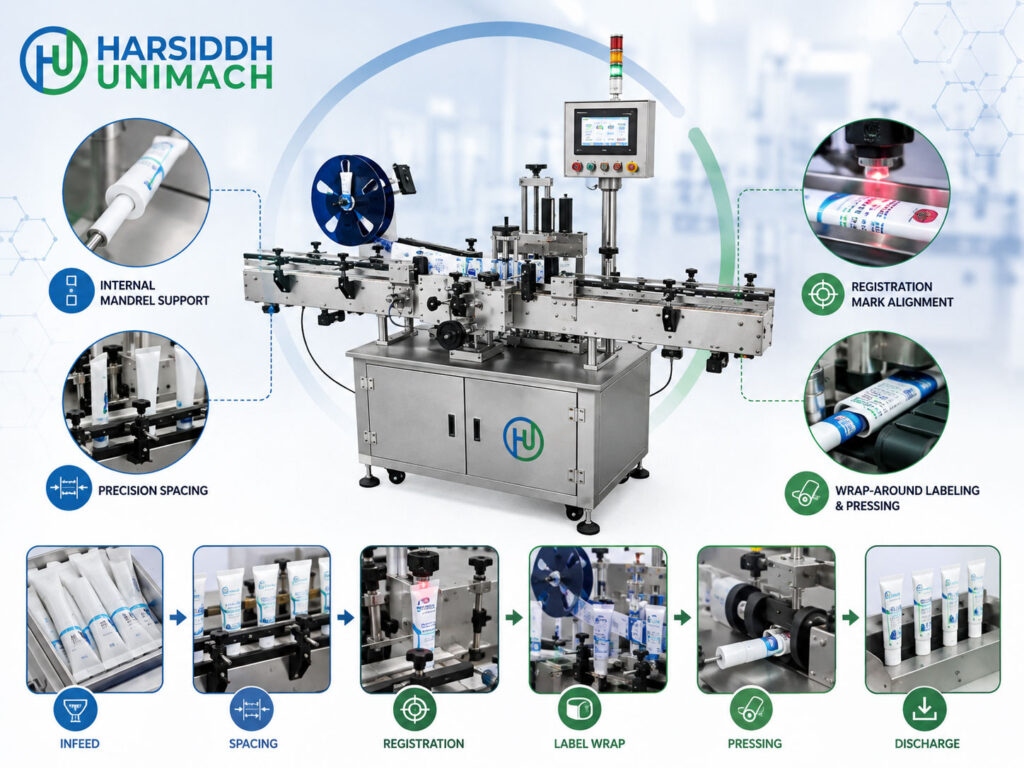
Tubes are everywhere in pharmaceutical, cosmetic and laboratory packaging: ointment tubes, cream tubes, gel tubes, toothpaste tubes, lip balm tubes, test tubes and sample tubes. Many are printed directly during manufacture, but just as many need a self-adhesive label, either because the brand wants a premium look, the product range is too varied for pre-printed tubes, or variable information must be added.
Labelling a tube is not the same as labelling a bottle. Tubes are often soft, sometimes tapered towards the cap, may be empty or filled, and are frequently labelled lying down rather than standing up. A tube labeling machine is built around these differences.
In this article, we explain the working principle of tube labelling machines, the different tubes they handle, how labels are applied by horizontal rolling, when to label before or after filling, how coding is added and how to set up and troubleshoot the machine.
If you are new to self-adhesive labelling in general, read our sticker labeling machine working principle first.
Types of Tubes That Are Labelled
| Tube Type | Material | Typical Products | Labelling Considerations |
|---|---|---|---|
| Plastic tubes | PE, co-extruded plastics | Creams, gels, lotions, cosmetics | Soft walls, may flex under pressure |
| Laminated (lami) tubes | Multilayer laminate | Toothpaste, creams, pharma | Firmer walls, side seam present |
| Aluminium tubes | Lacquered aluminium | Ointments, eye ointments, adhesives | Dents easily, label must not crease |
| Test tubes and sample tubes | Glass or plastic | Laboratory, diagnostics, blood collection | Rigid, small diameters, often barcodes |
| Cylindrical containers | Plastic or cardboard | Lip balms, sticks, effervescent tubes | Rigid, short or long |
Labelling Before or After Filling?
Collapsible tubes (plastic, lami and aluminium) can be labelled at two stages:
Labelling empty tubes before filling
- The tube is round, rigid enough and evenly shaped, so it rolls smoothly and labels apply cleanly.
- The labelled tubes are then loaded into the tube filler.
- The label must survive the filling, sealing and crimping process, including heat for plastic and lami tubes.
- Label position must be aligned with the tube’s eye mark so the filler seals the tube in the right orientation.
Labelling filled and sealed tubes
- The tube has a flat sealed end and a round body, so it is no longer a simple cylinder.
- Labels are applied to the round body, avoiding the seal.
- Filled tubes are softer and may deform under pressure, so pressing must be gentle.
Many manufacturers label empty tubes because it gives the most consistent result, but the right choice depends on the tube, label and filling process. For more on the filling side, read our tube filling machine working principle and our plastic tube filling and sealing machine working principle.
The Core Working Principle: Horizontal Rolling Application
Most tube labellers work horizontally. The tube lies on its side and rolls as the label is applied:
- Tubes are fed one at a time onto a transport system, lying horizontally.
- A sensor detects each tube.
- The label web advances and the label is peeled from its liner at a peel plate.
- The leading edge of the label touches the tube and sticks.
- A belt or roller makes the tube roll, drawing the label off the peel plate and wrapping it around the tube.
- Pressing rollers smooth the label down.
- The labelled tube is discharged.
Horizontal rolling suits tubes because they are cylindrical, often light, and unstable if stood on end, especially empty tubes or filled tubes with a sealed end. For more on this approach, read our horizontal sticker labeling machine working principle. The same rolling principle is used for small cylindrical items such as ampoules on the horizontal ampoule sticker labelling machine.
Main Components of a Tube Labeling Machine
- Infeed hopper or magazine – holds tubes lying horizontally, all facing the same way.
- Feed mechanism – a drum, star wheel or belt that separates tubes one at a time.
- Transport system – carries tubes at even spacing through the labelling station.
- Label unwind – holds the label roll with tension control.
- Gap sensor – detects the gap between labels.
- Coding unit – prints batch, manufacturing and expiry details.
- Peel plate – separates labels from the liner.
- Drive roller – stepper or servo driven, advances the web.
- Tube sensor – triggers the label dispense.
- Rolling belt or roller – rotates the tube to wrap the label.
- Pressing rollers or sponge – smooth the label onto the tube.
- Liner rewind – collects used backing.
- Outfeed tray or conveyor – collects labelled tubes, or transfers them directly to a tube filler or cartoner.
- Control panel – sets speed, label length, position and counts.
Step-by-Step: How a Tube Labeling Machine Works
Step 1: Loading tubes
Tubes are loaded into the hopper lying horizontally, with caps all pointing the same way. For filled tubes, the sealed end also faces the same direction.
Step 2: Separating and spacing
The feed mechanism picks one tube at a time and places it on the transport system at a fixed pitch. Even spacing ensures one label per tube.
Step 3: Coding
As the label web passes the coding unit, variable information is printed on each label.
Step 4: Detection
The tube sensor detects each tube and starts a delay that sets where the label begins on the tube.
Step 5: Dispensing
The drive advances the web, and the label separates at the peel plate. Its leading edge meets the tube at the set position along the tube’s length, clear of the cap shoulder and, on filled tubes, clear of the seal.
Step 6: Rolling wrap
A moving belt or roller presses lightly on the tube and makes it roll. As it rolls, the tube pulls the label off the peel plate and wraps it around its body. The label speed is matched to the tube’s surface speed to avoid wrinkles.
Step 7: Pressing
Additional rollers or a soft sponge continue to roll the tube, pressing the label down along its full length, especially the leading and trailing edges.
Step 8: Discharge
Labelled tubes are delivered to an outfeed tray, or fed directly into the next machine.
See the Automatic Tube Labeling Machine and our range of labeling machines. Browse also the labeling machines on Harsiddh Engineering.
Labelling Test Tubes and Sample Tubes
Laboratories, diagnostic kit manufacturers and blood collection tube producers label large numbers of small, rigid tubes. Test tube labelling follows the same rolling principle, with a few special points:
- Small diameters require thin, flexible labels and good edge pressing.
- Labels often carry barcodes, which must remain readable after wrapping, usually with the barcode running along the tube’s length.
- Some labels must leave a viewing window so the sample can be seen.
- Labels may need to withstand cold storage, centrifuging or chemicals.
See the Automatic Test Tube Sticker Labeling Machine.
Designing Labels for Tubes
- Material – flexible films such as PE work well on soft plastic tubes because they flex with the tube when it is squeezed. Paper labels can crack or wrinkle on squeezable tubes.
- Adhesive – must suit the tube material (plastic, laminate or aluminium) and, for labelling before filling, withstand the heat of sealing.
- Size – label height must clear the shoulder and the seal area; length is chosen for full or partial wrap.
- Squeeze resistance – labels on squeezable tubes must stay attached when the tube is pressed and rolled up by the user.
- Code area – a clear space for batch and expiry printing.
Always test labels on actual tubes, through the full filling and sealing process if labelling before filling.
Tube Labelling and Tube Filling Together
When tubes are labelled before filling, the labeller and filler work as a pair. Labelled tubes must be loaded into the filler with correct orientation so the filler’s eye mark sensor can align the seal with the artwork. Our tube fillers include the Automatic Single Head Tube Filling Machine and the Automatic Aluminum Tube Filling Machine. On Harsiddh Engineering, see:
- Automatic single head tube filling machine (HTF-40A)
- Automatic double head tube filling machine (HTF-70A)
- Automatic lami tube filling machine
- Automatic aluminium tube filling machine (HTF-40AL)
- Semi-automatic plastic tube filling machine
- Tube filling, crimping and batch coding machine
Browse the cream and ointment filling machines range for the full set of semi-solid filling solutions.
Key Settings and Their Effects
| Setting | What It Controls | Effect If Wrong |
|---|---|---|
| Feed timing | Tube spacing | Double feeding, labels bridging tubes |
| Label head position | Label position along the tube | Label on shoulder or seal |
| Sensor delay | Label start on circumference | Overlap in the wrong place |
| Label speed | Matching tube rolling speed | Wrinkles or stretched labels |
| Rolling belt pressure | Rotation and adhesion | Dented or deformed tubes if too high, poor wrap if too low |
| Pressing roller pressure | Edge adhesion | Flagging or tube damage |
| Web tension | Straight label path | Skewed labels |
| Coder settings | Print quality | Faint or missing codes |
Troubleshooting Common Tube Labelling Problems
| Problem | Likely Cause | Corrective Action |
|---|---|---|
| Wrinkled labels | Label speed faster than tube | Match speeds |
| Skewed labels | Tube not rolling straight, tapered tube | Adjust guides and belt, check tube shape |
| Labels lifting | Stiff label, low pressure | Use flexible film, increase pressing |
| Dented aluminium tubes | Excessive belt or roller pressure | Reduce pressure, use softer rollers |
| Labels peeling after squeezing | Paper label or unsuitable adhesive | Use flexible film and suitable adhesive |
| Labels damaged in filler | Heat from sealing, poor adhesive | Choose heat-resistant materials, check position |
| Double feeding | Feed timing | Adjust feed mechanism |
| Missing labels | Sensor fault, web break | Clean sensors, re-thread web, re-teach label |
Changeover Between Tube Sizes and Labels
Tube lines often run several products, tube diameters and label designs, so changeovers need to be quick and controlled. A typical changeover involves:
- Line clearance – removing all tubes and labels from the previous product to avoid mix-ups
- Changing feed parts – drum, star wheel or guides for the new tube diameter
- Adjusting the rolling belt and pressing rollers to suit the new diameter and tube stiffness
- Loading the new label roll and teaching the label length
- Setting label head position along the tube and the sensor delay
- Updating the coder with the new batch and expiry details
- Running test tubes and checking position, adhesion and code before production
Recording settings for each tube and label combination, and keeping change parts labelled and stored together, makes changeovers faster and more repeatable.
Maintenance Tips
- Clean adhesive build-up from peel plate, rollers and belts.
- Inspect rolling belts and pressing rollers for wear and hardening.
- Clean and check sensors regularly.
- Service the coder and replace consumables.
- Keep change parts for each tube diameter labelled and stored.
How to Choose a Tube Labeling Machine
- Tube types – plastic, lami, aluminium or test tubes
- Tube diameters and lengths
- Labelling stage – before or after filling
- Label material and size
- Output to match the filler or line
- Coding requirements
- Integration with tube fillers and cartoners
- Changeover needs
Frequently Asked Questions
What is the working principle of a tube labeling machine? Tubes are fed horizontally one at a time. As each tube passes the label head, a self-adhesive label is peeled from its liner and the tube is rolled by a belt or roller, wrapping the label around it. Pressing rollers then smooth the label down.
Should tubes be labelled before or after filling? Both are possible. Labelling empty tubes often gives the most consistent result, but the label must survive filling and sealing. Filled tubes can be labelled on the round body, away from the seal.
Why are tubes labelled horizontally? Tubes are cylindrical and often unstable when standing, so rolling them horizontally gives smooth, even label application.
What labels work best on squeezable tubes? Flexible film labels that move with the tube when it is squeezed.
Can test tubes be labelled on the same principle? Yes. Test tube labellers use the same rolling principle, with attention to small diameters and barcode readability.
Looking for a tube labeling machine? Contact our team or send an inquiry with your tube type, sizes and label details.