
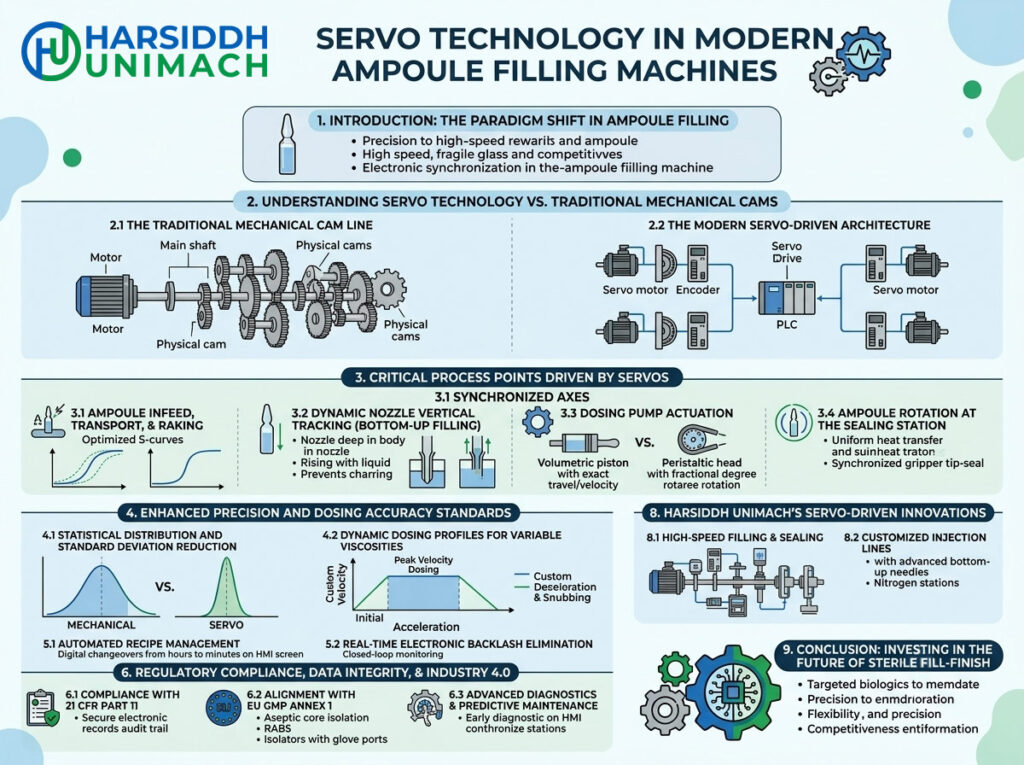
For decades, ampoule filling and sealing machines were built around a single main motor and a camshaft. Every movement — ampoule transport, needle up and down, pump stroke, tong motion — was driven by a mechanical cam profile cut into steel. These machines were robust and many are still running today. But they had clear limits: changing a fill volume or motion profile meant mechanical adjustment, and accuracy depended on the wear of cams, linkages and bearings.
Servo technology has changed that. By replacing mechanical cams with independently controlled servo motors, modern ampoule machines can dose more accurately, move more smoothly, change over faster and provide data that mechanical machines never could.
In this guide, we explain what servo technology is, where it is used in an ampoule filling machine, what benefits it brings, what it does not change, and how to decide whether a servo machine is right for your plant. For background on how ampoule machines work overall, see our ultimate guide to the ampoule filling and sealing machine working principle.
What Is a Servo System?
A servo system is a closed-loop motion control system made up of three parts:
- Servo motor – a motor designed for precise control of position, speed and torque.
- Feedback device (encoder) – continuously measures the motor’s actual position and speed.
- Servo drive and motion controller – compares the actual position with the commanded position and corrects any difference many times per second.
Because the system constantly checks and corrects itself, a servo motor can move to an exact position, follow a programmed motion profile and repeat it with very high consistency — cycle after cycle.
Servo vs conventional motors
A conventional motor simply runs at a speed. To create complex motions, mechanical machines convert that rotation into movement through cams, levers and gears. A servo motor, by contrast, can itself produce complex, programmable motions: accelerate, slow down, stop, reverse or hold position exactly as commanded.
Mechanical vs Servo Ampoule Machines
| Feature | Mechanical (Cam-Driven) | Servo-Driven |
|---|---|---|
| Motion source | One main motor with camshaft | Independent servo axes |
| Changing fill volume | Manual stroke adjustment | Set on HMI |
| Changing motion profile | Change or modify cams | Edit parameters in software |
| Repeatability | Depends on mechanical wear | High, maintained by feedback |
| Changeover | Slower, more manual adjustment | Faster, recipe-based |
| Diagnostics | Limited | Detailed alarms and data |
| Initial cost | Lower | Higher |
| Maintenance skills | Mechanical | Mechanical plus electrical/controls |
To see how the same principles apply on vial lines, read how servo-driven vial filling systems outperform mechanical lines.
Where Servo Motors Are Used in an Ampoule Filling Machine
Depending on the design, servo control may be applied to one or several functions.
1. Dosing pumps
This is the most common and most valuable use of servo technology. A servo motor drives the pistons of the dosing pumps, so the stroke length — and therefore the fill volume — is set electronically. Fill speed can be profiled, for example slow at the start, faster in the middle and slow at the end, and a precise suck-back can be added to prevent drips.
2. Needle carriage (vertical motion)
A servo controls how deep the filling needles dive into the ampoules and how fast they rise as the liquid level increases. Programmable dive and rise profiles allow bottom-up filling that minimises foaming and keeps the neck dry — essential for clean seals.
3. Needle tracking (horizontal motion)
On some machines, the needle carriage moves horizontally with the ampoules for part of the cycle so filling can continue while ampoules are moving. Servo control allows this tracking motion to be perfectly synchronised with the transport, increasing output.
4. Ampoule transport
The walking beam or rack-and-pinion transport can be servo-driven, allowing smooth acceleration and deceleration. Gentler motion reduces ampoule tilting, chipping and breakage, particularly with small or thin-walled ampoules.
5. Sealing tongs and rotation
Servo control of pull-sealing tongs and ampoule rotation allows precise timing relative to the flame, supporting consistent seal shape and length.
Electronic camming
In multi-axis servo machines, the motion controller links all axes through electronic cams — software profiles that replace physical cams. The transport, needles, pumps and tongs remain perfectly synchronised at any machine speed, and profiles can be modified without changing hardware.
Examples of servo-driven designs include the Automatic Servo Based Ampoule Filling and Sealing Machine. The same dosing principles are used in our servo based piston filling machine.
The Benefits of Servo Technology
Higher fill accuracy and repeatability
Because the servo system continuously corrects its position, each pump stroke is repeated precisely. Individual pumps can be fine-tuned from the HMI, so all heads deliver the same dose. This reduces underfills, overfills and product giveaway.
Better fill quality
Programmable fill profiles and needle motion reduce foaming, splashing and wet necks — the main causes of charred tips and weak seals. For oxygen-sensitive products, servo timing also coordinates nitrogen purging precisely with needle entry and exit. Learn more about how nitrogen flushing improves sterility and stability in ampoule filling machines.
Faster changeovers
On a mechanical machine, changing fill volume can mean adjusting each pump individually and running several test fills. On a servo machine, the operator selects a stored recipe, and fill volume, needle profile and speed are set automatically. Some change parts — such as transport plates for different ampoule sizes — are still needed, but setup time is greatly reduced. See our definitive guide to ampoule filling machine size conversion.
Gentle, smooth handling
Servo motion profiles can be optimised to accelerate and decelerate smoothly, reducing mechanical shock to fragile glass. Fewer broken ampoules mean fewer stoppages, less glass contamination and less cleaning.
Higher output
Precise synchronisation and features such as needle tracking allow servo machines to run faster without sacrificing accuracy. This is especially valuable in high-output machines like the Automatic Eight Head Ampoule Filling & Sealing Machine and our high-speed eight head vertical ampoule filling and sealing machine.
Diagnostics and data
Servo drives monitor position errors, torque and current. Unusual readings can indicate a jam, a worn component or a mechanical problem before it causes a breakdown. Combined with the PLC and HMI, machines can record alarms, production counts and recipe changes, supporting troubleshooting and, where required, data integrity expectations such as user access control and audit trails.
Less mechanical wear
With fewer cams, linkages and gears, there are fewer parts to wear out and adjust. The machine’s performance stays closer to its validated state over time.
What Servo Technology Does Not Change
Servo control improves motion and dosing, but some aspects of ampoule filling remain dependent on other factors:
- Seal quality still depends on burner design, gas-oxygen ratio and flame stability. Servo timing helps, but the flame must be set correctly.
- Ampoule quality — dimensional consistency and glass quality — still affects handling and sealing.
- Product properties such as viscosity and foaming still influence fill behaviour.
- Sterility assurance depends on the cleanroom, airflow, barrier technology and procedures, not just the machine.
- Operator skill is still needed, although the skill set shifts towards understanding controls and recipes.
Servo Dosing Options: Piston and Peristaltic
Servo technology can drive different types of dosing pumps:
- Servo piston pumps – high accuracy across a wide range of volumes and viscosities, well proven in ampoule filling.
- Servo peristaltic pumps – rollers driven by a servo motor push product through flexible tubing. The product contacts only the tubing, which can be single-use. This suits high-value, potent or sensitive products and multi-product facilities. See our peristaltic based liquid filling machine.
Servo Technology Across Machine Sizes
Servo control is available across a range of ampoule machine configurations:
- Four head machines for medium production — see our four head ampoule filling and sealing machine.
- Six head machines for higher production — see our six head ampoule filling and sealing machine.
- Eight head machines for high-volume production.
- Closed ampoule machines, where servo control helps synchronise the additional tip-opening step — for example, the eight head closed ampoule filling and sealing machine.
- Integrated lines, where servo-driven fillers are synchronised with washers and sterilising tunnels — see the Automatic Ampoule Filling Line (Compact Line) and our automatic ampoule filling line (compact line).
Browse our ampoule filling machines for open ampoules and ampoule filling machines for closed ampoules.
Is a Servo Ampoule Machine Right for You?
When servo is the clear choice
- You run several products or fill volumes and change over frequently
- You fill high-value products where accuracy and low product loss matter
- You need high output with consistent quality
- You supply regulated markets that expect detailed process data
- You want to reduce dependence on highly experienced mechanical setters
When a mechanical machine may still be suitable
- You run one or two products in long campaigns with rare changeovers
- Budget is the main constraint
- Your maintenance team is mainly mechanically skilled and servo support is limited
Considerations Before Investing
- Initial cost: servo machines cost more upfront, but savings in product loss, changeover time and rejects often justify the difference.
- Spare parts: servo motors, drives and encoders should be available locally or kept in stock.
- Skills and training: maintenance teams need training in servo systems, PLCs and HMIs.
- Electrical environment: stable power supply and proper earthing are important for reliable servo operation.
- Software validation: recipes, user levels and data functions should be covered in qualification.
- Supplier support: remote diagnostics and responsive service reduce downtime.
Maintaining a Servo Ampoule Machine
Servo machines need less mechanical adjustment, but good maintenance is still essential:
- Keep electrical cabinets clean, cool and dry
- Check cables and connectors on moving axes for wear
- Monitor drive alarms and trends in following error or torque
- Back up machine software, recipes and parameters regularly
- Continue routine mechanical maintenance — pump seals, needles, transport parts, burners and tongs
Our ampoule filling machine maintenance checklist lists the critical components to inspect regularly.
Questions to Ask Your Supplier
- Which axes on the machine are servo-driven — dosing only, or also needles, transport and tongs?
- How are fill volumes and motion profiles stored and protected in recipes?
- What fill accuracy has the machine achieved in factory tests at your volumes?
- Which servo brand is used, and are spares available locally?
- What diagnostics and alarm history does the HMI provide?
The Future: Smarter Servo Machines
Servo technology is the foundation for further innovation in ampoule filling. Trends include automatic dose correction using in-line weighing feedback, predictive maintenance based on drive data, faster recipe-driven changeovers, integration with plant-wide data systems and improved compatibility with barrier technologies such as RABS. As these features mature, servo ampoule machines will deliver even greater consistency with less manual intervention.
Frequently Asked Questions
What is a servo ampoule filling machine? It is an ampoule filling and sealing machine in which key motions — such as dosing pumps, needle movement and ampoule transport — are driven by servo motors under electronic control instead of mechanical cams.
How does servo technology improve fill accuracy? The servo system continuously measures and corrects motor position, so each pump stroke is repeated precisely. Doses can also be fine-tuned for each head from the HMI.
Does a servo machine produce better seals? Indirectly, yes. Servo-controlled needle motion keeps ampoule necks dry, and precise timing supports consistent sealing. However, flame settings and gas control remain critical.
Are servo ampoule machines harder to maintain? They need fewer mechanical adjustments but require electrical and controls skills. With proper training and spare parts, they are often easier to keep at peak performance.
Can existing mechanical machines be upgraded to servo? Some machines can be partially upgraded, for example with servo dosing, but full benefits usually come from machines designed for servo control from the start.
Interested in a servo-driven ampoule filling and sealing machine? Explore our ampoule filling machine range, contact our team or send an inquiry.