
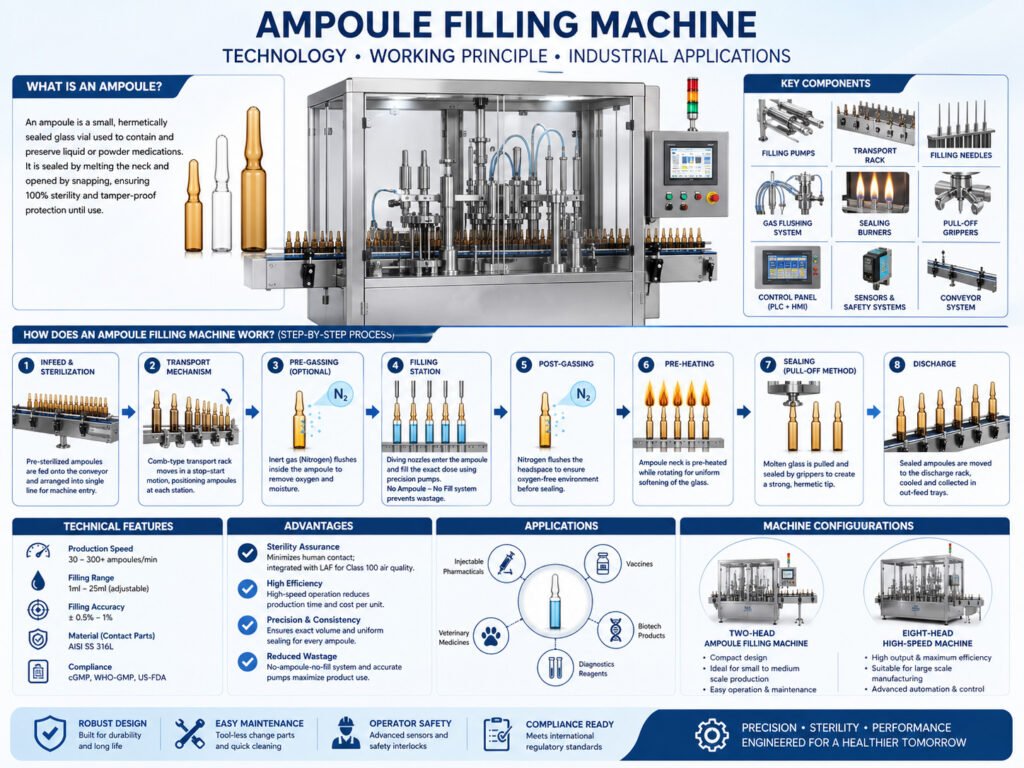
Glass ampoules are one of the oldest and most trusted containers in pharmaceutical packaging. Because the ampoule is sealed by melting its own glass, there is no rubber stopper, no cap and no closure component that could leach into the product or loosen over time. The result is an all-glass, hermetically sealed container that protects injectable drugs, vitamins, anaesthetics and many other liquids for years.
But that simplicity places high demands on the machine that fills and seals it. An ampoule filling machine must dose small volumes accurately, protect the product from oxygen and contamination, and then seal the glass neck with a flame — consistently, at speed, and without cracks, burnt tips or leaks.
In this guide, we explain what an ampoule filling machine is, the main parts it is built from, how it works step by step, the different types available, and what to look for when choosing one for your plant.
What Is an Ampoule?
An ampoule is a small, sealed glass container, usually made from Type I borosilicate glass, used to hold a single dose of liquid medicine. Common sizes range from 1 ml to 20 ml, with 1 ml, 2 ml, 5 ml and 10 ml being the most widely used for injectables.
Ampoules come in two main forms:
- Open (funnel-type) ampoules arrive at the filling line with an open neck and are ready to be washed, sterilised, filled and sealed.
- Closed ampoules are supplied already sealed by the glass manufacturer, keeping the inside clean until use. The machine cuts or opens the tip just before filling, then reseals it.
To understand where ampoules fit compared with other injectable containers, read our article on ampoule vs vial filling: key differences explained.
What Is an Ampoule Filling Machine?
An ampoule filling machine — more accurately, an ampoule filling and sealing machine — is a piece of pharmaceutical equipment that automatically doses a precise volume of liquid into glass ampoules, protects the product with inert gas where needed, and seals each ampoule by melting and closing its neck with a gas-oxygen flame.
In a complete injectable production line, the ampoule filling machine sits between the sterilising tunnel and the inspection and labelling stations. Machines range from compact, single-head units for laboratories and small batches to high-speed, eight-head machines producing many thousands of ampoules per hour. You can browse the full range in our ampoule filling machine category.
Main Components of an Ampoule Filling Machine
Although designs vary, most ampoule filling and sealing machines share the same core parts:
- Infeed hopper or turntable – receives sterilised ampoules from the tunnel or from trays and feeds them into the machine.
- Infeed worm (scroll) and transport system – separates and positions ampoules at the correct pitch. Many machines use a “walking beam” or rack-and-pinion movement to move ampoules step by step through each station.
- Filling needles (nozzles) – stainless steel needles that dive into the ampoule neck to dispense the liquid. The number of needles defines whether the machine is single-head, two-head, four-head, six-head or eight-head.
- Dosing system – syringe-type piston pumps, servo-driven pumps or peristaltic pumps that measure each dose precisely.
- Gas purging system – nozzles that flush ampoules with nitrogen or another inert gas before and after filling to displace oxygen.
- Sealing station – burners using a mixture of LPG or natural gas with oxygen, along with gripping jaws or rollers that rotate the ampoule for even heating and pull the tip for a clean seal.
- Outfeed tray or conveyor – collects sealed ampoules and sends them to inspection.
- Control system – a PLC and HMI (on automatic machines) that manage speed, dosing, gas flow and safety interlocks.
All product-contact parts are typically made from SS 316L, while the machine body is made from SS 304, following GMP design principles.
How Does an Ampoule Filling Machine Work? Step-by-Step
The working cycle of an automatic ampoule filling and sealing machine follows a clear sequence.
Step 1: Ampoule infeed
Sterilised and depyrogenated ampoules arrive at the infeed — either directly from a sterilising tunnel on an integrated line, or loaded manually from trays on standalone machines. The infeed worm or turntable separates them and delivers them into the transport system at a fixed spacing.
Step 2: Tip cutting (closed ampoules only)
For closed ampoules, the machine first opens the tip using a scoring or cutting mechanism, often combined with heating, so that the needles can enter. This step is skipped for open, funnel-type ampoules.
Step 3: Pre-gassing
Before any liquid is added, inert gas — usually nitrogen — is blown into the ampoule to displace air. This is essential for oxygen-sensitive products, which can degrade or change colour if exposed to oxygen during filling.
Step 4: Filling
The filling needles descend into the ampoule necks and dispense the set dose. On modern machines, the needles dive close to the bottom and rise as the liquid level increases, minimising foaming and splashing on the neck. A wet neck is one of the main causes of poor seals and charring, so a clean, controlled fill is critical.
Different dosing methods suit different products. Our guide to vacuum filling vs gravity filling in ampoule machines explains how each approach works.
Step 5: Post-gassing
After filling, a second burst of nitrogen fills the headspace above the liquid. This keeps oxygen out until the ampoule is sealed, protecting product stability over its shelf life. Learn more about how nitrogen flushing improves sterility and stability in ampoule filling machines.
Step 6: Pre-heating
The ampoule moves to the sealing station, where the neck is first pre-heated by a gentler flame while the ampoule rotates. Gradual heating reduces thermal shock and helps produce a uniform seal.
Step 7: Sealing
The neck is heated to its softening point by the main burners. Ampoules are sealed in one of two ways:
- Tip sealing (fusion sealing): the top of the neck is melted until the glass closes on itself. It is simple but more prone to incomplete seals and fine capillaries.
- Pull sealing: while the neck is soft, gripping jaws or tongs pull the tip away, creating a strong, uniform seal. Pull sealing is the preferred method for pharmaceutical injectables because it gives more reliable container integrity.
Step 8: Discharge
Sealed ampoules move to the outfeed tray or conveyor, where they cool before being sent on to leak testing, visual inspection and labelling.
Types of Ampoule Filling Machines
By number of heads
The number of filling needles largely decides output:
- Single-head machines suit laboratories, R&D and pilot batches.
- Two-head and four-head machines serve small and medium production. See our four head ampoule filling and sealing machine as an example.
- Six-head and eight-head machines are built for high-volume commercial production. The Automatic Eight Head Ampoule Filling & Sealing Machine is designed for plants that need maximum throughput.
Our detailed comparison of single-head, 2-head, 4-head and 6-head ampoule filling and sealing machines helps you match capacity to demand.
By ampoule type
Machines are built either for open ampoules or for closed ampoules, since closed ampoules need an additional tip-opening station. Compare the ranges for open ampoules and closed ampoules.
By dosing technology
- Syringe or piston pumps – the traditional choice; accurate and robust, with mechanical or servo adjustment.
- Servo-driven dosing – volumes are set from the HMI, giving faster changeovers and excellent repeatability. See the Automatic Servo Based Ampoule Filling and Sealing Machine.
- Peristaltic dosing – the product stays in a closed, replaceable tube, ideal for high-value or sensitive formulations and for easy cleaning.
By scale
For development work and small clinical batches, a compact machine such as the Automatic Lab Scale Ampoule Filling & Sealing Machine provides the same filling and sealing principles as production equipment in a much smaller footprint.
The Ampoule Filling Machine as Part of a Complete Line
In commercial injectable manufacturing, the ampoule filling machine is rarely used alone. A typical line includes:
- Ampoule washing – ampoules are cleaned inside and out with purified water, WFI and compressed air. See our ampoule washing machine range, including the rotary ampoule washing machine.
- Sterilisation and depyrogenation – a hot-air sterilizing tunnel for ampoules and vials dries, sterilises and cools the ampoules before they reach the filler.
- Filling and sealing – the ampoule filling and sealing machine.
- Inspection – sealed ampoules are checked for particles, fill level, cracks and seal defects using a visual ampoule and vial inspection machine.
- Labelling – ampoules are labelled and coded using dedicated labeling machines for ampoules.
When washing, sterilising, filling and sealing are combined in one synchronised system — as in our Automatic Ampoule Filling Line (Compact Line) — manual handling is minimised, floor space is reduced and sterility assurance improves.
Applications of Ampoule Filling Machines
Ampoule filling and sealing machines are used wherever a liquid needs an all-glass, tamper-evident, single-dose container:
- Pharmaceuticals: injectables such as vitamins, analgesics, antibiotics, anaesthetics, hormones and emergency drugs.
- Veterinary medicines: injectable formulations for animal health.
- Cosmetics and personal care: serums, hair and skin treatments supplied in single-use ampoules.
- Laboratories and diagnostics: reagents, standards and reference solutions that must remain stable and uncontaminated.
- Fragrances and specialty chemicals: essential oils and sample liquids that need protection from air.
Key Features to Look For
When comparing ampoule filling machines, consider:
- Fill accuracy and repeatability across the full volume range you need.
- Sealing quality – pull sealing, well-designed burners and precise gas flow control.
- Nitrogen purging before and after filling for oxygen-sensitive products.
- No-ampoule-no-fill sensing to avoid spillage and wasted product.
- Quick changeover between ampoule sizes with minimal change parts.
- GMP construction – SS 316L contact parts, smooth surfaces and easy cleaning.
- Documentation and validation support – IQ/OQ documents and factory acceptance testing.
- After-sales service – availability of spare parts and technical support.
Common Problems and How to Prevent Them
- Charred or burnt tips: usually caused by liquid on the ampoule neck. Use diving needles, control fill speed and prevent dripping.
- Leaking ampoules or fine capillaries: often linked to tip sealing, uneven heating or incorrect gas ratios. Pull sealing, correct burner alignment and uniform ampoule rotation solve most cases.
- Inaccurate fill volumes: caused by worn pump seals, air in the product line or incorrect settings. Regular calibration and preventive maintenance keep doses within limits.
- Ampoule breakage: caused by misaligned change parts, rough transfers or thermal shock. Correct setup and gradual pre-heating reduce breakage.
- Bulged or uneven seals: often a result of overheating or poor gas mixture balance. Adjusting flame intensity and timing restores consistent seals.
How Harsiddh Unimach Can Help
Harsiddh Unimach Pvt. Ltd. designs and manufactures ampoule filling and sealing machines from single-head lab models to high-speed eight-head systems, as well as complete ampoule lines with washing, sterilising, inspection and labelling. Our team can help you select the right machine for your ampoule sizes, output targets and product requirements. Learn more about Harsiddh Engineering.
Frequently Asked Questions
What is an ampoule filling machine used for? It is used to fill precise volumes of liquid into glass ampoules and seal them with a flame, creating an all-glass, hermetically sealed container — mainly for injectable pharmaceuticals, but also for cosmetics, laboratory reagents and specialty liquids.
What is the difference between tip sealing and pull sealing? Tip sealing melts the top of the neck until it closes, while pull sealing softens the neck and pulls the tip away. Pull sealing produces stronger, more uniform seals and is preferred for pharmaceutical injectables.
Why is nitrogen used in ampoule filling? Nitrogen displaces oxygen inside the ampoule before and after filling, protecting oxygen-sensitive products from degradation and extending shelf life.
What ampoule sizes can be filled? Most machines handle ampoules from 1 ml to 20 ml with suitable change parts. The exact range depends on the machine model.
How do I choose between a four-head and an eight-head ampoule filling machine? It depends on your required output. Four-head machines suit small and medium production, while eight-head machines are designed for high-volume commercial manufacturing.
Looking for the right ampoule filling machine for your plant? Contact our team or send an inquiry to discuss your requirements.