
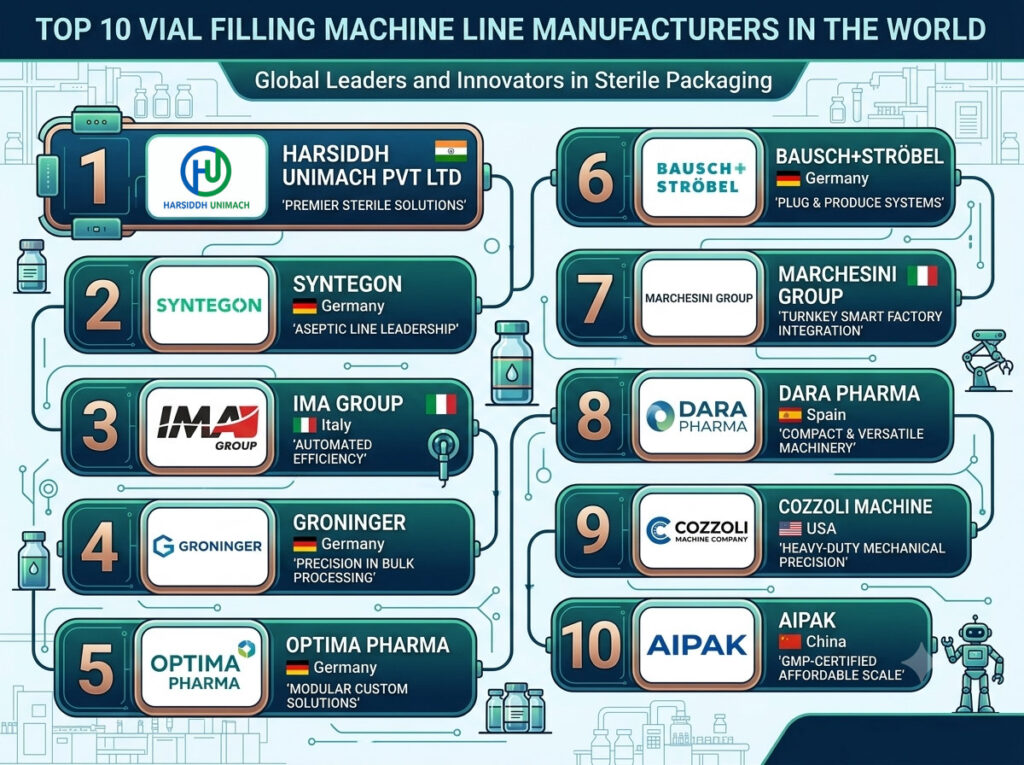
Vials are the workhorse container of the injectable world. They hold sterile solutions, suspensions, powders and freeze-dried products; they serve single-dose and multi-dose applications; and they are the standard format for antibiotics, vaccines, biologics and most high-value parenteral drugs. As demand for injectables grows, so does demand for reliable vial filling lines.
A vial filling line is a major, long-term investment. It typically includes washing, depyrogenation, filling, stoppering, capping, inspection and labelling — all working together under strict GMP control. The manufacturer you choose will influence your sterility assurance, output, flexibility and operating costs for many years.
In this guide, we introduce ten of the best-known vial filling machine line manufacturers in the world, explain what typically distinguishes them and share a practical framework for evaluating suppliers. We also explain why many injectable manufacturers choose Indian suppliers such as Harsiddh Unimach for dependable, cost-effective vial lines.
The companies below are listed in no particular order. Company structures, ownership and product ranges change over time, so confirm current details directly with each supplier.
What Defines a Leading Vial Line Manufacturer?
When evaluating vial line suppliers, the strongest typically offer:
- Complete line capability – washing, depyrogenation, filling, stoppering, capping, inspection and labelling
- Aseptic expertise – machine designs compatible with laminar airflow, RABS or isolators
- Dosing options – piston, peristaltic and other technologies for different products
- Lyophilisation support – partial stoppering and freeze-dryer loading for freeze-dried products
- Powder filling – vacuum-pressure powder dosing for sterile powders
- Validation documentation – comprehensive FAT, SAT, IQ and OQ support
- Service network – installation, training, spare parts and technical support
- Innovation – servo technology, ready-to-use nested formats, automation and data integration
1. Syntegon (Germany)
Formerly Bosch Packaging Technology, Syntegon is a global leader in processing and packaging technology. Its pharmaceutical liquid portfolio spans washing, sterilising, filling and closing systems for vials and other containers, often integrated with isolators for high-level sterility assurance.
Typical strengths: high-speed integrated lines, global service, barrier technology.
2. Bausch+Ströbel (Germany)
A specialist in filling and packaging machines for injectables, Bausch+Ströbel offers vial washing, filling and closing machines, inspection systems and complete lines, with a reputation for precision engineering.
Typical strengths: parenteral specialisation, precision, complete vial line offering.
3. Groninger (Germany)
Groninger builds filling and closing machines for pharmaceutical and consumer healthcare products, with strong capabilities in aseptic processing and nested ready-to-use vial and syringe formats.
Typical strengths: aseptic and nested processing, flexible multi-format machines.
4. Optima Pharma (Germany)
Optima Pharma provides turnkey filling lines for liquid and powder pharmaceuticals, frequently combined with isolators and freeze-drying systems from within its group.
Typical strengths: turnkey aseptic lines, isolator and freeze-dryer integration.
5. IMA Group (Italy)
IMA supplies automatic machines for pharmaceutical processing and packaging, including aseptic filling and freeze-drying solutions for vials through its pharmaceutical divisions.
Typical strengths: broad aseptic and lyophilisation portfolio, global reach.
6. Marchesini Group (Italy)
Marchesini Group designs primary and secondary packaging machinery for pharmaceuticals, including equipment for liquid products and integrated packaging lines.
Typical strengths: end-to-end packaging line integration.
7. Steriline (Italy)
Steriline focuses on aseptic processing lines, offering vial washing, depyrogenation, filling, closing and decontamination equipment, often with integrated barrier systems.
Typical strengths: sterile line specialisation, barrier integration.
8. Dara Pharma (Spain)
Dara Pharma manufactures aseptic filling and closing machines for vials, syringes and other formats, including isolator-integrated and small-batch solutions.
Typical strengths: flexible multi-format equipment, clinical and small-batch capability.
9. Tofflon (China)
Tofflon is a major Chinese pharmaceutical equipment company known for freeze-drying systems and aseptic processing equipment, including vial filling lines and related systems.
Typical strengths: freeze-drying expertise, integrated aseptic solutions, competitive pricing.
10. AST (USA)
AST designs aseptic filling and closing systems for vials, syringes and cartridges, with a focus on flexible, automated platforms for sterile products, including those processed in nested formats.
Typical strengths: flexible aseptic platforms, North American presence, nested container processing.
How Supplier Types Typically Compare
| Supplier Type | Typical Focus | Strengths | Points to Consider |
|---|---|---|---|
| Large European groups | High-speed, isolator-integrated lines | Advanced technology, global service | Higher investment, longer lead times |
| European specialists | Injectable-focused lines | Precision, customisation | Premium pricing |
| North American specialists | Flexible aseptic platforms | Regional support, nested formats | Investment level, regional coverage |
| Large Asian manufacturers | Broad portfolios incl. lyophilisation | Competitive pricing, capacity | Evaluate documentation and local service |
| Indian specialist manufacturers | Practical, robust vial lines | Value, customisation, responsive service | Confirm references and export experience |
Why Indian Vial Line Manufacturers Are Worth Considering
India is a global hub for generic injectables, and its machinery manufacturers have developed deep experience in building vial lines for high-volume production. Indian suppliers typically offer:
- Strong value – GMP-compliant equipment at competitive cost
- Practical engineering – machines designed for real-world generic injectable production
- Customisation – flexibility to suit specific vial sizes, products and layouts
- Fast support – quicker access to engineers and spares in India, Asia, Africa and the Middle East
- Export experience – many manufacturers supply customers worldwide
Harsiddh Unimach: A Complete Vial Line Partner From India
Harsiddh Unimach Pvt. Ltd., based in Ahmedabad, Gujarat, manufactures complete vial processing solutions — from individual machines to fully integrated lines for liquid and powder injectables. Learn more about Harsiddh Unimach and see our clientele.
Our vial line portfolio
- Washing: the linear vial washing machine cleans vials with ultrasonic, water and air stages.
- Depyrogenation: the sterilizing tunnel for ampoules and vials dries, sterilises and cools vials before filling.
- Liquid filling and stoppering: the Automatic Injectable Liquid Vial Filling and Stoppering Machine, the Automatic Rotary Vial Filling Machine and our liquid vial filling machine with rubber stoppering.
- Powder filling: a range of injectable powder filling machines for sterile powders.
- Capping: 1, 4, 6 and 8 head vial cap sealing machines.
- Inspection: the visual ampoule and vial inspection machine.
- Labelling: labeling machines for vials.
- Complete lines: the Automatic Liquid Vial Filling Line (Compact Line) integrates washing, sterilising, filling, stoppering and capping in a space-saving system.
Explore the complete range in our injectable liquid vial filling line category and the vial filling machines for liquid vials on Harsiddh Engineering.
What customers value
- Accurate dosing with servo piston and peristaltic options
- Reliable stopper feeding and placement
- Nitrogen purging for oxygen-sensitive products
- GMP-compliant stainless steel construction and cleanable design
- Practical machines that are straightforward to operate and maintain
- Documentation support for qualification
- Responsive service and spare parts
How to Evaluate Vial Line Manufacturers
1. Product and format fit
Confirm the supplier can handle your products (liquid, powder or lyophilised), vial sizes, fill volumes and stopper types. Our guide to the types of vial filling machines used in pharmaceutical manufacturing explains the options.
2. Sterility assurance
Ask how machines are designed to minimise interventions and whether they are compatible with RABS or isolators if your contamination control strategy requires them.
3. Dosing accuracy and product loss
Request fill accuracy data at your volumes and ask about hold-up volume — especially important for high-value products.
4. Stoppering reliability
Stopper feeding and placement are frequent sources of stoppages. Ask to see stoppering performance with your stopper type.
5. Line integration and speed balance
Check that washer, tunnel, filler, capper, inspection and labeller are matched in speed and controls.
6. Documentation and validation
Confirm what is included: drawings, material certificates, FAT/SAT protocols and IQ/OQ documents.
7. Service, training and spares
Understand where service engineers are located, how fast spares arrive and what training is provided.
8. Total cost of ownership
Compare purchase price alongside utilities, spare parts, changeover time, product loss and downtime. Our article on aseptic vial filling line cost and key cost drivers explains where costs arise.
For a concise buying checklist, see vial filling line checklist: 7 things to evaluate before buying.
Importing vs Buying From a Regional Manufacturer
Global groups often suit very large facilities needing advanced isolator lines, high speeds and extensive automation. Consider lead times, travel for factory acceptance testing, currency exposure and local service availability.
Regional manufacturers often provide faster delivery, easier factory visits, simpler communication and quicker spare parts. For many generic injectable plants, a well-engineered regional line delivers the best balance of performance, cost and support.
In every case, insist on a factory acceptance test with your own vials and stoppers, complete documentation and a clear training and spares plan.
Questions to Ask Before You Sign
- Which vial sizes, stopper types and fill volumes are covered, and which change parts are included?
- What output is guaranteed for your product and vials?
- Which dosing technology is offered, and what accuracy is demonstrated?
- Can the machine perform partial stoppering for lyophilised products if needed?
- How is the machine designed for barrier compatibility?
- What documentation is supplied for qualification?
- What is the delivery and installation timeline?
- What training and first-year spares are included?
- What warranty and service terms apply?
- Can you speak to customers with similar products?
Matching the Supplier to Your Plant Profile
Different plants have different priorities, and the “best” supplier depends on yours:
- Large multinational biologics facility: typically prioritises isolator integration, very high speeds, nested ready-to-use formats and global service agreements. Large European groups and specialist aseptic builders are common choices.
- Contract manufacturer with many products: needs flexibility, fast changeovers, single-use product paths and reliable documentation for multiple clients. Flexible multi-format machines, whether from global or regional suppliers, fit well.
- Generic injectable producer for domestic and emerging markets: usually values robust, proven machines, competitive investment, quick spare parts and local service. Indian specialist manufacturers are often the most practical choice.
- Start-up injectable unit: benefits from compact integrated lines that reduce cleanroom space and capital cost, with room to expand later.
- Antibiotic powder plant: needs dedicated powder filling and stoppering machines with strong dust control and accurate powder dosing.
Defining your profile clearly before approaching suppliers helps you shortlist the right partners and compare proposals fairly. Share a written user requirement specification (URS) with every shortlisted supplier so that quotations are based on the same scope, speeds, vial sizes and documentation expectations — this makes comparisons far more meaningful.
Global Trends in Vial Filling Lines
- Servo technology for accurate dosing and fast changeovers
- Barrier systems such as RABS and isolators
- Ready-to-use nested vials for flexible small-batch production
- Peristaltic, single-use product paths for biologics and multi-product plants
- Compact integrated lines that save cleanroom space
- Automated inspection and serialization for quality and traceability
- Data connectivity for batch records and predictive maintenance
Also Looking for Ampoule Filling Lines?
Many plants run both vial and ampoule lines. Read our companion guide to the top 10 ampoule filling machine line manufacturers in the world.
Frequently Asked Questions
Who are the leading vial filling machine manufacturers in the world? Well-known names include Syntegon, Bausch+Ströbel, Groninger, Optima Pharma, IMA, Marchesini Group, Steriline, Dara Pharma, Tofflon and AST, along with specialist Indian manufacturers such as Harsiddh Unimach.
What does a complete vial filling line include? Typically a vial washer, depyrogenation tunnel, filling and stoppering machine, capping machine, inspection machine and labelling machine.
How do I choose a vial filling line supplier? Evaluate product fit, sterility assurance, dosing accuracy, stoppering reliability, integration, documentation, service and total cost of ownership.
Are Indian vial filling machines reliable? Yes. Leading Indian manufacturers build GMP-compliant vial lines used by injectable producers across many countries, offering strong value and responsive support.
Does Harsiddh Unimach supply complete vial lines? Yes. Harsiddh Unimach supplies individual machines and complete vial lines for liquid and powder injectables, including compact integrated systems.
Looking for a reliable vial filling line partner? Contact our team or send an inquiry to discuss your requirements.