
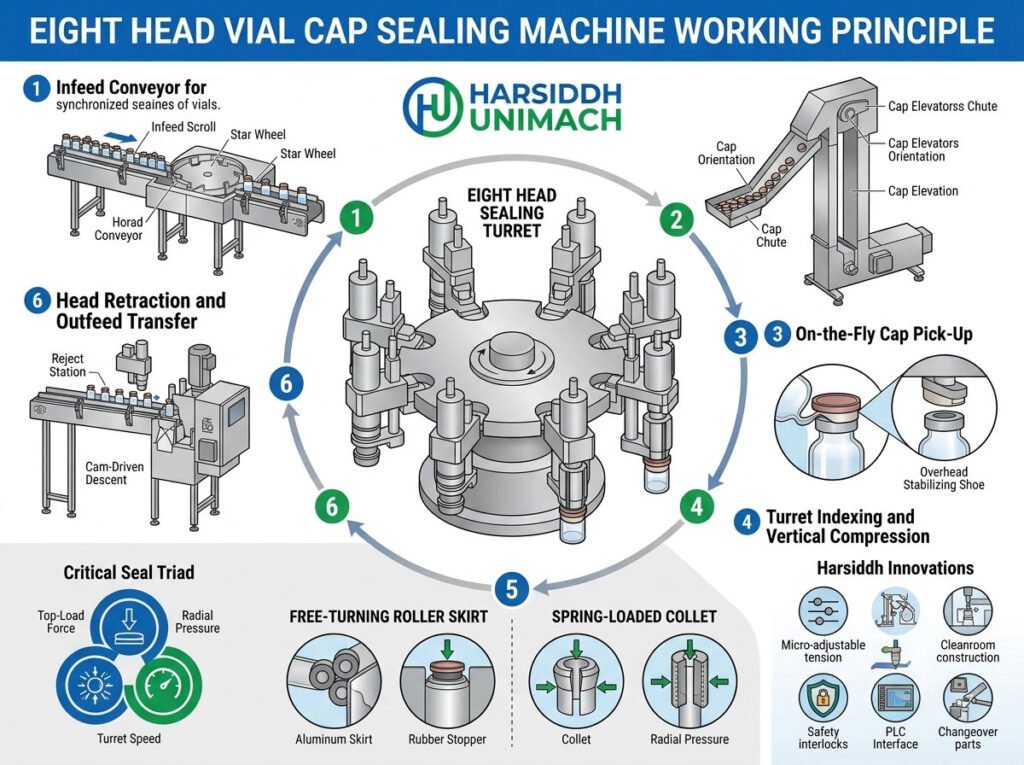
In high-speed sterile packaging, liquid dosing is only half the battle. Securing parenteral vials with an airtight, tamper-evident seal is what maintains product integrity, prevents cross-contamination, and ensures compliance with global cGMP, FDA, and ISO 13485 standards. Among continuous-motion capping systems, the Eight Head Vial Cap Sealing Machine stands out as an industry workhorse for high-capacity pharmaceutical manufacturing.
Engineering an eight-head rotary sealing system requires managing synchronized fluid dynamics, mechanical cam movements, precise torque control, and container transport. At Harsiddh Unimach Pvt. Ltd., we have designed and built cGMP-compliant pharmaceutical packaging equipment for over three decades.
This detailed guide breaks down the working principle, operational mechanics, station-by-station process, key technical innovations, and maintenance protocols of the Eight Head Automatic Vial Cap Sealing Machine.
1. What Is an Eight Head Vial Cap Sealing Machine?
An Eight Head Vial Cap Sealing Machine is an automated, high-speed rotary packaging unit designed to apply, position, and crimp aluminum or flip-off seals onto glass vials.
                                [ EIGHT HEAD SEALING TURRET ]
                                             │
      ┌──────────────────────────────────────┴──────────────────────────────────────┐
      ▼                                                                             ▼
[ 8 Independent Sealing Spindles ]                                    [ Continuous Rotary Motion ]
      │                                                                             │
      ▼                                                                             ▼
[ Uniform Crimping Pressure ]                                         [ High Throughput Operations ]
 (Up to 240–400 Vials/Min)                                             (Zero Vial Breakage)
By deploying eight independent, synchronized sealing spindles mounted on a central rotating turret, the machine executes continuous-motion capping rather than intermittent start-stop motion. This continuous rotary operation enables processing speeds up to 240 to 400 vials per minute (depending on vial neck size and cap diameter) without compromising crimping quality or risking vial breakage.
Essential Components
- Infeed & Outfeed Star Wheels: Synchronized star wheels feed stoppered vials into the rotary sealing turret and transfer sealed vials out smoothly.
- Vibratory Cap Elevator & Chute: Sorts, aligns, and feeds flip-off or tear-off aluminum caps oriented correctly to the pick-up station.
- Eight-Head Rotary Turret: Houses eight spring-loaded or pneumatically assisted sealing heads equipped with precision crimping rollers.
- Positive Cam Track Mechanism: Controls the vertical descent, crimping engagement, and lift-off of the eight heads as the turret rotates 360°.
- Variable Frequency Drive (VFD) & PLC Control: Manages line synchronization, turret speed, and safety interlocks via an HMI touchscreen interface.
2. The Complete Process: Step-by-Step Mechanical Operation
To understand how an eight-head rotary vial capper achieves speed and seal consistency, let’s trace a single glass vial through the complete 360° sealing lifecycle.
 [ Infeed Conveyor & Scroll ] ──► [ Infeed Star Wheel ] ──► [ Cap Pick-Up Station ]
                                                                    │
                                                                    ▼
 [ Outfeed Discharge ] ◄── [ Outfeed Star Wheel ] ◄── [ 8-Head Sealing Turret ]
Step 1: Infeed Transport and Pitch Separation
Filled and stoppered glass vials arrive on the slat conveyor from the freeze-drying (lyophilization) unloader or liquid filling station.
- An infeed feed worm (infeed scroll) engages the incoming vials.
- The variable-pitch scroll separates the tightly packed vials, spacing them to match the entry pitch of the infeed star wheel.
- The infeed star wheel receives the vials and transfers them onto the central rotating turret platform.
Step 2: Cap Orientation and Delivery
Concurrently, aluminum flip-off caps are sorted in a stainless steel vibratory bowl feeder or rotary elevator.
- The feeder aligns caps open-side-down and transfers them into an inclined delivery chute.
- An optical sensor monitors cap supply levels in the chute, automatically signaling the bowl feeder to pause if a back-up occurs.
- At the base of the chute, individual caps rest at a precision gate mechanism waiting for incoming vials.
Step 3: “On-the-Fly” Cap Pick-Up
Unlike stationary systems that place caps using mechanical pick-and-place arms, the eight-head capper uses an “on-the-fly” pick-up system.
- As a stoppered vial moves past the bottom of the cap chute, the lip of the rubber stopper physically catches the leading edge of the cap.
- The vial pulls the cap out of the chute pocket while an overhead stabilizing shoe immediately presses down on the cap, seating it squarely over the vial neck before entering the sealing turret.
Safety Interlock Note: If an optical proximity sensor detects a missing vial at the infeed, the cap release gate stays closed—preventing cap waste and line jamming.
Step 4: Turret Indexing and Vertical Compression
As the vial enters the eight-head sealing turret:
- Platform Alignment: The vial settles onto a spring-loaded bottom pedestal or rotating platform aligned directly beneath one of the eight sealing heads.
- Cam-Driven Descent: A precision-machined upper cam track forces the sealing head downward over the top of the vial cap.
- Rubber Stopper Compression: Before the crimping rollers touch the aluminum skirt, a central pressure pad presses the cap down onto the rubber stopper. This top-load pressure compresses the elastomeric stopper face against the glass crown, establishing a tight seal.
Step 5: Rotary Skirt Crimping Mechanism
Once top compression is established, the actual seal crimping begins. Depending on machine configuration, two primary mechanics are used:
                          [ TOP-LOAD PRESSURE PAD ]
                                    │
                         Compresses Stopper Face
                                    │
                                    ▼
       ┌────────────────────────────┴────────────────────────────┐
       ▼                                                         ▼
[ FREE-TURNING ROLLER SKIRT ]                           [ SPRING-LOADED COLLET ]
* 3 or 4 carbide rollers engage                         * Uniform radial collapse
* Rotates around aluminum skirt                         * Ideal for dark-room/cleanroom
* Spins edge tightly under crown                          zero-particulate lines
- Free-Turning Roller System (3-Roller or 4-Roller): Three or four hardened stainless steel or tungsten carbide rollers move radially inward toward the spinning cap. As the head rotates, the rollers spin around the aluminum skirt, gently rolling the bottom edge inward underneath the glass vial neck crown.
- Spring-Loaded Collet System: A specialized collet snaps over the neck, applying uniform 360° radial pressure to crimp the aluminum skirt neatly beneath the glass ridge.
Step 6: Head Retraction and Outfeed Transfer
- Cam Lift-Off: As the turret completes its 360° rotation cycle, the upper cam track guides the sealing head upward, releasing top compression.
- Outfeed Star Wheel: The fully sealed vial is guided out of the turret pocket by the outfeed star wheel onto the exit conveyor.
- Rejection Station (Optional Integration): An inline camera or sensor checks for missing caps, damaged flip-off tops, or high-stopper defects. Defective units are automatically diverted into a reject tray via a high-speed pneumatic pusher.
3. Key Technical Comparison: Free-Spinning Rollers vs. Spring-Loaded Collets
| Feature / Parameter | Free-Spinning Roller Mechanism | Spring-Loaded Collet System |
| Sealing Force Application | Progressive point contact via 3 or 4 spinning rollers | Direct 360° simultaneous radial compression |
| Particle Generation | Low (if micro-polished rollers are used) | Extremely Low (minimal friction rub) |
| Vial Tolerances Flexibility | Excellent (handles variations in glass thickness easily) | Moderate (requires uniform glass dimensions) |
| Cosmetic Seal Appearance | Smooth, polished skirt edge | Clean, uniform crimp lines |
| Ideal Application | Standard liquid injectables, antibiotics, large SVPs | Highly sterile biologics, lyophilized products |
4. Critical Parameters for High-Precision Vial Sealing
To achieve consistent seal integrity and comply with Container Closure Integrity Testing (CCIT) standards, three operational parameters must be calibrated:
                            ┌─────────────────────────┐
                            │  CRITICAL SEAL TRIAD    │
                            └────────────┬────────────┘
                                         │
               ┌─────────────────────────┼─────────────────────────┐
               ▼                         ▼                         ▼
      [ Top-Load Force ]          [ Radial Pressure ]       [ Turret Speed ]
      (Stopper Deflection)         (Crimping Smoothness)     (Dwell Time)
- Top-Load Compression Force: The vertical downward force applied to the stopper during sealing. Insufficient top load leaves gaps between the stopper and glass rim, compromising container closure integrity. Excessive force can crack fragile borosilicate glass necks.
- Radial Crimping Pressure: The inward force applied by the rollers or collet. Correct adjustment forms a tight, wrinkle-free tuck underneath the glass crown without flaking the aluminum anodized coating.
- Turret Rotation Speed & Dwell Time: The time the crimping rollers spend in contact with the cap skirt. Servo-controlled turrets ensure optimal dwell time even during machine acceleration or deceleration.
5. Engineering Innovations by Harsiddh Unimach Pvt. Ltd.
At Harsiddh Unimach Pvt. Ltd., our eight-head automatic vial cap sealing machinery is built for high-speed, pharmaceutical cleanroom operations.
[ Infeed Scroll ] ──► [ Star Wheel ] ──► [ Cap Pick-Up ] ──► [ 8-Head Turret ] ──► [ CCIT Rejection ] ──► [ Outfeed Line ]
Key Technical Innovations
- Independent Spring-Tension Adjustment: Each of the eight sealing heads features micro-adjustable compression springs, allowing operators to calibrate individual head pressure for uniform sealing across all stations.
- cGMP Cleanroom Compliant Construction: Stainless steel 316L for all product contact parts and SS 304 main frames, designed with sloped surfaces to prevent particle accumulation.
- Integrated Safety Interlocks: “No Vial – No Cap” and “No Cap – Machine Stop” sensors prevent unsealed vials from moving down the line and eliminate cap waste.
- Variable Speed Control via Touchscreen HMI: Real-time diagnostics, production counter, fault logging, and speed adjustment via a central PLC touchscreen panel.
- Tool-Less Changeover Parts: Color-coded star wheels, feed scrolls, and guide tracks enable quick size changes between 2 ml to 100 ml vial formats, reducing batch downtime.
6. Maintenance & Troubleshooting Guide for Eight-Head Cappers
| Issue / Symptom | Possible Root Cause | Recommended Corrective Action |
| Loose Caps / Unsealed Skirts | Low top-load force or worn crimping rollers | Adjust upper cam pressure; inspect rollers for wear and replace if necessary |
| Wrinkled or Torn Aluminum Skirts | Excessive radial pressure on crimping arms | Back off roller tension setting; check cap quality for consistent aluminum gauge |
| Vial Neck Breakage at Turret | Incorrect height adjustment on upper cam track | Recalibrate head clearance for glass height tolerances |
| Cap Jamming at Entry Chute | Misaligned chute gates or static buildup | Re-align chute rails; install anti-static ionizer bars near cap bowl |
| Particulate Dust Near Turret | Friction from metal-on-metal roller contact | Upgrade to micro-polished tungsten carbide rollers or collet capping heads |
Frequently Asked Questions (FAQ)
What output speed can an Eight Head Vial Cap Sealing Machine achieve?
An eight-head continuous-motion rotary vial sealer typically reaches speeds between 200 and 400 vials per minute, depending on vial dimensions, fluid viscosity, and line synchronization settings.
What is the difference between a capping machine and a sealing machine?
A capping machine places threaded or press-fit closures onto bottles, whereas a vial sealing machine applies aluminum or flip-off caps and mechanically crimps the aluminum skirt beneath the neck ring of glass vials to form a hermetic seal.
Can an eight-head sealing unit process both liquid and lyophilized vials?
Yes. Modern eight-head sealers from Harsiddh Unimach handle both standard liquid injectables and full/half-stoppered lyophilized (freeze-dried) vials. Precise top-load settings prevent displacement of half-stoppered cakes prior to crimping.
Upgrade Your Sterile Packaging Line with Harsiddh Unimach
Selecting an Eight Head Automatic Vial Cap Sealing Machine is an investment in product safety, regulatory compliance, and high-volume production output. With custom-engineered head mechanics, cGMP compliance, and easy-changeover tooling, Harsiddh Unimach Pvt. Ltd. delivers reliable sealing technology for parenteral manufacturing facilities worldwide.
Explore our full range of vial washing, filling, stoppering, and cap sealing machinery at www.harsiddhunimach.com.
- Website: www.harsiddhunimach.com
- Direct Email Inquiry: info@harsiddhunimach.com
- Specialization: Automatic Vial Cap Sealing Machines, Liquid Vial Filling & Stoppering Lines, Ampoule Processing Equipment, and Turnkey cGMP Packaging Solutions.