
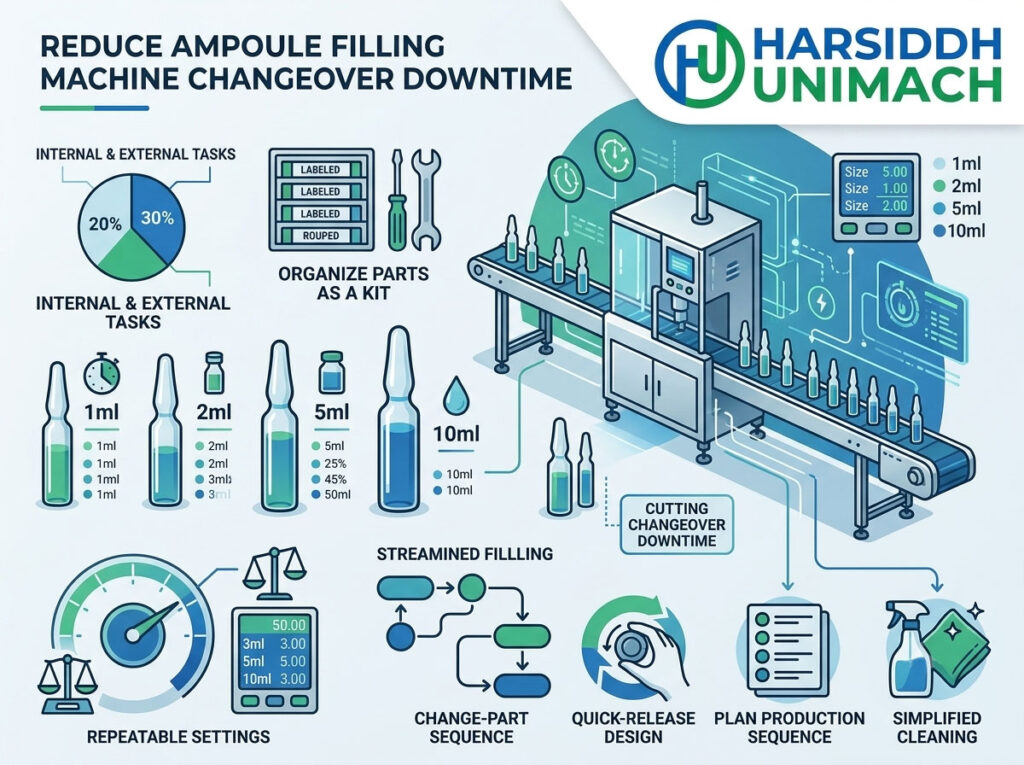
A plant that runs 1 ml, 2 ml, 5 ml and 10 ml ampoules on the same line rarely loses time to slow filling. It loses time to ampoule filling machine changeover: the hours spent swapping parts, resetting needles, retuning flames and proving the first good unit. On a busy injectable schedule, each of those hours is lost output.
At Harsiddh Unimach Pvt. Ltd., we design our ampoule filling and sealing machines so that size changes are structured, repeatable and quick. This guide covers what changes between ampoule sizes, where the time goes, and how to cut it without compromising quality or GMP compliance.
Why Ampoule Changeover Costs More Than You Think
Every minute spent on changeover is a minute of zero output. But the cost goes beyond the clock:
- Lost capacity. Frequent changeovers on a small-batch schedule can consume a large share of the shift.
- Rejects. A poorly fitted change part or a badly tuned flame produces cracked, deformed or unevenly sealed ampoules.
- Extra product waste. Every recalibration burns through expensive liquid that never reaches a patient.
- Compliance risk. A rushed, undocumented changeover invites line-clearance errors and mix-ups.
The goal is a faster, controlled and repeatable changeover, not simply a hurried one.
What Actually Changes When You Switch Ampoule Size
Switching between ampoule sizes touches more of the machine than most teams expect. On a typical ampoule filling and sealing line, the items usually affected are:
| Machine area | What may need to change |
|---|---|
| Feeding and infeed | Feeding track, hopper guides, star wheel |
| Transport | Ampoule rack or carrier, guide rails |
| Filling station | Dosing syringes or pumps, filling needles (length and diameter), needle height |
| Gas flushing | Pre- and post-filling nitrogen needles and their position |
| Sealing station | Burner height, flame settings, pre-heating unit for thicker glass, ampoule rotation and draw-off alignment |
| Output | Discharge cassette or magazine |
Depending on the model, Harsiddh Unimach machines run ampoules from roughly 1 ml to 10 ml, with some models reaching 25 ml. Format parts such as the star wheel and ampoule rack give a snug fit for each diameter. Knowing this list is the first step, because a changeover you can list is a changeover you can standardise.
Where the Time Really Goes
When teams time a changeover, the mechanical swap is often the smaller part. The bigger losses are usually:
- Searching for parts or tools. Missing, misplaced or unlabelled change parts.
- Trial-and-error adjustment. Needle height, rail width and flame position set by eye rather than by known values.
- Dosing recalibration. Priming, purging and checking fill volume repeatedly.
- Cleaning and line clearance. Waiting for cleaning sign-off before anything can start.
- First-off approval. Running and inspecting units until everyone is confident.
Once you know which category dominates on your line, you know where to focus.
7 Proven Ways to Reduce Ampoule Changeover Downtime
1. Apply SMED (Single-Minute Exchange of Die) thinking
SMED separates changeover tasks into two groups:
- Internal tasks can only be done while the machine is stopped, such as removing the star wheel or swapping needles.
- External tasks can be done while the machine is still running the previous batch, such as fetching and inspecting the next set of parts, pre-cleaning them, and preparing documentation.
Moving as many tasks as possible from internal to external is often the single biggest gain. The machine stops later and restarts sooner.
2. Organise change parts as a kit
Make one labelled, size-specific kit per ampoule format. Each kit holds the star wheel, rack, needles, syringes, guides and gas needles for that size. Store kits on a shadow board or a dedicated trolley, mark parts with the ampoule size, and keep a photo checklist with each kit. Kits that are cleaned, inspected and staged before the changeover begins remove the “search and fix” phase entirely.
3. Choose quick-release and tool-light design
Every fastener that needs a spanner adds seconds, and every extra tool adds a chance of loss or contamination. Prefer knurled knobs, quick-release clamps, locating pins and keyed parts that cannot be fitted wrongly. When evaluating a machine, ask how many tools a full size change needs. A design that positions parts by locating features rather than by feel is safer as well as faster.
4. Make settings repeatable, not guessed
Trial and error is the biggest hidden time sink. Replace it with:
- Scales, index marks or counters on adjustable items such as needle height and rail width.
- Recorded setpoints for each ampoule size, kept on a controlled sheet at the machine.
- PLC recipes that store speed, fill volume and other parameters per product or format, so operators recall proven settings instead of re-entering them.
A machine with a touchscreen HMI and recipe storage turns a sensitive adjustment into a recall-and-confirm step.
5. Plan the production sequence
Not every changeover is equal. Moving from a 2 ml to a 5 ml ampoule may need new format parts, while moving between two products in the same ampoule size may only need a dosing change and cleaning. Sequence your schedule to reduce the heavy changes:
- Group batches by ampoule size, so format parts change less often.
- When sizes must change, step progressively (small to large, or the reverse) rather than jumping back and forth.
- Where volume changes but the ampoule stays the same, adjust the dosing stroke instead of swapping the whole set.
A schedule that respects the machine can save more time than any hardware tweak.
6. Simplify cleaning and line clearance
Cleaning and line clearance are mandatory, so make them efficient rather than skipping them:
- Design the product path with SS 316L contact parts, smooth surfaces and few crevices for faster, more reliable cleaning.
- Prepare a written, step-by-step cleaning and line-clearance sequence and follow it every time.
- Have a second operator clean and inspect the next kit offline while the machine is still running.
Faster cleaning comes from better design and better preparation, not shorter cleaning.
7. Standardise the procedure and train the team
The best hardware fails if each shift changes over differently. Write one standard operating procedure, ideally with photographs, and train every operator on it. Two-person changeovers with clearly split tasks, one on mechanical items and one on dosing and documentation, are usually faster than one person working through a long sequence. Review the SOP after every few changeovers and update it with what the team learns.
A Sample Ampoule Size Changeover Sequence
The exact steps depend on your machine and your SOP, but a well-organised sequence generally looks like this:
- Before stopping: stage the next kit, printed checklist, gloves and cleaned parts; confirm the next batch record.
- Stop and clear: complete the previous batch, clear ampoules and product, and perform line clearance.
- Remove old parts: take out the feeding parts, star wheel, rack, needles and gas needles.
- Fit new parts: install the next size kit, using locating pins and index marks.
- Set the filling station: fit syringes or pumps, set needle height and stroke, and prime.
- Set the sealing station: set burner height and flame, and confirm pre-heating for thicker glass.
- Dry run: run empty or with test ampoules to check transport and alignment.
- First-off check: verify fill volume, seal quality, and gas flushing before releasing production.
- Document: complete the changeover record and get sign-off.
Each step becomes faster once it is written down, assigned and timed.
Protecting Quality and GMP Compliance During Faster Changeovers
Speed never justifies a shortcut. A faster changeover should be a more controlled changeover:
- Documented procedures and records for every change, so the process is traceable.
- Verified first-off checks on fill accuracy, seal integrity and gas flushing.
- Sensor protection such as “No Ampoule, No Filling” logic, which prevents dosing into an empty position if something is misaligned during restart.
- Validated parameters. Format changes and recipes should be covered by your validation approach so that stored settings are trusted settings.
If you want to see how compliance shapes machine design, read our article on the importance of GMP compliance in pharmaceutical machinery.
How to Track Changeover Performance
You cannot improve what you do not measure. Define changeover time clearly: from the last good ampoule of one batch to the first good ampoule of the next. Then record:
- Total changeover time and the time for each step.
- Which steps ran while the machine was stopped and which could have run earlier.
- Rejects and product waste during start-up.
- Repeat problems, such as the same part being missing or the same setting needing rework.
Review the numbers monthly, pick the biggest loss, fix it, and measure again. Even modest, steady improvements add up across a year of production.
Choosing an Ampoule Filling Machine Built for Quick Changeovers
If changeover time is a priority, evaluate machines with these questions:
- How many change parts does each ampoule size need, and are they clearly identified?
- Are adjustments tool-light, with scales or indexing to repeat settings?
- Does the control system offer recipe storage and an intuitive HMI?
- What ampoule size range does the model cover without heavy modification?
- How easy is access for cleaning and inspection?
Harsiddh Unimach offers models from compact 2-head machines for pilot and small batches through 4-head, 6-head and 8-head high-speed machines. Browse the full ampoule filling machine category to compare outputs. For thin-walled or specialised containers, see our automatic crushable ampoule filling and sealing machine, which is designed for gentle handling and quick batch changes. If you are still deciding on capacity, our guide on choosing the right ampoule filling machine and our overview of how an ampoule filling machine works will help.
Think About the Whole Line, Not Just the Filler
A fast filler still waits if the equipment around it is slow to change. Check upstream and downstream:
- Washing: an ampoule or vial washer that changes formats quickly keeps the filler fed. See our washing machine range and the guide to selecting the right pharmaceutical washing machine.
- Labeling: ampoules need stable handling. Our automatic horizontal ampoule sticker labeling machine lays ampoules on rollers for steady, accurate labeling.
- Inspection: online checks catch defects early. Explore our visual inspection machines.
- Vial lines: if you also run vials, see our vial filling machines and injectable liquid vial filling line.
Aligning changeover plans across the whole line means the entire line changes over together, not one machine at a time.
Frequently Asked Questions
How long should an ampoule filling machine changeover take?
There is no single figure. It depends on the machine, the size difference, cleaning requirements and how prepared the team is. A better target is to measure your current time, find the biggest losses and reduce them step by step.
Which parts usually change between ampoule sizes?
Commonly the star wheel, ampoule rack or carrier, guide rails, filling and gas needles, dosing syringes or pumps, and burner and flame settings. The exact list depends on your machine model.
Can one machine handle several ampoule sizes?
Yes. Harsiddh Unimach ampoule filling and sealing machines cover a range of sizes using change parts, typically 1 ml to 10 ml, with some models extending further.
Does a faster changeover affect GMP compliance?
It should not. Faster should come from better preparation, standard procedures and smarter design, while cleaning, line clearance, first-off checks and documentation stay in place.
Conclusion
Reducing ampoule filling machine changeover time is mostly about preparation, standardisation and design. Separate internal and external tasks, build labelled change-part kits, use repeatable settings and recipes, sequence batches sensibly, and write and train one clear procedure. Choose equipment that supports quick, repeatable size changes from the start.
Harsiddh Unimach Pvt. Ltd. builds ampoule filling and sealing machines, washing, labeling and inspection equipment for pharmaceutical manufacturers. To discuss your ampoule sizes, output targets and changeover goals, visit www.harsiddhunimach.com or email info@harsiddhunimach.com for a technical proposal.
Related reading: