
For pharmaceutical manufacturers, especially those handling high-value biologics, monoclonal antibodies, and specialty injectables, every fraction of a milliliter lost on the filling line has a direct cost. Unlike oral solid dosage manufacturing, where raw material costs are comparatively low, injectable formulations can run into thousands of dollars per liter. At high filling speeds — often 150 to 240 vials per minute on modern lines — even a marginal loss rate compounds into a significant financial and yield problem over a production shift.
Product loss during injectable vial filling isn’t usually the result of one dramatic failure. It is almost always the sum of small, mechanical inefficiencies: a slightly misaligned nozzle, an aggressive pump stroke, a longer-than-necessary changeover, or a filling accuracy tolerance that drifts over a run. Understanding where these losses originate — and how to engineer them out — is essential for any facility trying to protect margins without compromising sterility or compliance.
As a manufacturer of cGMP-compliant injectable liquid vial filling lines, Harsiddh Unimach Pvt. Ltd. has spent years refining the mechanical details that separate a high-yield line from one that quietly bleeds product with every cycle. This guide breaks down where product loss actually happens on an injectable vial filling line, and the engineering controls that minimize it at commercial speed.
Where Product Loss Actually Happens on a Filling Line
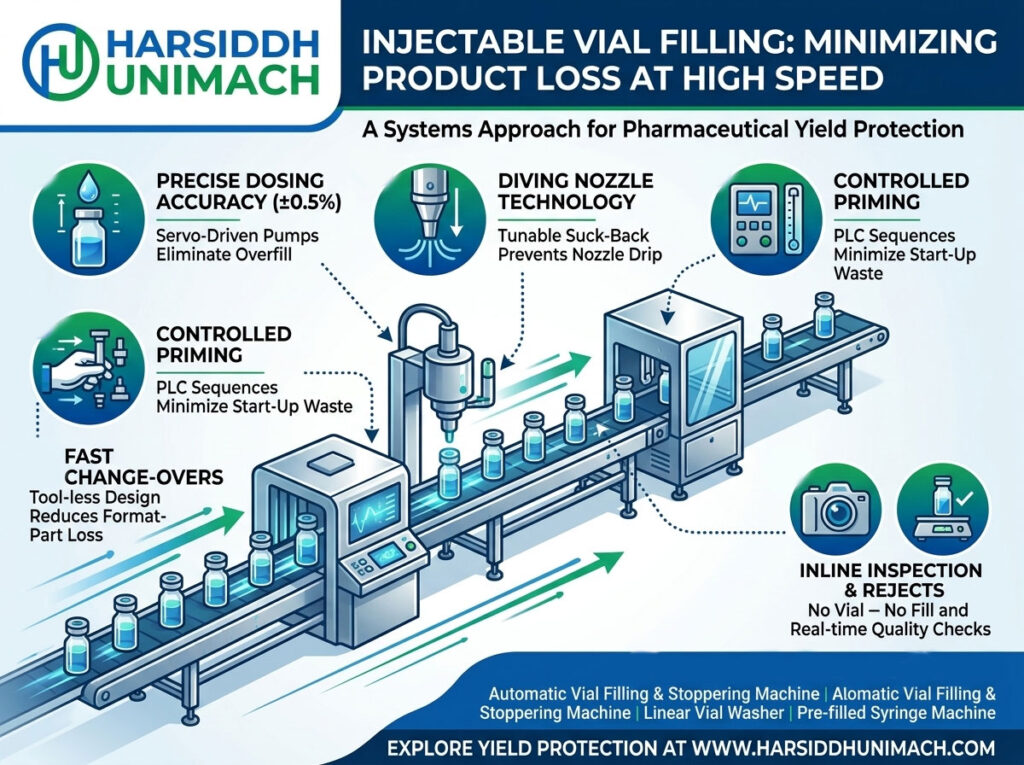
Before addressing solutions, it helps to map out exactly where injectable product is lost during a typical filling run. Loss generally falls into five categories:
- Dosing overfill and underfill variance — compensating for inconsistent pump accuracy by deliberately overfilling to stay within regulatory tolerance.
- Nozzle drip and residual hang-up — droplets that cling to the nozzle tip or vial neck instead of landing inside the container.
- Line priming and start-up loss — product used to prime pumps and tubing before a run reaches target accuracy.
- Changeover and format-part loss — residual product left in bowls, hoppers, and tubing during a product or batch switch.
- Rejected vials from filling defects — vials pulled from the line due to underweight, overweight, or contamination, each carrying a full dose of wasted formulation.
Each of these categories responds to different engineering interventions, and a facility serious about minimizing loss needs to address all five rather than focusing on just one.
1. Dosing Accuracy: The Root of Most Overfill Losses
The single largest contributor to product loss on most injectable lines is dosing variance. When a pump system can’t hold tight repeatability across a shift, operators are forced to set the target fill volume higher than the labeled dose simply to guarantee every vial passes the lower specification limit. That “safety margin” is pure product loss, multiplied across every vial filled that day.
The mechanical fix: High-precision volumetric pump systems — whether reciprocating piston pumps in AISI 316L stainless steel or ceramic, or servo-driven peristaltic pumps — hold dosing accuracy within ±0.5% when properly maintained and calibrated. At this level of repeatability, the required overfill margin shrinks dramatically, which on a high-value injectable can translate into meaningful savings over a single production run.
Servo-driven peristaltic pumps are particularly effective for shear-sensitive biologics, since they avoid the piston-to-cylinder contact that can stress delicate protein structures, while still holding tight volumetric control. Piston syringe pumps, by contrast, tend to suit lower-viscosity, non-shear-sensitive injectables where mechanical simplicity and long-term seal durability matter more.
Choosing the correct pump technology for a specific formulation — rather than defaulting to a single pump type across every product — is one of the most effective yield-protection decisions a facility can make early in the line specification process.
2. Diving Nozzle Design and the Drip Problem
Nozzle drip is a quieter but persistent source of loss. Every droplet that clings to a nozzle tip after the dispense stroke, or drips onto the vial neck instead of falling inside, represents lost product and — just as importantly — a contamination risk that can cause stopper seating failures downstream.
The mechanical fix: Diving nozzle assemblies that lower into the vial neck and dispense in a bottom-up sequence, retracting as the liquid rises, dramatically reduce splash-back and neck contact. Combined with a properly tuned “suck-back” or reverse-stroke function on the pump, the nozzle draws back a small, controlled volume at the end of each stroke to snap off the meniscus cleanly at the tip rather than letting it drip.
For high-viscosity or foam-prone injectables, nozzle geometry matters as much as the suck-back setting — a wider bore with a slower approach speed reduces foaming, while a narrower nozzle with a faster retraction rate suits thin, low-viscosity solutions. Getting this pairing wrong is a common, avoidable source of both product loss and cosmetic rejects.
3. Reducing Start-Up and Priming Loss
Every filling run begins with a priming sequence — product is pushed through the pump, manifold, and nozzle to purge air and stabilize flow before the line reaches target accuracy. On manually tuned lines, this priming volume is often generously overestimated “to be safe,” and that entire volume is discarded before the first saleable vial is filled.
The mechanical fix: PLC-controlled fill sequences with pre-programmed priming volumes, combined with in-line flow sensors that confirm stable dosing before the line begins counting production vials, reduce this waste to the minimum genuinely required. Touchscreen HMI controls that store validated recipes per product — rather than requiring operators to manually re-tune priming volumes each changeover — also reduce the tendency to over-prime “just in case,” which is a common but costly habit on manually operated lines.
4. Engineering Faster, Lower-Loss Changeovers
Changeovers are one of the most overlooked sources of product loss. Every time a line switches from one vial size, format, or product to another, residual formulation remains trapped in gassing manifolds, filling tubing, stopper bowls, and pump heads. On facilities running multiple SKUs through the same line, this loss recurs multiple times per week.
The mechanical fix: Tool-less changeover systems with quick-release format parts reduce both the time and the residual product volume left behind during a changeover, since fewer disassembly steps mean less product sits in disconnected tubing for longer. Where facilities run frequent product switches, dedicated single-use or easily sanitized product-contact pathways (particularly for high-value biologics) can further cut cross-batch loss to near zero.
We’ve covered changeover engineering in more depth in our dedicated post on vial filling machine changeover best practices, which walks through SMED-based methods for reducing both downtime and residual product loss during format switches.
5. Reducing Rejected-Vial Loss Through Inline Inspection
Every vial pulled from the line for underweight, overweight, particulate contamination, or stopper defects represents a full dose of lost product — not just a rejected container. On a high-speed line filling an expensive biologic, a reject rate that seems statistically small can still represent a meaningful revenue loss over a production run.
The mechanical fix: Inline check-weighing and camera-based inspection systems catch dosing drift and cosmetic defects in real time, allowing the line to be corrected mid-run rather than after an entire batch has been filled outside tolerance. A “No Vial – No Fill” sensor check — which confirms a vial is correctly present and upright before the pump fires — also prevents wasted dispense cycles into missing, tipped, or misaligned containers, a small but real source of avoidable loss on high-speed lines.
Catching drift early, rather than discovering it during end-of-batch quality review, is what separates a facility with a controlled reject rate from one that discovers yield problems only after the product is already lost.
Bringing It Together: A Systems Approach to Yield Protection
None of these five sources of loss exist in isolation — a facility that only upgrades its pumps but ignores nozzle tuning, or that improves nozzle design but still runs manual, untimed changeovers, will only capture part of the available yield improvement. Protecting product on a high-speed injectable line requires treating dosing accuracy, nozzle mechanics, priming control, changeover engineering, and inline inspection as one connected system rather than five separate problems.
At Harsiddh Unimach Pvt. Ltd., our vial filling machines and dedicated automatic injectable liquid vial filling and stoppering machine are engineered around exactly this systems view — combining servo-driven dosing accuracy within ±0.5%, diving nozzle assemblies with tunable suck-back control, PLC-managed priming sequences, tool-less format changeovers, and integrated “No Vial – No Fill” protection in a single line.
For facilities also filling pre-filled syringes or ophthalmic formulations alongside vials, the same yield-protection principles apply on our automatic pre-filled syringe (PFS) filling and stoppering machine and automatic eye and ear drop filling machine, both of which use the same precision dosing philosophy adapted to their respective container formats.
Upstream cleanliness also plays a role in yield protection that’s easy to overlook: vials entering the filling line with residual particulate or moisture can cause dosing sensor errors and false rejects, adding to apparent — though avoidable — product loss. Our washing machines, including the automatic linear vial washer, are designed to feed consistently clean, dry vials into the filling line, reducing false rejects caused by upstream contamination rather than actual dosing error.
If you’re mapping out how filling stations interact across a complete line — from infeed to outfeed — our detailed breakdown in Vial Filling Machine Diagram: Understanding Every Station in the Filling Line is a useful companion resource, showing exactly where in the process each of the loss points discussed above actually occurs mechanically.
Final Thoughts
Minimizing product loss on an injectable vial filling line isn’t about a single upgrade — it’s about closing the small mechanical gaps that, individually, seem insignificant but compound into real cost at high-speed volumes. Dosing accuracy, nozzle engineering, controlled priming, efficient changeovers, and inline inspection each play a distinct role, and a well-engineered line addresses all five together.
Harsiddh Unimach Pvt. Ltd. designs and manufactures cGMP-compliant injectable vial filling lines built specifically around this yield-protection philosophy, backed by full Factory Acceptance Testing (FAT) and Design/Installation/Operational Qualification (DQ/IQ/OQ) documentation to support regulatory approval.
To discuss how a custom-engineered vial filling line can reduce product loss for your specific formulation, reach out to our technical team at info@harsiddhunimach.com or explore our full equipment range at www.harsiddhunimach.com.