
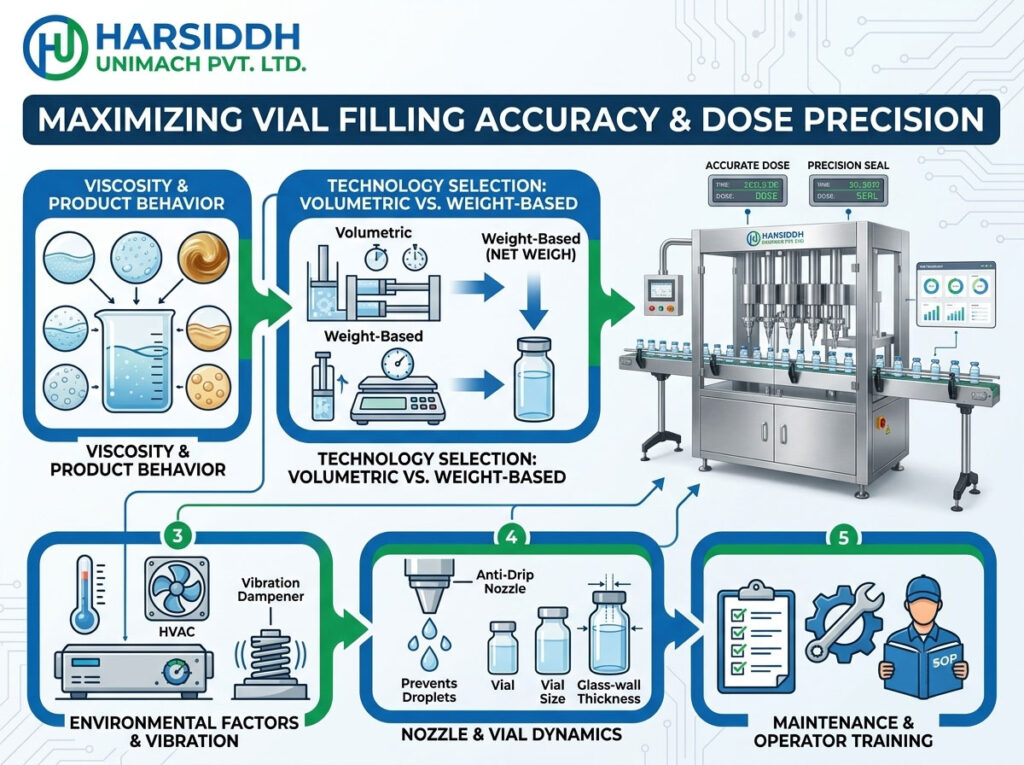
In pharmaceutical manufacturing, a single milliliter can be the difference between a therapeutic dose and a regulatory recall. Fill accuracy isn’t a nice-to-have on a vial filling line — it’s the single metric that determines whether a batch is compliant, profitable, and safe for the patient who eventually receives it.
Yet fill accuracy is rarely the result of one setting or one component. It’s the outcome of a dozen interacting variables — from the viscosity of the formulation to the humidity in the cleanroom to the way an operator calibrates a load cell on a Monday morning. Understanding these variables is the first step toward consistently hitting your target dose, batch after batch.
At Harsiddh Unimach Pvt. Ltd., we design and manufacture precision vial filling machines for pharmaceutical and biotech manufacturers, and dose precision is the question we field most often from engineering teams evaluating new equipment. This guide breaks down exactly what affects fill accuracy, how to measure it, and how to control it on your production line.
Why Fill Accuracy Matters More Than Ever
Regulatory bodies like the FDA, EMA, and WHO enforce strict fill-volume tolerances under GMP guidelines, and for good reason. In injectable drug manufacturing, both overfilling and underfilling carry serious consequences:
- Underfilling shortchanges the patient of the labeled dose, which can render a treatment ineffective — a critical risk for vaccines, biologics, and narrow-therapeutic-index drugs.
- Overfilling wastes expensive active pharmaceutical ingredients (APIs), some of which cost more per milliliter than gold, and it can also push a formulation outside its validated stability profile.
- Inconsistent fills across a batch trigger quality holds, rejected lots, and — in the worst cases — product recalls that damage both revenue and reputation.
Because of these stakes, fill accuracy isn’t just an engineering metric. It’s a compliance requirement, a cost-control lever, and a patient-safety issue rolled into one number.
How Fill Accuracy Is Measured
Before diving into what affects accuracy, it helps to understand how it’s quantified. Manufacturers typically track:
- Mean fill volume — the average volume delivered across a sample of vials, which should match the target fill volume as closely as possible.
- Standard deviation (SD) — how much individual fills vary around that mean; lower SD means tighter, more repeatable dosing.
- Coefficient of variation (CV%) — SD expressed as a percentage of the mean, allowing accuracy to be compared across different fill volumes and product lines.
- In-process control (IPC) sampling — periodic weight checks during a run, typically every 15–30 minutes, to catch drift before it affects an entire batch.
A well-tuned vial filling machine should hold a CV% well under 1% for most injectable products, though the acceptable tolerance ultimately depends on the drug’s therapeutic index and your regulatory filing.
The Core Factors That Affect Fill Accuracy
1. Filling Technology: Volumetric vs. Weight-Based
The underlying filling principle is the single biggest determinant of achievable accuracy.
- Volumetric filling (piston, peristaltic, or time-pressure systems) dispenses a fixed physical volume. It’s fast and cost-effective, but because it measures space rather than mass, it’s vulnerable to any factor that changes the fluid’s density — including temperature and viscosity shifts.
- Weight-based (net weigh) filling uses load cells to dispense to a target mass in real time, correcting for density variation as it fills. This is why net weigh systems are the standard for high-value biologics, vaccines, and narrow-tolerance injectables.
If your product’s density is highly stable and your run speed is the priority, volumetric filling may be sufficient. If precision is non-negotiable — which it usually is in injectable manufacturing — weight-based filling delivers materially tighter tolerances.
2. Product Viscosity and Rheology
Viscosity has an outsized effect on fill accuracy, particularly for volumetric systems. Thin, water-like solutions flow predictably and fill cleanly. But many injectable formulations — suspensions, oil-based solutions, or high-concentration biologics — behave very differently:
- High-viscosity fluids flow more slowly through nozzles and tubing, which can cause under-delivery if fill timing isn’t recalibrated for the specific formulation.
- Non-Newtonian fluids (those whose viscosity changes under shear, like some protein formulations) can behave inconsistently at different pump speeds, leading to fill variability across a batch.
- Foaming and aeration in viscous or protein-rich fluids introduce air into the fill line, which volumetric systems interpret as product volume — causing systematic underfilling that’s easy to miss until a batch is weighed.
Matching your pump type (piston vs. peristaltic vs. rotary lobe) and nozzle design to your specific fluid’s rheology is essential groundwork before you even look at machine calibration.
3. Temperature Fluctuations
Liquids expand and contract with temperature, and this single variable is responsible for more volumetric fill deviations than almost any other factor.
- A formulation filled at 25°C will occupy a different volume than the same mass filled at 15°C or 35°C.
- Cleanroom HVAC cycling, seasonal ambient shifts, and even the heat generated by the filling machine’s own motors over a long production run can nudge fluid temperature enough to shift fill volumes outside tolerance.
- Products that are temperature-sensitive by formulation (e.g., cold-chain biologics) are especially vulnerable, since any deviation from validated storage temperature during the fill process can affect both volume and product stability.
Weight-based systems are largely immune to this issue since mass doesn’t change with temperature — one of the strongest arguments for net weigh filling in temperature-variable environments.
4. Vial and Container Variability
Even a perfectly calibrated machine can produce inconsistent-looking results if the containers themselves vary:
- Glass wall thickness variation in vials from different lots or suppliers changes the internal volume, which affects the visual fill level even when the weight (and true dose) is identical.
- Neck finish tolerances can affect how consistently a filling needle or nozzle seats above the vial, introducing splash or drip variability.
- Container cleanliness — residual moisture or particulates from washing and depyrogenation — can interfere with load cell readings or introduce measurement noise in vision-based fill checks.
For visual consistency across a batch (important for both quality perception and automated inspection systems), tightly toleranced, validated vial specifications matter as much as the filling machine itself.
5. Nozzle Design and Fill Dynamics
The point where product actually meets container is a frequent, underrated source of fill error:
- Drip and dribble after valve closure adds uncontrolled volume unless the nozzle has proper anti-drip or suck-back design.
- Splashing on high-speed lines can cause product to miss the vial mouth entirely or coat the vial neck, both of which distort fill readings and contaminate the closure area.
- Nozzle diameter and dive depth relative to the vial affect both fill speed and foam generation, particularly with viscous or surfactant-containing formulations.
Advanced nozzle designs — diving nozzles, anti-drip valves, and bottom-up filling for foam-prone liquids — directly reduce the variability introduced at this final, critical step.
6. Load Cell Sensitivity and Environmental Vibration
For weight-based systems, the load cell is the heart of accuracy — and it’s also the most environmentally sensitive component on the line.
- Floor vibration from nearby machinery, forklifts, or even HVAC air handlers can introduce noise into a load cell’s reading, forcing the system to either slow down (to allow settling) or accept a wider tolerance band.
- Load cell drift over time, without regular recalibration, can introduce a systematic bias that isn’t caught until a batch is audited.
- Electrical interference from poorly shielded cabling near sensitive load cell electronics can introduce subtle reading errors that are difficult to diagnose without proper signal filtering.
Isolating filling stations from vibration sources, using vibration-dampening mounts, and maintaining a rigorous load cell calibration schedule are non-negotiable for holding tight CV% over long production runs.
7. Machine Speed and Line Throughput
There’s an inherent tension between speed and accuracy on any filling line:
- Faster cycle times reduce the settling time available for weight-based systems to capture a stable reading, which can force a trade-off between throughput and precision.
- High-speed volumetric systems rely on consistent valve timing at every cycle — even microsecond-level inconsistencies in valve actuation, multiplied across thousands of cycles, add up to measurable batch-level variability.
- Rapid acceleration and deceleration of the container conveyor can introduce splashing or off-center vial positioning under the nozzle.
The right approach isn’t always “slower is better” — it’s matching machine speed to the specific accuracy requirement of your product, with a validated process that proves the chosen speed consistently meets tolerance.
8. Calibration Frequency and Preventive Maintenance
No filling technology stays accurate indefinitely without maintenance discipline:
- Piston and seal wear on volumetric systems gradually changes stroke volume, introducing slow, easy-to-miss drift over weeks or months of use.
- Load cell recalibration should follow a defined schedule (and always after any mechanical adjustment or component swap) to catch and correct drift before it affects product.
- Software and PLC calibration for flow-meter-based systems needs periodic verification against a certified reference standard, since electronic drift can be just as real as mechanical wear.
Manufacturers with the tightest, most defensible fill-accuracy records almost always have the most rigorous calibration logs to match.
9. Operator Technique and SOP Adherence
Even the best-engineered machine depends on consistent human input:
- Inconsistent taring procedures between operators can introduce small but real weight-based errors.
- Manual line clearance and changeover procedures that skip validated steps can leave residual product or incorrect nozzle settings from a previous run.
- Deviations from validated Standard Operating Procedures (SOPs) — even well-intentioned “efficiency” shortcuts — are a common root cause identified in fill-accuracy deviation investigations.
Standardized, well-documented SOPs — paired with regular operator training and requalification — close the gap between what a machine is capable of and what it actually delivers, run after run.
How to Improve Fill Accuracy on Your Line
Bringing these factors together, here’s a practical checklist for tightening dose precision:
- Match your filling technology to your product’s risk profile. High-value, narrow-tolerance injectables generally justify the investment in weight-based (net weigh) filling.
- Characterize your fluid’s rheology before commissioning. Know your viscosity, foaming tendency, and temperature sensitivity, and select pumps and nozzles accordingly.
- Control your environment. Stabilize cleanroom temperature, isolate filling stations from vibration sources, and monitor humidity where it affects product behavior.
- Tighten your container specifications. Work with vial suppliers who can hold consistent wall thickness and neck-finish tolerances.
- Invest in nozzle engineering. Anti-drip valves and application-specific nozzle geometry pay for themselves quickly in reduced product loss and rework.
- Build a real calibration cadence. Load cells, pistons, and flow meters all need scheduled verification — not just reactive fixes after a deviation.
- Document and train relentlessly. SOP adherence is free precision — it costs nothing but discipline, and it closes the gap between a machine’s rated accuracy and its actual output.
The Harsiddh Unimach Approach to Precision Filling
At Harsiddh Unimach Pvt. Ltd., we engineer both volumetric and weight-based vial filling machines built specifically for the accuracy demands of pharmaceutical and biotech manufacturing. Our filling lines feature:
- Premium, vibration-filtered load cell integration for stable, real-time weight-based dosing even in busy production environments.
- Multi-stage fill profiles (bulk-to-dribble transition) that eliminate overshoot and foaming on sensitive formulations.
- Application-specific nozzle design, including anti-drip and diving nozzle options, engineered around your product’s specific viscosity and foaming behavior.
- SS 316L contact parts and sanitary, low-maintenance fluid paths built for consistent, contamination-free performance across long production runs.
- Full data logging and traceability, integrable with your SCADA or ERP systems, so every fill is documented and audit-ready.
We work with our clients from the earliest stages of fluid characterization through to full line validation, because dose precision is never just about the machine — it’s about matching the right technology, environment, and process discipline to your specific product.
Conclusion
Fill accuracy on a vial filling line is never governed by a single variable — it’s the sum of your filling technology, your product’s physical behavior, your environmental controls, your equipment maintenance, and your operational discipline. Manufacturers who treat dose precision as a systems problem, rather than a single machine setting, are the ones who consistently pass audits, minimize product loss, and protect the patients who ultimately depend on that dose being exactly right.
Looking to improve fill accuracy on your production line? Get in touch with the engineering team at Harsiddh Unimach Pvt. Ltd. Visit us at www.harsiddhunimach.com or email us directly at info@harsiddhunimach.com to schedule a technical evaluation of your vial filling process.
Frequently Asked Questions
What is considered good fill accuracy for a vial filling machine? Most injectable products target a coefficient of variation (CV%) below 1%, though the acceptable range depends on the drug’s therapeutic index and regulatory filing requirements.
Is weight-based filling always more accurate than volumetric filling? Generally, yes, for products sensitive to temperature or density variation. However, well-maintained volumetric systems can achieve excellent accuracy for stable, low-viscosity fluids at high speed.
How often should filling equipment be recalibrated? Load cells and flow meters should follow a defined preventive maintenance schedule — typically at set intervals and after any mechanical adjustment — rather than only after a deviation is detected.
Can nozzle design really affect fill accuracy that much? Yes. Drip, splash, and foam introduced at the nozzle are among the most common — and most preventable — sources of fill variability on a production line.
Related machines & categories:
- Vial Filling Machines
- Injectable Liquid Vial Filling Line
- Washing Machine
- Capping Machines
- Inspection Machines
Related blog posts:
- Vial Filling Machine Selection Guide: How to Choose the Right Filling System for Injectable Products
- How to Select the Right Filling Machine for Injectable Manufacturing
- Vial Filling Machine Changeover: Best Practices for Faster Product and Format Changes
- Vial Filling Machine Validation: Key Parameters Manufacturers Should Check Before Production
- Vial Filling Machine Inspection Points: What to Monitor During Pharmaceutical Production