
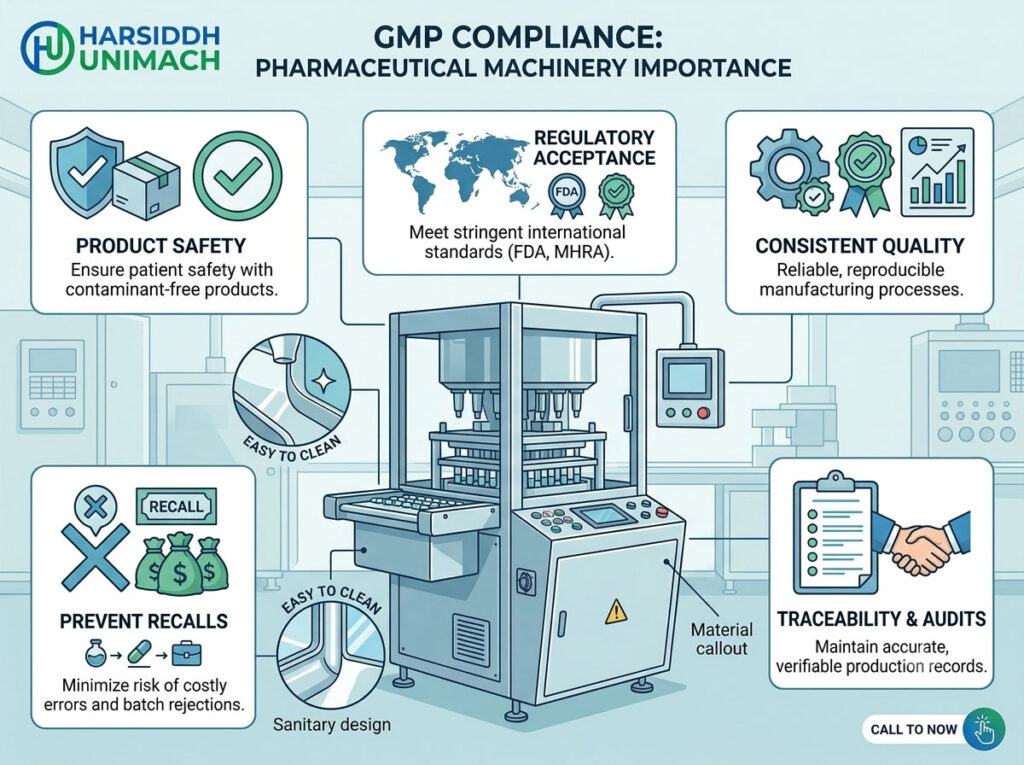
Good Manufacturing Practice (GMP) is often discussed in terms of procedures, records and people. But GMP starts long before the first batch is made. It starts at the drawing board, when engineers decide what a machine will be made of, how its surfaces will be finished, where product will flow, how it will be cleaned and how it will be controlled.
A machine designed with GMP in mind makes compliance easier every day: it cleans quickly and reliably, protects the product from contamination, behaves consistently and comes with the documents needed to prove it. A machine designed without GMP in mind can make compliance a constant struggle, no matter how good the procedures around it are.
This article explains why GMP compliance matters in pharmaceutical machinery and how it shapes machine design. It covers the core design principles, then looks at specific GMP considerations for each type of machine in a typical pharmaceutical packaging line. It also clarifies what the machine manufacturer and the pharmaceutical user are each responsible for.
For how GMP applies to the day-to-day operation of a filling line, such as cleaning, line clearance and in-process controls, see our companion article on GMP compliance in filling lines.
GMP requirements differ between regulators and are updated over time. This article gives a general overview; your quality and regulatory teams should confirm the specific requirements that apply to your products and markets.
What GMP Expects of Equipment
GMP guidelines generally require that equipment used in manufacturing:
- is designed, located and maintained to suit the operations carried out
- does not present a hazard to product quality
- has product-contact parts that are not reactive, additive or absorptive
- can be cleaned effectively and, where needed, sterilised
- is qualified before use and kept in a qualified state
- is operated and maintained according to written procedures, with records
The machine manufacturer’s role is to design and build equipment that makes these requirements achievable. The user’s role is to qualify, operate and maintain it correctly.
Why GMP-Focused Machine Design Matters
Protecting Patients
Machines are in direct contact with products that patients will take. Contamination from materials, lubricants, particles or residues of previous products can cause harm. GMP-focused design minimises these risks at the source.
Making Compliance Achievable
Some compliance requirements are very difficult to meet with poorly designed equipment. A machine with crevices, dead legs or inaccessible areas may never pass cleaning validation reliably. A machine without suitable controls may make it hard to prevent unauthorised changes.
Reducing Cost and Effort
Well-designed equipment cleans faster, changes over faster and causes fewer deviations. Qualification is simpler when documentation is complete and the machine performs consistently.
Supporting Market Access
Regulators and customers in many markets inspect equipment as part of site audits. Machinery that reflects GMP principles supports a positive inspection outcome.
Core GMP Design Principles for Pharmaceutical Machinery
1. Suitable Materials of Construction
- Product-contact parts are typically made from stainless steel grades suited to pharmaceutical use, chosen for corrosion resistance and cleanability.
- Non-contact structural parts are usually stainless steel or other corrosion-resistant materials suitable for cleanroom environments.
- Elastomers and plastics for seals, gaskets and tubing should be pharmaceutical grade and compatible with the product and cleaning agents.
- Material certificates should be available for product-contact parts so materials can be traced and verified during qualification.
2. Appropriate Surface Finish
Smooth surfaces are easier to clean and less likely to harbour residues or microorganisms. Product-contact surfaces are typically polished to a defined finish, and welds are ground and finished smoothly. External surfaces should also be easy to wipe down.
3. Hygienic, Cleanable Design
- no dead legs, pockets or crevices where product can stagnate
- parts that drain completely
- rounded internal corners
- minimal threads and fasteners in the product zone
- open frame designs that allow cleaning beneath and around the machine
- sloped surfaces that shed liquids
- quick-release product-contact parts for cleaning and sterilisation
4. Separation of Product and Mechanical Zones
Drives, gearboxes and lubricated parts should be separated from the product zone, for example by placing mechanisms below a sealed table top. This reduces the risk of lubricants, wear particles or dirt reaching the product.
5. Controlled Lubrication
Where lubrication is needed near the product zone, suitable food-grade or pharmaceutical-grade lubricants should be used, and lubrication points should be designed to prevent contamination.
6. Consistent, Controlled Operation
- accurate, repeatable mechanisms for dosing, closing and labelling
- controls that allow settings to be stored and protected
- user access levels to prevent unauthorised changes
- alarms and interlocks for critical conditions
Our article on advanced technologies in pharmaceutical filling machines explains how modern controls support both compliance and efficiency.
7. Error Prevention
Features such as no-container, no-fill, missing closure detection and automatic rejection help prevent defective products from continuing down the line.
8. Safety
Guards, interlocks and emergency stops protect operators. Safety design should meet the requirements of the country where the machine is installed.
9. Documentation and Qualification Support
A GMP-ready machine is supported by documents that allow the user to qualify it:
- functional and design specifications
- general arrangement and part drawings
- material certificates
- electrical and pneumatic diagrams
- operation and maintenance manuals
- spare parts lists
- Factory and Site Acceptance Test records
- qualification protocol support for IQ and OQ
Our guide to automatic vial filling equipment validation and IQ, OQ and PQ explains how these documents are used.
GMP Considerations Machine by Machine
Each machine in a pharmaceutical packaging line has its own GMP priorities.
Container Washing Machines
Washers remove particles and contaminants from vials, ampoules and bottles before filling.
GMP priorities:
- consistent, validated washing performance
- water and air quality appropriate to the product (for example, purified water or water for injection for injectables, and filtered compressed air)
- gentle handling to avoid glass damage
- easy access for cleaning and inspection
Examples include an automatic rotary vial washing machine and a rotary ampoule washing machine.
Depyrogenation Tunnels
Tunnels sterilise and depyrogenate glass containers with hot air before filling.
GMP priorities:
- uniform, validated temperature across the belt
- filtered, controlled airflow to protect containers
- monitoring and recording of critical parameters such as temperature and belt speed
- safe cooling before containers enter the filling zone
See our sterilizing tunnel for ampoules and vials.
Filling and Sealing Machines
The filler is where product is most exposed and dose accuracy is set.
GMP priorities:
- accurate, repeatable dosing
- product-contact parts that are easily removed for cleaning and sterilisation, or disposable
- protection of the filling zone, especially for sterile products
- immediate closure after filling
- minimal manual interventions
Examples include a liquid vial filling machine with rubber stoppering and an eight head closed ampoule filling and sealing machine. For sterile vial filling, see our cGMP compliance guide for sterile vial filling machinery.
Capping and Cap Sealing Machines
Cappers apply closures that protect the product and show tamper evidence.
GMP priorities:
- consistent torque or crimp force
- detection and rejection of missing or faulty closures
- designs that avoid generating particles, especially near open containers
- easy cleaning of cap feeding systems
Examples include a vial cap sealing machine with 1, 4, 6 or 8 heads and a bottle screw and ROPP capping machine.
Labelling Machines
Labelling errors are among the most serious GMP risks because they can lead to mix-ups.
GMP priorities:
- accurate label placement
- reliable batch, expiry and other coding
- label presence and, where specified, code verification
- reject systems for faulty labels
- design that supports line clearance, so no stray labels remain between batches
Examples include an automatic horizontal ampoule sticker labeling machine and our range of labeling machines for vials.
Inspection Machines
Injectable products are inspected for visible particles and defects.
GMP priorities:
- consistent lighting and viewing conditions
- controlled container rotation so particles move and become visible
- ergonomic design that supports inspector concentration
- clear segregation of accepted and rejected containers
Examples include a visual vial and bottle inspection machine and our wider range of inspection machines.
Integrated Lines
When machines are combined into an integrated line, GMP benefits include fewer manual transfers, coordinated controls and consistent documentation. An automatic liquid vial filling line is designed as one system from washing to capping.
GMP Design Checklist for Machinery
| Area | What to Check |
|---|---|
| Materials | Suitable grades for product contact, with certificates |
| Surfaces | Smooth, polished product-contact surfaces; finished welds |
| Cleanability | No dead legs or crevices; quick-release parts; full drainage |
| Zone separation | Mechanisms separated from the product zone |
| Lubrication | Suitable lubricants, contained lubrication points |
| Controls | Recipes, access levels, alarms |
| Error prevention | No-container, no-fill; closure and label checks; rejection |
| Safety | Guards, interlocks, emergency stops |
| Documentation | Drawings, certificates, manuals, FAT and SAT, IQ and OQ support |
| Support | Training, spare parts, service |
Who Is Responsible for What?
GMP compliance is shared between the machine manufacturer and the pharmaceutical company.
| Machine Manufacturer | Pharmaceutical User |
|---|---|
| Designs and builds equipment suited to the intended use | Defines requirements in a User Requirement Specification |
| Uses suitable materials and provides certificates | Reviews and approves the design |
| Applies hygienic design principles | Qualifies the equipment (IQ, OQ, PQ) |
| Performs FAT and supports SAT | Validates cleaning and processes |
| Provides documentation and training | Writes and follows SOPs |
| Supplies spare parts and service | Maintains, calibrates and controls changes |
A machine cannot be “GMP compliant” on its own; compliance is achieved when a suitably designed machine is properly qualified, operated and maintained within the user’s quality system. For a broader view of compliance across the packaging line, see our article on the importance of compliance in pharmaceutical packaging machinery.
Keeping Machinery GMP-Compliant Over Its Life
GMP-focused design is only the starting point. Over years of use, machines wear, parts are replaced and processes change. To keep equipment compliant:
- Maintain it as designed: use approved spare parts and lubricants, and follow the manufacturer’s maintenance schedule.
- Control changes: assess every modification, software update or part substitution through change control before it is made.
- Calibrate instruments: sensors, gauges and controllers that affect quality must be calibrated at defined intervals.
- Review periodically: check performance, deviations and maintenance history to confirm the machine remains in a qualified state.
- Train new staff: make sure operators and technicians understand both how to use the machine and why its GMP features matter.
Our article on strategies for ensuring compliance and efficiency in pharmaceutical filling lines explains how good maintenance and change control also improve line performance.
Common GMP Design Weaknesses to Avoid
- Hard-to-reach areas where product or dust accumulates
- Painted or corrosion-prone surfaces in clean areas
- Lubricated mechanisms above or near open containers
- Product-contact parts that require tools and long dismantling for cleaning
- Settings that can be changed without control or record
- Missing material certificates or incomplete documentation
- Designs that require frequent manual interventions in critical zones
Frequently Asked Questions
Can a machine be certified as GMP compliant? Machines can be designed to support GMP, but compliance depends on qualification, operation and maintenance at the user’s site.
What material is used for product-contact parts? Stainless steel grades suitable for pharmaceutical use are standard, with pharmaceutical-grade elastomers and plastics for seals and tubing. Confirm the specific grades with your supplier.
Why are material certificates important? They prove what product-contact parts are made of and are usually reviewed during installation qualification.
Does GMP apply to non-sterile machinery? Yes. All equipment used in pharmaceutical manufacturing must be suitable, cleanable and qualified, although sterile equipment has additional requirements.
What should a URS include about GMP? Materials, surface finish, cleanability, controls, documentation, testing and qualification support.
Choose GMP-Ready Machinery From Harsiddh
Harsiddh Unimach designs and manufactures washing machines, depyrogenation tunnels, filling and sealing machines, cappers, labellers and inspection machines with GMP principles built in, supported by documentation for your qualification. Our team can review your requirements and recommend equipment that helps you meet GMP with confidence.
Contact us through our contact page or send your requirements via our inquiry form.