
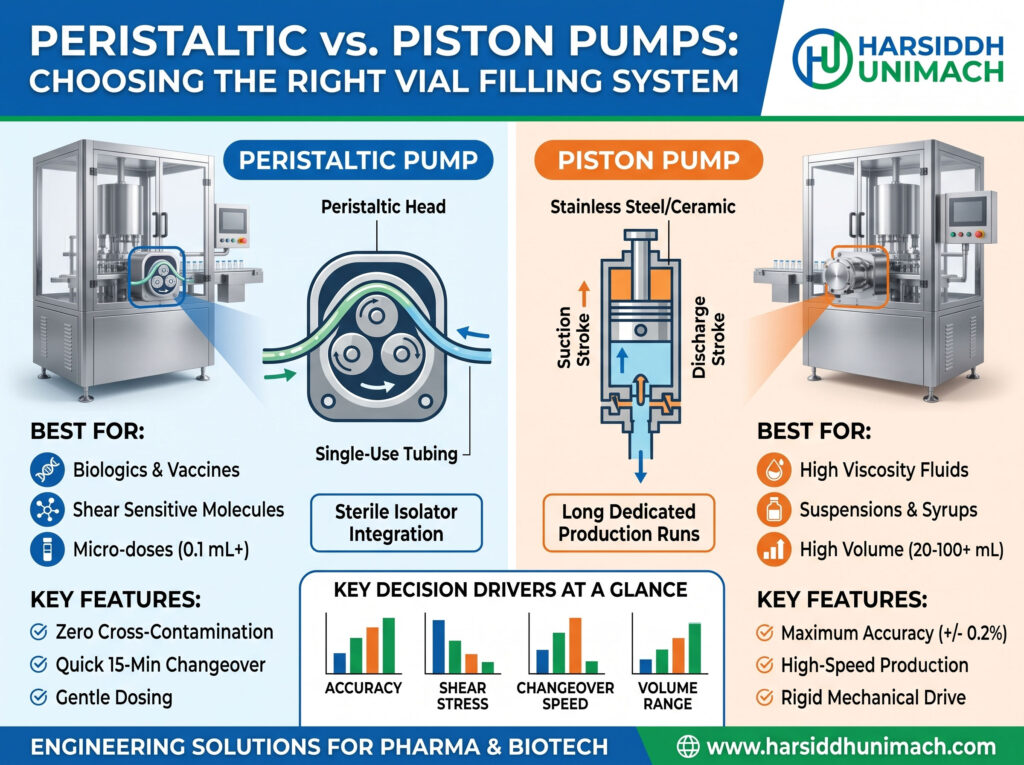
When you choose a vial filling machine, one of the most important decisions is the dosing pump. In injectable manufacturing, two technologies dominate: peristaltic pumps and piston (rotary piston or valveless/valved piston) pumps. Both can deliver accurate, sterile doses into vials, but they work in very different ways and suit different products, batch sizes and plant strategies.
Choosing the wrong pump can mean longer cleaning times, higher running costs, product damage, poorer accuracy or difficult changeovers. Choosing the right one supports product quality, efficiency and compliance for years.
This guide explains how each pump works, compares them across the factors that matter most for vial lines, and provides a practical decision framework.
How a Peristaltic Pump Works
A peristaltic pump moves liquid through a flexible tube by squeezing it with rollers mounted on a rotating head:
- The tube is placed in the pump head around the rollers.
- As the head rotates, rollers compress the tube, trapping a small volume of liquid between them.
- The trapped liquid is pushed along the tube towards the outlet.
- Behind each roller, the tube recovers its shape and draws in fresh liquid.
The dose is controlled by the rotation of the pump head, usually driven by a servo or stepper motor. The key point: the product only touches the tubing, never the pump mechanism.
How a Piston Pump Works
A piston pump measures liquid in a precision cylinder:
- The piston retracts, drawing liquid into the cylinder through an inlet (via valves, or by rotating the piston to open ports in valveless designs).
- The flow path switches to the outlet.
- The piston advances, pushing a fixed volume to the filling needle.
The dose is controlled by the stroke length, set mechanically or by a servo drive. Product contacts the piston, cylinder and valves, which are typically made of stainless steel or ceramic with very tight tolerances.
Types of Piston Pumps Used in Vial Filling
Not all piston pumps are the same. Common designs include:
- Valved piston pumps – separate inlet and outlet valves (such as ball or rotary valves) control flow direction. Robust and suitable for a wide range of products.
- Valveless rotary piston pumps – the piston rotates as well as moving back and forth, opening and closing ports in the cylinder. With fewer moving parts in the product path, they offer very good accuracy and are easier to clean.
- Ceramic piston pumps – pistons and cylinders made of technical ceramics, offering wear resistance and precise fits, often used for high-accuracy injectable filling.
The choice of material and design affects accuracy, cleaning and suitability for different products.
Choosing Tubing for Peristaltic Pumps
Tubing is the heart of a peristaltic system. Selection considerations include:
- Material – pharmaceutical-grade silicone and other elastomers, chosen for compatibility with the product
- Wall thickness and inner diameter – matched to the fill volume and pump head
- Consistency – uniform dimensions for repeatable doses
- Durability – resistance to wear over the expected run time
- Sterilisation compatibility – suitable for autoclaving or gamma irradiation, depending on the approach
- Extractables and leachables – evaluated as part of product compatibility studies
Tubing suppliers and machine suppliers can advise on the best options for your product and pump.
Head-to-Head Comparison
| Factor | Peristaltic Pump | Piston Pump |
|---|---|---|
| Product contact parts | Tubing only | Piston, cylinder, valves |
| Cleaning | Replace tubing; minimal cleaning | Dismantle, clean and sterilise pump parts, or clean in place |
| Changeover between products | Fast: change tubing set | Slower: clean or swap pump sets |
| Cross-contamination risk | Very low with new tubing | Depends on cleaning effectiveness |
| Accuracy | Very good for small and medium volumes; depends on tubing condition | Very high across a wide range of volumes |
| Viscosity range | Low to medium | Low to high |
| Shear on product | Generally gentle | Generally low, depends on design |
| Running costs | Tubing is a consumable | Pumps are durable but need maintenance |
| Particle risk | Tubing wear must be managed | Close-fitting parts must not shed particles |
| Typical applications | Biologics, multi-product lines, small batches, high-potency products | High-volume production, wide volume range, viscous products |
Factor 1: Accuracy
Peristaltic
Modern servo-driven peristaltic pumps deliver very good accuracy, particularly for small and medium fill volumes. Accuracy depends on:
- Tubing material and wall consistency
- Tubing age – tubing can change shape slightly over time, so it is replaced on a schedule
- Pump head design and roller pressure
- Calibration at start-up and after tubing changes
Piston
Piston pumps are known for excellent accuracy and repeatability across a wide range of volumes. Because the volume is defined by a rigid cylinder and stroke, accuracy remains stable over long runs, provided seals and parts are in good condition.
In practice: both technologies can meet tight accuracy requirements; the right choice depends on fill volume, product and how the line is run.
Factor 2: Product Contact, Cleaning and Sterilisation
Peristaltic
The fluid path is the tubing, needles and connectors. In many installations, this path is supplied as a pre-assembled, pre-sterilised set that is installed for each batch and discarded afterwards. This greatly reduces cleaning and cleaning validation effort and supports aseptic processing.
Piston
Piston pumps must be cleaned and sterilised between batches or products, either by dismantling and autoclaving or through clean-in-place and sterilise-in-place systems. This requires validated procedures, time and careful handling of precision parts.
In practice: for plants running many different products, peristaltic systems can save significant cleaning time. For plants running one product continuously, piston cleaning may be acceptable.
Factor 3: Viscosity and Product Type
- Peristaltic pumps handle aqueous solutions and low-to-medium viscosity products well. Very viscous products can be harder to pump accurately through tubing.
- Piston pumps handle a wide range, including oily and more viscous injectables.
Shear-sensitive products such as some proteins and biologics often benefit from the gentle action of peristaltic pumps, although well-designed piston pumps can also be gentle.
Factor 4: Changeovers and Flexibility
| Task | Peristaltic | Piston |
|---|---|---|
| Product change | Install new tubing set | Clean or exchange pump set |
| Volume change | Change rotation in recipe | Change stroke in recipe (servo) or mechanically |
| Cleaning validation | Reduced (single-use path) | Required for each product |
For contract manufacturers and multi-product plants, peristaltic flexibility can be a major advantage.
Factor 5: Running Costs
- Peristaltic – tubing sets are consumables and add a cost per batch, but cleaning time, utilities and labour are reduced.
- Piston – pumps last a long time but require maintenance, cleaning resources and occasional replacement of seals or worn parts.
The best way to compare is total cost per batch, including consumables, cleaning time, labour, utilities and downtime.
Factor 6: Particles and Product Quality
Both technologies must avoid adding particles to the product:
- Peristaltic – tubing must be suitable for pharmaceutical use and replaced before wear could cause particle shedding.
- Piston – precision parts and materials must be chosen so that operation does not generate particles, and pumps must be maintained properly.
Follow the supplier’s recommendations and your own validation results.
Maintenance Comparison
| Maintenance Task | Peristaltic | Piston |
|---|---|---|
| Routine replacement | Tubing sets on schedule or per batch | Seals and O-rings at intervals |
| Cleaning | Mainly needles and pump head exterior | Full fluid path, including pumps |
| Calibration | After each tubing change and at start-up | At start-up and at defined intervals |
| Wear inspection | Tubing condition, roller condition | Piston and cylinder wear, valve condition |
| Spare parts | Tubing sets, rollers | Pump sets, seals, valves |
Common Misconceptions
“Peristaltic pumps are not accurate enough for injectables.” Modern servo-driven peristaltic systems are widely used for injectables and can meet demanding accuracy requirements, particularly for small and medium volumes.
“Piston pumps are always harder to clean.” Some piston designs, such as valveless rotary pumps, are designed for efficient cleaning and sterilisation, though they still require validated procedures.
“Single-use is always more expensive.” Consumable costs can be balanced by savings in cleaning time, utilities, labour and validation effort, especially in multi-product plants.
Validation Considerations
Whichever pump you choose, validation must show that it consistently delivers accurate, sterile doses:
- Accuracy and precision studies across the full range of fill volumes and over extended runs
- Cleaning validation for reusable piston pumps, or verification of single-use set integrity and sterility for peristaltic systems
- Product compatibility of contact materials, including tubing extractables where relevant
- Media fills for aseptic processes, as defined by your quality system
Decision Guide
| Your Situation | Likely Better Choice |
|---|---|
| Many products, frequent changeovers | Peristaltic |
| High-potency or cytotoxic products, minimal contact desired | Peristaltic |
| Biologics or shear-sensitive products | Peristaltic (often) |
| Small to medium batches | Peristaltic |
| One product, long continuous runs | Piston |
| Wide range of fill volumes, including larger fills | Piston |
| Viscous or oily injectables | Piston |
| Minimising consumable costs is a priority | Piston |
Some machines offer both options, allowing the pump type to be chosen per product.
Running Trials Before You Decide
The most reliable way to choose is to test both technologies with your own product. During trials, compare fill accuracy across all heads over an extended run, check for foaming or splashing at your target speed, observe how the product behaves in the fluid path, and time a full changeover for each system. Record cleaning effort for the piston option and tubing life for the peristaltic option. These results, combined with your batch sizes and product mix, give a clear picture of which pump will perform best on your line.
Peristaltic and Piston Options from Harsiddh
- Automatic Peristaltic Based Liquid Filling Machine and the peristaltic based liquid filling machine
- Automatic Peristaltic Based Ampoule Filling Machine
- Automatic Servo Based Vial Filling Machine
- Two Head Liquid Vial Filling Stoppering Machine
- Liquid vial filling machine with rubber stoppering
- Servo based piston filling machine
- Pre-filled syringe filling and stoppering machine
Browse our vial filling machines and the vial filling machines for liquid vials.
The Pump Is Part of a Complete Line
Whichever pump you choose, it operates within a complete injectable line:
- Washing on a linear vial washer
- Depyrogenation in a sterilizing tunnel for ampoules and vials
- Filling and stoppering
- Cap sealing on a vial cap sealing machine
- Inspection and labelling
Integrated solutions such as the automatic liquid vial filling line combine these steps.
For related reading, see how servo-driven vial filling systems outperform mechanical lines, liquid filling machine technologies compared, the vial filling machine selection guide and vial filling machine nozzle selection.
Frequently Asked Questions
What is the main difference between peristaltic and piston pumps? Peristaltic pumps move liquid by squeezing flexible tubing, so product only touches the tube. Piston pumps measure liquid in a precision cylinder, so product contacts the piston, cylinder and valves.
Which is more accurate for vial filling? Both can be very accurate. Piston pumps are often preferred across a wide volume range; servo-driven peristaltic pumps perform very well for small and medium volumes.
Why are peristaltic pumps popular for biologics? They offer gentle handling, single-use fluid paths and minimal product contact, reducing cleaning and cross-contamination risk.
When are piston pumps the better choice? For long runs of one product, wider volume ranges, larger fills and more viscous injectables.
Are tubing costs a disadvantage for peristaltic pumps? Tubing is a consumable cost, but it is often offset by reduced cleaning time, labour and validation effort.
Not sure which pump suits your vial line? Contact our team or send an inquiry with your products, fill volumes and batch sizes.