
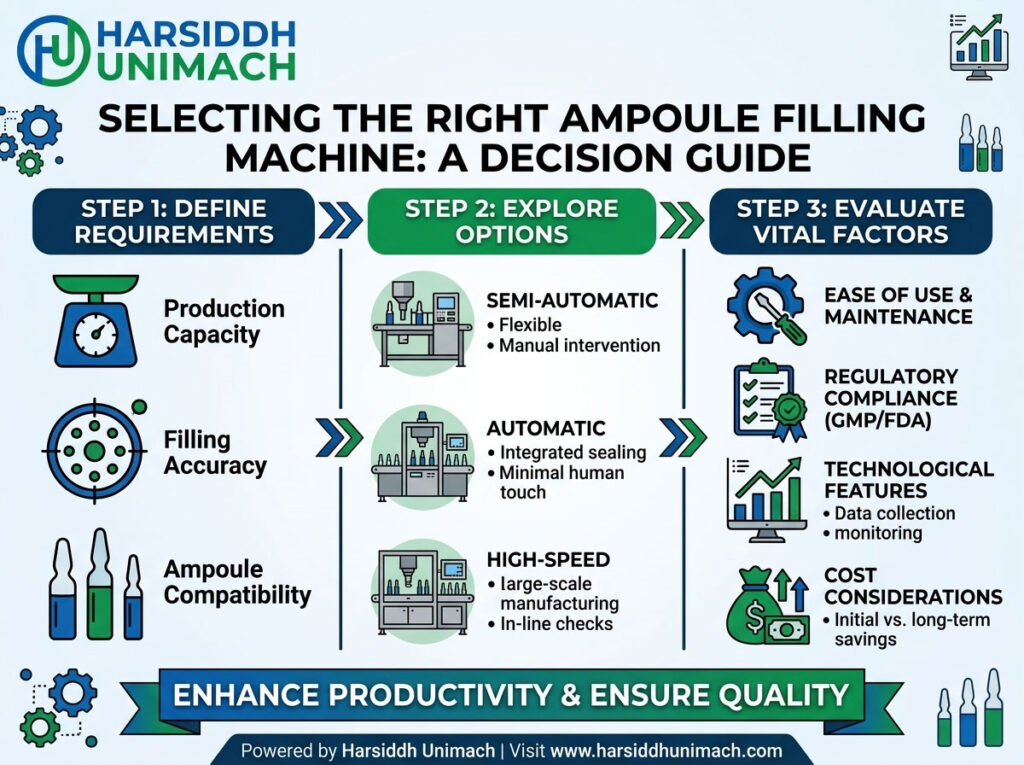
An ampoule filling and sealing machine is a long-term investment. Once installed and qualified, it may run your injectable products for many years. Choose well, and the machine delivers accurate fills, consistent seals and smooth changeovers shift after shift. Choose poorly, and you may live with bottlenecks, high reject rates, difficult cleaning or a machine that cannot handle your next product.
This buyer’s guide walks you through the decisions in a logical order: starting with your product and ampoules, then output, dosing, sealing and protection, followed by line integration, compliance, utilities, supplier support and total cost. At the end you will find a checklist and a list of questions to ask suppliers.
If you are new to how these machines work, start with the ultimate guide to ampoule filling and sealing machine working principle.
Step 1: Define Your Product
Everything starts with the product you will fill. Write down:
- Product type – aqueous solution, oily solution, suspension or other
- Viscosity – thin liquids behave very differently from oily or viscous products
- Foaming tendency – some products foam during dosing
- Oxygen sensitivity – whether nitrogen purging is required
- Heat sensitivity – whether the product can tolerate the sealing process near the neck
- Shear sensitivity – whether gentle dosing is needed
- Sterility approach – aseptic filling or terminal sterilisation after sealing
- Number of products – one dedicated product or many
These properties influence the dosing system, sealing settings, nitrogen requirement and cleaning design. Also confirm that ampoules are the right container; our article on ampoule vs vial filling: key differences explained can help.
Step 2: Define Your Ampoules
Ampoule sizes
List every ampoule size you need to run now and in the foreseeable future. The machine must handle this range with suitable change parts. Running many sizes means changeover design becomes very important.
Ampoule type
| Ampoule Type | Description | Machine Implications |
|---|---|---|
| Open ampoules | Supplied with an open funnel or neck | Must be washed and depyrogenated; filled and sealed by pulling |
| Closed ampoules | Supplied sealed; opened on the machine | Machine needs an opening (cutting) station before filling |
| Crushable ampoules | Thin-walled, in a protective sleeve | Specialised handling |
Make sure the machine is designed for the ampoule types you will use.
Ampoule quality
Dimensional consistency of ampoules affects machine performance. Discuss tolerances with both your ampoule supplier and machine supplier.
Step 3: Determine Output and Number of Heads
Output is mainly determined by the number of filling and sealing heads.
Calculate your requirement
Work out the number of ampoules you need per year, then per shift, taking into account:
- Number of shifts and working days
- Realistic efficiency, allowing for changeovers, cleaning, breaks and stoppages
- Growth over the next few years
Divide the required good ampoules per hour by a realistic efficiency factor to get the machine speed you need.
Match heads to demand
| Configuration | Typical Use |
|---|---|
| Single head | R&D, clinical batches, very small production |
| Two head | Small batch production |
| Four head | Medium output |
| Six head | Higher output |
| Eight head | High-volume production |
On Harsiddh Engineering, see the single head ampoule filling and sealing machine, two head, four head, six head and eight head models, and the four head closed ampoule filling and sealing machine.
For a detailed comparison, read ampoule filling and sealing machines comparison: single head, 2 head, 4 head and 6 head models. For small-scale needs, see working principle of a small-scale ampoule filling and sealing machine. For high-volume production, read why choose an automatic eight head ampoule filling sealing machine and see the Automatic Eight Head Ampoule Filling and Sealing Machine.
Avoid both extremes
- Too small – the machine becomes a bottleneck, forcing extra shifts.
- Too large – higher investment, more change parts and more complexity than you need, and possibly more product lost at start-up and line clearance.
Step 4: Choose the Dosing System
The dosing system determines fill accuracy, cleaning effort and product handling.
| Dosing Option | Strengths | Considerations |
|---|---|---|
| Piston pumps (mechanical) | Robust, accurate, proven | Mechanical adjustment, more parts to clean |
| Servo-driven piston pumps | Digital setting, head trimming, recipes, smooth motion | Higher initial cost |
| Peristaltic pumps | Product contacts only tubing, easy cleaning, low cross-contamination risk | Tubing replacement, suited to specific volume ranges |
Consider your fill volume range, product properties, number of products and cleaning strategy. A servo-based machine such as the Automatic Servo Based Ampoule Filling and Sealing Machine offers flexibility for multi-product plants.
Some products and processes also raise questions about filling methods, such as vacuum vs gravity. Read vacuum filling vs gravity filling in ampoule machines for an engineering comparison.
Step 5: Evaluate Sealing Performance
Sealing quality determines a large share of your reject rate. Ask:
- What type of sealing is used (pull sealing for open ampoules, tip sealing for closed)?
- How are gas and oxygen flows controlled and monitored?
- How consistent are tips across the full ampoule size range?
- How is the ampoule rotated during heating?
- Are there safeguards if gas pressure drops?
- How easy is it to clean and set burners?
Insist on seeing sealing samples for your ampoule sizes during trials or factory acceptance tests.
Step 6: Decide on Product Protection Features
- Nitrogen purging before and/or after filling for oxygen-sensitive products
- No ampoule, no fill to prevent product waste
- Drip prevention (suck-back or cut-off) to keep necks clean for sealing
- Laminar airflow or barrier systems over the filling zone for aseptic processing
Match these features to your product’s needs and your facility’s contamination control strategy.
Step 7: Plan Line Integration
The filler is one part of a complete line. Make sure it integrates with:
- Washing – such as a rotary ampoule washing machine
- Depyrogenation – such as a sterilizing tunnel for ampoules and vials
- Inspection – such as the visual ampoule and vial inspection machine
- Labelling and packing
Check speed matching, transfer design, height alignment and control communication between machines. Buying a complete line from one supplier can simplify integration and responsibility.
Step 8: Check Changeover and Cleaning
For multi-product or multi-size plants, these points have a big impact on productivity:
- How long does a size changeover take, and how many parts are changed?
- Are change parts tool-less, colour-coded and clearly marked?
- Can settings be stored as recipes?
- Which parts contact the product, and how are they removed for cleaning or sterilisation?
- Are surfaces smooth and free of hidden areas?
Ask the supplier to demonstrate a full size changeover during the factory acceptance test, timed and carried out by your own operators where possible. This shows the real effort involved, not just the theoretical one.
Step 9: Confirm GMP and Documentation
Pharmaceutical machines must be qualified. Check that the supplier provides:
- Design documentation and drawings
- Material certificates for product contact parts
- Surface finish information
- Installation and operational qualification (IQ/OQ) documentation or support
- Factory acceptance test (FAT) and site acceptance test (SAT) protocols
- Operation and maintenance manuals
- Spare parts lists
Also review control system features such as user access levels and data recording against your data integrity requirements.
Step 10: Consider Utilities and Space
Make sure your facility can support the machine:
- Floor space and layout – including access for operation, cleaning and maintenance
- Electrical supply
- Fuel gas and oxygen for sealing burners
- Nitrogen supply and quality, if used
- Compressed air
- Room classification and airflow
Utility requirements should be confirmed early, as upgrading utilities later can be expensive.
Step 11: Evaluate the Supplier
The supplier relationship matters as much as the machine. Consider:
- Experience with ampoule machines and similar products
- Installation and commissioning support
- Operator and maintenance training
- Spare parts availability and lead times
- Remote and on-site service support
- References from existing customers
Step 12: Compare Total Cost of Ownership
Purchase price is only part of the cost. Over the machine’s life, consider:
| Cost Element | Questions to Ask |
|---|---|
| Purchase price | What exactly is included? |
| Change parts | How much for each additional ampoule size? |
| Installation and qualification | Who does what, and at what cost? |
| Utilities | Gas, oxygen, nitrogen, power and air consumption |
| Product loss | Start-up waste, rejects, line clearance losses |
| Spare parts and consumables | Seals, tubing, burner parts |
| Maintenance | Routine service effort and cost |
| Downtime | Reliability and service response |
A machine with a slightly higher purchase price but lower rejects, faster changeovers and better reliability is often the better investment.
Common Mistakes When Buying an Ampoule Filling Machine
- Choosing on price alone – a lower purchase price can be outweighed by higher rejects, longer changeovers and more downtime.
- Ignoring future products – a machine that fits today’s single product may not handle next year’s new ampoule size or oxygen-sensitive formulation.
- Underestimating changeover needs – on multi-product lines, slow changeovers can cost more output than a lower machine speed.
- Skipping trials – without trials on your own product and ampoules, fill accuracy and sealing quality are assumptions.
- Forgetting utilities – gas, oxygen, nitrogen and room requirements discovered late can delay installation.
- Treating the filler in isolation – a fast filler cannot outrun a slow washer, tunnel or inspection machine.
- Overlooking documentation – incomplete qualification documents can delay release of the line for production.
Making the Most of Trials and the FAT
Trials and the factory acceptance test (FAT) are your best opportunity to confirm the machine before it ships. Use them to:
- Run your actual product, or a suitable placebo, in your actual ampoules
- Check fill accuracy across all heads over an extended run
- Inspect sealed ampoules for tip quality and consistency
- Time a full size changeover
- Test safeguards such as no ampoule-no fill and gas pressure alarms
- Review documentation and operator interfaces
- Agree on any corrections before the machine leaves the factory
A well-prepared FAT protocol, agreed with the supplier in advance, saves time and avoids surprises during installation.
Buyer’s Checklist
- Product properties documented
- Ampoule sizes and types listed
- Output requirement calculated with realistic efficiency and growth
- Number of heads selected
- Dosing system chosen
- Sealing performance verified on samples
- Nitrogen and safeguards specified
- Line integration planned
- Changeover and cleaning reviewed
- GMP documentation confirmed
- Utilities and space confirmed
- Supplier support evaluated
- Total cost of ownership compared
Questions to Ask Suppliers
- Can you run trials with our product and ampoules?
- What fill accuracy can we expect for our volumes, and how is it demonstrated?
- How long does a size changeover take?
- What documentation do you provide for qualification?
- What are the utility requirements?
- Which spare parts should we keep on site?
- What training and after-sales support do you provide?
- Can the machine be upgraded later, for example with servo dosing or nitrogen?
Browse our full range of ampoule filling machines to compare options.
Frequently Asked Questions
What is the most important factor in choosing an ampoule filling machine? Matching the machine to your product, ampoule types and realistic output requirement. Everything else follows from these.
How many filling heads do I need? Calculate the good ampoules you need per hour, allow for realistic efficiency and growth, and choose the configuration that meets that need without excessive overcapacity.
Should I choose servo or mechanical dosing? Servo dosing offers digital setting, head trimming and recipes, which are valuable for multi-product plants. Mechanical dosing is proven and robust for simpler applications.
Do I need nitrogen purging? Only if your product is sensitive to oxygen. Your product development data should guide this.
Why is total cost of ownership important? Running costs, rejects, changeovers and downtime often matter more over the machine’s life than the purchase price.
Ready to choose your ampoule filling machine? Contact our team or send an inquiry with your product details, ampoule sizes and output targets, and we will help you select the right solution.