
The global pharmaceutical landscape is moving at an unprecedented velocity. With the skyrocketing demand for vaccines, biologics, customized oncology therapies, and everyday critical-care injectables, manufacturing facilities no longer have the luxury of slow, fragmented production cycles. When you are processing parenterals, the twin mandates of the industry are absolute: maximum throughput and flawless sterility.
While small-scale or multi-head pilot systems serve their purpose in R&D laboratories, commercial-scale blockbuster drugs demand a heavy-duty industrial workhorse. Enter the Automatic Eight Head Ampoule Filling and Sealing Machine.
For high-volume pharmaceutical manufacturing plants looking to scale efficiently without sacrificing a single fraction of accuracy, an 8-head monoblock machine is the gold standard. As a leading global pioneer in high-speed liquid packaging lines, Harsiddh Unimach Pvt. Ltd. engineers high-capacity, cGMP-compliant injectable lines built for this exact scale.
This definitive guide breaks down why upgrading to an automatic 8-head ampoule line is the smartest operational shift your plant can make.
The Scale-Up Dilemma: Why 2-Head or 4-Head Systems Fall Short in High-Volume Lines
When stepping into high-volume production, attempting to run low-head machinery beyond its designed operational threshold introduces severe mechanical vulnerabilities.
- The Velocity Bottleneck: A standard 2-head or 4-head machine maxes out quickly. To increase yield, operators often push the stroke speed of the mechanical cams, which induces heavy vibrations, leading to glass breakages and frequent line stoppages.
- Elevated Contamination Windows: Lower-capacity machines mean glass ampoules spend more time exposed to the environment between the de-nesting station and the final flame-sealing zone. In sterile manufacturing, every second of exposure increases the biological risk profile.
- Component Wear and Tear: Forcing a lower-capacity filler to work 24/7 at peak capacity accelerates the wear on volumetric syringes, valves, and drive belts, driving up maintenance downtime.
The 8-head machine solves this by distributing the operational load across eight synchronized processing channels simultaneously, delivering massive throughput at an optimized, smooth, and sustainable mechanical pace.
Technical Architecture of an Eight Head Monoblock Machine
An automatic eight-head ampoule filling and sealing machine is a masterpiece of synchronized automation. Rather than treating filling, gassing, and sealing as isolated events, a modern monoblock system integrates these phases onto a single, high-speed structural frame.
Key Structural Anatomy
To understand its efficiency, let’s look at the robust engineering components that drive an 8-head system manufactured by Harsiddh Unimach Pvt. Ltd.:
| Component System | Material Construction | Functional Role in High-Speed Output |
| Infeed Wire-Mesh Conveyor | AISI SS 304 / 316 | Receives bulk sterile ampoules directly from the sterilization tunnel without manual intervention. |
| Octal Scroll & Star Wheel Assembly | High-density Delrin / SS 304 | Segregates and indexes precisely eight ampoules per mechanical cycle into the transport track. |
| 8-Nozzle Gassing Manifold | AISI SS 316L | Delivers simultaneous pre- and post-nitrogen flushing to 8 containers at once to drop residual oxygen levels below 1%. |
| 8-Head Volumetric Dosing Pumps | AISI SS 316L / Rotary Piston | Precisely measures and discharges eight identical fluid doses with an accuracy profile of ±0.5%. |
| Servo-Driven Filling Nozzles | AISI SS 316L | Automatically descends deep into the ampoule necks, utilizing bottom-up retraction to prevent neck wetting. |
| Double-Row Pre-heating Burners | Heavy-Duty Brass | Provides progressive, uniform thermal conditioning to 8 rotating ampoule necks concurrently. |
| 8-Point Gripper/Clipper Mechanism | Hardened Stainless Steel | Grips and cleanly pulls away 8 waste glass tips simultaneously during the standard pull-sealing phase. |
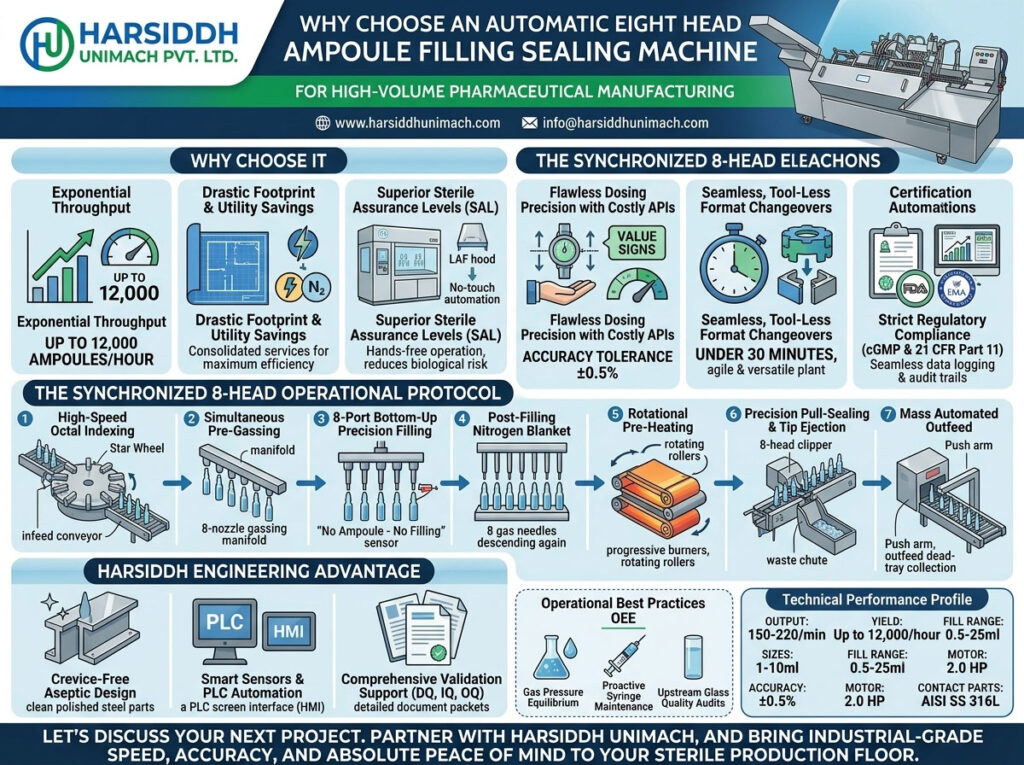
The Synchronized 8-Head Operational Protocol: How It Works
The magic of an automatic eight-head machine lies in its high-speed harmonic progression. Governed by an advanced, central PLC system and synchronized via precision servo motors or an oil-bath eccentric cam track, the machine processes blocks of eight ampoules through a continuous, step-by-step cycle.
[Infeed Conveyor]
       │
       ▼
[8x Star-Wheel Indexing] ───> [8x Pre-Nitrogen Gassing]
                                          │
                                          ▼
[8x Flame Pull-Seal]     <─── [8x Post-Gas] <─── [8x Bottom-Up Volumetric Fill]
       │
       ▼
[Automated Outfeed Tray]
Phase 1: High-Speed Octal Indexing
Freshly depyrogenated open-mouth glass ampoules exit the cooling zone of a sterilization tunnel and feed directly onto the machine’s infeed conveyor. A precision-machined rotative scroll wheel separates the tightly packed glass containers, allowing a specialized 8-slot star wheel to capture exactly eight ampoules at a time and seamlessly transfer them onto a horizontal slant-travel transport rack.
Phase 2: Simultaneous Pre-Gassing
Atmospheric oxygen is the mortal enemy of shelf-life for many parenteral formulations, including vitamins, antibiotics, and biologics. Once the 8 ampoules are positioned on the transport track, a manifold carrying eight stainless steel gas needles descends into the container necks. A high-pressure, metered pulse of sterile Nitrogen (N₂) or Argon gas is introduced, rapidly purging out oxygen.
Phase 3: 8-Port Bottom-Up Precision Filling
Immediately following the purge, the rack moves the 8 containers under the filling station.
The “No Ampoule – No Filling” Guardrail: High-speed lines cannot afford messy spills. Integrated proximity sensors scan all eight slots on the rack. If slot number 4 is empty due to a minor upstream supply gap, the PLC instantly isolates dosing pump number 4. The other seven pumps fire perfectly, ensuring zero product wastage and clean machinery tracks.
The 8 filling nozzles descend deep into the ampoule necks. Using advanced bottom-up filling profiles, the nozzles discharge liquid while retracting in perfect synchronization with the rising fluid level. This eliminates a common high-speed flaw known as “neck wetting”, where stray droplets touch the upper glass rim, causing unsightly charring and product carbonization during the sealing phase.
Phase 4: Post-Filling Nitrogen Blanket
To lock out air before closure, the 8 ampoules slide under a post-gassing manifold. A secondary injection of inert gas blankets the headspace above the liquid, ensuring the container contains a completely sterile, non-reactive atmosphere.
Phase 5: Rotational Pre-Heating
The 8 filled ampoules transition onto specialized, motorized rotation rollers. As the ampoules spin rapidly on their axes, they move past a series of focused, progressive gas burners fueled by a precise mixture of LPG and Oxygen (O₂). This continuous rotation guarantees that the entire circumference of the glass neck softens uniformly, preventing thermal cracks.
Phase 6: Precision Pull-Sealing and Tip Ejection
Once the glass reaches its ideal plastic state, the ampoules hit the primary sealing zone. A high-intensity pinpoint flame melts the center of the neck. Simultaneously, an 8-headed mechanical clipper assembly descends, grabs the waste glass tops, and pulls them vertically upward.
The molten glass pinches closed, fuses perfectly in the center, and forms a hermetically sealed, elegant dome. The waste glass tips are clipped off cleanly and dropped down an internal waste chute, keeping the production line completely clear.
Phase 7: Mass Automated Outfeed
The 8 freshly sealed, hot ampoules are pushed gently off the transport rack by a synchronized discharge arm onto an upright collection dead-tray or an integrated outfeed conveyor belt, bound for downstream optical inspection, leak testing, and labeling.
Top 6 Reasons to Choose an 8-Head Machine for High-Volume Lines
If you are evaluating whether to invest in an 8-head system, the operational and financial advantages become clear when looking at long-term total cost of ownership (TCO) and overall equipment effectiveness (OEE).
1. Exponential Throughput (Up to 12,000 Ampoules/Hour)
While a single-head machine produces a modest output, an automatic 8-head machine easily hits production speeds ranging from 150 to 200+ ampoules per minute (depending on the ampoule size and liquid viscosity). This translates to an output of up to 12,000 perfectly sealed units per hour, allowing you to clear large production campaigns in record time.
2. Drastic Footprint and Utility Savings
Think you need multiple machines to achieve high output? Think again. Operating a single 8-head monoblock machine takes up a fraction of the valuable cleanroom real estate required by running three distinct 2-head or 4-head machines side-by-side. Furthermore, a single machine consolidates your utility hookups—requiring only one main electrical drop, one centralized exhaust hood, and one regulated gas/oxygen manifold line.
3. Superior Sterile Assurance Levels (SAL)
In high-volume pharmaceutical manufacturing, human contact is the number one source of contamination. The automatic 8-head line built by Harsiddh Unimach Pvt. Ltd. is engineered for hands-free automation. From the moment empty glass enters the machine to the final outfeed collection, the product remains untouched by human hands. The compact monoblock frame is also optimized for quick integration under Laminar Air Flow (LAF) hoods or full Isolation Barrier Systems (RABS).
4. Flawless Dosing Precision with Costly APIs
When manufacturing expensive oncology drugs, monoclonal antibodies, or complex vaccines, even a 1% overfill across millions of vials represents a massive financial loss. Utilizing premium volumetric syringe blocks or servo-driven peristaltic pump networks, our 8-head fillers maintain a strict accuracy tolerance of ±0.5%. Every drop goes exactly where it belongs.
5. Seamless, Tool-Less Format Changeovers
A common myth is that high-speed machines are difficult to adjust. Modern 8-head machines feature modular, toolless format parts. If your schedule requires shifting production from 1ml ampoules to 5ml or 10ml variants, the operator simply utilizes quick-release handwheels and swap-out star wheels. The entire changeover can be completed in under 30 minutes, keeping your plant agile and versatile.
6. Strict Regulatory Compliance (cGMP & 21 CFR Part 11)
High-volume manufacturing lines face intense regulatory scrutiny from the FDA, EMA, and local boards. An automatic 8-head line from Harsiddh Unimach features complete structural isolation between the mechanical drive mechanics (located safely below the tabletop base) and the sterile fluid pathways above. The system can be configured with an advanced PLC control panel that tracks batch data, logs alarm histories, and ensures full compliance with 21 CFR Part 11 electronic data standards.
Technical Performance Profile: Harsiddh Unimach 8-Head System
To assist your engineering and procurement teams with operational mapping, here is a breakdown of the standard technical specifications for our high-capacity 8-head model:
+------------------------------------+-------------------------------------------+
| Technical Parameter                | Performance Specification (8-Head Model)  |
+------------------------------------+-------------------------------------------+
| Production Output Capacity         | 150 to 220 Ampoules / Minute              |
| Hourly Yield Target                | Up to 12,000 units / hour                 |
| Supported Ampoule Sizes            | 1ml, 2ml, 3ml, 5ml, 10ml (Type B, C, D)   |
| Dosing Volume Flexibility          | 0.5 ml to 25 ml                           |
| Filling Accuracy Percentage        | ± 0.5% to ± 1.0% (Formulation dependent)  |
| Main Drive Motor Power             | 2.0 HP, 3-Phase, 415 Volts, 50 Hz          |
| Contact Parts Material             | Premium AISI SS 316L Stainless Steel       |
| Non-Contact Structural Shell       | AISI SS 304 Stainless Steel               |
| Required Combustible Fuel Gases    | LPG + Pure Oxygen (O2)                    |
| Inert Purging Gas Requirement      | Industrial-Grade Sterile Nitrogen (N2)    |
+------------------------------------+-------------------------------------------+
Operational Best Practices for Maximizing High-Speed Line OEE
To get the most out of an automatic 8-head ampoule line, production managers should instill a few foundational operational habits within their cleanroom teams:
Gas Pressure Equilibrium
The sealing station relies on a precise mix of LPG and Oxygen. If your gas pressure fluctuates, your sealing flames can become asymmetric, leading to malformed glass domes or microscopic “pinhole leakers”. Ensure your line is paired with high-quality, dual-stage pressure regulators and clear flowmeters to monitor the gas stream visually.
Proactive Syringe and Valve Maintenance
At high speeds, liquid dosing valves actuate hundreds of thousands of times per week. Implement a proactive preventative maintenance schedule. Inspect the Teflon seals, pistons, and O-rings of your AISI SS 316L pumps regularly to prevent micro-wear that could cause subtle drift in your fill tolerances.
Upstream Glass Quality Audits
An 8-head machine operates fast. If your incoming borosilicate glass ampoules suffer from structural inconsistencies, dimensional variations, or micro-cracks sustained during bulk transport, the high-temperature sealing flames can cause thermal shock and breakage. Partner with trusted, cGMP-validated glass manufacturers to match the high standards of your machinery.
Why Choose Harsiddh Unimach Pvt. Ltd. as Your Injectable Packaging Partner?
When operating at a high commercial volume, you aren’t just buying a machine—you are investing in a critical partnership. Any unexpected equipment breakdown on a mass production line can quickly result in costly losses.
At Harsiddh Unimach Pvt. Ltd., based in the manufacturing hub of Ahmedabad, India, we build packaging machinery designed for continuous operation.
The Harsiddh Engineering Advantage:
- Crevice-Free Aseptic Design: Every track, bracket, and nozzle on our filling line is meticulously polished. Our designs avoid sharp internal angles or open threads where bacteria could nest, ensuring flawless Clean-in-Place (CIP) and Sterilize-in-Place (SIP) validation cycles.
- Smart Sensors & PLC Automation: Our lines feature advanced automation, utilizing premium PLCs and user-friendly touchscreens (HMIs). This puts control of the entire line—including speed matching, gas timings, and sensor overrides—right at your operators’ fingertips.
- Comprehensive Validation Support: We don’t just ship hardware. We deliver complete regulatory validation documentation packages, including detailed Design Qualification (DQ), Installation Qualification (IQ), and Operational Qualification (OQ) protocols to help you pass audits effortlessly.
Frequently Asked Questions (FAQs)
What types of ampoules can an automatic 8-head machine handle?
An automatic 8-head machine is designed to accommodate standard international glass ampoule formats, including Type B (cut-neck), Type C (open-funnel), and Type D (closed-mouth) glass containers, spanning capacities from 1ml up to 10ml with minimal format changeovers.
Can the machine be integrated directly with an upstream washing machine and sterilization tunnel?
Yes. Our 8-head monoblock machine is designed for seamless, end-to-end integration. It connects directly with automatic rotary ampoule washing machines and hot-air laminar flow depyrogenation tunnels via specialized, synchronized conveyor tracking systems.
What is the advantage of using Rotary Piston Pumps versus Peristaltic Pumps on an 8-head line?
- Rotary Piston Pumps (SS 316L): Excellent for standard aqueous solutions, suspension liquids, and heavy-duty runs over years of operation without deterioration.
- Peristaltic Pumps: Ideal for high-value biological products, shear-sensitive molecules, or corrosive acids. Because the fluid only touches disposable silicone tubing, it simplifies cleanups and reduces cross-contamination risks to zero.
What happens if an ampoule breaks on the high-speed line?
Our 8-head machine features a sloped, open-bed tabletop structure. If an ampoule breaks, the fragments fall straight through to a collection hopper beneath the machine frame, keeping broken glass away from the main transport rack and functional stations.
Final Thoughts
Scaling up your parenteral line doesn’t have to mean doubling your operational headaches. By switching to an Automatic Eight Head Ampoule Filling and Sealing Machine, you combine high-speed throughput with precision dosing accuracy and robust sterility assurance.
Don’t let legacy, low-capacity systems bottleneck your company’s market growth. Upgrade your production capabilities with a high-speed line engineered for performance, longevity, and compliance.
Let’s Discuss Your Next Project
For custom line layouts, detailed pricing configurations, or to schedule a remote video trial of our machinery, connect with the expert engineering desk at Harsiddh Unimach Pvt. Ltd. today:
- Official Portal: www.harsiddhunimach.com
- Direct Engineering Mail: info@harsiddhunimach.com
Partner with Harsiddh Unimach, and bring industrial-grade speed, accuracy, and absolute peace of mind to your sterile production floor.