
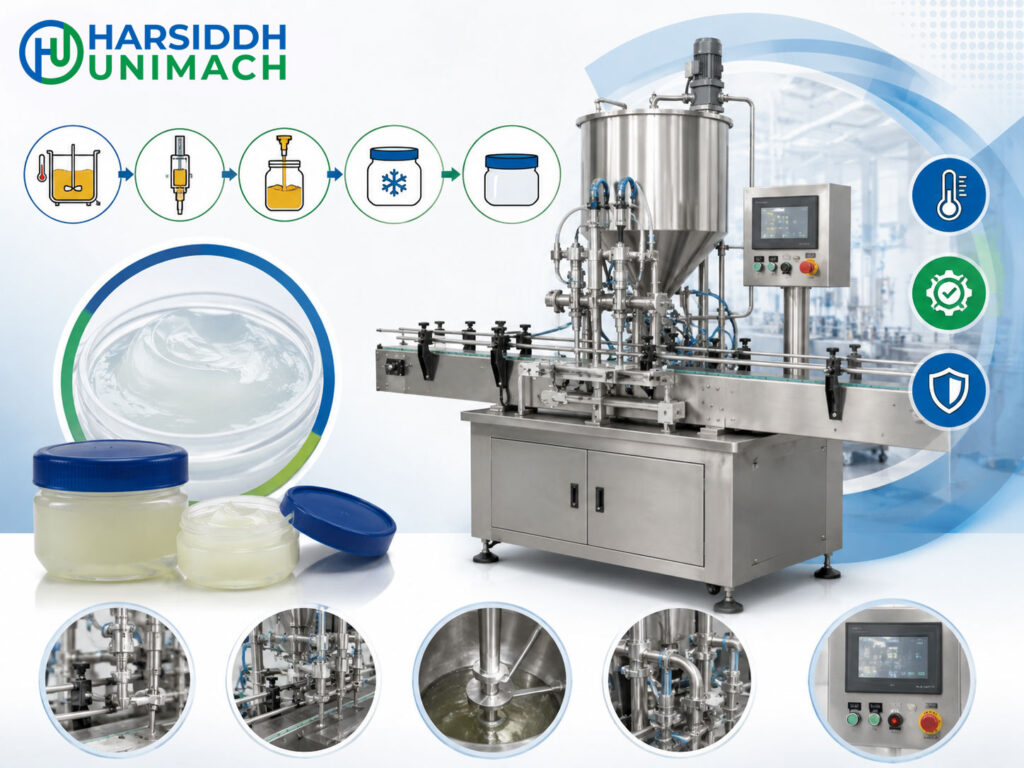
“Jelly” covers a family of products that look similar on the shelf but behave very differently on a filling line. Petroleum jelly is a soft, waxy semi-solid that is usually melted and filled hot into jars, where it sets as it cools. Lubricating jellies, ultrasound gels, hair gels, hand sanitiser gels and aloe gels are water-based gels that are normally filled cold. Medicated jellies and gels sit somewhere in between.
A jelly filling machine has to be set up for the product it is filling. In this article, we explain the working principle for both main approaches: hot filling of petroleum jelly and similar products, and cold filling of gels. We cover how the product is conditioned, how each dose is measured, how containers are filled and closed, and which settings and checks keep the process consistent.
Types of Jelly Products and How They Are Filled
| Product | Base | Usual Filling Method | Typical Containers |
|---|---|---|---|
| Petroleum jelly | Mineral hydrocarbons | Hot filling (melted), sets on cooling | Jars, tubs, tubes |
| Lubricating jelly | Water-based gel | Cold filling | Tubes, bottles, sachets |
| Ultrasound gel | Water-based gel | Cold filling | Bottles, cans |
| Hair gel | Water-based gel | Cold filling | Jars, tubes |
| Sanitiser and aloe gels | Water or alcohol-based | Cold filling | Pump bottles, flip-top bottles |
| Medicated jellies | Various | Cold or warm filling | Tubes, jars |
The petroleum jelly process is the most specialised, so we look at it first.
Hot Filling Petroleum Jelly: The Working Principle
At room temperature, petroleum jelly is a soft semi-solid that is difficult to pump and dose accurately. When heated, it melts into a free-flowing liquid. Hot filling takes advantage of this:
- The jelly is melted to a controlled temperature in a heated tank.
- It is kept liquid in a heated hopper and heated product lines.
- A pump or piston doses a fixed volume into each jar.
- The filled jars cool, and the jelly solidifies with a smooth, glossy surface.
- Jars are capped, labelled and packed once the product has set sufficiently.
Filling as a liquid gives a level, attractive surface in the jar and allows fast, accurate dosing.
Main components of a hot jelly filling machine
- Melting tank – jacketed vessel heated by hot water, thermal oil or electric elements, often with a slow stirrer.
- Heated transfer line – insulated or traced pipework that stops the jelly from setting on its way to the filler.
- Heated hopper or buffer tank – holds the molten jelly at filling temperature above the pumps.
- Dosing pumps – piston pumps or gear pumps, sometimes with heated cylinders.
- Heated nozzles – keep the jelly from solidifying at the tip between fills.
- Container conveyor and indexing system – positions jars under the nozzles.
- Cooling section – an extended conveyor, cooling tunnel or air-cooling zone that allows the jelly to set.
- Capping station – applies lids once the product is ready.
- Temperature controllers – for tank, lines, hopper, pumps and nozzles.
- Control panel – volume, speed, temperatures and interlocks.
See the Automatic Petroleum Jelly Filling Machine and the petroleum jelly filling machine on Harsiddh Engineering.
Step-by-step hot filling process
Step 1: Melting
Petroleum jelly is loaded into the melting tank and heated until fully liquid. A slow stirrer keeps the temperature even. The filling temperature is chosen so the jelly flows freely but does not overheat; the correct value depends on the grade and should be set from the product specification.
Step 2: Transfer and holding
The molten jelly is transferred through heated lines to the filler’s hopper. Every part the product touches, from tank to nozzle, is kept warm. A cold spot anywhere in the system can cause the jelly to set, blocking lines or changing the dose.
Step 3: Jar positioning
Empty, clean jars travel on the conveyor and are stopped under the nozzles by gates or a star wheel. Sensors confirm each position is filled before dosing.
Step 4: Dosing
Each pump delivers a set volume of molten jelly. With piston pumps, the stroke length sets the volume. With servo gear pumps, the volume is set by the number of pump revolutions. Because the product is liquid at this stage, filling is fast and accurate.
Nozzles usually fill from just above or just inside the jar mouth. Filling smoothly, without splashing, gives a clean, level surface.
Step 5: Clean cut-off
Heated nozzles with positive shut-off or suck-back stop the flow cleanly, preventing drips on the jar rim. A clean rim matters both for appearance and for lid fitting.
Step 6: Cooling and setting
Filled jars move slowly along a cooling conveyor or through a cooling zone. As the jelly cools, it solidifies from the outside inwards. Controlled cooling helps produce a smooth, glossy surface without cracks, shrinkage hollows or a cloudy appearance. Jars must not be moved roughly or tilted until the surface has set.
Step 7: Capping and finishing
Once the jelly has set enough, jars are capped, for example on an Automatic Jar Capping Machine. They are then labelled and packed. Capping too early can trap condensation under the lid; capping too late slows the line.
Key settings for hot filling
| Setting | Effect If Too Low | Effect If Too High |
|---|---|---|
| Melting temperature | Jelly not fully liquid, poor flow | Overheating, possible discolouration or odour |
| Line and nozzle temperature | Jelly sets in lines or nozzles | Unnecessary energy use, slower setting |
| Fill volume | Under-filled jars | Overflow, rim contamination |
| Fill speed | Slow output | Splashing, uneven surface |
| Cooling rate | Long cooling, slow line | Cracks, shrinkage, cloudy surface |
| Time before capping | Condensation under lid | Line bottleneck |
Cold Filling Gels and Jellies: The Working Principle
Water-based gels and jellies are usually filled at room temperature. They are viscous, often clear and can trap air bubbles that are clearly visible in transparent packs.
How cold gel filling works
- The gel is transferred from the manufacturing vessel to the filler hopper, gently, to avoid adding air.
- A piston pump or gear pump draws a fixed volume of gel.
- The pump pushes the gel through a nozzle into the container, often a diving nozzle that starts near the bottom and rises with the product to avoid trapping air.
- A shut-off or suck-back stops the flow cleanly.
- Containers move on to capping, sealing and labelling.
See the Automatic Gel Filling Machine and the lotion and gel filling machine.
Air bubble control
Visible air bubbles are the most common quality issue with clear gels. They are reduced by:
- De-aerating the gel during manufacture, for example under vacuum
- Using low-shear transfer and slow stirring
- Filling bottom-up with diving nozzles
- Using a gentle speed profile at the start and end of each fill
- Allowing containers to rest briefly before capping so small bubbles rise
Dosing Technologies for Jelly and Gel
Servo piston fillers
A servo motor drives each piston, allowing digital volume setting, speed profiles and stored recipes. Well suited to viscous gels and jellies. See the Automatic Servo Based Piston Filling Machine and the servo based piston filling machine.
Servo gear pump fillers
A servo-controlled gear pump delivers product continuously, with the dose set by revolutions. Gear pumps suit hot, molten products and larger volumes, and they have no piston seals to wear. See the servo based gear pump filling machine.
Viscous product fillers
For thick oils, jellies and other heavy products, dedicated viscous fillers combine robust pumps with suitable nozzles. See the Automatic Viscous Liquid Filling Machine and the servo based oil and viscous filling machine.
For more on how servo control improves filling, read the working principle of servo based liquid filling machines. For thick products in general, see our high viscous liquid filling machine working principle.
Related viscous products
Many plants that fill jelly also fill other thick products into jars and bottles, such as honey, syrups and edible pastes. The same principles apply: positive displacement dosing, careful temperature control and clean cut-off. For example, the Automatic Honey Filling Machine uses a similar approach for a thick, sticky product, and a single line can often be configured to handle more than one of these products with suitable change parts and settings.
Hot Filling vs Cold Filling
| Aspect | Hot Filling (Petroleum Jelly) | Cold Filling (Gels) |
|---|---|---|
| Product state at filling | Molten liquid | Viscous gel |
| Heating required | Tank, lines, hopper, pumps, nozzles | Usually none |
| Main quality focus | Surface finish after cooling, no cracks | No air bubbles, clarity |
| Cooling stage | Required before capping | Not required |
| Typical pumps | Heated piston or gear pumps | Piston or gear pumps |
| Typical containers | Jars and tubs | Tubes, bottles, jars |
Closing, Sealing and Labelling
After filling, containers are closed according to type:
- Jars and tubs – screw lids, sometimes with an inner liner; see the capping machines for glass and PET bottles
- Bottles – screw caps, flip-tops or pumps, often with a foil seal on an induction sealing machine
- Tubes – heat sealed or crimped on a tube filling machine
Round jars and bottles are then labelled, for example on labeling machines for round bottles.
Petroleum jelly is also a common base for ointments. For the semi-solid side of the range, see our ointment filling machine working principle and the cream and ointment filling machines.
Troubleshooting Common Problems
| Problem | Likely Cause | Corrective Action |
|---|---|---|
| Jelly setting in lines or nozzles | Cold spot in heating | Check tracing, nozzle heaters and controllers |
| Fill weight drifting (hot fill) | Temperature changing in hopper | Stabilise hopper temperature |
| Cracked or sunken surface | Cooling too fast or uneven | Slow and even out cooling |
| Cloudy or dull surface | Cooling conditions, product temperature | Adjust filling and cooling temperatures |
| Drips on jar rims | Weak cut-off, nozzle too cool or too warm | Adjust shut-off, suck-back and nozzle temperature |
| Air bubbles in clear gel | Air in product, top filling | De-aerate, use diving nozzles, slow fill start |
| Light fills (cold gel) | Pump not fully priming | Keep hopper level up, slow piston draw |
| Condensation under lids | Capped too hot | Allow more cooling before capping |
Maintenance Tips
- Check all heaters, temperature sensors and controllers regularly on hot-fill machines.
- Inspect insulation and heat tracing on product lines.
- Clean pumps, valves and nozzles thoroughly; for petroleum jelly, clean while warm so residues remain liquid.
- Inspect piston seals or gear pump wear.
- Verify fill weights at regular intervals and trend them.
- Keep change parts and settings recorded for each container size.
How to Choose a Jelly Filling Machine
- Product type – petroleum jelly (hot fill) or gel (cold fill)
- Containers – jars, tubs, bottles or tubes
- Fill volume range
- Output – number of heads and line speed
- Pump type – piston or gear pump, heated or unheated
- Cooling requirements for hot filling
- Downstream needs – capping, sealing and labelling
- Hygiene and GMP for pharmaceutical or medical gels
Frequently Asked Questions
What is the working principle of a petroleum jelly filling machine? The jelly is melted and kept liquid in heated tanks, lines and hoppers. A pump doses a fixed volume into each jar, and the jelly sets as it cools before the jar is capped.
Why is petroleum jelly filled hot? At room temperature it is a soft semi-solid that is hard to dose accurately. Melted, it flows freely and sets with a smooth surface in the jar.
How are gels filled without bubbles? By de-aerating the gel, transferring it gently, filling bottom-up with diving nozzles and using gentle speed profiles.
Which pump is best for jelly? Piston pumps suit most gels and jellies; servo gear pumps are often preferred for hot, molten products and larger volumes.
When should hot-filled jars be capped? After the jelly has cooled and set enough to avoid condensation under the lid and surface damage.
Need a jelly or gel filling machine? Contact our team or send an inquiry with your product, container and output details.