
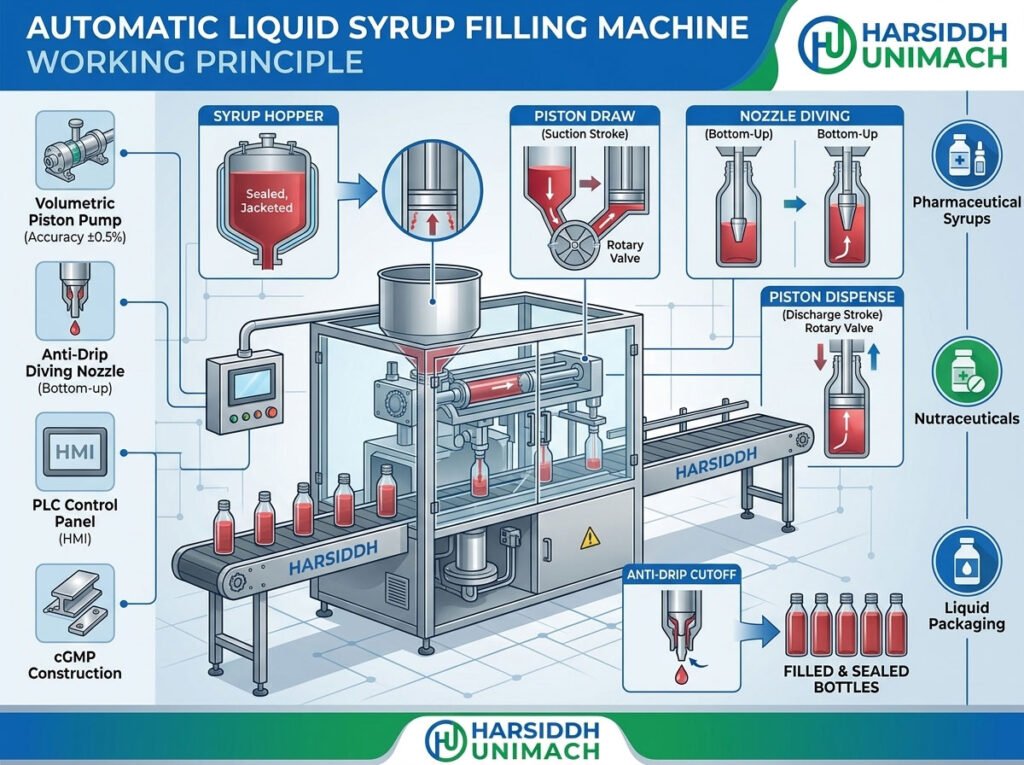
Cough syrups, antacids, paediatric suspensions, multivitamin tonics, antibiotics reconstituted from dry powder and many other oral liquids reach patients in bottles filled on automatic syrup filling machines. These products may look simple, but filling them consistently is a real engineering task: syrups can be thick or thin, clear or full of suspended particles, prone to foaming, and sensitive to temperature changes that alter their viscosity.
An automatic liquid syrup filling machine solves these challenges by combining accurate volumetric dosing, controlled nozzle movement and synchronised bottle handling — usually as part of a complete line that also cleans, caps, seals, labels and packs the bottles.
In this article, we explain how an automatic syrup filling machine works, how it handles different syrup types, what the complete syrup line looks like, which settings matter most and how to troubleshoot common problems. For a shorter overview of the basic principle, see our article on the liquid syrup filling machine working principle.
What Is an Automatic Liquid Syrup Filling Machine?
It is a machine that automatically fills measured volumes of syrup or other oral liquids into bottles — typically glass or PET — with multiple nozzles working in parallel. Bottles are conveyed, positioned, filled and discharged without manual handling, and the filler is usually linked to upstream bottle preparation and downstream capping and labelling equipment.
See the Automatic Liquid Syrup Filling Machine and our range of bottle filling machines for oral liquids.
The Core Working Principle
An automatic syrup filler works on the volumetric principle: each nozzle is connected to a dosing unit that measures a fixed volume of product and pushes it into the bottle. Because the dose is defined by a mechanical volume — a piston stroke or cylinder displacement — it remains consistent even when the syrup’s thickness varies slightly.
Two dosing designs are most common:
1. Volumetric syringe (piston) dosing
Multiple syringe-type cylinders, one per nozzle, are driven together. On the suction stroke, each piston draws syrup from a supply tank through a non-return valve or rotary valve. On the delivery stroke, it pushes the measured volume out through the nozzle into the bottle. Fill volume is set by adjusting the stroke length. See our volumetric bottle liquid filler.
2. Servo-driven piston dosing
Servo motors drive the pistons, so stroke, speed and suck-back are set digitally from the HMI. This allows fast changeovers between bottle sizes, individual nozzle fine-tuning and programmable fill profiles. See our servo based piston filling machine, and read the working principle of servo based liquid filling machines for the engineering details.
Step-by-Step Filling Cycle
Step 1: Bottle arrival
Clean, empty bottles arrive on the conveyor in a single line, spaced by guides.
Step 2: Positioning
Pneumatic stopper gates or a star wheel hold a group of bottles — matching the number of nozzles — directly under the filling head. Sensors confirm each bottle is present.
Step 3: Nozzle entry
The nozzle carriage descends. For foamy or thin syrups, nozzles dive into the bottle and fill from the bottom up; for thick syrups, nozzles may stop just inside the neck.
Step 4: Dosing
The pistons deliver the set volume. On servo machines, a slow-fast-slow profile reduces splashing at the start and foaming at the end.
Step 5: Drip control
At the end of the dose, a short suck-back draws the last drop back into the nozzle, or a shut-off valve closes the tip. This keeps bottle necks clean for capping and labelling.
Step 6: Nozzle withdrawal and release
Nozzles rise clear of the bottles, gates open and filled bottles move on to capping. The next group enters, and the cycle repeats.
No-bottle-no-fill
If a bottle is missing from a position, that nozzle does not dispense — preventing spillage and product loss.
Automatic Syrup Filling: Piston Cycle and Complete Line
Handling Different Types of Syrup
Clear, thin syrups
Flow easily and fill quickly. Diving nozzles and controlled speed prevent splashing and foaming.
Thick, viscous syrups
Need positive-displacement piston dosing, larger nozzles and slower fill speeds. Warming the product within its validated temperature range can also help flow.
Suspensions
Antacids, antibiotic suspensions and many paediatric products contain suspended particles that settle over time. To keep every dose uniform:
- A stirrer or agitator in the supply tank keeps particles evenly distributed
- Valves and nozzles are sized to prevent blockage
- Short, continuous product paths reduce settling between doses
Foamy products
Some syrups trap air and foam when agitated. Bottom-up filling, slow start and finish speeds and reduced agitation in the tank help control foaming.
Temperature-sensitive syrups
Viscosity changes with temperature, which can affect fill weight on some systems. Volumetric piston dosing is less sensitive, but stable product temperature still improves consistency.
The Complete Automatic Syrup Filling Line
In most plants, the filler is one part of an integrated line:
1. Bottle unscrambling
Loose bottles are oriented and fed onto the conveyor by a bottle unscrambler.
2. Bottle cleaning
Bottles are cleaned either with ionised air and vacuum on an automatic bottle airjet and vacuum cleaning machine, or washed with water on a linear bottle washing machine, depending on product and container requirements.
3. Filling
The automatic syrup filling machine doses each bottle.
4. Capping
Most syrup bottles are closed with ROPP (roll-on pilfer-proof) caps, formed onto the bottle thread by rollers, or with screw caps. See the Automatic Six Head Bottle ROPP Capping Machine and read the bottle ROPP capping machine working principle.
5. Measuring cup placement
Many syrups are supplied with a dosing cup placed over the cap. The Automatic Measuring Cup Placement Machine places and presses cups automatically.
6. Induction sealing
Where caps contain a foil liner, an induction sealing machine bonds the foil to the bottle mouth, providing tamper evidence and leak protection.
7. Inspection
Bottles are checked for fill level, cap presence and leaks — manually at a bottle visual inspection table or with automated systems.
8. Labelling and coding
Wrap-around labels with batch and expiry details are applied by machines such as the Automatic Round Bottle Sticker Labeling Machine. See our range of labeling machines for round bottles.
9. Cartoning and packing
Labelled bottles are packed into cartons, often with leaflets and measuring cups, then case-packed for dispatch.
Dry Syrup vs Liquid Syrup
Some antibiotics are supplied as dry syrup — a powder filled into bottles and reconstituted with water by the pharmacist or patient. Dry syrup lines use powder filling machines instead of liquid fillers. Learn more in the dry syrup filling machine working principle.
Key Settings and Their Effects
| Setting | Effect if Incorrect |
|---|---|
| Piston stroke / fill volume | Under- or overfilling |
| Fill speed profile | Splashing, foaming or slow output |
| Nozzle dive depth | Foaming or nozzle contacting product |
| Suck-back | Drips on bottle necks, poor capping or labelling |
| Agitator speed | Uneven suspension or excess foaming |
| Product temperature | Viscosity changes affecting flow |
| Conveyor and gate timing | Bottle jams or mispositioned bottles |
Verifying Fill Accuracy
Syrup bottles are labelled with a declared volume, and every bottle must contain at least that amount — without wasteful overfilling. A typical verification routine includes:
- Start-up check: weigh sample bottles from every nozzle before production begins and adjust any nozzle that is out of limit.
- Regular in-process checks: repeat weighing at defined intervals during the batch and after any stoppage or adjustment.
- Density conversion: because checks are usually done by weight, the product’s density is used to convert the declared volume into a target weight.
- Trend monitoring: recording results over time reveals gradual drift caused by seal wear or temperature changes.
- End-of-batch check: confirms the process remained in control throughout.
Servo machines make corrections easier, because individual nozzles can be fine-tuned from the HMI without stopping to adjust mechanical stops.
Example: A Paediatric Suspension Line
Consider a manufacturer filling a paediatric antibiotic suspension into 60 ml and 100 ml amber PET bottles. The product contains suspended particles, foams if agitated too vigorously and must be dosed accurately.
A practical line would include:
- A bottle unscrambler and air-jet cleaner to prepare the PET bottles
- A servo piston syrup filler with a gently agitated supply tank, diving nozzles and suck-back
- A ROPP capping machine followed by a measuring cup placement machine
- An induction sealer for tamper evidence
- An inspection station and a round bottle labeller
With recipe-based servo settings, switching between 60 ml and 100 ml bottles requires only a few change parts and a recipe selection, while the agitator keeps every dose uniform from the first bottle to the last.
Typical Bottle Formats
Syrup lines most commonly handle round amber glass or PET bottles in sizes from small paediatric volumes up to larger family packs, as well as some flat or oval bottles. Bottle shape and neck size determine guide parts, star wheels, nozzle size and capping heads, so confirming every bottle format at the start of a project is essential.
GMP and Hygiene Considerations
- SS 316L product-contact parts with smooth, polished surfaces
- Quick-release pistons, valves and nozzles for cleaning and inspection
- Validated cleaning procedures between products to prevent cross-contamination
- Documented fill weight checks at defined intervals
- Line clearance between batches, especially for labels and printed materials
- Calibrated balances for fill verification
Troubleshooting Common Problems
| Problem | Likely Cause | Solution |
|---|---|---|
| Fill volume variation | Air in product line, worn piston seals | Prime system, replace seals |
| Dripping nozzles | Suck-back not set, worn valves | Adjust suck-back, service valves |
| Foaming or overflow | Fill speed too high, nozzles not diving | Slow fill, use bottom-up filling |
| Non-uniform suspension doses | Insufficient agitation, settling in lines | Adjust agitator, shorten product path |
| Blocked nozzles | Particles too large for nozzle | Use larger nozzles, check formulation |
| Bottles jamming | Incorrect guides, damaged bottles | Adjust guides, check bottle quality |
| Sticky necks causing label problems | Drips during filling | Fix drip control, clean necks |
Maintenance Tips
- Clean all product-contact parts after each batch or product change
- Inspect and replace piston seals and valve O-rings regularly
- Check nozzles for wear or damage
- Verify fill accuracy at the start of each shift
- Lubricate drive components as specified
- Keep critical spares — seals, valves and nozzles — in stock
How to Choose an Automatic Syrup Filling Machine
- Product types – thin, thick, suspension or foamy
- Bottle sizes and materials – glass or PET, round or flat
- Fill volume range and accuracy
- Output – number of nozzles and line speed
- Dosing technology – volumetric syringe or servo piston
- Line integration – unscrambler, cleaner, capper, cup placer, sealer and labeller
- GMP features and documentation
- Service and spare parts support
Explore our complete range of liquid filling machines.
Frequently Asked Questions
How does an automatic liquid syrup filling machine work? Bottles are positioned under multiple nozzles, and volumetric piston pumps deliver a fixed volume of syrup into each bottle, with drip control and no-bottle-no-fill protection.
Which dosing system is best for syrups? Volumetric piston dosing — either syringe-type or servo-driven — is the most common choice because it handles a wide viscosity range accurately.
How are suspensions filled uniformly? An agitator keeps particles evenly distributed in the supply tank, and nozzles and valves are sized to prevent blockages.
What other machines are part of a syrup line? Typically a bottle unscrambler, bottle cleaner, filler, ROPP or screw capper, measuring cup placer, induction sealer, inspection station and labeller.
How is foaming controlled? By filling from the bottom up with diving nozzles, using slower start and finish speeds and limiting agitation.
Planning a new syrup filling line? Contact our team or send an inquiry to discuss your products and bottles.