
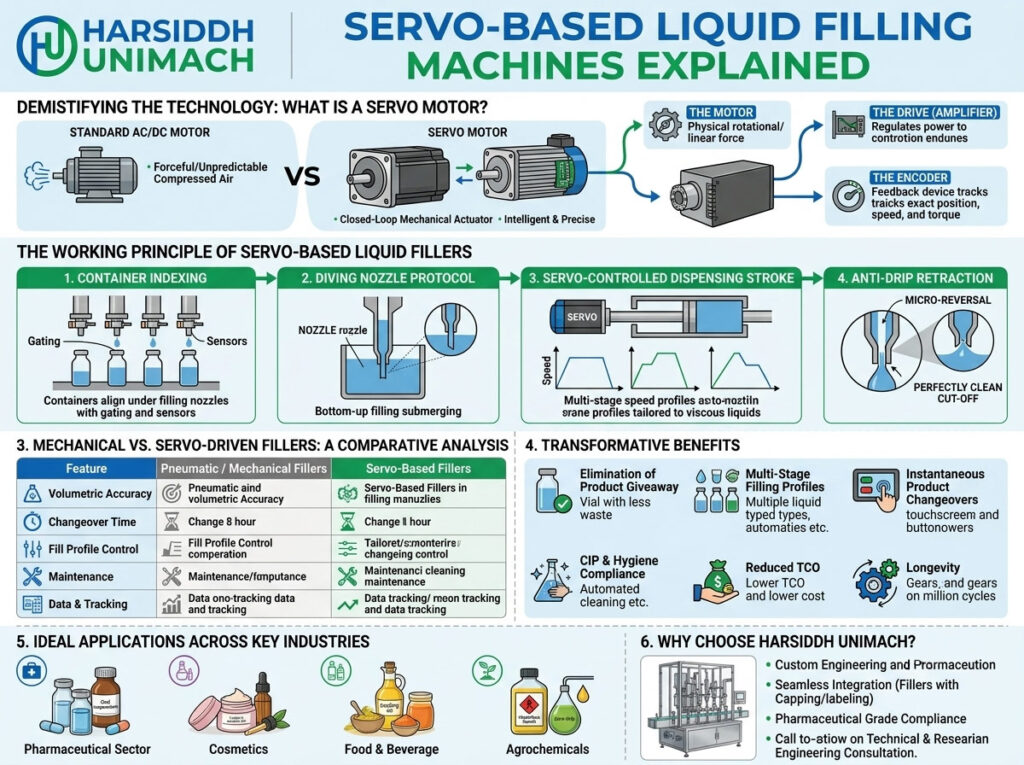
Ask any production manager what they want from a liquid filling machine and the answers are usually the same: accurate fills, fast changeovers, reliable operation and minimal waste. For many manufacturers, the technology that delivers all of these is the servo based liquid filling machine.
Servo fillers have become the standard choice across pharmaceuticals, cosmetics, food, chemicals and personal care. They replace mechanical linkages and pneumatic cylinders with precisely controlled servo motors, allowing fill volumes, speeds and nozzle movements to be set and stored digitally.
This guide explains what servo based liquid filling machines are, the main types available, the benefits they bring, where they are used, what they cost to own and how to choose the right one for your plant. If you want a detailed look at the engineering inside the machine, read our companion article on the working principle of servo based liquid filling machines.
What Is a Servo Based Liquid Filling Machine?
A servo based liquid filling machine uses one or more servo motors to drive the dosing system — and often other motions such as nozzle movement — under electronic control. A servo motor works with a feedback device and a drive that constantly checks the motor’s actual position and corrects it, so every movement is precise and repeatable.
In practice, this means the operator simply enters the required fill volume and speed on the touchscreen. The machine calculates the exact motor movement needed and repeats it, container after container, with consistent results.
If you are new to filling machines in general, our complete beginner’s guide to liquid filling machines is a good place to start.
How Servo Fillers Differ From Conventional Machines
| Feature | Pneumatic / Mechanical Filler | Servo Based Filler |
|---|---|---|
| Volume adjustment | Manual screws, stops or stroke settings | Entered on HMI |
| Repeatability | Affected by air pressure and wear | High, controlled by feedback |
| Fill speed control | Limited | Fully programmable profiles |
| Changeover | Manual, slower | Recipe-based, fast |
| Nozzle movement | Fixed stroke | Programmable dive and rise |
| Data and diagnostics | Minimal | Alarms, counts, recipe history |
| Initial cost | Lower | Higher |
| Long-term operating cost | Higher giveaway and downtime | Lower giveaway and downtime |
Main Types of Servo Based Liquid Filling Machines
Servo control can be combined with different dosing technologies. The right type depends on your product.
1. Servo piston filling machines
A servo motor drives the piston that draws product into a cylinder and pushes it out through the nozzle. Because the piston positively displaces the product, servo piston fillers handle a very wide viscosity range — from thin syrups to thick creams and pastes.
Best for: pharmaceutical syrups and suspensions, lotions, creams, gels, sauces, honey and viscous chemicals.
See the Automatic Servo Based Piston Filling Machine and our servo based piston filling machine.
2. Servo gear pump filling machines
A servo motor turns a gear pump a precise number of revolutions. Each revolution delivers a known volume with smooth, low-pulsation flow, making these machines ideal for continuous, high-speed filling.
Best for: edible oils, lubricants, liquid detergents, shampoos and medium-viscosity liquids.
See our servo based gear pump filling machine and our servo based oil and viscous filling machine, as well as the Automatic Servo Based Oil Filling Machine.
3. Servo peristaltic filling machines
A servo motor drives the rollers of a peristaltic pump, which squeeze a flexible tube to move the product. The product only touches the tubing, which can be single-use.
Best for: small volumes, sterile products, eye and ear drops, injectables, diagnostics and high-value liquids.
See our peristaltic based liquid filling machine.
4. Servo multi-nozzle inline fillers
Several servo-driven dosing heads work in parallel on an inline conveyor, filling multiple containers per cycle. The number of nozzles can be chosen to match required output. See the Automatic Servo Based Liquid Filling Machine.
5. Servo monoblock filling and capping machines
Filling and capping are combined on one base, with servo control for dosing and often for container handling. Monoblocks save floor space and reduce transfers between machines. See our liquid bottle filling and capping machine (monoblock).
Key Benefits of Servo Based Liquid Filling Machines
1. High accuracy and repeatability
Closed-loop servo control repeats the same motion precisely on every cycle, and individual nozzles can be fine-tuned from the HMI. This keeps fills consistently close to target.
2. Lower product giveaway
Because variation is lower, fill targets can be set closer to the declared quantity without risk of underfilling. Over thousands of containers per day, this reduces product giveaway significantly.
3. Fast, simple changeovers
Fill volumes, speeds and nozzle profiles are stored as recipes. Switching products or container sizes means selecting a recipe and fitting a few change parts, rather than mechanically adjusting every pump. Our article on improving liquid filling machine changeover time explains how to make the most of this.
4. Programmable fill profiles
Servo machines can start slowly to avoid splashing, speed up in the middle of the fill and slow again at the end. Combined with diving nozzles that fill from the bottom up, this controls foaming in products such as shampoos, detergents and sanitisers.
5. Clean, drip-free filling
A controlled suck-back at the end of each dose draws the last drop back into the nozzle, keeping containers, conveyors and capping areas clean.
6. Wide product range
One machine can often handle many products and volumes, simply by changing recipes and, where needed, nozzles or pistons.
7. Less dependence on air supply
Unlike pneumatic fillers, whose accuracy can vary with compressed air pressure, servo fillers use electrical drives for dosing, making them more consistent and often reducing compressed air consumption.
8. Better data and diagnostics
Servo drives and PLCs record alarms, production counts and settings, helping teams troubleshoot faster and supporting quality documentation.
Applications Across Industries
Pharmaceuticals
Oral syrups, suspensions, antacids, eye and ear drops and other liquid medicines require precise dosing and GMP construction. Servo piston and peristaltic fillers are widely used. See our bottle filling machines for oral liquids.
Cosmetics and personal care
Shampoos, conditioners, lotions, serums, hair oils and gels need accurate filling and an attractive, consistent fill level. Examples include the Automatic Shampoo Filling Machine, our cosmetic bottle filling machine and our lotion and gel filling machine.
Food and beverages
Edible oils, sauces, syrups, honey and dairy products benefit from servo fillers’ accuracy and hygienic design.
Chemicals and home care
Detergents, disinfectants, floor cleaners and lubricants are filled accurately and cleanly, with materials chosen for chemical compatibility.
What Does a Servo Filler Cost to Own?
Servo based machines usually have a higher purchase price than pneumatic or mechanical fillers. However, the total cost of ownership is often lower because of:
- Reduced product giveaway from tighter accuracy
- Shorter changeovers, increasing productive hours
- Fewer rejects and spills
- Less mechanical wear and adjustment
- Lower dependence on skilled mechanical setters
To build a business case for your own plant, use our guide on how to calculate filling machine ROI.
A Practical Example: Switching From Pneumatic to Servo
Consider a mid-sized manufacturer filling three syrup products in 60 ml, 100 ml and 200 ml bottles on a pneumatic piston filler. Every changeover requires an experienced setter to adjust each piston stroke by hand, run test fills and fine-tune until weights are within limits. Air pressure fluctuations during the shift cause fill weights to drift, so operators set targets slightly high to stay safe — giving away product on every bottle.
After moving to a servo piston filler, the operator selects the product recipe on the HMI, fits the correct change parts and runs a short verification check. Fill weights stay stable throughout the shift because dosing no longer depends on air pressure. With less variation, the quality team can approve a target closer to the declared volume. The result is faster changeovers, less giveaway, fewer adjustments and more predictable output — the typical pattern seen when plants make the switch.
Features to Look For in a Servo Filler
When comparing machines, look for:
- Individual nozzle fine-tuning from the HMI
- Programmable fill profiles (speed ramps at the start and end of the dose)
- Diving nozzles with adjustable dive depth and rise speed
- Suck-back or shut-off nozzles for drip-free filling
- No-bottle-no-fill sensing to prevent spills
- Recipe storage with password-protected access levels
- Tool-less or quick-release change parts
- Contact parts in materials suited to your product (SS 316L for pharmaceutical and food use)
- Easy disassembly for cleaning and inspection
- Alarm history and production counters
- Compatibility with upstream and downstream equipment, including line synchronisation
Where Servo Filling Is Heading
Servo technology continues to evolve. Increasingly, servo fillers are linked to inline check-weighers that automatically correct each nozzle’s dose, reducing manual checks. Drive data is being used for predictive maintenance, warning of seal or pump wear before accuracy suffers. Connectivity with plant systems allows production and quality data to be collected automatically. These developments make servo fillers not only more accurate, but also smarter and easier to manage over their working life.
How to Choose the Right Servo Filling Machine
1. Understand your product
Viscosity, foaming, particles, temperature sensitivity and sterility requirements determine whether a piston, gear pump or peristaltic system is best.
2. Define fill volumes and accuracy
List the full range of volumes you need now and in future, and the accuracy required for each.
3. Calculate output
Determine how many containers per minute you need, based on realistic operating hours and efficiency, and choose the number of nozzles accordingly.
4. Consider containers
Bottle shapes, neck sizes and materials affect nozzle design, container handling and change parts.
5. Plan the line
A filler works with unscramblers, cappers, sealers and labellers. Make sure speeds and controls are matched.
6. Check hygiene and compliance
Pharmaceutical and food applications need suitable contact materials, cleanable design and documentation.
7. Evaluate service and support
Ask about spare parts availability, training, remote support and the supplier’s experience with similar products.
Common Mistakes to Avoid
- Choosing the wrong dosing technology for the product’s viscosity or sterility needs
- Buying for today’s volume only, leaving no capacity for growth
- Ignoring downstream equipment, so capping or labelling becomes the bottleneck
- Skipping product trials — testing your actual product reveals foaming or dripping issues early
- Neglecting operator training on recipes and fine-tuning
Maintenance Tips for Servo Fillers
- Clean product-contact parts after each batch or product change
- Inspect piston seals, pump gears or peristaltic tubing regularly
- Verify fill accuracy at the start of each shift by weighing samples
- Keep electrical cabinets clean and cool, and check cables on moving parts
- Back up recipes and machine parameters
- Keep critical spares — seals, tubing, nozzles and sensors — in stock
Frequently Asked Questions
What is a servo based liquid filling machine? It is a filling machine that uses servo motors to control dosing and other motions electronically, providing precise, repeatable fills and easy adjustment from a touchscreen.
What are the main types of servo fillers? Servo piston, servo gear pump, servo peristaltic, multi-nozzle inline fillers and servo monoblock filling and capping machines.
Are servo fillers suitable for thick products? Yes. Servo piston fillers in particular handle a wide viscosity range, from thin liquids to creams and pastes.
Is a servo filler worth the higher price? For most manufacturers, yes. Savings from reduced giveaway, faster changeovers and fewer rejects often recover the price difference quickly.
Can one servo machine fill different products? Often, yes. By selecting recipes and changing a few parts, a servo filler can handle a range of products and container sizes.
Looking for the right servo based liquid filling machine? Explore our liquid filling machines and the full range of liquid filling machines on Harsiddh Engineering, contact our team or send an inquiry.