
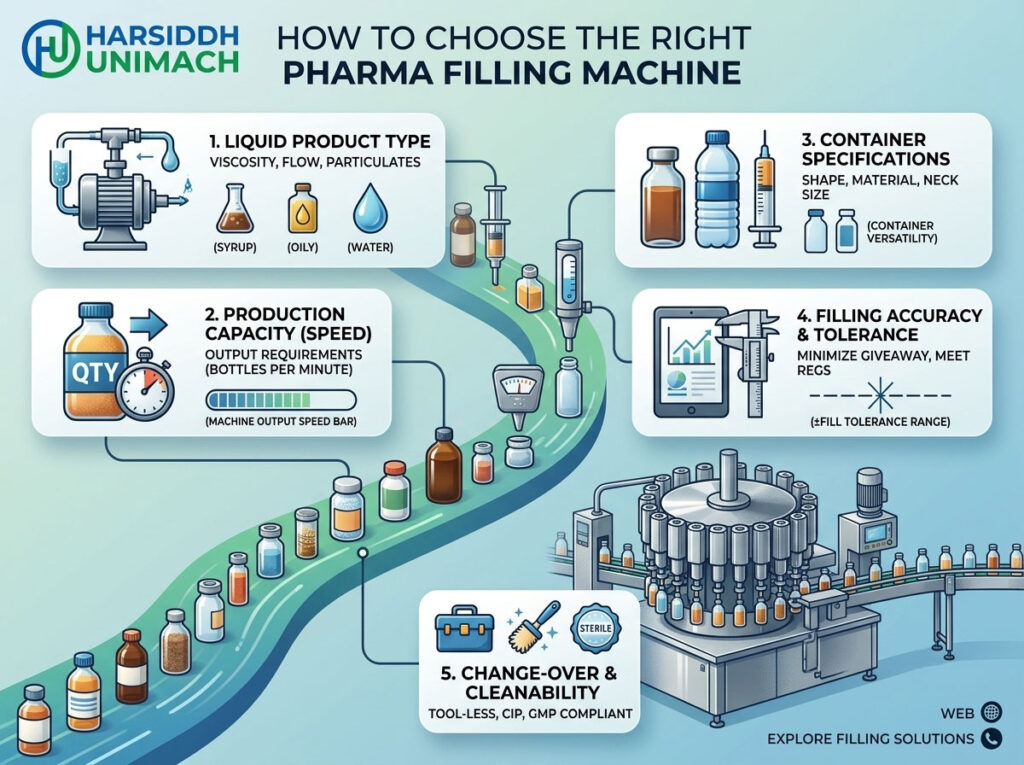
At the heart of every filling machine is its dosing system: the mechanism that measures out the product and delivers it into the container. Two machines can look similar from the outside yet use completely different dosing principles, and the choice between them affects accuracy, speed, product loss, cleaning, changeover time and even whether the machine can handle your product at all.
Pharmaceutical manufacturers can choose from several established filling technologies: piston, peristaltic, gravity, gear pump, auger, volumetric powder dosing and pressure filling for aerosols, among others. Each has strengths and limitations, and each suits certain products better than others.
This guide explains how to choose the right filling technology for your pharmaceutical product. It describes how each technology works in practical terms, which products it suits, its main advantages and limitations, and finishes with a decision matrix based on product properties.
This article is part of a series. Other guides help you choose by container type and by level of automation. For in-depth comparisons within a category, see our articles on liquid filling machine technologies and types of powder filling machines.
Start With Your Product’s Properties
The right filling technology depends mainly on the product. Before comparing machines, describe your product in these terms:
| Property | Why It Matters |
|---|---|
| Physical form | Liquid, semi-solid, powder or pressurised product |
| Viscosity | Thin liquids flow easily; thick products need positive displacement |
| Flow behaviour | Foaming, stringing, dripping, bridging (powders) or settling |
| Particles | Suspensions or products with particles can damage some pumps |
| Sterility | Product path must be sterilisable or disposable |
| Shear sensitivity | Some biologics and emulsions are damaged by high shear |
| Value | High-value products need minimal loss and high accuracy |
| Fill volume or weight | Small doses need high precision; large fills need speed |
| Temperature | Some products must be filled warm or cool |
With this profile in hand, you can match the product to the technologies that suit it.
Liquid Filling Technologies
Piston Filling
How it works: a piston moves inside a cylinder, drawing product in on the suction stroke and pushing it out on the delivery stroke. Valves, often rotary valves, direct the flow. The fill volume is set by the stroke length.
Best for: a wide range of viscosities, from thin solutions to syrups, creams and ointments; injectables where accurate volumetric dosing is needed.
Advantages:
- high accuracy and repeatability
- handles viscous products well
- volume easily set, especially with servo drives
Limitations:
- more parts to dismantle and clean than a peristaltic system
- seals and valves wear and need replacement
- may not suit products that are abrasive or contain large particles, depending on design
An automatic servo based piston filling machine combines piston dosing with programmable control of stroke and speed.
Peristaltic Filling
How it works: product flows through flexible tubing. Rollers on a rotating pump head squeeze the tubing, pushing a defined volume of product forward. The product touches only the tubing, never the pump.
Best for: sterile liquids, small volumes, high-value products and multi-product operations where cross-contamination must be avoided.
Advantages:
- product contacts only the tubing, which can be disposable or dedicated
- very fast, simple changeovers
- reduced cleaning and cleaning validation effort
- gentle on many shear-sensitive products
Limitations:
- tubing wears and must be replaced
- accuracy can vary as tubing ages, so monitoring is important
- less suitable for very viscous products or very large volumes
An automatic peristaltic based liquid filling machine applies this principle to bottle filling. Our article on peristaltic vs piston pumps for vial lines compares the two most common injectable dosing systems in detail.
Gravity Filling
How it works: product flows from an elevated tank through valves and nozzles into containers. Fill volume is controlled by the time the valve stays open or by the level in the container.
Best for: thin, free-flowing liquids such as oral solutions and some syrups.
Advantages:
- simple design with few moving parts
- low cost and easy maintenance
- gentle on the product
Limitations:
- accuracy depends on consistent viscosity, temperature and tank level
- not suitable for viscous products
- slower for larger volumes
A gravity based liquid filling machine suits thin oral liquids.
Gear Pump Filling
How it works: two meshing gears rotate inside a housing, carrying product from the inlet to the outlet. Fill volume is controlled by the number of revolutions, typically with a servo motor.
Best for: medium to high-viscosity liquids, continuous flow applications and products that need fast filling of larger volumes.
Advantages:
- smooth, continuous flow
- good accuracy with servo control
- handles a range of viscosities
Limitations:
- not ideal for products with abrasive particles
- more product-contact surfaces to clean than peristaltic
A servo based gear pump filling machine is one example.
Flow Meter and Time-Pressure Filling
Some machines measure product with mass or volumetric flow meters, or control the fill by time under constant pressure. These systems offer clean product paths and suit certain thin liquids, though they are less common for viscous pharmaceutical products. Our liquid filling technologies comparison, linked above, covers them in more detail.
Semi-Solid Filling Technologies
Creams, ointments and gels are usually filled with piston fillers, often with heated and stirred hoppers to keep the product at the right consistency. For tubes, the filler is combined with tube orientation and sealing:
- an automatic aluminium tube filling machine crimps metal tubes after filling
- laminated and plastic tubes are heat-sealed
Key technical points are clean cut-off at the end of the fill to avoid tails, accurate dosing of thick products and suitable hopper design. Browse our cream and ointment filling machines.
Powder Filling Technologies
Auger Filling
How it works: a rotating screw (auger) inside a funnel delivers powder into the container. Fill quantity is controlled by the number of auger rotations.
Best for: dry syrups, oral powders and many non-free-flowing or free-flowing powders.
Advantages:
- handles a wide range of powders
- accurate when powder density is consistent
- good dust control with proper design
Limitations:
- accuracy depends on consistent bulk density
- auger and funnel must be matched to the powder and fill size
Examples include an automatic auger type powder filling machine. See our full range of dry powder filling machines.
Volumetric Wheel (Disc) Filling for Sterile Powders
How it works: a rotating wheel with precisely sized cavities picks up powder from a hopper, often with vacuum assistance, and discharges it into vials, usually followed immediately by stoppering.
Best for: sterile injectable powders in vials.
Advantages:
- designed for small, accurate powder doses in vials
- integrates filling and stoppering
Limitations:
- cavity size sets the dose, so different doses may need different wheels or adjustment
- requires careful control of powder properties and environment
Options include an automatic single wheel volumetric injectable vial dry powder filling and stoppering machine and a double wheel injectable dry powder filling machine with vial rubber stoppering for higher output.
Pressurised Product Filling
Some pharmaceutical and healthcare products, such as topical sprays, are packed in aerosol cans. Aerosol filling involves filling the product concentrate, crimping the valve and filling propellant under pressure, often in separate stages. These machines have specific safety requirements, particularly for flammable propellants. See our range of aerosol filling machines.
Technology Comparison Summary
| Technology | Product Types | Accuracy | Changeover and Cleaning | Typical Pharma Use |
|---|---|---|---|---|
| Piston | Thin to viscous liquids, creams | High | Moderate | Injectables, syrups, creams |
| Peristaltic | Thin to medium liquids | High at small volumes | Very fast | Sterile liquids, high-value products |
| Gravity | Thin liquids | Moderate | Easy | Oral liquids |
| Gear pump | Medium to high viscosity | Good with servo | Moderate | Viscous liquids, larger volumes |
| Auger | Powders | Good with consistent density | Moderate | Dry syrups, oral powders |
| Volumetric wheel | Sterile powders | Good for small doses | Moderate | Injectable powders in vials |
| Aerosol (pressure) | Pressurised products | Good | Specialised | Topical sprays |
Decision Matrix by Product Property
| If Your Product Is… | Consider… | Avoid or Check Carefully… |
|---|---|---|
| Thin, free-flowing liquid | Gravity, peristaltic, piston | — |
| Viscous liquid or syrup | Piston, gear pump | Gravity |
| Cream, ointment or gel | Piston with suitable hopper | Gravity, peristaltic |
| Sterile liquid, small volume | Peristaltic, piston | Gravity |
| High-value or shear-sensitive | Peristaltic or carefully designed piston | High-shear systems |
| Foaming | Bottom-up filling with piston or servo control | Fast top filling |
| Containing particles | Suitable piston design | Pumps sensitive to particles |
| Multi-product with frequent changeovers | Peristaltic, quick-release piston | Systems with many hard-to-clean parts |
| Free-flowing or non-free-flowing powder | Auger | — |
| Sterile powder in vials | Volumetric wheel | Non-sterile powder fillers |
Use this matrix as a starting point, then confirm with trials on your actual product.
Other Factors That Influence the Technology Choice
Fill Volume Range
Small volumes need precise systems, such as peristaltic or small-bore piston pumps. Large volumes need systems that fill quickly without splashing. If your range is very wide, ask whether one technology covers it or whether different pump sizes are needed.
Accuracy Requirements
Tighter accuracy reduces overfill and product loss, which is especially valuable for expensive products. Ask suppliers for accuracy data at your fill volumes with your product.
Cleaning and Changeover
If you run many products, technologies with simple or disposable product paths save time and reduce cross-contamination risk.
Sterility
Sterile products need product paths that can be sterilised or are supplied sterile. Peristaltic tubing and removable piston pumps are both used in sterile filling.
Integration With Containers and Closures
The filling technology must work with your containers and closure equipment. For example, an automatic eye and ear drop filling line combines precise small-volume dosing with plugging and capping.
Test Before You Decide
Product behaviour in a real machine can differ from expectations. Before committing:
- arrange trials with your product, or a close equivalent, on the technologies you are considering
- measure accuracy at your smallest and largest fill volumes
- observe foaming, dripping, stringing or powder flow
- check how easy the system is to clean and change over
Trials are the most reliable way to confirm that a technology suits your product.
Common Mistakes When Choosing Filling Technology
- Choosing by machine price, not product fit. A cheaper technology that does not suit the product causes ongoing losses.
- Ignoring viscosity changes. Products that thicken when cool may need temperature control or a different technology.
- Underestimating cleaning. Complex product paths add changeover time in multi-product plants.
- Assuming one technology suits all products. Plants with mixed portfolios may need more than one type.
- Skipping trials. Brochure accuracy figures may not reflect your product.
Frequently Asked Questions
Which filling technology is most accurate? Piston and peristaltic systems typically offer high accuracy, but the best choice depends on your product, volume and conditions.
Is peristaltic filling suitable for viscous products? It suits thin to medium viscosity products. Very viscous products are usually better filled with piston or gear pumps.
Can one machine handle both liquids and powders? Generally no. Liquids and powders need different dosing systems and usually different machines.
What is the best technology for sterile injectables? Piston and peristaltic systems are both widely used. The choice depends on product properties, volume, value and cleaning or sterilisation strategy.
How do I fill a foaming product? Bottom-up filling, slower fill profiles and servo control help reduce foaming. Trials will show the best approach.
Find the Right Filling Technology With Harsiddh
Harsiddh Unimach manufactures piston, peristaltic, gravity, gear pump, auger, volumetric powder and aerosol filling machines, along with complete lines for vials, ampoules, bottles, tubes and powders. Explore our full range of liquid filling machines, or share your product details with our team for a technology recommendation and trial.
Contact us through our contact page or send your requirements through our inquiry form.