
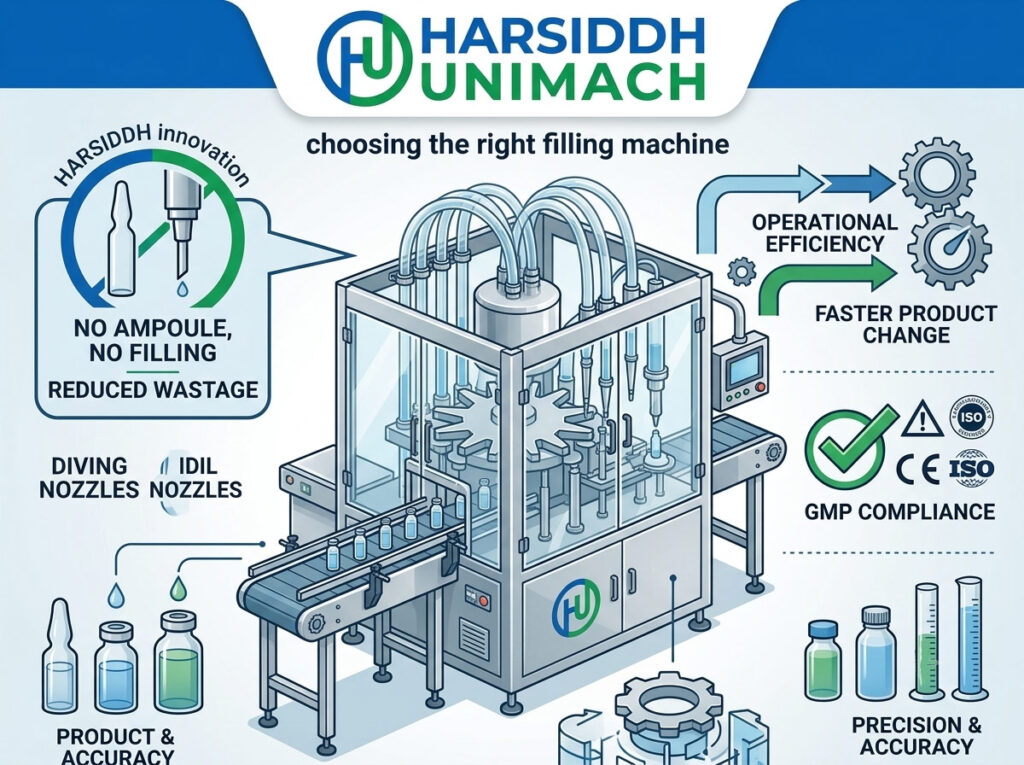
In a pharmaceutical plant, few equipment decisions have as long-lasting an effect as the choice of filling machine. A filler is typically used for many years. Over that time it will handle millions of doses, run through countless batches and changeovers, face regulatory inspections and shape what products the plant can make and how profitably it can make them.
When the choice is right, the filler quietly does its job: accurate doses, steady output, smooth inspections and room to grow. When it is wrong, the problems show up everywhere, from rejected batches and investigations to missed deliveries, high waste and expensive modifications.
This article explains why choosing the right filling machine is so important for pharmaceutical production. Rather than a step-by-step buying guide, it looks at the impact of the decision on quality, compliance, cost, capacity, flexibility and growth, highlights the warning signs of a poor fit and summarises how to get the decision right.
If you are ready to start the selection itself, our article on the filling machine buying process, supplier evaluation and total cost walks through it step by step.
The Filling Machine: Where Product Becomes a Medicine Pack
Up to the filling step, a pharmaceutical product exists as bulk material in a tank or hopper. At the filler, it becomes individual doses in containers that will reach patients. That makes the filler the point where:
- the dose is set for every patient
- the product is most exposed to contamination
- the most valuable material on the line is handled
- the speed of the whole line is usually decided
Because so much happens at this one machine, its suitability affects nearly every measure of plant performance.
Impact 1: Product Quality and Patient Safety
The most important reason to choose the right filler is the patient. A filler that does not suit the product can cause:
- Dose variation: if the dosing system is not suited to the product’s viscosity, flow or volume, fill quantities drift.
- Contamination: poor hygienic design, unsuitable materials or too many manual interventions increase the risk of particles or microorganisms.
- Container damage: rough handling can chip glass, creating particles and leaks.
- Closure failures: if stoppering, sealing or capping is not matched to the container, closures may leak or fail.
For sterile products, the stakes are highest. A machine designed for sterile filling, with a protected filling zone, sterilisable product path and minimal interventions, is essential. Our guide to choosing filling machines for sterile and non-sterile production explains the differences.
Impact 2: Regulatory Compliance
Regulators expect filling equipment to be suitable for its intended use, qualified, cleanable and controlled. A poorly chosen machine can make compliance difficult or impossible:
- surfaces and parts that are hard to clean make cleaning validation challenging
- unsuitable materials may lack certificates or react with the product
- lack of controls, such as no-container, no-fill or reject functions, increases error risk
- frequent jams lead to undocumented interventions
- missing documentation delays qualification
These issues can lead to inspection findings, delayed approvals and, in serious cases, product recalls. Our article on the importance of GMP compliance in filling lines explores these requirements in detail.
Impact 3: Operating Cost
The purchase price of a filling machine is often small compared with its lifetime operating cost. The right machine reduces:
- Product loss: accurate dosing allows lower overfill, and good drip control reduces waste. For high-value products such as biologics, even small savings per container add up.
- Rejects and rework: consistent filling and closing mean fewer rejected containers.
- Labour: appropriate automation reduces the number of operators needed and the time spent on adjustments.
- Maintenance: robust design and readily available spare parts reduce repair costs and downtime.
- Utilities and consumables: efficient design uses less compressed air, power and disposables.
A machine that is cheaper to buy but wastes product, stops often or needs constant adjustment usually costs more over its life.
Impact 4: Capacity and Delivery Performance
A filler that is too slow for demand becomes a permanent bottleneck. The plant runs extra shifts, delays other products and struggles to meet delivery commitments. A filler that is far too fast, on the other hand, ties up capital and may be harder to clean and change over.
The right machine is sized for realistic demand, including expected growth, with an honest assumption for line efficiency. Our technical guide to sizing and selecting a filling machine shows how to calculate the speed and number of heads you need.
Impact 5: Flexibility and Changeover Time
Many pharmaceutical plants run several products, fill volumes and container sizes on the same equipment. A filler that changes over slowly can lose more production time to changeovers than to anything else.
The right machine for a multi-product plant offers:
- quick-release product-contact parts
- disposable product paths where suitable, such as on an automatic peristaltic based liquid filling machine
- stored recipes for fill volumes and settings
- change parts for every container size in the range
For a plant running one product in high volume, flexibility matters less than speed and reliability. Matching the machine to your product mix is what counts.
Impact 6: Growth and Future Products
A filler bought today will still be in use when your product portfolio has changed. The right choice considers:
- products in development that may need different filling technology
- new container sizes or types
- possible export markets with different requirements
- future capacity needs
A machine with a wider volume range, extra format capability or the option to add heads can save you from buying a new machine within a few years.
Impact 7: People and Working Conditions
The filler affects the people who run it every day. A machine that is hard to set up, frequently jams or needs awkward cleaning creates frustration, fatigue and higher risk of mistakes. A well-designed machine with clear controls, safe guarding and easy access helps operators work accurately and safely, and makes training simpler.
Impact 8: Reputation and Customer Trust
For contract manufacturers in particular, filling performance directly affects customer relationships. On-time delivery, consistent quality and smooth audits build trust and win repeat business. Quality problems or delays caused by unsuitable equipment can damage that trust quickly.
Summary: The Ripple Effect of the Filling Machine Choice
| Area | Right Filling Machine | Wrong Filling Machine |
|---|---|---|
| Quality | Consistent doses and closures | Variation, defects, rejects |
| Patient safety | Low contamination and error risk | Higher risk of harm |
| Compliance | Smooth qualification and inspections | Findings, delays, possible recalls |
| Cost | Low waste and maintenance | High waste, repairs, labour |
| Capacity | Meets demand with margin | Bottleneck or idle capacity |
| Flexibility | Fast changeovers | Long, error-prone changeovers |
| Growth | Supports new products | Limits the portfolio |
| People | Safe, easy operation | Frustration, fatigue, errors |
| Reputation | Reliable supply and quality | Delays and complaints |
Warning Signs That a Filling Machine Is the Wrong Fit
If you already have a filler, these signs suggest it may not suit your current needs:
- Fill weights or volumes regularly drift or fail checks.
- Overfill targets are high to avoid underfills.
- The filler is always the bottleneck, and extra shifts are common.
- Changeovers take much longer than planned.
- Jams and minor stops are frequent.
- Cleaning is difficult or cleaning validation is challenging.
- Spare parts are slow to arrive or hard to find.
- The machine cannot handle new products or containers.
- Operators rely on “tricks” to keep it running.
- Inspection findings relate to the filling step.
If several of these apply, it may be time to review whether upgrading, adding capacity or replacing the machine is the right move.
How to Get the Decision Right
The detailed process is covered in our other guides, but the key principles are:
Start From the Product
Understand the product’s properties: viscosity, foaming, sensitivity and sterility. Then choose a filling technology that suits it. Our guide to choosing the right filling machine by dosage form explains how.
Match the Container and Closure
The container decides much of the machine design. Examples include:
- Sterile powders in vials: an automatic servo based injectable vial dry powder filling and stoppering machine or an injectable dry powder vial filling and rubber stoppering machine
- Ampoules: from an automatic lab-scale ampoule filling and sealing machine for development work to a four head closed ampoule filling and sealing machine for production
- Eye drops: an automatic eye and ear drop filling line
- Oral liquids: a gravity based liquid filling machine or a liquid bottle filling and capping monoblock
- Dry syrups: an automatic dry syrup powder filling line
- Creams and ointments: an automatic lami tube filling machine or, for smaller batches, a semi-automatic plastic tube filling machine
Size for Real Demand
Calculate the speed you need from demand, working hours and realistic efficiency, and allow for growth.
Think About the Whole Line
The filler must work with washers, cappers, sealers such as an induction sealing machine, and labeling machines. Matched speeds and smooth transfers are essential.
Compare Total Cost, Not Just Price
Include product loss, maintenance, labour, downtime and spare parts over the machine’s life.
Test Before You Buy
Trials with your product and containers, and a thorough Factory Acceptance Test, confirm the machine performs as expected before it reaches your plant.
Choose a Supplier, Not Just a Machine
Look for experience with similar products, good documentation, training, spare parts and responsive service.
Upgrade, Add Capacity or Replace?
If an existing filler shows several warning signs, there are usually three options. Each suits a different situation.
| Option | When It Makes Sense | Points to Consider |
|---|---|---|
| Upgrade the existing machine | The basic design suits the product, but parts, controls or dosing need improvement | Lower cost; limited by the original design; needs change control and possibly requalification |
| Add a second machine | Demand has grown, but the existing filler still performs well | More capacity and a backup; needs space, operators and cleaning time |
| Replace the machine | The dosing technology, design or capacity no longer suits your products | Higher investment; latest technology; full qualification needed |
Before deciding, gather data: output, downtime by cause, reject rates, fill accuracy trends, changeover times and maintenance costs. This turns the discussion from opinion into facts and makes it easier to justify the investment to management.
Questions Management Should Ask Before Approving a Filler
A filling machine is a significant capital investment, so decision-makers should be comfortable with the answers to these questions:
- Does the machine suit every product and container we plan to run?
- Is the speed based on our product and realistic efficiency, not headline figures?
- What is the total cost of ownership over the machine’s life?
- What documentation and qualification support are included?
- How quickly can the supplier provide spare parts and service?
- Does the choice support our growth plans for the next five to ten years?
Frequently Asked Questions
Why is the filling machine so important compared with other machines? It sets the dose, handles the most valuable material, carries the highest contamination risk and often limits line speed.
Can a wrong filling machine be fixed? Sometimes, through modifications, new change parts or upgrades. But fundamental mismatches, such as the wrong dosing technology or a non-sterile design for a sterile product, usually require a different machine.
How long does a pharmaceutical filling machine last? With good maintenance and spare parts support, many years. That is why it is important to plan for future needs.
Is it better to buy a more expensive machine? Not necessarily. The best machine is the one that matches your product, container, volume and compliance needs at the lowest total cost of ownership.
What is the first step in choosing a filling machine? Define your product, container, output and compliance requirements clearly, ideally in a written User Requirement Specification.
Choose With Confidence: Talk to Harsiddh
Harsiddh Unimach manufactures filling machines for injectables, ampoules, vials, oral liquids, eye drops, creams, powders and more, from lab-scale units to complete production lines. Our team takes time to understand your product, containers, volumes and compliance needs before recommending a solution, so your filling machine supports your production for years to come.
Contact us through our contact page or share your requirements through our inquiry form.