
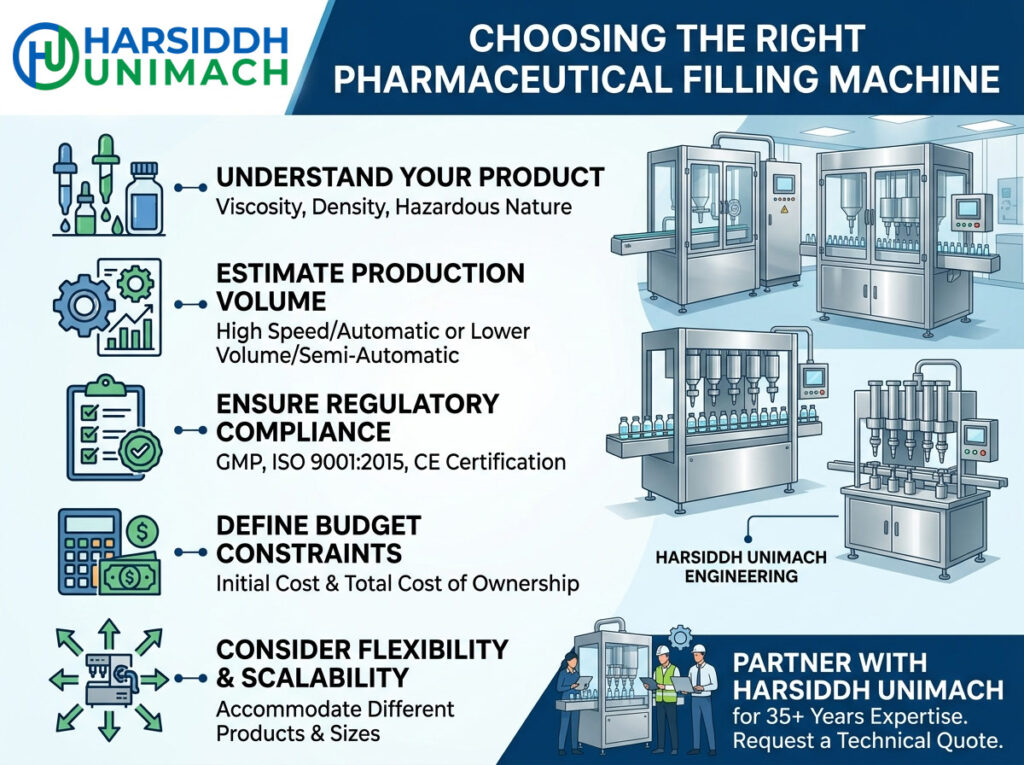
When pharmaceutical manufacturers start looking for a filling machine, they usually think about the product first: is it a liquid, a cream or a powder? That is an important question, and our guide to choosing a filling machine by dosage form covers it in detail.
But there is a second question that shapes the machine just as much: what container is the product going into? The same liquid can be filled into a glass vial, a sealed ampoule, a prefilled syringe or a plastic bottle, and each needs a very different machine. The container decides how the filler handles it, how the dose is delivered, how the container is closed and what other machines the line needs.
This guide takes a container-by-container approach to choosing a pharmaceutical filling machine. For each common container, it explains what the filler must do, the main choices to make and the questions to ask suppliers.
Why the Container Drives the Machine Choice
The container affects almost every part of the filling machine:
| Container Feature | Machine Impact |
|---|---|
| Material (glass, plastic, aluminium, laminate) | Handling forces, breakage risk, static, washing needs |
| Shape and stability | Conveying method, need for pucks or holders, speed limits |
| Opening size | Nozzle or needle size, fill speed, risk of splashing |
| Closure system | Stoppering, crimping, capping, flame-sealing or crimp-sealing tubes |
| Sterility requirement | Washing, depyrogenation, protected filling zone |
| Fill volume range | Pump size, number of heads, accuracy |
Because of this, the container and closure system should be fixed, or at least narrowed down, early in the project. Changing the container after the machine is ordered usually means new change parts or even a different machine.
1. Glass Vials
Vials are used for injectable liquids, sterile powders, lyophilised products and vaccines. They are closed with a rubber stopper and an aluminium crimp cap.
What the Filler Must Do
- Fill accurately into a narrow neck, often with small volumes
- Insert a rubber stopper immediately after filling (fully, or partially for freeze-drying)
- Handle glass gently to avoid breakage and particles
- Work in a protected, controlled environment for sterile products
Main Choices
- Liquid or powder: liquid vials use piston or peristaltic dosing, as on an automatic injectable liquid vial filling and stoppering machine or a liquid vial filling machine with rubber stoppering. Sterile powders need dedicated injectable powder filling machines.
- Number of heads: set by required output and batch size.
- Stand-alone machine or complete line: sterile vials also need washing, depyrogenation and cap sealing. Our guide to choosing the right injectable liquid vial filling line explains how to plan the whole line.
Questions to Ask
- What range of vial sizes and fill volumes can the machine handle?
- What fill accuracy is achievable at my smallest volume?
- Does stoppering support partial insertion if I need lyophilisation?
- How is the filling zone protected?
2. Glass Ampoules
Ampoules are sealed glass containers with no separate closure. After filling, the neck is melted and sealed with a flame, giving a fully closed glass container. They are widely used for small-volume injectables.
What the Filler Must Do
- Fill accurately through a narrow neck without wetting it (a wet neck can cause poor seals)
- Optionally flush with nitrogen before and after filling for oxygen-sensitive products
- Seal the neck with a controlled flame to form a consistent, leak-free tip
- Handle ampoules gently and avoid glass particles
Main Choices
- Open or closed ampoules: open (funnel-neck) ampoules are filled and sealed directly, while closed ampoules are opened on the machine before filling. See our ranges of ampoule filling machines for closed ampoules.
- Number of heads: from lab-scale machines to high-output machines such as an automatic eight head ampoule filling and sealing machine.
- Nitrogen flushing if the product is oxygen-sensitive.
Our step-by-step ampoule filling machine buyer’s guide covers these choices in depth.
Questions to Ask
- Which ampoule sizes and types can the machine handle?
- How is sealing quality controlled and checked?
- Is nitrogen flushing available, and at which stages?
3. Prefilled Syringes
Prefilled syringes (PFS) deliver a ready-to-use dose, improving convenience and reducing dosing errors. They are increasingly used for biologics, vaccines and anticoagulants.
What the Filler Must Do
- Fill very small volumes precisely into the syringe barrel
- Insert the plunger stopper without trapping excessive air
- Handle syringes, often supplied in nests and tubs, in a sterile environment
- Minimise product loss, as PFS products are often high-value
Main Choices
- Dosing system: piston or peristaltic, chosen for accuracy at small volumes and product compatibility.
- Stoppering method: vacuum or mechanical placement of the plunger stopper.
- Output and barrier technology suited to the product.
An automatic prefilled syringe filling and stoppering machine is designed for this application.
Questions to Ask
- Which syringe sizes and formats are supported?
- How is air in the syringe controlled during stoppering?
- What is the product loss at start-up and end of batch?
4. Oral Liquid Bottles
Plastic and glass bottles hold syrups, suspensions and solutions. They are closed with screw caps, ROPP caps or child-resistant closures, and sometimes have a measuring cup.
What the Filler Must Do
- Fill medium to large volumes quickly and accurately
- Handle foaming or viscous products without overflow or drips
- Work with bottle unscramblers, washers, cappers and labellers at matched speeds
Main Choices
- Filling principle: gravity, piston or peristaltic depending on viscosity and accuracy needs. Browse our bottle filling machines for oral liquids.
- Number of heads: set by bottle size and output.
- Bottle handling: stable round bottles convey easily; flat or unusual shapes may need special guides.
- Capping type: screw, ROPP or child-resistant.
Questions to Ask
- How does the machine handle foaming products?
- Can it run my full range of bottle sizes and shapes?
- How are drips controlled at the nozzle?
5. Dropper Bottles for Eye, Ear and Nasal Drops
Eye drops in particular are usually sterile and are filled into small plastic dropper bottles closed with a nozzle insert (plug) and a cap.
What the Filler Must Do
- Fill small volumes accurately into narrow plastic bottles
- Place the nozzle insert and then the cap, often in the same machine
- Maintain the required level of hygiene or sterility
Main Choices
- Three-in-one machine for filling, plugging and capping, such as an automatic eye and ear drop filling machine.
- Complete line including bottle feeding and labelling, such as an automatic eye and ear drop filling line.
Questions to Ask
- Which bottle, plug and cap designs are supported?
- How are plug and cap placement checked?
- What is the protection for the filling zone?
6. Tubes for Creams, Ointments and Gels
Topical products are filled into aluminium, laminated or plastic tubes. Tubes are filled from the open end and then sealed by crimping (aluminium) or heat-sealing (laminated and plastic).
What the Filler Must Do
- Orient the tube using an eye mark so the print faces the right way
- Fill viscous products accurately with a clean cut-off and no tail
- Seal the tube end securely, with batch coding
Main Choices
- Tube material: an automatic aluminum tube filling machine crimps metal tubes, while an automatic lami tube filling machine heat-seals laminated tubes.
- Hopper heating and stirring for products that need it.
- Single or double head for output.
Questions to Ask
- Can the machine run both aluminium and laminated tubes?
- What range of tube diameters and lengths is supported?
- How is the seal quality checked?
7. Bottles and Jars for Powders
Dry syrup powders, oral powders and other dry products are filled into bottles or jars, then capped. Some products, such as dry syrups, are reconstituted with water by the pharmacist or patient.
What the Filler Must Do
- Dose powder accurately by volume or weight
- Control dust
- Handle powders that flow freely or tend to bridge
Main Choices
- Dosing method: auger fillers suit many powders. See our range of dry syrup powder filling machines.
- Single or multi-head machines for output.
- Integration with bottle cleaning and capping.
Questions to Ask
- How consistent is the fill weight with my powder?
- How is dust controlled?
- How easy is the dosing system to clean between products?
8. Specialty Containers
Some products use less common containers that need dedicated machines:
- Onion skin tubes (OST) for small-volume products
- Crushable ampoules, which are broken by the user to release the contents
- Biological indicators used in sterilisation monitoring
These are covered by our range of filling machines for onion skin tubes, crushable ampoules and biological indicators. Because these containers are specialised, share samples with the supplier early.
Container Comparison Summary
| Container | Typical Products | Closure | Key Filling Challenge |
|---|---|---|---|
| Glass vial | Injectables, sterile powders, vaccines | Stopper + crimp cap | Sterility, small volume accuracy |
| Glass ampoule | Small-volume injectables | Flame-sealed | Dry neck, consistent seal |
| Prefilled syringe | Biologics, vaccines | Plunger stopper | Tiny volumes, air control, product loss |
| Oral liquid bottle | Syrups, suspensions | Screw, ROPP, child-resistant cap | Foaming, speed, drips |
| Dropper bottle | Eye, ear, nasal drops | Plug + cap | Small volumes, hygiene |
| Tube | Creams, ointments, gels | Crimp or heat seal | Viscosity, clean cut-off, seal |
| Powder bottle or jar | Dry syrups, oral powders | Screw or ROPP cap | Dosing consistency, dust |
| Specialty containers | Various | Varies | Specialised handling |
When You Use More Than One Container
Many manufacturers fill the same product into different containers, for example a vial for hospitals and a prefilled syringe for home use. Others run several products in different containers on shared facilities. In these cases:
- Decide whether one flexible machine or several dedicated machines suits you better.
- Check whether container changes are a simple format change or need a different machine.
- Plan cleaning and line clearance carefully to prevent mix-ups between containers.
Bringing It Together: The Selection Steps
- Fix the container and closure system with your packaging development and regulatory teams.
- Collect container samples and drawings for every size you will run.
- Define product and fill volume requirements for each container.
- Choose the filling and closing principle suited to the container.
- Size the machine for realistic output and batch sizes.
- Plan the rest of the line, such as washing, capping, labelling and inspection.
- Write a URS and compare suppliers fairly.
For detail on comparing specifications and quotations, see our guide to pharmaceutical filling machine specifications and what to check before you buy. For the full purchasing process, from URS to qualification, read our article on the filling machine buying process and total cost of ownership.
Frequently Asked Questions
Can one machine fill both vials and ampoules? Generally not, because ampoules are flame-sealed while vials are stoppered and capped. They usually need different machines.
Can one machine fill different vial sizes? Usually yes, within the machine’s range and with the correct change parts.
Are prefilled syringe machines very different from vial fillers? Yes. Syringes need different handling, very precise small-volume dosing and plunger stoppering, so they use dedicated machines.
Do I need different machines for aluminium and laminated tubes? Not always. Some tube fillers can handle both with different sealing units. Confirm with the supplier.
Should I choose the container before the machine? Yes. The container and closure system determine much of the machine design, so they should be decided first.
Find the Right Filling Machine for Your Container With Harsiddh
Harsiddh Unimach manufactures filling machines for vials, ampoules, bottles, dropper bottles, tubes, powder containers and specialty containers, along with the washing, capping, sealing and labelling equipment that completes a production line. Share your container samples and product details with our team, and we will recommend the right machine for your application.
Contact us through our contact page or send your requirements via our inquiry form.