
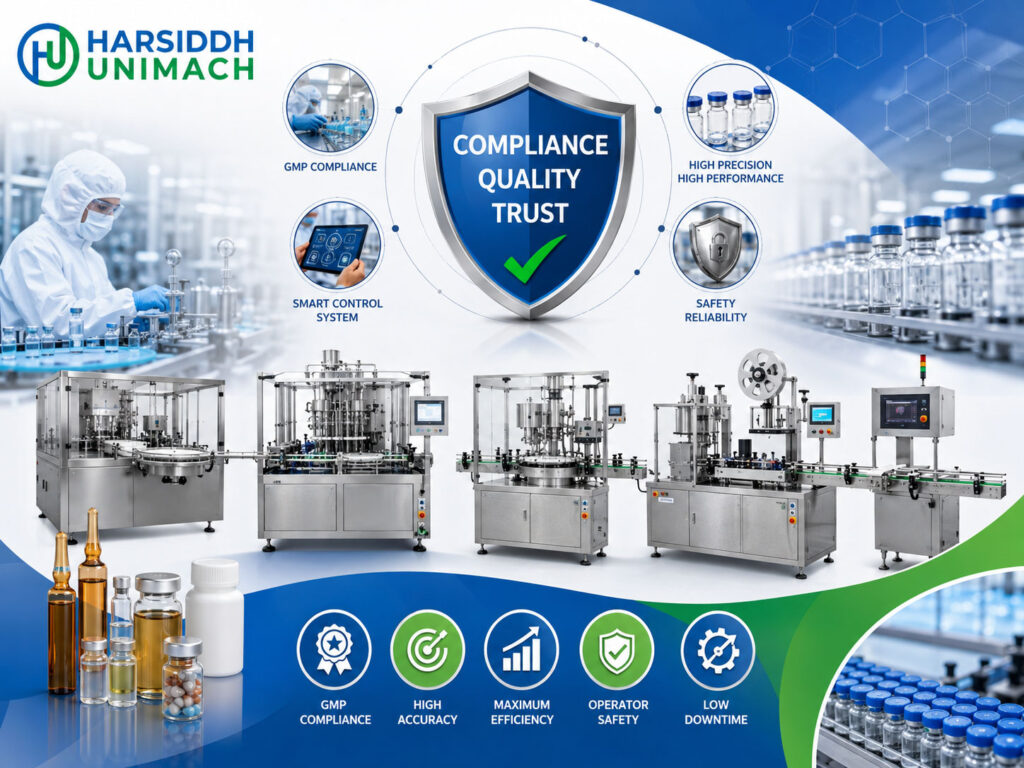
A medicine can be made perfectly and still fail the patient at the packaging stage. A wrong label, a loose cap, a missing tamper-evident seal or a bottle filled short can make a good product unsafe, illegal to sell or both. That is why regulators treat packaging as part of manufacturing, not as an afterthought, and why the machines that fill, close, seal and label pharmaceutical products must be designed and run to meet strict requirements.
This article explains why compliance matters in pharmaceutical packaging machinery, what packaging lines are expected to achieve, how machine design supports compliance at each stage of the line, and what documentation and validation are needed. It also looks at the role of the machine supplier and offers a practical checklist for buyers.
Compliance requirements vary by country, product and market, so treat this article as a general overview. Your quality assurance and regulatory teams should confirm exactly which rules apply to your products.
What “Compliance” Means for Packaging Machinery
In pharmaceutical manufacturing, compliance means meeting the requirements set by regulators, pharmacopoeias, customers and your own quality system. For packaging machinery, it usually covers four areas:
- Good Manufacturing Practice (GMP): the machine must be designed, installed, operated, cleaned and maintained so that it consistently produces product of the right quality without contamination or mix-ups.
- Product and pack requirements: correct fill quantity, secure closure, correct and legible labelling, tamper evidence and, where required, traceability codes.
- Documentation and validation: proof that the machine was built as specified, installed correctly and performs reliably, with records that support every batch.
- Operator and machine safety: guarding, electrical safety and safe working practices, according to the rules in the country of installation.
A broader discussion of GMP principles in equipment design is available in our article on the importance of GMP compliance in pharmaceutical machinery. This article focuses on the packaging stage specifically: filling, closing, sealing and labelling.
Why Compliance Matters: The Real Costs of Getting It Wrong
Compliance is sometimes seen as paperwork. In practice, it protects patients and the business. The risks of non-compliant packaging include:
Patient Safety
Packaging errors can directly harm patients. A label showing the wrong strength, a mixed-up leaflet or an underfilled dose can lead to medication errors. A failed seal can let in moisture, air or contamination, reducing the product’s effectiveness or safety.
Product Recalls
Labelling and packaging errors are a common cause of pharmaceutical recalls. A recall means recovering product from the market, investigating the cause, correcting the process and often destroying stock. The direct cost is high, and the damage to reputation can last much longer.
Regulatory Action
Inspectors examine packaging lines closely. Findings such as poor line clearance, uncontrolled label stock, unvalidated equipment or missing records can lead to inspection observations, warning letters, import restrictions or loss of approval to supply a market.
Lost Market Access
Many export markets and large buyers will only accept products from compliant sites. Packaging that does not meet a market’s requirements, for example on traceability codes or tamper evidence, may simply not be allowed in.
Higher Operating Costs
Non-compliant processes tend to create more rejects, rework, investigations and deviations. A well-designed, compliant line usually runs more smoothly and wastes less.
In short, compliance is not only about passing inspections. It is about making sure every pack that leaves the factory is right.
Key Compliance Requirements for Packaging Lines
The table below summarises what packaging lines are typically expected to achieve and how machinery helps.
| Requirement | Why It Matters | How Machinery Helps |
|---|---|---|
| Accurate fill quantity | Patient receives the labelled dose | Precise dosing systems, fill checks, reject of out-of-limit containers |
| Secure closure | Protects product integrity and prevents leaks | Controlled capping torque, consistent crimping, sealing checks |
| Tamper evidence | Shows if a pack has been opened | ROPP caps, induction seals, flip-off caps, tamper-evident labels |
| Correct labelling | Right product, strength, batch and expiry | Accurate label placement, batch coding, label presence checks |
| No mix-ups | Prevents wrong labels or components entering a batch | Line clearance design, segregation, format-specific parts |
| Contamination control | Protects product from particles and microbes | Hygienic design, suitable materials, easy cleaning |
| Traceability | Lets every pack be traced if problems arise | Batch coding, serialisation interfaces where required |
| Records | Proves each batch was made correctly | Batch counters, alarms, data recording, audit trails where applicable |
Let us look at how these requirements apply at each stage of the packaging line.
Compliance at Each Stage of the Packaging Line
1. Container Preparation
Clean containers are the starting point for a compliant pack. For injectables, vials and ampoules are washed and depyrogenated before filling. For oral liquids, bottles are washed or air-cleaned to remove particles. Machines should deliver consistent cleaning and, where required, allow cleaning performance to be validated.
2. Filling
Fill accuracy is a GMP and legal requirement: the patient must receive the labelled quantity. Compliant filling machines offer:
- accurate, repeatable dosing with documented accuracy
- product-contact parts made from suitable, non-reactive materials, typically stainless steel grades and approved elastomers
- designs that drain fully and can be cleaned and, where needed, sterilised
- no-container, no-fill functions to prevent spillage
- in sterile applications, protection of the filling zone, for example with laminar airflow or barrier systems
For injectables, an automatic injectable liquid vial filling and stoppering machine combines filling and stoppering so the vial is closed quickly after filling. Our cGMP compliance guide for sterile vial filling machinery covers the sterile filling requirements in more detail.
3. Closing and Sealing
A secure, tamper-evident closure protects the product until the patient opens it. Depending on the pack, this may involve:
- ROPP capping: roll-on pilfer-proof caps form a tamper-evident band on bottles. A four head bottle ROPP capping machine or a bottle screw and ROPP capping machine applies these caps consistently.
- Induction sealing: a foil liner is bonded to the bottle neck, giving a hermetic, tamper-evident seal. An automatic induction cap sealing machine or an induction sealing machine can be added after the capper.
- Vial cap sealing: aluminium caps are crimped over the stopper to hold it securely. A vial cap sealing machine with 1, 4, 6 or 8 heads is specified to suit the cap and neck size.
- Ampoule sealing: glass ampoules are flame-sealed, creating a closed container with no separate closure.
Consistency is the key compliance point. Closures that are too loose may leak or fail tamper tests; closures that are too tight may crack containers or be hard for patients to open. Machines with controlled torque or crimping force, and settings that can be recorded and repeated, help keep closures within specification. The full range of capping machines covers screw, ROPP, lug and other closure types.
4. Labelling and Coding
Labelling errors are among the most serious packaging risks, because a wrong label can put the wrong medicine in a patient’s hands. Compliant labelling requires:
- accurate label placement, with no skewed, wrinkled or missing labels
- correct batch number, manufacturing date and expiry date, usually printed online
- checks for label presence and, where specified, code readability
- reject systems that remove faulty packs reliably
- controlled label stock and line clearance to prevent mix-ups
Machines such as an automatic front and back sticker labeling machine or the range of labeling machines for vials can be fitted with coders and inspection systems to suit your requirements. Browse all our labeling machines for bottles, ampoules, vials and flat containers.
5. Traceability and Serialisation
Many markets now require unique identifiers on pharmaceutical packs, allowing each unit to be traced through the supply chain. Requirements vary by country and product, and they change over time, so check the current rules for every market you supply. Packaging machines may need to interface with printers, cameras and serialisation software. Our ultimate guide to serialisation in pharmaceutical packaging explains how this works and what it means for machinery.
Machine Design Features That Support Compliance
When evaluating packaging machinery, look for these design features.
Hygienic Construction
- Product-contact parts made from suitable stainless steel and approved polymers or elastomers
- Smooth surfaces with no sharp corners or crevices where product can collect
- Open frame designs or sloped surfaces that are easy to clean and do not trap dirt
- Minimal fasteners in the product zone
Material Traceability
Material certificates for product-contact parts allow you to show what the parts are made of. These are normally included in the machine’s documentation package.
Controlled and Repeatable Settings
Recipes, digital readouts and fixed adjustment points help operators set the machine the same way every time. On machines with programmable controls, access levels can restrict who changes critical settings.
Error Prevention
- No-container, no-fill and no-container, no-cap functions
- Missing-label and missing-cap detection where specified
- Reliable reject mechanisms that confirm the faulty pack has been removed
- Format-specific change parts that are marked to prevent fitting the wrong part
Easy Line Clearance
Line clearance between batches removes all materials from the previous batch. Machines with good visibility, few hidden places for labels or components to lodge, and easy access make line clearance faster and more reliable.
Data and Records
Batch counters, alarm logs and, on more advanced systems, electronic records with audit trails support batch documentation. Where electronic records are used for GMP decisions, data integrity requirements apply, and your QA team should confirm what controls are needed.
Safety
Guards, interlocks, emergency stops and safe electrical design protect operators. Safety requirements depend on the country of installation, so share them with your supplier at the enquiry stage.
Documentation: The Proof Behind Compliance
A compliant machine is not enough on its own. You need documentation that proves it was specified, built, installed and tested correctly. A typical documentation package includes:
| Document | Purpose |
|---|---|
| User Requirement Specification (URS) | Your written statement of what the machine must do |
| Functional and design specifications | The supplier’s description of how the machine meets the URS |
| Drawings and parts lists | Records of the machine’s construction |
| Material certificates | Proof of materials for product-contact parts |
| Factory Acceptance Test (FAT) records | Testing at the supplier’s site before dispatch |
| Site Acceptance Test (SAT) records | Testing after installation at your site |
| IQ, OQ and PQ protocols and reports | Formal qualification evidence |
| Operating and maintenance manuals | Instructions for safe, correct use |
| Spare parts list | Support for maintenance and continued performance |
Discuss the required documents with your supplier before ordering. Adding documentation after delivery is harder and slower.
Validation and Qualification
Validation shows that the machine and process consistently produce product meeting its specifications. For equipment, this is done through qualification:
- Installation Qualification (IQ) confirms the machine is installed correctly, with the right utilities, parts and documents.
- Operational Qualification (OQ) confirms it operates as intended across its operating range, including alarms and safety functions.
- Performance Qualification (PQ) confirms it performs consistently under real production conditions.
Our guide to automatic vial filling equipment validation and IQ, OQ and PQ explains each stage in detail. The same principles apply to capping, sealing and labelling machines.
Compliance does not end at qualification. Any significant change to the machine, process or materials should go through change control, and the machine should be maintained, calibrated and periodically reviewed to make sure it remains in a validated state.
Integrated Lines and Compliance
Running separate machines from different suppliers can work, but it adds interfaces where problems can occur: speeds that do not match, conveyors that cause jams or tipping, and documentation in different formats. An integrated line from one supplier can simplify compliance, because the machines are designed to work together and documented as one system.
Examples include an automatic liquid vial filling line, an automatic ampoule filling line for injectables, and a liquid bottle filling and capping monoblock for oral liquids. For a wider look at packaging line options, see our article on effective packaging solutions for the pharmaceutical industry.
The Role of the Machine Supplier
Compliance is ultimately the manufacturer’s responsibility, but a good supplier makes it much easier. Look for a supplier that:
- understands pharmaceutical GMP and the documentation it requires
- reviews your URS carefully and states clearly what the machine will and will not do
- provides material certificates, drawings, manuals and qualification support
- offers FAT and SAT and supports IQ and OQ
- supplies spare parts and service to keep the machine performing as validated
- can adapt machines to your specific containers, closures and labels
Compliance Checklist for Buying Packaging Machinery
Use this checklist when evaluating a new machine or line:
- Have you written a clear URS covering product, containers, closures, labels, speed and compliance requirements?
- Are product-contact materials suitable and backed by certificates?
- Is the design hygienic and easy to clean and clear between batches?
- Does the machine include error-prevention features such as no-container, no-fill and reject systems?
- Can closure torque, crimping or sealing be controlled and repeated?
- Does the labeller support batch coding and the inspections you need?
- Can the machine interface with serialisation systems if your markets require it?
- What documentation is included, and is FAT, SAT and qualification support offered?
- Does the machine meet the safety requirements of your country?
- Are spare parts, training and service available?
Common Compliance Mistakes in Packaging Operations
- Treating packaging as less important than manufacturing. Packaging errors can be just as harmful as manufacturing errors.
- Weak line clearance. Leftover labels, cartons or components from the previous batch are a frequent cause of mix-ups.
- Uncontrolled label stock. Labels should be stored, issued and reconciled under control.
- Changes without change control. Adjusting a machine or swapping a part without assessment can take it out of its validated state.
- Neglected maintenance. Worn parts drift out of specification, causing leaks, poor seals or misplaced labels.
- Poor training. Operators must understand both how to run the machine and why the compliance steps matter.
Frequently Asked Questions
Is packaging covered by GMP? Yes. GMP covers packaging and labelling as well as manufacturing, including line clearance, label control and equipment qualification.
Does a machine come “GMP certified”? Machines are designed to support GMP, but compliance depends on how the machine is specified, installed, qualified, operated and maintained at your site. Ask your supplier what documentation they provide.
Are tamper-evident closures required? Requirements depend on the product and market. Check the current regulations for every market you supply with your regulatory team.
Do I need serialisation? Many markets require it for certain products. Requirements differ by country and change over time, so confirm the current rules for your products.
How often should packaging machines be requalified? This depends on your quality system, risk assessment and any changes made. Periodic review and change control keep the machine in a validated state.
Partner With Harsiddh for Compliant Packaging Machinery
Harsiddh Unimach designs and manufactures filling, capping, sealing and labelling machines for injectable, oral liquid and other pharmaceutical products, built with hygienic construction, reliable error prevention and documentation to support your qualification. Our team can review your products, containers and compliance requirements and recommend machines or complete lines to match.
To discuss your packaging line, reach us through our contact page or send your requirements through our inquiry form.